RaeRae Reacts · One Piece Episode 229
Water 7 Looks Like a Vacation Until the City Sends the Bill
One Piece Episode 229 escapes Aokiji, meets a frog fighting a sea train, and reaches Water 7 with hope for the Going Merry already carrying a deadline.
Bottom line: Water 7 looks like a vacation because the city has not sent the bill yet
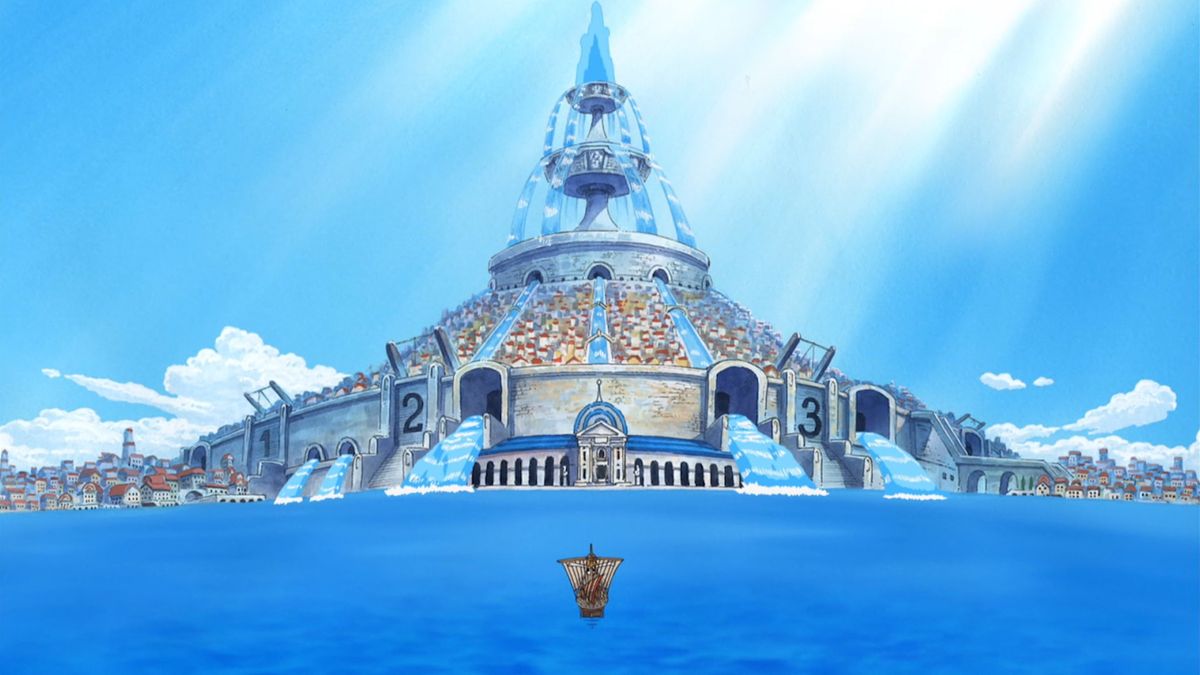
One Piece Episode 229 carries the Straw Hats away from Aokiji’s ice, introduces a frog stubborn enough to challenge a sea train, and delivers Water 7 as a city built from movement. Canals climb between buildings. Trains cross the ocean. Shipwrights hold public respect. The crew finally reaches a place that might repair the Going Merry, and every beautiful new system quietly points toward the crisis waiting inside the ship.
The episode feels bright because arrival should feel bright. Luffy sees a swimming frog and wants answers. Kokoro offers information with the ease of somebody who has watched generations pass through Shift Station. Chimney and Gonbe turn the railway stop into a family space. Nothing demands grief yet. The city’s engineering still carries hope.
Episode facts: the Water 7 television story begins here
Episode 229 aired in Japan on April 17, 2005 under the official title “The Dashing Sea Train and the City of Water: Water Seven.” Hirohiko Kamisaka wrote the screenplay, Munehisa Sakai directed, Masayuki Takagi served as animation director, and Miyuki Sato with Tadami Shimokawa handled the art direction.
The official synopsis begins with the Straw Hats chasing a frog that swims freestyle. A whistle and smoke announce a train racing across the sea. At Shift Station, stationmaster Kokoro and Chimney explain that the sea train travels between islands on ocean rails. The official One Piece story index identifies Episodes 229 through 263 as the Water 7 television range.
Yokozuna introduces the arc through failure he chooses every day
The giant frog Yokozuna throws himself against the sea train even though the train wins. His ritual is absurd before the history becomes clear. Luffy understands the compulsion immediately. A creature challenging something stronger because surrender feels worse makes perfect sense to him.
That recognition prepares the arc’s emotional language. Water 7 will ask what happens when loyalty cannot repair damage, when effort cannot reverse every verdict, and when refusing to stop can look brave or destructive depending on what the refusal protects. Yokozuna carries that argument before anybody names the Merry’s condition.
The Rocketman announcement changes the geography of the Grand Line
A train running across the ocean is not simply another strange vehicle. The sea train connects islands on a schedule, reducing the isolation that gives the Grand Line so much danger and political shape. Routes create trade, labor, news, migration, and control.
The Straw Hats travel by trusting Nami, weather, currents, Log Poses, and the Merry. Water 7 introduces infrastructure built to make movement repeatable. The contrast places their intimate, fragile ship beside an industrial system designed to outlast individual voyages.
Kokoro treats impossible technology as local routine
Kokoro does not present the sea train like a tour guide unveiling magic. She explains schedules and destinations because the railway belongs to ordinary life. Her lack of ceremony tells us how deeply the technology has changed the region.
That everyday tone also gives her authority. Kokoro knows the route, the station, the people, and the history behind the machine. The crew arrives with wonder, but local knowledge controls what the wonder means. Water 7 is not a backdrop waiting for pirates to discover significance. Residents already live inside the system.
Chimney and Gonbe make Shift Station feel inhabited
Chimney’s energy keeps the station from becoming a cold transit diagram. She treats pirates, frogs, trains, and Kokoro’s habits as parts of the same lively world. Gonbe, the rabbit that people keep calling a cat, adds the exact kind of unnecessary confusion One Piece enjoys.
The pair matters because infrastructure can flatten a setting into machinery. Chimney makes the railway personal. People grow up beside these tracks, learn the whistles, know the travelers, and turn a work site into home.
Aokiji’s defeat follows the crew even when nobody names the fear
The Straw Hats survived the admiral, but Episode 229 cannot erase the encounter simply by changing the weather. Robin carries the warning. Luffy carries the memory of absolute physical defeat. The crew carries proof that the world contains forces capable of stopping them without a long battle.
The bright arrival therefore contains a pressure viewers can feel before the characters discuss the consequences. Water 7 offers repair at the exact moment the crew learns how vulnerable their journey has become. The ship and the family both need more than optimism.
The Going Merry reaches a city famous for the judgment the crew fears
Water 7’s shipwrights represent expertise. That expertise attracts the Straw Hats because the Merry has accumulated damage across the East Blue, Reverse Mountain, Alabasta, Skypiea, and the fall into G-8. Usopp’s repairs kept the ship moving, but love and patchwork cannot substitute for a professional structural assessment forever.
The crew arrives hoping money can convert devotion into repair. The city’s reputation makes that hope reasonable. The same reputation means any bad news will carry authority. A skilled shipwright can tell them something a hopeful crewmate cannot argue away.
Luffy’s excitement hides how much responsibility the gold created
The Skypiea treasure promises a route to repair and perhaps a new shipwright. Wealth looks like freedom after months of scarcity. The crew can finally approach a major yard without begging, bargaining from weakness, or improvising another patch.
Money also creates risk. Somebody must transport, exchange, and protect the value inside a crowded city. Nami understands that immediately. Luffy sees possibilities. Usopp feels the weight because the money has become attached to the Merry’s survival.
The city’s vertical water system makes navigation a civic experience
Water 7 rises in layers, with canals functioning as streets and water elevators moving people through elevation. The design makes the city readable through flow rather than a flat road grid. Every route depends on managed water.
Nami enters a place where navigation is not confined to the sea outside town. Citizens have built daily life around currents, levels, and transport creatures. Her expertise remains relevant, but local engineering rewrites the scale of the problem.
The Yagara Bulls turn travel into relationship rather than machinery
The crew learns that Yagara Bulls carry residents and visitors through the canals. The animals make the city’s transport system feel playful and alive. Movement depends on a working relationship between people, water, and creatures suited to the environment.
That arrangement contrasts with the sea train’s industrial force. Water 7 contains both forms at once: scheduled steel connecting islands and animal-powered taxis navigating neighborhood channels. The city does not reduce progress to replacing every living system with a machine.
Robin’s quiet attention turns the tourist arrival into surveillance
Robin observes new places differently from Luffy. He rushes toward novelty. She watches people, symbols, routes, and possible threats. After Aokiji, her caution carries additional weight. A beautiful city can still contain agents, informants, and institutions connected to the government hunting her.
The episode does not force her fear into every shot. That restraint fits Robin’s survival method. She resumes composure because composure has long functioned as camouflage. Viewers now know enough to question the calm.
Usopp’s attachment to the Merry becomes financial and physical pressure
Usopp has repaired the ship with his own hands, defended her honor, and tied the vessel to Kaya and the life he left behind. Carrying money intended for professional repair should feel hopeful. The responsibility also places the future of that relationship in his grip.
Water 7 will punish the assumption that care guarantees competence. Usopp’s repairs mattered because they kept the crew alive. Their limits also matter. Love does not become fake when expertise reveals that love cannot solve every structural failure.
Sanji notices food because cities reveal themselves through appetite
New ingredients and local dishes give Sanji another way to read Water 7. Food shows trade routes, available water, labor patterns, and what residents consider ordinary pleasure. The crew’s arrival is not complete until somebody eats something strange.
That appetite keeps the episode grounded in fandom joy before the arc turns painful. One Piece earns heavy drama partly because the world remains worth exploring. Grief matters more when the characters have reasons to love the road carrying them toward grief.
Zoro’s caution does not cancel his curiosity
Zoro rarely performs tourist wonder like Luffy, but he reads the environment for threats and practical limits. A layered canal city creates obvious opportunities for separation, ambush, and getting lost. For Zoro, the last concern qualifies as a natural disaster.
His presence stabilizes the arrival without making him the responsible adult in every scene. The crew distributes caution unevenly. Nami protects money and routes. Robin reads people. Zoro measures force. Usopp worries about the ship. Luffy supplies momentum.
The episode sells civic competence before revealing civic corruption
Water 7 initially appears functional. Trains run. Stations operate. Canals move traffic. Skilled shipwrights hold public esteem. The city’s competence makes the later political and criminal conflict more effective because dysfunction is not visible as simple decay.
Institutions can produce useful infrastructure while hiding coercion, secrecy, and unequal power. A clean public surface does not prove every system underneath deserves trust. The arc will apply that lesson to Galley-La, the World Government, and the stories told about Robin.
What changed when I watched the arrival knowing the Merry’s verdict
The first visit feels like relief. The crew has gold, a destination, and access to the best shipwrights. On a repeat watch, every celebration becomes tender because expertise will not deliver the answer they want. The city can evaluate the ship honestly; honesty cannot guarantee repair.
Yokozuna’s daily challenge becomes even sharper under that knowledge. Refusing an impossible limit may express love, grief, denial, or all three. Water 7 begins with a frog losing to a train because the arc is about people deciding what to do when determination meets something determination cannot change.
The episode’s weakness is allowing recovery from Aokiji to happen too quietly
The adventure needs forward motion, but the crew’s transition from frozen emergency to excited travel feels fast. Robin nearly died. Luffy encountered an opponent who could end the voyage. A little more space for bodily recovery or awkward silence would have preserved the weight.
The quick turn also reflects how the Straw Hats cope. Movement becomes medicine until the next crisis forces the buried fear back into view. I wanted one stronger connective scene, especially for Robin and Chopper. The missing conversation does not erase the trauma. The absence tells us the crew has not learned how to discuss the trauma yet.
RaeRae verdict: the best city entrance in One Piece begins with a frog losing on purpose
Water 7 arrives through motion, labor, animals, public infrastructure, and one impossible act of devotion. Yokozuna’s challenge makes the sea train emotionally legible before the crew knows the history. Kokoro and Chimney make the station feel lived in. The city earns wonder before asking the audience to survive heartbreak.
Episode 229 does not need a major fight. The chapter builds a place strong enough to change the crew. Every canal, rail, repair yard, and layer of the city points toward the same question: what happens when the journey’s beloved vessel reaches people qualified to tell the truth? The answer will hurt because the welcome feels so generous first.
Receipts and the route into the shipwright city
The official One Piece Episode 229 page supplies the April 17, 2005 broadcast date, Japanese title, synopsis, and production credits. The synopsis confirms Yokozuna’s freestyle pursuit, the sea train’s arrival, and Kokoro with Chimney explaining the railway at Shift Station. The official index defines Episodes 229 through 263 as Water 7.
Episode 230 brings the Straw Hats into Water 7’s central districts aboard Yagara Bulls, introduces the water elevators and local food, and sends them toward the giant shipyard. This React belongs in a bounded Water 7 arrival shelf covering the city’s welcome through the crew’s first devastating internal break, with every episode represented by a static image card once unique media production resumes.