RaeRae Reacts · One Piece Episode 226
Nami Drowns Foxy’s Last Trick
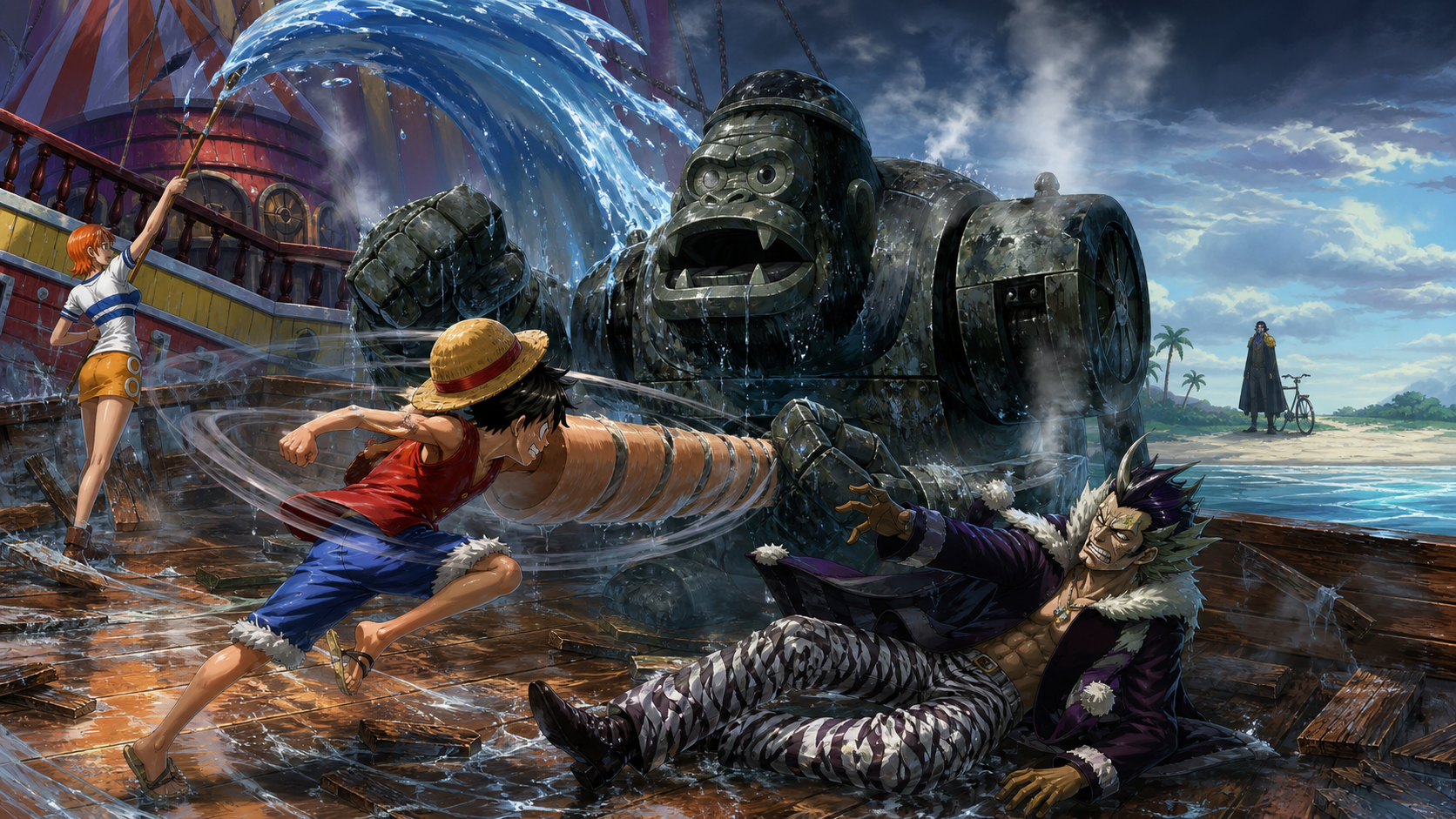
One Piece Episode 226 lets Nami extinguish Gorilla Puncher 13, Luffy finish Foxy, and Aokiji quietly replace comic danger with institutional dread.
Bottom line: Foxy wins his crew back and immediately proves he learned almost nothing
One Piece Episode 226 gives Foxy the comeback he begged for, lets Luffy defeat the pirates who took his ship, and then watches Foxy spring another trap on the people who saved him. Of course he does. Foxy can locate courage when his pride is bleeding, but gratitude still has to fight through layers of ego, habit, and theatrical nonsense. The episode refuses to mistake one brave stand for a repaired character.
That refusal makes the ending better. A softer show might reward Foxy with instant wisdom and a respectful farewell. One Piece knows this man. Foxy regains his crew, hears his name again, and returns to the behavior that created the problem. Luffy beats him again because decency does not require becoming stupid. Then the series drops the clown curtain and places Aokiji on the road ahead.
Episode facts: the final Foxy fight points toward the most dangerous man
Episode 226 aired in Japan on March 20, 2005 under the official title commonly translated as “The Guy Who’s the Closest to Invincible? And the Most Dangerous Man!” Yoshiyuki Suga wrote the screenplay, Katsumi Tokoro directed, Masayuki Takagi served as animation director, and Miyuki Sato with Michiyo Kawasaki handled the art direction.
The official One Piece synopsis centers Foxy’s trap, Gorilla Puncher 13, Nami’s rain, and Luffy’s Gum-Gum Pinwheel finish. The title also announces a second presence before the episode fully explains him. Foxy occupies the visible fight. Aokiji owns the question hanging over the exit. That split title tells viewers not to confuse the loudest man with the greatest threat.
Foxy’s crew returns because spectacle can repair a crowd faster than trust
Once the invaders fall, Foxy’s followers rally around him again. The reversal feels emotionally convenient because the episode does not examine who chose the mutiny, who submitted from fear, or who simply followed the winning flag. A renewed chant repairs the surface before anybody addresses the fracture underneath.
That shortcut still fits Foxy’s leadership. He measures belonging through visible enthusiasm. If the crowd cheers, he can pretend the relationship is whole. Quiet resentment would require work he has never learned to do. The restored performance allows captain and crew to avoid the harder question of why another group could occupy the Sexy Foxy so easily.
Luffy helps because his standards do not depend on Foxy deserving them
Luffy’s role remains wonderfully plain. Somebody stole a ship and crew, so he helps stop the theft. He does not prepare a character assessment, demand an apology, or wait for Foxy to become worthy. His choice comes from his own values rather than the recipient’s moral record.
That distinction protects Luffy from the usual trap in redemption stories. Helping Foxy does not certify Foxy as good. Luffy acts because stolen people and abused bonds offend him. The captain can extend mercy without surrendering judgment, and the punch waiting after Foxy’s next betrayal proves the boundary remains intact.
Gorilla Puncher 13 turns cheating into industrial equipment
Foxy’s mechanical gorilla is exactly the kind of weapon he would love: oversized, ridiculous, theatrical, and built to make an unfair advantage look like a main event. The burning fists force Luffy to fight machinery as much as the captain directing the machine. Foxy hides weak judgment behind hardware and calls the result strength.
The contraption also exposes the limit of his imagination. Every solution becomes another trick layered over the last trick. Foxy could leave after receiving help. He could acknowledge the loss. Instead, he needs one more stage where victory might rewrite humiliation. Gorilla Puncher 13 is insecurity with pistons.
Nami solves the fire because navigation includes reading conditions
Luffy struggles against flaming punches until Nami creates rain and takes the fire out of the weapon. Her intervention is practical, fast, and built around the environment. She does not need to overpower the machine. She changes the condition that gives the machine an advantage.
That is Nami’s fighting intelligence at its best. Weather is not decorative magic in her hands. Weather becomes an answer to heat, visibility, movement, and terrain. Foxy builds one enormous object around one intended effect. Nami alters the field and makes the expensive object wet metal.
The Clima-Tact keeps proving that support is not secondary work
Anime battles often reserve importance for the person landing the final blow. Episode 226 makes Luffy’s finish possible because Nami removes the burning threat first. The sequence gives support a clear causal role. Without her rain, repeated punches keep controlling the distance.
Nami’s contribution also suits the crew’s internal structure. She reads the problem, supplies the condition, and trusts Luffy to exploit the opening. Nobody needs a meeting. Their shared history allows specialization to become rhythm. Foxy’s operation requires orders and applause. The Straw Hats move through expectation earned over time.
Luffy’s spinning finish turns Foxy’s machine against the performance
Once the fire disappears, Luffy uses Gum-Gum Pinwheel and tears through the remaining advantage. The attack converts elastic momentum into uncontrolled rotation, matching the episode’s carnival machinery while refusing to play by Foxy’s script. Luffy becomes the wilder spectacle.
The visual joke lands because Foxy always assumes he owns the show. He builds props, names weapons, arranges surprises, and expects the audience to admire the reveal. Luffy treats the whole production as something breakable. The captain who cannot plan a formal entrance can still destroy a staged ending.
Foxy’s second defeat feels smaller because the real contest already ended
Long Ring Long Land gave Luffy and Foxy a prolonged captain duel with crew membership on the line. This rematch lacks that emotional scale. Foxy has already shown his limits, and the Straw Hats no longer risk losing one another through tournament rules. Gorilla Puncher 13 becomes cleanup rather than climax.
That smaller feeling is appropriate. The return arc exists to close the anime’s expanded Foxy business, not to argue that he suddenly matches Luffy’s growing world. The episode gives him one last machine, one last betrayal, and one last flight through the air. Then the horizon changes.
Gratitude loses to habit the moment Foxy feels secure
Foxy’s betrayal after being rescued and restored is the most honest character beat in the chapter. Crisis briefly makes him brave. Security makes him Foxy again. He does not carry the lesson forward because he never processed the lesson. He only survived the humiliation.
People can behave better under pressure without becoming better afterward. The emergency supplies a clear demand. Ordinary life requires a chosen practice. Foxy has no practice of accountability, so he returns to cheating as soon as the crowd returns. One noble act cannot build a new pattern by itself.
Porche and Hamburg enable him because affection without correction becomes maintenance
Porche and Hamburg care about Foxy, but their loyalty often protects his worst habits. They restore his confidence, celebrate his schemes, and help rebuild the stage after each failure. Their affection keeps him from collapsing and keeps him from changing.
The relationship is funny until the same dynamic creates harm. A crew that treats every criticism as an attack on the captain cannot distinguish support from enabling. Foxy’s sensitivity controls the emotional weather around him. Everybody learns to manage his feelings instead of challenging his choices.
Luffy’s response is not forgiveness theater
Luffy does not deliver a speech about betrayal. He stops the trap and sends Foxy away. The brevity respects both characters. Foxy would not absorb a lecture, and Luffy does not need verbal closure before enforcing a limit.
That response feels more human than a polished reconciliation. Luffy already did the generous thing. Foxy answered with another attack. The next action does not cancel the earlier rescue, and the rescue does not excuse the new attack. Each choice receives its own consequence.
The anime-original extension stretches Foxy past his strongest material
The extra Foxy episodes provide more crew comedy and a bridge after Ocean’s Dream, but the character has begun repeating himself. Trap, boast, insult, collapse, recover, cheat again. Repetition can define a character; too much repetition can replace development.
Episode 226 survives because Nami’s tactical rain and the Aokiji tease give the chapter direction. Without those elements, Gorilla Puncher 13 would feel like another machine added to delay departure. The production knows the joke has reached the edge, so the ending points toward a danger with no need for carnival rules.
The title’s “closest to invincible” phrase belongs to a world beyond Foxy
Foxy would love to imagine the title describes him or his machine. The phrase hangs over a Marine admiral whose reputation carries institutional weight. Aokiji belongs to the World Government’s highest military tier, and his arrival changes how the audience should measure power.
Until now, Foxy manipulates speed by slowing selected targets. Aokiji can freeze bodies, sea, and escape routes. One power makes a game unfair. The other can turn geography into custody. The comparison is not subtle, and the tonal contrast works.
Robin senses danger before Luffy has enough information to care
The transition matters most for Robin. Luffy can meet a stranger and decide based on present behavior. Robin has decades of evidence attached to Marine authority. An admiral is not an abstract rank in her life. The title reaches backward toward Ohara, pursuit, and every organization that traded her safety for advantage.
That difference in knowledge creates suspense without requiring Aokiji to attack immediately. Viewers can read Robin’s fear as information. The crew has accepted her, but acceptance does not automatically give them access to every memory she carries. The next episodes force hidden history into the shared space.
The bicycle is funnier and more unsettling than a warship
Aokiji arrives with a bicycle rather than a fleet, which makes his presence look casual. The visual choice strips away the expected warning signs. No cannon announces him. No formation surrounds him. A man travels alone because the environment itself can become his road.
That ease communicates power better than another oversized weapon. Gorilla Puncher 13 needs fuel, machinery, and a deck. Aokiji needs the ability he carries in his body. The bicycle makes the impossible look like a personal commute.
What changed when the comedy stopped protecting the crew
Foxy’s attacks can hurt people, but the arc promises elasticity. The Straw Hats will complain, cheat back, and leave together. Aokiji’s silhouette breaks that promise before the full confrontation begins. Robin’s response tells us the next conflict reaches beyond bruises and embarrassment.
The change made Foxy’s final machine feel even smaller on a repeat watch. Gorilla Puncher 13 still provides movement and a satisfying Nami assist. The meaningful tension lives at the edge of the frame. A powerful institution has found the woman that institution taught the world to fear.
The episode’s best craft choice is refusing a smooth tonal transition
A gradual shift might feel elegant, but One Piece often places absurdity beside terror because the crew experiences both within the same voyage. Foxy flies away. Aokiji waits ahead. The cut does not ask the audience to prepare emotionally. The characters do not receive that courtesy either.
That jagged rhythm resembles real danger more than a carefully dimmed stage. People can finish laughing and encounter a threat before the feeling leaves their bodies. Episode 226 uses contrast as warning. Comfort has no contractual length.
RaeRae verdict: Nami wins the fight Foxy thinks his machine controls
Luffy lands the finish, but Nami reads the weakness that makes the finish possible. Her rain transforms a flaming mechanical threat into a soaked monument to Foxy’s bad judgment. That sequence gives the rematch its strongest teamwork and stops the chapter from becoming a recycled solo victory.
Foxy earns a little respect in Episode 225 and spends most of that credit immediately. Fine. Growth does not arrive because the episode number changed. The crew saves him, restores his flag, survives his ingratitude, and moves on. Foxy remains Foxy. The sea ahead has no obligation to remain this forgiving.
Receipts and the route into Aokiji’s arrival
The official One Piece episode page supplies the March 20, 2005 broadcast date, Japanese title, synopsis, and staff credits. The synopsis specifically identifies Nami’s rain extinguishing Gorilla Puncher 13’s flames and Luffy defeating Foxy with Gum-Gum Pinwheel. The official story index groups the chapter inside the Davy Back Fight television range.
Episode 227 brings Marine Admiral Aokiji directly before the Straw Hats. Continue through the Episodes 225–228 directory for the exact card sequence. Foxy’s return ends with another comic defeat. Robin’s fear begins a conflict that cannot be solved by winning a game and sailing away.