RaeRae Reacts · One Piece Episode 222
Robin Finds the Road Beyond the Horn Boy
One Piece Episode 222 brings Luffy and Nami back together, turns Zoro’s isolation into a weapon, and lets Robin trace the theft toward the Sea God’s Palace.
Bottom line: recovering Luffy does not recover the crew
One Piece Episode 222 returns Luffy’s memories and immediately shows why one restored captain cannot repair six damaged relationships by command. He knows Nami and Zoro belong with him. Nami does not know why she should believe that claim. Zoro has already been isolated long enough for the horn boy to turn confusion into control. Robin keeps the group moving because she respects the difference between knowing the truth and proving the truth.
The episode works best when everybody contributes from the self that survived. Usopp builds the raft. Sanji cooks and carries Nami’s gold because his priorities remain gloriously predictable. Chopper follows people he still does not fully remember because Hiriluk taught him to move toward impossible hope. Robin reads the island rather than accepting the obvious culprit. Luffy catches Nami, but he cannot drag trust back into her memory. The crew advances through work before affection catches up.
Episode facts and the island landing
Episode 222 aired in Japan on February 20, 2005. Yoshiyuki Suga wrote the screenplay with assistance from Hito Koyama. Ken Koyama directed the episode, Masayuki Takagi served as animation director, and Miyuki Sato and Michiyo Kawasaki handled the art direction. The official title announces the practical mission: recover the memories and land the pirate crew on the island.
This is the third chapter in the five-episode Ocean’s Dream story, an anime-original adaptation inspired by the PlayStation game. The detour remains outside the manga route. Episode 222 earns its place by moving beyond the first shock of memory loss and asking how people cooperate when only one member remembers the relationship everybody else is supposed to trust.
Luffy remembers captaincy as a relationship, not a hat
Luffy wakes with his memories restored after damaging the horn. His first priority is not the mystery boy, revenge, breakfast, or a speech about his title. He remembers that Nami and Zoro are missing and wants to bring them back. That sequence makes the recovery believable. Captaincy returns as responsibility toward specific people.
He tells Sanji, Usopp, Chopper, and Robin who they are within the crew. The information helps, but roles cannot reproduce years of proof. Luffy still has to lead people who hear their own lives described by someone they only recently accepted as a stranger. His certainty becomes useful because he does not demand that they feel the same certainty immediately.
Robin makes Luffy wait for daylight
Luffy wants to charge onto the island during the night. Robin points out that they have never visited this place and do not know where Nami or Zoro went. Searching a strange island in darkness would trade urgency for chaos. Luffy listens and waits until morning.
That small exchange restores another piece of the crew before anyone else remembers. Luffy leads, but he accepts expertise. Robin does not need to challenge his title to redirect a bad plan. She names the practical problem, and he changes course. Their working trust exists in action even while most of the group cannot remember building such a habit.
Sanji returns to Zeff before he returns to the crew
Sanji remembers the rock where he and Zeff starved. That history explains his cooking more deeply than Robin’s statement that he serves as the crew’s chef. He learned that food can separate life from death and that a person may give away nearly everything to keep another human alive. The memory survives because Zeff shaped him before Luffy arrived at Baratie.
Without the voyage, Sanji still knows the rule underneath his work. Feed the hungry. Protect the kitchen. Search for All Blue. His devotion to Nami supplies comedy, but Zeff supplies the moral structure. The crew did not invent Sanji’s values. The crew gave those values a moving home.
Usopp remembers Kaya and the village that heard his lies
Usopp returns to the stories he told Kaya and the mornings he warned Syrup Village about imaginary pirates. The memories preserve his loneliness, affection, fear, and ambition. He may not remember sailing with Luffy, but he remembers wanting a life large enough to match the tales.
That foundation explains why he starts building rather than waiting for rescue. The Going Merry cannot reach the shore safely through the coral, so Usopp creates a raft. His hands produce a route while everybody argues about identity. This is exactly why long episode coverage matters: the man who lies about captaincy also keeps making the equipment that allows the actual captain’s plans to happen.
Chopper remembers Hiriluk’s impossible faith
Chopper remembers being taken in by Dr. Hiriluk. The memory carries rejection, medicine, foolish courage, and the first human who treated him as someone worth teaching. He does not remember Luffy’s invitation or the cherry blossoms that marked his departure, but Hiriluk’s belief remains inside the doctor Chopper became.
That surviving bond gives him a reason to keep moving beside strangers. Hiriluk taught him that an impossible idea may deserve work before proof arrives. Chopper cannot verify every claim Luffy makes, yet he can recognize the possibility that his life grew beyond Drum Island. Hope becomes a learned discipline rather than a cute personality trait.
Nami can identify the problem and still reject the proposed family
At the island inn, Nami studies Robin’s account and her own situation. She wants to return to Cocoyasi Village but faces a geographical fact the old Nami never had to solve: she is already deep inside the Grand Line. East Blue is not one ordinary boat ride away. Even her plan home depends on navigation knowledge and routes acquired during the missing years.
The innkeeper then loses more memory, proving the attack is active and local. Nami has evidence that Robin did not invent the crisis. She still lacks evidence that Luffy’s crew is safe. The episode lets those conclusions remain separate. Believing in memory theft does not require believing every stranger’s story about who she became.
Usopp’s raft is ugly, useful, and exactly right
Morning arrives, and the group needs a vessel capable of crossing the shallow coral water. Different ideas appear, but Usopp’s construction becomes the practical answer. The raft is not glamorous. The raft gets everybody ashore.
I love this kind of crew labor because adventure depends on more than combat. Somebody measures, ties, balances, tests, and repairs. Usopp’s mechanical intelligence often hides beneath jokes about fear and exaggeration. Episode 222 gives the missing crew a route because he can turn available wood and rope into transportation.
The island cannot remember how to help
When the Straw Hats enter town, conversation becomes difficult. Villagers have lost personal histories and cannot supply reliable directions. The community no longer functions as a shared archive. Every request for help runs into somebody else’s missing context.
The damage shows why memory theft is political even inside a small filler story. A town depends on people remembering names, routes, work, promises, ownership, warnings, and care. Remove those connections and ordinary cooperation becomes exhausting. The residents do not need to become evil for the island to fall apart. Confusion does enough damage.
Luffy catches Nami without earning instant trust
Luffy spots Nami and closes the distance before she can escape. His joy comes from restored memory. Her alarm comes from missing memory. The same encounter holds reunion for one person and capture for the other.
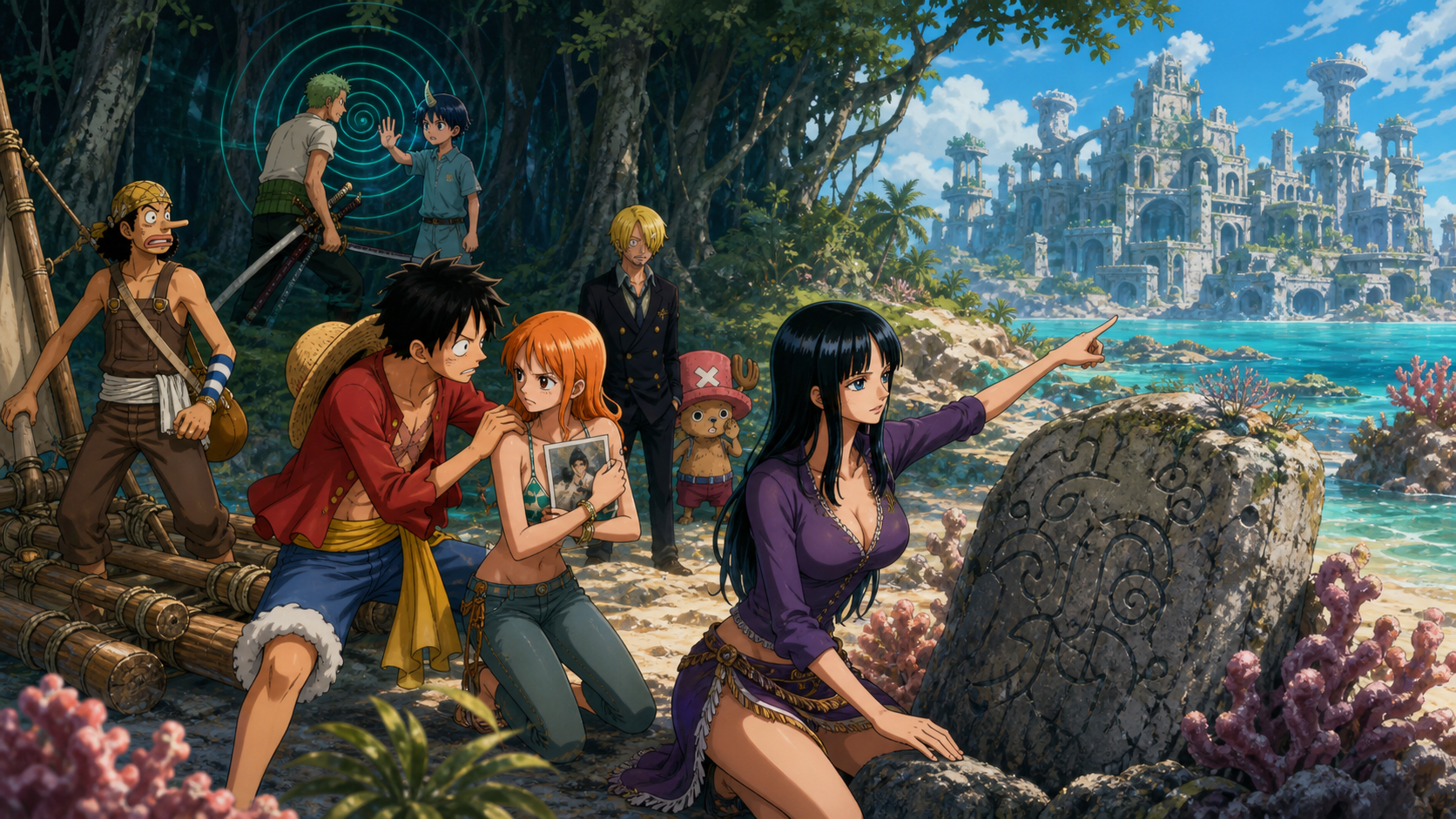
The crew explains the horn boy and the stolen memories. Nami has seen enough damage around town to consider the account. She agrees to help find the culprit and recover what was taken, but cooperation is not surrender. She wants her own life back. The goal overlaps with Luffy’s goal, which gives them a temporary route forward without requiring a false emotional shortcut.
Sanji carrying the gold is funny and completely predictable
Nami protects the Skypiea gold because the money offers leverage in a life she no longer understands. Sanji carries the load because Nami asked and because memory loss did not remove his willingness to perform impossible service for a beautiful woman. The gag works because fans recognize the pattern even when he cannot.
The gold also keeps the previous episode’s material problem present. Nami did not leave with only hurt feelings. She left with a major crew resource and a plan to use that resource for home. Bringing her back means bringing her priorities into the investigation, not treating the money as a silly obstacle that disappeared between episodes.
The horn boy turns Zoro’s isolation into a weapon
In the forest, the mysterious boy finally approaches Zoro and uses hypnosis. Zoro’s discipline protects him from ordinary persuasion, so the attack bypasses consent. The boy does not restore facts or convince him through evidence. He redirects a powerful body whose social anchors are already missing.
This is the nightmare version of the episode’s central question. The crew has been rebuilding cooperation through explanation, labor, and choice. The boy manufactures obedience through stolen memory and direct control. Zoro becomes dangerous because his strength remains while his loyalty and judgment are cut away from the people who normally help aim that strength.
Robin reads the stone and refuses the obvious answer
The group reaches a deserted area where Robin finds ancient writing carved into stone. Her archaeological skill moves the story beyond chasing one suspicious child. The inscription suggests that the visible boy is not the true thief. The mystery has a deeper source connected to the Sea God’s Palace.
This is Robin at her best. She changes her theory when new evidence appears. The boy carries the horn and participates in the attacks, but participation does not settle authorship. A weaker investigation would stop at the first face available for blame. Robin reads the older structure around the crime and asks who benefits from the boy’s actions.
The Sea God’s Palace gives the search a destination
Robin directs the group toward the Sea God’s Palace. The name sounds grand enough for Luffy to charge ahead and specific enough to organize everyone else. An abstract crisis finally gains a physical destination.
The palace also shifts the arc from domestic unease on the Going Merry into island adventure. The crew now has a route, a suspected mechanism, one restored captain, one guarded navigator, several amnesiac members choosing cooperation, and a swordsman being turned against them. That is enough structure for the final two episodes to move.
Recovered memory does not make Luffy cautious
Luffy behaves much as he did before the theft, which reassures the others and creates a new problem. His confidence can look like proof because the personality remains consistent. His impulsiveness also remains consistent. Robin has to keep translating energy into a workable plan.
The episode understands that memory is not the only source of identity. Temperament, appetite, skill, habits, values, wounds, and bodily practice all survive in different measures. Luffy with memory and Luffy without memory look similar from a distance. The restored version knows who deserves his urgency.
What changed when I replayed the episode
On the first watch, Robin’s stone discovery felt like a normal clue leading to the next location. On replay, the discovery became the episode’s clearest moral distinction. She refuses to confuse the most visible participant with the entire system behind the harm. The horn boy is dangerous. The palace may explain why the danger exists.
I also noticed how much of the reunion happens through labor. Usopp builds. Sanji carries. Robin translates. Luffy searches. Nami navigates the uncertainty. Chopper follows a hope he cannot prove. Nobody delivers one magical speech that makes the crew whole. They act like a crew before they feel like one.
The production gives the island two faces
The bright shore and strange town keep the adventure visually open while the forest closes around Zoro. Daylight protects the search party from the same hidden-night rhythm that enabled the first theft. The deeper shade around Zoro signals that one member remains outside the group’s shared investigation.
Flashbacks break the forward movement, but each memory has a clear job. Zeff explains Sanji’s service. Kaya explains Usopp’s stories and desire for adventure. Hiriluk explains Chopper’s faith. The episode does not recap the entire recruitment journey. The surviving scenes identify what existed before Luffy and what the crew later helped those foundations become.
RaeRae’s verdict
Episode 222 earns a strong middle-chapter verdict because the crew starts functioning before the relationships fully return. That choice respects the damage. Nami does not suddenly melt because Luffy remembers her. Sanji, Usopp, and Chopper do not need complete biographies before contributing. Robin does not stop thinking once a suspicious boy appears.
The Zoro hypnosis is a blunt device, and the Sea God’s Palace arrives with familiar filler-arc convenience. The character logic around those devices stays solid. Strength without shared judgment becomes dangerous. Evidence without trust moves slowly. Chosen family is rebuilt through repeated work. The episode gets everybody onto the island, but the real landing happens when these half-strangers choose the same problem together.
Official source and next route
The official ONE PIECE episode guide confirms the February 20, 2005 broadcast date and production credits for the crew’s island landing. Continue through the bounded Ocean’s Dream directory for Episode 223, where the Sea God’s Palace route collides with a hypnotized Zoro and the crew has to defend a bond several members still cannot remember.