RaeRae Reacts · One Piece Episode 220
The Straw Hats Forget Why They Chose Each Other
One Piece Episode 220 erases every shared voyage except Robin’s memory, sending Nami toward Cocoyasi Village and Zoro back toward a solitary life.
Bottom line: the crew disappears before the bodies leave the ship
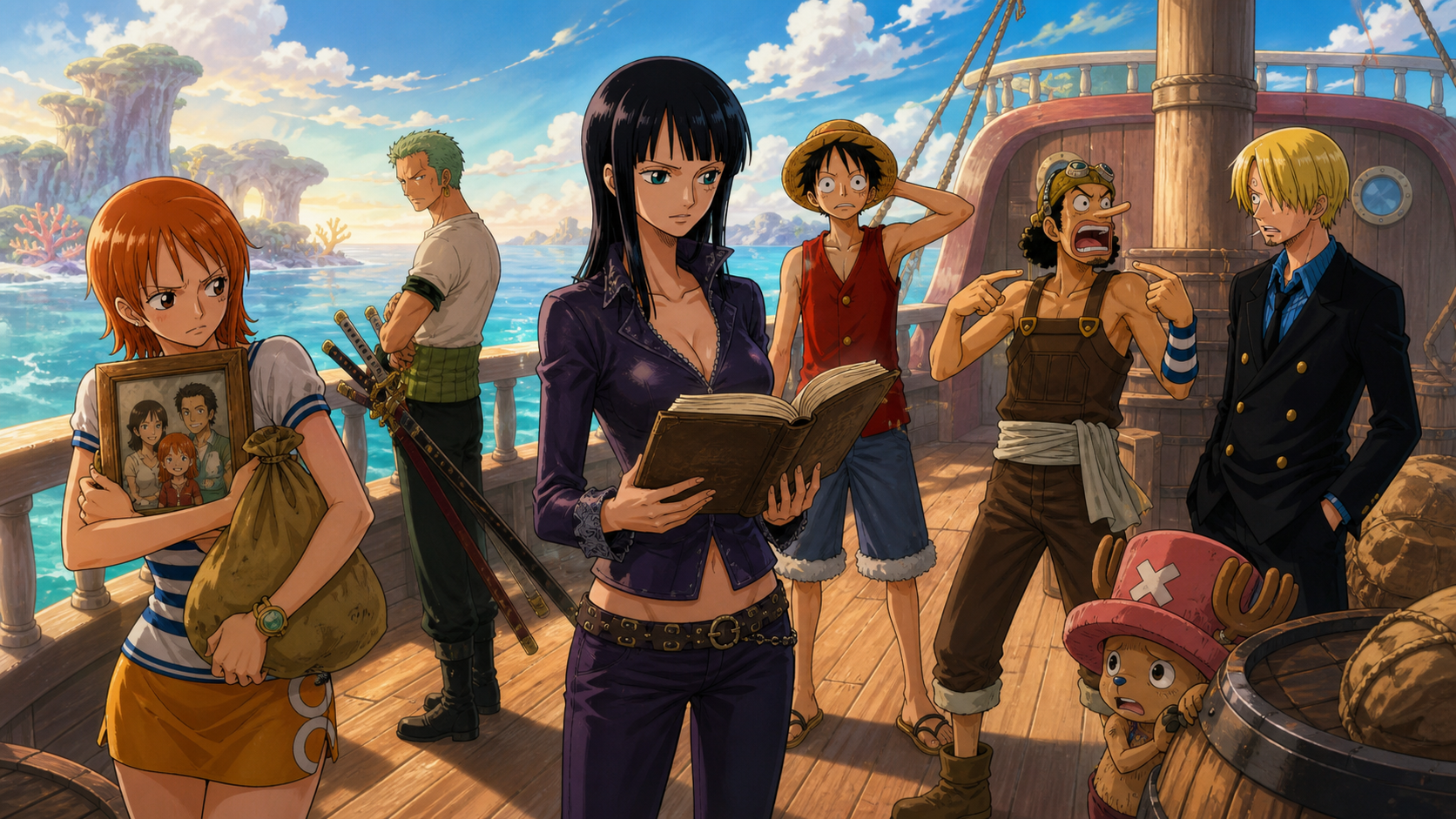
One Piece Episode 220 takes away every shared adventure except Robin’s memory and immediately exposes how much work holds this crew together. The Going Merry still carries the same people, weapons, maps, food, gold, and scars. None of those objects can explain why seven strangers should trust one another. Nami sees pirates and reaches for an exit. Zoro sees strangers and returns to the lonely road of a bounty hunter. Chopper sees humans and hides. Usopp sees confusion and tries to promote himself. Sanji sees Nami and falls in love again because apparently memory theft cannot defeat that particular disaster.
My first reaction was laughter because the character comedy lands. My second reaction was much less comfortable. The episode rolls each Straw Hat backward to the last self they understood before Luffy entered the picture. Their old fears return faster than their dreams. Robin becomes the only keeper of a family history that nobody else believes. She joined the crew most recently, yet she has to explain a bond built through scenes she never witnessed. That reversal gives this anime-original story a sharper idea than the usual memory-loss gimmick.
Episode facts and the anime-only route
Episode 220 aired in Japan on February 6, 2005. Junki Takegami wrote the script with assistance from Jin Koyama, Munehisa Sakai directed the episode, Eisaku Inoue served as animation director, and Miyuki Sato and Kunihiro Chida handled the art direction. The official Japanese title asks three blunt questions: Was the memory lost? Was the memory stolen? Who are you?
This episode begins the five-part Ocean’s Dream story, Episodes 220 through 224. The arc adapts ideas from the PlayStation game One Piece: Ocean’s Dream rather than manga chapters. That makes the story anime-original. Fans can skip the five episodes without losing the manga plot, but “filler” does not answer whether the episode has something worthwhile to say. Episode 220 uses a temporary break in continuity to examine the crew’s construction. The question is not whether these people will reunite. We already know the answer. The fun comes from seeing which parts of them survive when the emotional evidence disappears.
The night makes Robin the witness
The Going Merry rests near a small island surrounded by coral reefs. Everyone sleeps except Robin, who stays awake reading. A mysterious figure appears near the water and plays a seahorse-shaped instrument. The attack arrives quietly. No cannon announces danger. No enemy boards the deck with a speech. Sleep becomes the opening, and memory leaves without waking the victims.
Robin’s book matters because reading keeps her conscious, but the scene also fits her entire life. She survives by watching, listening, and staying awake while other people accept safety. The habit once protected a hunted child. Here, the same habit preserves the crew’s shared history. Robin does not receive a heroic warning or special immunity. She happens to be doing what Robin always does. Character creates survival before anybody understands the threat.
Nami wakes inside somebody else’s life
Nami wakes first and does not recognize Robin. From Robin’s position, a friend has vanished behind a familiar face. From Nami’s position, an unknown woman is standing inside a room filled with possessions she cannot place. Both reactions make sense, which keeps the scene from becoming cheap confusion. Robin asks questions carefully. Nami answers from the last life her mind still accepts.
The missing memories send Nami back before Luffy, Arlong Park’s liberation, Alabasta, Skypiea, and every mile of proof that these pirates are her people. Her distrust of pirates returns because the experiences that changed that judgment are gone. The episode does not pretend friendship is a personality setting buried beneath the damage. Trust came from actions repeated over time. Remove the actions and the old survival rule takes control again.
Usopp lies because fear still knows his name
Usopp wakes among unfamiliar men and almost immediately claims he is a famous pirate captain. Of course he does. His memories are damaged, but his first defense remains a story large enough to stand between him and danger. The lie is funny because everybody can see through the performance. The lie is also honest in the sideways way Usopp often tells the truth. He wants to become the brave captain he describes, even when he has forgotten the crew that helped him move toward that person.
Sanji dismantles the claim quickly. Usopp cannot bluff his way into authority when every listener is equally confused. Still, his instinct says something useful: when structure disappears, Usopp manufactures structure with himself at the center. Fear does not make him passive. Fear makes him theatrical. The episode remembers that his comedy and courage come from the same source.
Sanji meets Nami and repeats the whole mistake
Sanji sees Nami and falls for her as though the universe pressed a reset button on his heart. I laughed, sighed, and accepted that memory theft has limits. His attraction survives without the history of meals, arguments, storms, rescues, and unpaid kitchen labor. The gag gives the episode some necessary air while everyone else spirals.
More importantly, Sanji still turns toward breakfast. Nobody understands the ship, but he understands hunger and the work required to answer hunger. Cooking gives the strangers one immediate reason to remain in the same space. He may not remember being the Straw Hats’ cook, yet his hands and values still move toward feeding people. Skill survives memory here, but skill alone does not restore belonging. Breakfast can gather bodies around a table. Breakfast cannot make those bodies trust the story Robin tells.
Chopper loses the humans who taught him home
Chopper wakes surrounded by humans he does not know and hides behind a barrel. The image looks adorable until his history enters the room. Chopper learned to fear rejection long before the Straw Hats welcomed him. Without Drum Island’s departure and the crew’s acceptance, the ship becomes another human place where a strange reindeer may be hunted, mocked, or driven away.
Luffy chases him with curiosity, which does not help. Robin has to explain that Chopper is their doctor and companion. Her words cannot replace Chopper’s memories of laughing, fighting, treating injuries, and being treated as a person. The episode briefly returns him to the emotional distance between wanting human connection and expecting human cruelty. That distance makes his small frightened body carry one of the morning’s heaviest losses.
Luffy keeps the appetite but loses the promise
Luffy remains physically Luffy. He is direct, curious, hungry, and ready to chase something interesting. What disappears is the chain of promises that turned those instincts into captaincy. He cannot remember choosing these people, protecting their dreams, or asking them to trust his route. Robin can tell him that he is captain, but a title supplied by a stranger sounds ridiculous.
This is where the episode could have made him secretly recognize everybody through pure destiny. I am glad the story resists that shortcut at first. Chosen family deserves more than magical recognition. Luffy built his crew by entering specific crises and making specific promises. Those promises matter because people remember who showed up. His body still has power, but leadership without shared memory becomes a claim nobody has reason to follow.
Zoro returns to the man who walked alone
Zoro drops from the crow’s nest and immediately changes the room. Usopp recognizes the infamous bounty hunter, which gives everyone a fact they can understand. Zoro has swords, a reputation, and no memory of swearing himself to Luffy. From his view, staying aboard an unknown pirate ship would make less sense than leaving.
The loyalty fans treat as one of Zoro’s permanent traits was not handed to him at birth. Luffy earned that loyalty through Shells Town, and Zoro kept choosing the bond through every battle afterward. Episode 220 removes the beginning and leaves only the solitary swordsman. He does not become cruel. He becomes unattached. That distinction matters. Loyalty is not obedience hiding inside his muscles. Loyalty is history, judgment, and a promise he can no longer access.
Robin has the weakest receipts for the biggest truth
Robin tells the group that they are pirates sailing the Grand Line under Luffy. The explanation sounds outrageous because she cannot give everyone the origin story they need. She joined after Alabasta. She did not witness Luffy meeting Zoro, Nami’s long struggle under Arlong, Usopp’s stand at Syrup Village, Sanji leaving Baratie, or Chopper choosing the sea. She knows the current relationships and pieces of the journey, not every private road that created them.
That limitation makes her role much better. A convenient narrator could solve the mystery with a perfect recap. Robin cannot. She holds the truth without holding enough evidence to make frightened people accept the truth. Fans know she is right, but Nami and Zoro are not foolish for refusing. Trust does not become reasonable merely because the audience has more information.
Nami’s logbook proves authorship, not belonging
Nami finds a logbook written in her own hand. The pages prove she recorded a voyage she cannot remember. That discovery should be overwhelming. Her handwriting becomes evidence from a version of herself who feels like another person. Maps, routes, and notes can confirm movement across the sea. They cannot restore the warmth, anger, fear, and relief attached to the miles.
The distinction is the episode’s strongest idea. Records preserve facts. Relationships require lived meaning. Nami believes the writing because she recognizes her hand, yet recognition does not make the strangers safe. She searches for the last emotional anchor still available and finds the photograph of Bellemere and Nojiko. The picture does not ask her to trust an unknown captain. The picture points home.
The photograph pulls harder than the pirate flag
Nami takes the family photograph, the Waver, and the gold recovered from Skypiea. Her exit may look selfish when the current Nami is still visible to us, but the woman making the choice remembers a very different life. Money still means survival, leverage, and the possibility of returning to Cocoyasi Village. Pirates still mean danger. A mysterious ship full of armed strangers has no moral claim on her.
I love that the episode lets Nami choose a practical escape instead of waiting for Robin to talk her into comfort. She reads the available evidence and acts. The decision hurts because we remember what she cannot. We remember Luffy placing the straw hat on her head. We remember the crew walking toward Arlong Park. Those memories belong to the audience and Robin now. Nami carries only the earlier wound.
Zoro follows because no vow remains
After Nami leaves, Zoro decides he has no reason to stay. He jumps into the water and swims toward the island. The departure is quieter than Nami’s and just as revealing. He does not need the gold, the Waver, or a plan home. A swordsman accustomed to walking alone simply resumes walking alone.
The crew’s fracture happens without a fight because conflict requires a shared relationship too. Nobody can accuse Zoro of betraying a vow he does not remember making. Nobody can demand that Nami trust pirates when the evidence that changed her mind has been stolen. Robin watches the family come apart while lacking the authority to command strangers back into place.
The comedy works because the pain stays underneath
Episode 220 keeps the morning lively with Usopp’s lies, Sanji’s instant devotion, Luffy’s confusion, and Chopper’s hiding. Those jokes prevent the premise from sinking into self-important misery. The humor also preserves character. Memory loss does not turn everyone into blank mannequins waiting for exposition. Old habits, skills, appetites, fears, and ambitions keep colliding.
The balance is not perfect. Some reactions move quickly because the arc has only five episodes, and the mysterious watcher carries the broad shape of an anime-original villain. Still, the character comedy does more than fill time. Each joke answers the same question from a different angle: what remains when the voyage disappears? Usopp’s bluff remains. Sanji’s service and attraction remain. Luffy’s curiosity remains. Chopper’s fear remains. Those pieces are recognizable, but none equals the whole person fans know.
What changed when I replayed the episode
On the first watch, Nami and Zoro leaving feel like the main event. On replay, Robin’s position became much sadder. She remembers being accepted by this crew after expecting rejection, and now the acceptance exists only in her mind. The people who gave her a place cannot remember giving anything. She has to protect a home whose other residents see her as an intruder.
I also noticed how carefully the story separates stored information from emotional memory. The logbook can establish Nami’s route. Zoro’s reputation can establish his profession. The ship can establish that people traveled together. None of those facts explains affection. The episode understands that a relationship is not a database of encounters. Meaning grows from how people interpret those encounters and what they promise afterward.
The production keeps danger quiet
The coral-ringed island and calm morning colors make the crisis feel wrong in a useful way. The crew has survived thunder, warships, gods, and pirate games. Here, warm daylight reveals the damage after the attack has already succeeded. The ordinary deck becomes unfamiliar because the characters no longer recognize the social map of their own home.
The mysterious music and underwater imagery give the theft a dream logic without drowning the episode in spectacle. Much of the tension comes from faces, distance, and blocking. Robin stands close enough to help but cannot cross the gap created by disbelief. Nami and Zoro move toward the ship’s edges. Chopper puts an object between himself and everyone else. The direction lets separation become physical before anybody explains the theme.
RaeRae’s verdict
Episode 220 is a strong opening for a short anime-original arc because the memory trick reveals character instead of replacing character. The funniest choices come from old habits. The saddest choices come from old wounds. Robin becomes the keeper of a chosen family that has forgotten choosing her, and that alone gives the episode a reason to exist beyond filling broadcast time.
The episode also refuses an easy idea that friendship lives somewhere untouched by experience. These people became a crew through labor, rescue, conflict, food, promises, and miles. Take away the shared history and the pirate flag cannot hold them. Nami reaches for home. Zoro reaches for solitude. Robin reaches for evidence. The next episode has to prove whether strangers can rebuild enough trust to investigate the theft before another night takes whatever remains.
Official source and next route
The official ONE PIECE episode guide confirms the February 6, 2005 broadcast date, production credits, coral-island setting, overnight memory loss, and Robin’s immunity because she stayed awake reading. Continue through the bounded Ocean’s Dream directory for Episodes 220 through 224, then follow the next React as Robin starts turning a shared dream and a strange whistle into an investigation.