RaeRae Reacts · One Piece Episode 219
Luffy Reflects Foxy’s Beam and Wins Everyone Back
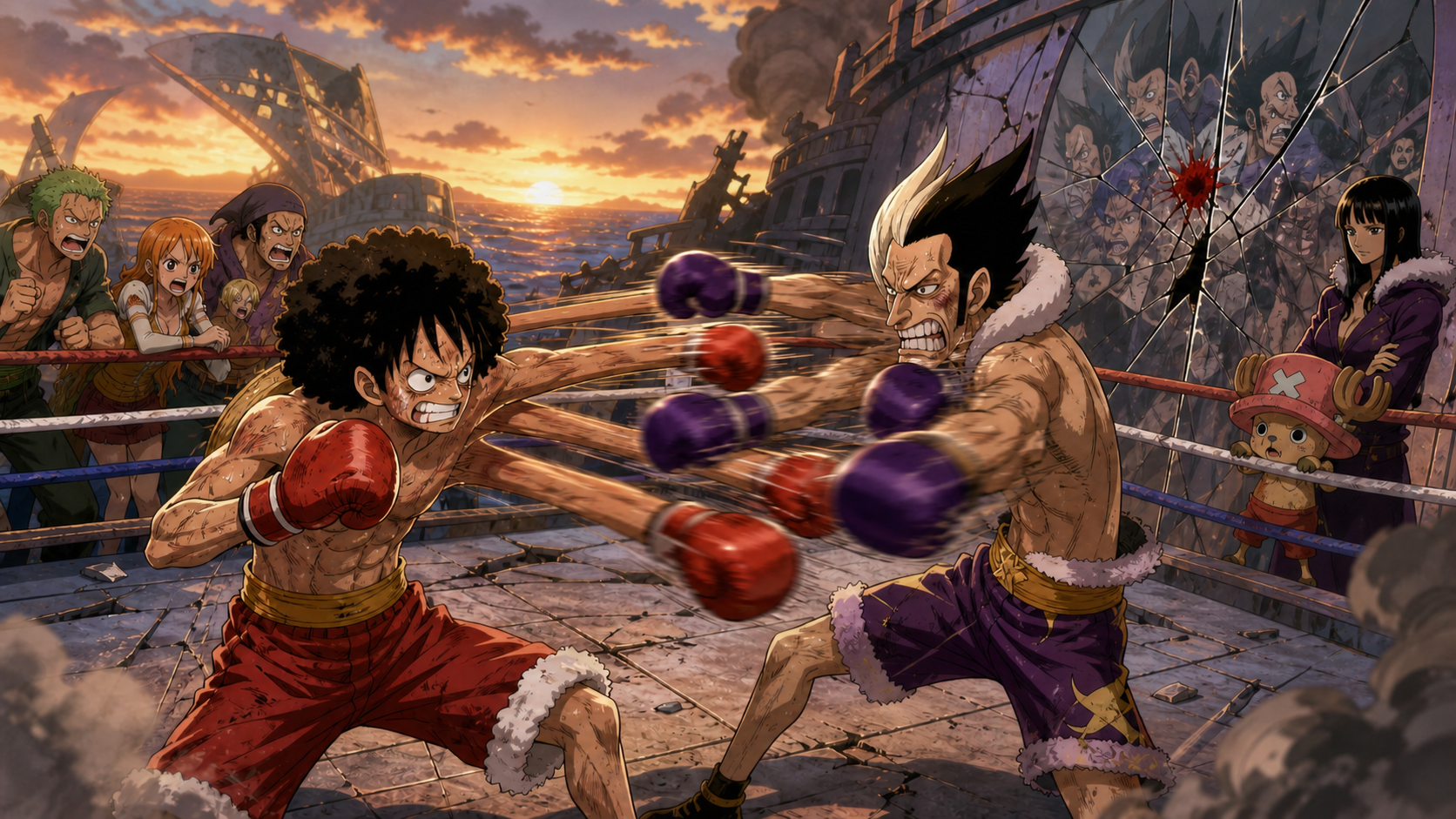
One Piece Episode 219 lets a mirror shard expose Foxy’s own beam, brings Robin and Chopper home, and leaves his crew sailing under Luffy’s terrible flag art.
Bottom line
One Piece Episode 219 ends the Davy Back Fight with blood, a mirror shard, and Luffy refusing to stay down until Robin and Chopper are standing beside him again. Foxy has the Slow-Slow Beam, his ship, his traps, and a final Megaton Kyubi Rush. Luffy has already absorbed more punishment than anybody should survive. He still finds the one answer Foxy cannot twist: reflect the beam, trap Foxy inside his own slowed time, and hit him hard enough to end the wager.
The victory restores the crew, then the anime adds one more strange flex. Luffy can claim five hundred Foxy Pirates, takes Robin, Chopper, and 497 others, and immediately releases the unwanted recruits. He also takes the flag and replaces Foxy’s symbol with a terrible drawing. The episode rejects forced belonging at the end, even though Luffy should never have accepted a system that made forced belonging possible.
First watch: the mirror shard finally gives the afro a second job
A shard from the destroyed mirror remains caught in Luffy’s afro. The hairstyle that began as Usopp’s confidence ritual now carries the practical tool that defeats Foxy’s beam.
That payoff is perfect One Piece logic. A visual gag, environmental damage, and tactical solution meet in one piece of glass. The afro does not create power. The afro keeps the answer close enough for Luffy to use.
Luffy stands because the crew is still divided
Foxy keeps knocking him down. Luffy keeps rising because Robin and Chopper remain attached to the result. The fight has stopped being about pride, costumes, or whether Foxy deserves respect.
Every return to his feet is a refusal to let the crew pay permanently for his rematch decision. That responsibility does not absolve him. The responsibility gives his endurance a purpose beyond winning.
Foxy mistakes repeated knockdowns for a finished fight
Foxy celebrates every collapse as if Luffy’s history contains no evidence. Crocodile left him for dead. Enel buried him under gold. G-8 trapped him in seastone. Luffy’s defining combat habit is returning after the opponent has started the victory speech.
Foxy’s impatience keeps creating openings. He wants emotional confirmation more than tactical certainty, so he watches for humiliation instead of checking whether Luffy can still move.
The final Slow-Slow Beam turns back toward its owner
Luffy raises the mirror shard and reflects the Noro Noro Beam. Foxy’s greatest control tool becomes a threat moving along the same line he chose.
The reversal is satisfying because Luffy learned from the mirrored chamber. Episode 218 showed him breaking the surface that multiplied the beams. Episode 219 shows him carrying that knowledge into a smaller, more precise counter.
Blood makes the reflections tell the truth
Foxy’s mirrored tricks create several possible targets. Luffy’s blood marks the real body and separates the captain from the copies. Pain becomes information.
The image is rough without becoming empty gore. Luffy cannot rely on clean vision after smoke, reflections, and repeated impacts. The evidence on the glass gives him one reliable point inside Foxy’s visual noise.
Foxy finally experiences the delay he weaponized
The reflected beam slows Foxy. For most of the fight, he used delayed time to stack attacks and deny Luffy a response. Now Foxy occupies the helpless interval.
The reversal exposes how dependent his fighting system is on acting alone inside stolen seconds. Once somebody else controls the timing, his theatrical confidence has nowhere to hide.
Gum-Gum Gatling spends the last reserve
Luffy launches a final barrage after reaching the edge of exhaustion. The rapid punches answer Foxy’s machinery with the body Foxy kept trying to reduce to a target.
The attack matters because Luffy has no untouched strength waiting for the climax. He uses what remains. The animation sells effort through bruised posture, uneven breath, and the refusal to lower his gloves.
Megaton Kyubi Rush gives Foxy one honest exchange
Foxy answers with his own desperate multi-punch rush. The final exchange strips away corridors, costumes, trapdoors, cannons, and machines. Two captains throw everything still available.
Foxy earned the right to be dangerous by building the earlier system well. Luffy earns the final advantage by surviving that system long enough to force a direct finish.
The last man standing settles more than the score
Luffy remains upright after the exchange. The result returns Robin and Chopper, protects the rest of the Straw Hats, and ends the generational loyalty clause attached to defeat.
The body standing in the ring becomes evidence that Foxy’s paperwork cannot override the crew’s chosen bond. The win matters because the rules were real enough to hurt them.
Robin returns without a recruitment speech
Robin does not need to prove why she belongs. The crew fought because her place was already settled. Foxy’s selection never changed that fact.
Her return is especially important before Water 7, where her history and fear will make belonging much harder to trust. Long Ring Long Land establishes that Luffy will fight a whole system to bring her back, even after his own mistake gave the system access.
Chopper comes home for the second time
Chopper has endured two transfers during one island visit. His joy at returning cannot make that repetition harmless.
The crew embraces him because nobody considered the Foxy uniform a real change of loyalty. Chopper’s identity stayed with the people he chose, no matter how many ceremonies claimed otherwise.
Five hundred recruits reveal the absurd scale of the wager
The expanded final stake gives Luffy the right to claim five hundred people. Robin and Chopper count among them, leaving 497 Foxy Pirates under his authority.
The number turns Foxy’s collection logic against him. A captain who built power by taking people can lose almost the entire structure in one result.
Luffy releases the people he never wanted to own
Luffy does not keep 497 strangers as trophies. He restores his crewmates and releases the rest. The choice separates rescue from conquest.
That refusal is the cleanest moral answer the episode gives to the Davy Back tradition. Winning a person does not create genuine belonging. If somebody has not chosen the Straw Hats, Luffy has no use for forced loyalty.
Keeping Foxy would have repeated Foxy’s own mistake
A large crew can look powerful while containing people with no shared purpose. Foxy’s numbers already produced friendly fire, weak coordination, and members who performed identity instead of trust.
Luffy’s crew remains small because the relationships matter more than the head count. Releasing the unwanted recruits protects that difference.
The pirate flag is the prize that actually hurts Foxy
Luffy takes Foxy’s Jolly Roger. A flag carries the identity Foxy values more than any single game. Removing the symbol wounds his public image after the physical defeat.
The choice also answers Foxy’s earlier willingness to gamble the Straw Hat flag. Crew symbols are not decorative property. They represent promises, histories, and the name people sail under.
The replacement drawing is disrespect with crayons
Luffy gives the Foxy Pirates a badly drawn replacement. The image ruins the polished brand Foxy built across uniforms, bombs, sails, and ship decorations.
The punishment fits him better than another lecture. Foxy survives. His vanity has to sail under art that looks like Luffy drew the captain during an earthquake.
Tonjit and Shelly deserve the quiet after the games
The end of Foxy’s control lets the island return to the people and relationships the challenge interrupted. Tonjit and Shelly were never supposed to become props in a recruitment spectacle.
Their reunion reminds viewers that the arc began with ordinary separation and community, not an arena. Foxy’s arrival imposed the games on a world that already had its own life.
The arc makes chosen family visible by threatening ownership
The Davy Back Fight asks whether a rule can transfer belonging. Chopper’s tears, Robin’s removal, Zoro and Sanji’s truce, and Luffy’s refusal to remain down all answer no.
Rules can move bodies and uniforms. Chosen family survives through decisions repeated under pressure. The Straw Hats keep choosing one another after every scoreboard tries to say otherwise.
Luffy wins the argument and still owes the crew an apology
His faith in the Straw Hats proves justified. His decision to rematch remains reckless. Success does not retroactively create consent.
The episode celebrates the rescue without spending much time on accountability. RaeRae can do both. I love that Luffy refused to lose Robin and Chopper. I am still mad he put them back on the table.
Production notes
Episode 219 aired in Japan on January 30, 2005. Hirohiko Uesaka wrote the script, Takahiro Imamura directed the episode, Naoki Tate served as animation director, and Miyuki Sato with Michiyo Kawasaki handled the art. The official ONE PIECE guide frames the climax around Luffy rising for his friends, Gum-Gum Gatling, Foxy’s Megaton Kyubi Rush, and the question of who remains standing.
The direction gives the final exchange weight by showing accumulated damage. The mirror, blood marker, slowed time, and crossing barrages turn earlier mechanics into the conclusion instead of introducing one convenient new power.
What the episode gets right
Episode 219 pays off nearly every visual tool from the captain fight. The afro holds the mirror. The mirror redirects the beam. Blood identifies the true target. Foxy’s time theft traps Foxy. Luffy’s durability buys the seconds needed to connect those pieces.
The post-fight choice also restores agency. Robin and Chopper return because they already chose the Straw Hats. The 497 others leave because Luffy refuses to confuse victory with consent.
What still bothers me
The anime extension adds games that repeat Chopper’s transfer and temporarily take Robin, which can dilute the sharpness of the original three-event structure. More spectacle creates more opportunities for the crew’s pain to become a resettable gag.
The finale repairs the relationships, but the captain’s decision receives less challenge than the consequences deserve. Luffy’s victory is real. The lesson should be real too.
RaeRae verdict
Episode 219 gives Long Ring Long Land the finish the arc needed. Luffy does not overpower Foxy through a mystery upgrade. He learns the beam, uses the broken environment, carries pain into strategy, and refuses to let chosen family become a transferable prize.
Foxy loses the fight, almost all his crew, and the flag that turned every corner of his world into personal advertising. Robin and Chopper come home. The afro retires undefeated. Somebody still needs to take Luffy aside and explain that “we won” is not the same sentence as “you were right.”
Official source
ONE PIECE.com Episode 219 guide
Reflection Is the Perfect Answer to Foxy
Luffy reflecting the Slow-Slow Beam gives Foxy exactly what he has spent the entire arc distributing. Foxy depends on distance between action and consequence. He fires the beam, moves while someone else freezes, and calls the result clever. Reflection collapses that distance. His own advantage returns before he can hide behind another rule.
Winning everyone back matters because the Davy Back Fight tried to convert relationships into inventory. Chopper’s tears, Robin’s forced transfer, and the crew’s fury all reject that premise. Luffy does not win new property. He restores the choices Foxy’s game attempted to erase. The distinction matters, especially for a crew built from people who joined after being isolated, used, or discarded.
The final refusal to take Foxy’s crewmates also exposes the captain’s priorities. Luffy wants his family, not a larger head count. RaeRae verdict: Episode 219 ends the game with the right kind of victory. Foxy receives his own beam, the Straw Hats return to one another, and the scoreboard finally stops pretending friendship can be transferred by paperwork.
One more receipt: Chopper returning to the lineup carries special weight after the shame and fear of being traded. His relief confirms that winning means restored belonging, not a technical result on Foxy’s board.
The victory also restores the crew’s rhythm before the next crisis arrives. Everybody leaves the field carrying proof that Foxy could delay their bond, embarrass their bond, and exploit their bond, but never own the final decision.