RaeRae Reacts · One Piece Episode 211
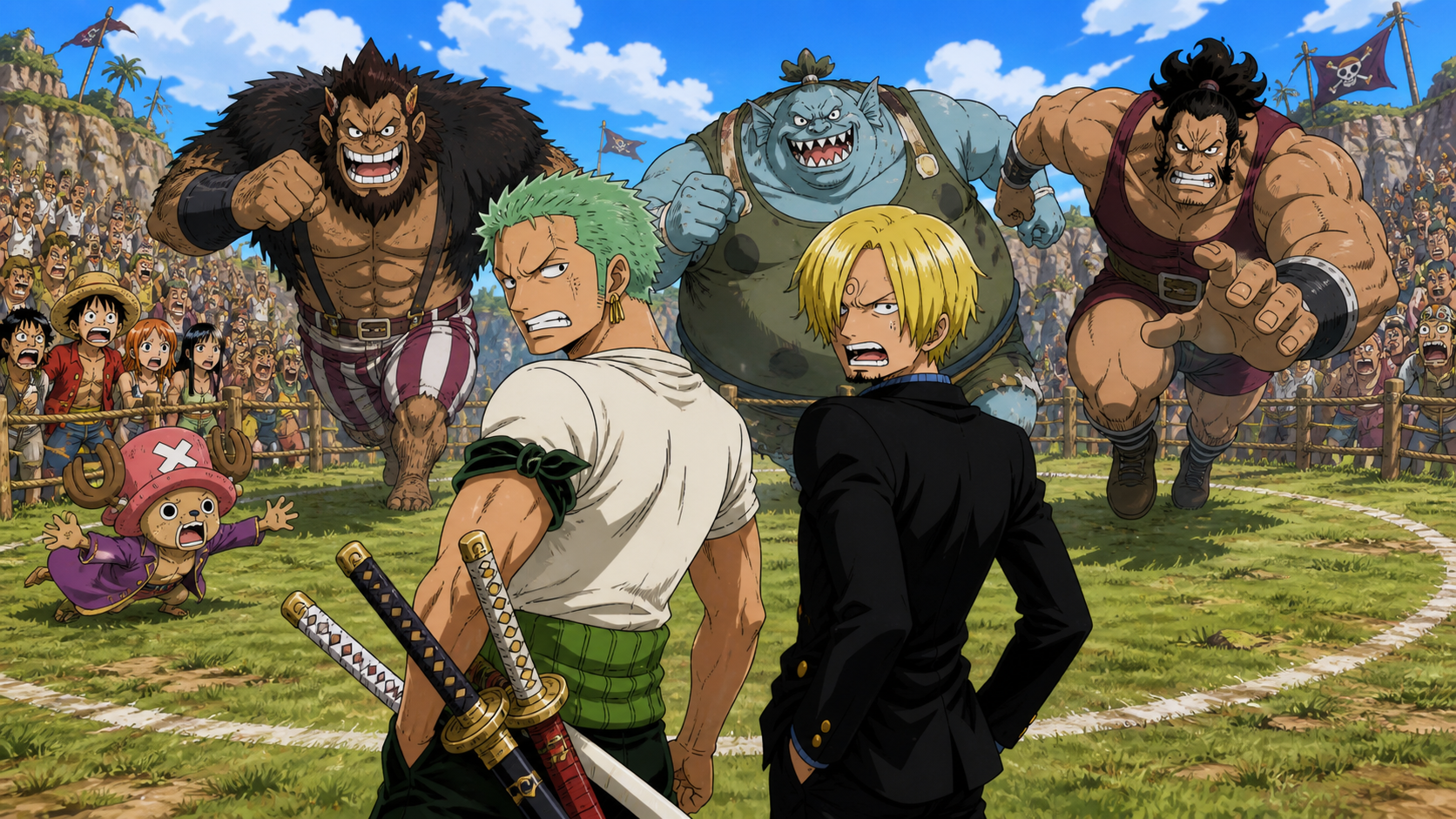
Zoro and Sanji Fight Each Other While Chopper Waits
One Piece Episode 211 puts Chopper’s freedom behind a Groggy Ring goal and asks whether Zoro and Sanji can stop performing rivalry long enough to rescue him.
Bottom line
One Piece Episode 211 puts Chopper’s freedom in the hands of Zoro and Sanji, then gives those two men every possible reason to make the rescue harder. Groggy Ring is a violent goal game with almost no meaningful protection, the Foxy team has three undefeated giants, and the Straw Hats enter one player short because Foxy took Chopper after the Donut Race. Zoro and Sanji still spend the opening stretch arguing like their rivalry matters more than the terrified crewmate watching from the wrong side.
The episode works because their conflict is funny and genuinely irresponsible at the same time. Zoro and Sanji trust each other in emergencies more than either man will admit, but unspoken trust cannot coordinate a team while Hamburg, Pickles, and Big Pan are using bodies as weapons. Chopper does not need their pride. He needs them to stop performing hostility long enough to bring him home.
First watch: please save the baby before comparing egos
I enjoy Zoro and Sanji’s fights when the arguments release pressure or expose how similar they are. Episode 211 tests my patience because Chopper is crying in a Foxy uniform while they continue the same insults. The stakes are sitting right behind the boundary rope wearing another crew’s colors.
Their rivalry has become comfortable enough to feel safe to them. They know insults will not end the relationship. Chopper does not have that security in this moment. He hears rules saying his relationship with the Straw Hats has already ended.
Chopper’s coat is the cruelest costume change
The Foxy Pirates dress Chopper in their colors immediately. The outfit turns an emotional wound into public branding. A new coat is supposed to make the transfer look complete before Chopper has processed what happened.
Chopper spent years treated as neither reindeer nor human. The Straw Hats gave him a place where nobody demanded that he become less strange. Foxy’s uniform says belonging can be reassigned by ceremony. His tears say the body wearing a symbol still has a choice.
Luffy’s promise matters because he caused the risk
Luffy tells Chopper they will win him back. The confidence comforts because Chopper trusts his captain. The promise also carries responsibility. Luffy accepted the wager that let Foxy take him.
A leader does not repair harm by pretending the harm came from nowhere. Luffy’s determination is necessary, but the arc should keep the original decision visible. Chopper needs rescue from Foxy and reassurance that his captain understands what was gambled.
Groggy Ring is football stripped of restraint
The game asks teams to drive a designated player into the opposing goal. Weapons are barred, but tackles, throws, formations, and attacks against bodies receive enormous freedom. The rule against weapons creates the appearance of control while almost every dangerous action remains available.
That structure favors size and rehearsed violence. The Groggy Monsters have built their identity around crushing opponents inside the allowed chaos. Zoro and Sanji enter with combat experience, but combat experience is not the same as practiced team play.
The missing third player is not an accident
The Straw Hats should have three competitors. Chopper’s transfer leaves only two. Foxy’s first win therefore changes the next game before the whistle. The Davy Back Fight compounds advantage.
That design resembles every rigged system where one victory purchases tools for the next victory. Foxy can weaken an opponent, strengthen his own roster, and call the following imbalance a fresh contest. The scoreboard resets. Power does not.
Hamburg turns laughter into impact
Hamburg looks like a walking punchline until he starts moving bodies. The ape-like build, constant grin, and exaggerated confidence fit the Foxy carnival, but his strength is real. He can throw, tackle, and absorb punishment.
That combination matters. The Straw Hats are used to jokes becoming threats. A ridiculous silhouette does not grant permission to stop paying attention. Hamburg uses the moment of underestimation as another opening.
Pickles attacks like the field owes him space
Pickles brings direct mass and forward force. His tackles do not need elegance because the game rewards displacement. If an opponent leaves the useful part of the field, technique becomes irrelevant.
Zoro understands force but initially answers as an individual fighter. Groggy Ring punishes that instinct. Stopping one charge may expose Sanji. Avoiding one body may open a lane. Every successful response has to include the teammate he is busy insulting.
Big Pan makes the size mismatch ridiculous
Big Pan is a Wotan, born from giant and fish-man heritage, and his enormous body turns him into both player and terrain. He can receive teammates, launch attacks, and occupy space no ordinary competitor can contest cleanly.
The design is funny because he is round, expressive, and surprisingly mobile. The danger comes from scale. Zoro and Sanji cannot treat him as one more opponent when his body can reshape the entire play.
The Groggy Monsters are undefeated for a reason
Hamburg, Pickles, and Big Pan have rehearsed formations. They understand who blocks, who carries momentum, and how to convert size differences into scoring opportunities. Their teamwork is not decorative villain synchronization.
The contrast with Zoro and Sanji could not be clearer. The Straw Hats have stronger individual reputations, but the Foxy trio starts as a team. Coordination can make lesser power more useful than greater power pointed in two directions.
Zoro refuses to perform concern
Zoro cares about Chopper. His refusal to coddle Chopper is part of that care. He wants the doctor to stop crying, remember who chose him, and trust the crew’s strength. The message has value even when the delivery is harsh.
The problem is timing. Chopper has been publicly claimed, isolated, and dressed by strangers. Telling him to stand firm may help, but standing firm does not erase fear. Zoro’s care often arrives as a demand because demands are the emotional language he finds easiest.
Sanji protects vulnerability and attacks Zoro
Sanji responds more openly to Chopper’s distress. He sees a smaller crewmate frightened by separation and wants to restore safety. That protective instinct is one of Sanji’s best qualities.
He also uses the moment to criticize Zoro, which turns care into another rivalry weapon. Sanji can be correct about tenderness and still sabotage the rescue through ego. Being emotionally perceptive does not excuse refusing practical cooperation.
Their rivalry works because the trust is real
Zoro and Sanji insult each other with the confidence of men who have already survived together. Each knows the other will move toward danger. Each knows the other can carry enormous weight. The arguments happen on top of that foundation.
Groggy Ring asks whether buried trust can become visible coordination. A crew cannot always depend on instinct arriving at the correct second. Sometimes people have to name a plan, accept a role, and stop treating agreement as surrender.
No swords changes Zoro’s problem-solving language
Zoro’s swords remain out of play under the event rules. The restriction removes the tools around which he organizes distance, timing, and threat. He has strength, speed, and durability, but his familiar combat grammar is missing.
That limitation is useful. Zoro has to engage bodies and space without converting the match into a sword fight. The game tests adaptation rather than another variation of cutting power.
Sanji’s legs fit the game until teamwork becomes necessary
Sanji already fights without handheld weapons, so Groggy Ring appears suited to him. Kicks can redirect momentum, create distance, and move a scoring body toward the ring.
The apparent fit becomes a trap if he assumes individual technique will solve every formation. Hamburg, Pickles, and Big Pan can absorb or redirect one attacker. Sanji needs Zoro to make openings, even if admitting that fact hurts his pride.
The referee keeps discovering new ways not to see
Foxy’s officiating culture treats violence against the Straw Hats as ordinary play and scrutinizes any response that threatens the home team. The bias is less about one missed call than a consistent direction of interpretation.
That pattern tells the competitors that appeals are useless. Zoro and Sanji cannot wait for fairness to rescue them. They have to understand the actual enforcement boundary, which is much wider for Foxy’s crew.
The crowd wants humiliation, not competition
The Foxy audience cheers hardest when the Straw Hats look powerless. Chopper’s distress, the numerical mismatch, and the Groggy Monsters’ crushing formations become entertainment.
A crowd trained by repeated conquest stops seeing opponents as people. The visitors are temporary characters in Foxy’s victory story. That dehumanization makes stealing a crewmate easier to celebrate.
Robin and Nami understand the tactical problem first
From the sideline, Robin and Nami can see that Zoro and Sanji are losing structure rather than strength. Their warnings focus on coordination because another burst of individual effort will not fix the formation gap.
The women’s perspective continues the arc’s emphasis on intelligence. They cannot enter the field, but they can diagnose the failure. Whether the men listen becomes another test of pride.
Usopp experiences the worst kind of helplessness
Usopp helped create the Donut Race lead and watched Foxy steal the result. Now he has to watch the next consequence unfold from outside the boundary. His tools and plans cannot directly replace the missing player.
He can still observe, warn, and support Chopper. The episode remembers that helplessness does not mean indifference. Sometimes the crew member who wants to fix everything has to trust two people currently behaving like idiots.
The episode delays cooperation because the delay is the point
Viewers know Zoro and Sanji will eventually coordinate. The frustration comes from watching them resist the obvious answer while Chopper pays the emotional price. The delay turns a familiar rivalry gag into a leadership failure.
That choice risks repetition, but the risk supports the theme. Trust hidden under insults is not enough. The next step requires deliberate teamwork, and neither man wants to move first.
Takahiro Imamura gives the field weight
Director Takahiro Imamura stages Groggy Ring through collisions, spatial mismatch, and reaction rather than treating the event as a normal duel. The goal, ropes, crowd, and opponent formations stay visible enough to explain why position matters.
Chopper appears across the boundary at key moments, keeping the objective present. Without those cuts, the match could become another comedy fight. His distress turns every wasted argument into lost time.
Hideaki Maniwa sells three different kinds of mass
Animation director Hideaki Maniwa differentiates the Groggy Monsters through movement. Hamburg carries springy brute force, Pickles drives forward like a wall, and Big Pan moves with rolling scale.
Zoro and Sanji look smaller but sharper. Their silhouettes create lines against the opponents’ bulk. The visual question becomes whether speed and precision can matter before the giants establish another formation.
What changed when I replayed the episode
On first watch, Zoro and Sanji’s arguing dominated my reaction. On replay, Chopper’s coat and placement changed the whole rhythm. Every joke happens while he stands inside a crowd claiming he no longer belongs to the Straw Hats.
I also respected the Groggy Monsters more. Foxy’s system is corrupt, but these three have trained together. Their coordination exposes a real weakness in the Straw Hat pair. Cheating does not create that weakness; pride does.
What works
Chopper gives the game emotional stakes. The two-against-three structure carries forward the Donut Race consequence. Each Groggy Monster has a distinct physical function. Zoro and Sanji’s rivalry becomes a problem the plot can measure rather than a detached running gag.
The episode also understands that rescue requires emotional reassurance and practical competence. Promising Chopper a return is not enough. Somebody has to win.
What does not work as well
The arguing repeats beyond the point where both characters understand the danger. A shorter delay could preserve the same flaw without making them look careless about Chopper.
The officiating remains broadly biased instead of specifically argued. One clear disputed ruling would sharpen the institutional critique more than several crowd reactions. The episode saves much of that frustration for the continuation.
RaeRae’s verdict
Episode 211 makes a ridiculous pirate sport emotionally effective by putting Chopper behind the wrong rope. I do not care about Foxy’s undefeated team record. I care that a frightened doctor is watching his strongest brothers waste time proving which one dislikes the other more.
Zoro and Sanji have the ability to win. The question is whether they can respect Chopper’s fear enough to cooperate. Chosen family sounds beautiful during a feast. Chosen family becomes real when pride has to shut up and do the work.
Production notes and receipts
One Piece Episode 211, “Round 2! Shoot into the Groggy Ring,” aired in Japan on November 28, 2004. Junki Takegami wrote the script, Takahiro Imamura directed, Hideaki Maniwa supervised animation, and Miyuki Sato and Fumihiro Uchikawa received the listed art credits.
The official One Piece episode record confirms the airdate, staff, Chopper rescue objective, undefeated Groggy Monsters, two-against-three mismatch, and Zoro and Sanji’s refusal to cooperate. The episode continues directly into the decisive Groggy Ring finish in Episode 212.