RaeRae Reacts · One Piece Episode 207
Long Ring Long Land Stretches the World Before Foxy Arrives
One Piece Episode 207 widens the voyage, reunites Tonjit with Shelly, and lets Foxy turn a peaceful island into a threat against the Straw Hats’ chosen family.
Bottom line
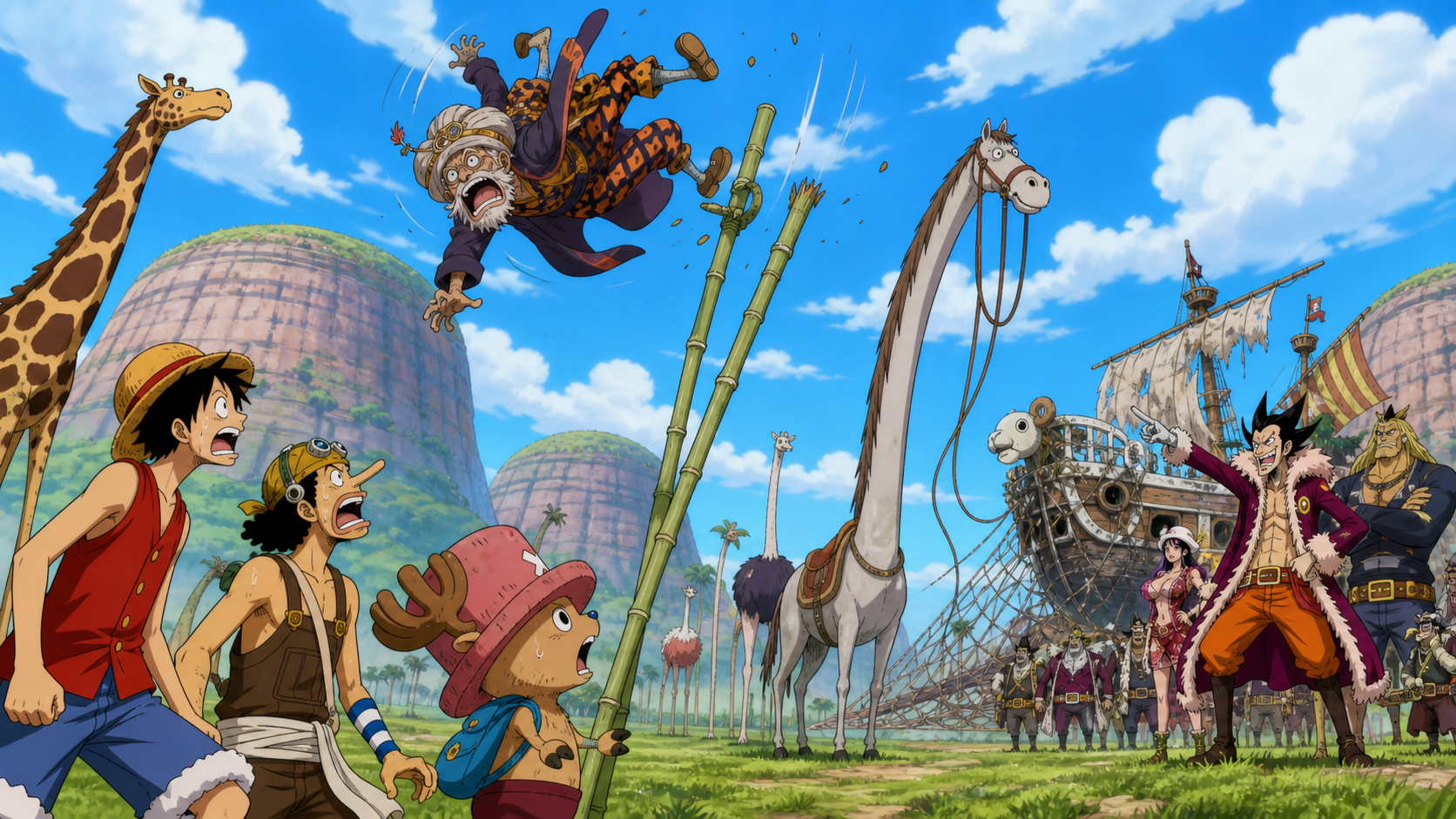
One Piece Episode 207 looks like a vacation after G-8, then Foxy sails in and puts a price on everybody’s freedom. Long Ring Long Land is bright, ridiculous, and wonderfully loose at first. Luffy, Usopp, and Chopper meet animals stretched past common sense, knock an old man out of ten years of bamboo-stilt isolation, and reunite Tonjit with the horse who never stopped waiting. That gentle reunion should have been the whole meal. Foxy arrives before the feeling can settle, traps the Going Merry, and turns a pirate tradition into a threat against the crew itself.
The episode also marks a genuine television change. One Piece moves into widescreen presentation, introduces “Kokoro no Chizu,” and gives the world more horizontal breathing room. The new frame suits this island because every joke depends on distance. Necks keep going. Horizons keep going. Bamboo keeps going. Even the silence stretches. The production change does not merely make the picture wider; the direction uses width to make the Straw Hats look tiny inside a landscape that has been patiently growing strange without them.
First watch: I wanted one quiet island
After Navarone, I wanted the crew to get one meal, one nap, and maybe twenty minutes without somebody aiming a cannon. Episode 207 opens with exactly that promise. The sea is calm. The island looks empty. The animals are goofy instead of murderous. Luffy, Usopp, and Chopper can wander around making bad decisions without the rest of the crew immediately paying for those decisions.
Then Foxy appears. Of course Foxy appears. One Piece understands that peace makes the next intrusion feel ruder. The Foxy Pirates do not arrive through a grand battle entrance. They occupy the Merry, surround the crew, and act as though the rules already belong to them. My mood changed before a punch landed. That is the episode’s cleanest trick.
A wider world for a new stretch of the voyage
Episode 207 was the first regular One Piece episode produced for 16:9 high-definition broadcast. The wider composition matters immediately. Long Ring Long Land needs empty sky, distant ridges, and animals whose bodies continue well past where a normal frame would expect them to stop. Director Junichi Fujise repeatedly places characters at one edge while a neck, bamboo stalk, or horizon pulls the eye across the rest of the image.
The upgrade does not magically make every drawing richer. Some movement remains economical, and several reaction poses carry a scene longer than modern viewers may expect. Still, the spatial comedy works. Luffy can stare from the ground while Tonjit drops from absurd height. Shelly can occupy the landscape as both horse and landmark. The format change gives the island’s central joke room to breathe.
“Kokoro no Chizu” feels like the door opening again
The new opening arrives with forward motion in every corner. “Kokoro no Chizu” feels less like a victory lap than a renewed travel promise. Skypiea proved the sky existed. G-8 proved the crew could survive a disciplined institution. Long Ring Long Land puts the Straw Hats back on an open route where the next danger can wear a stupid face and still matter.
I love that choice. One Piece never needs darkness to prove seriousness. Bright music and ridiculous shapes can introduce a story about forced wagers, stolen crewmates, and the arrogance of people who hide coercion behind tradition. The series lets adventure sound fun while quietly asking who controls the game.
Doflamingo closes Bellamy’s chapter with contempt
The Mock Town cutaway refuses to let Jaya disappear cleanly. Donquixote Doflamingo confronts Bellamy and Sarquiss after their defeat, and the punishment says more about Doflamingo than another speech could. Bellamy worshipped the age of cynical pirates. Doflamingo treats that worship as disposable the moment Bellamy becomes embarrassing.
That scene matters beside Foxy’s arrival. Both captains control other pirates through performance, reputation, and rules that serve the person at the top. Doflamingo uses fear and remote domination. Foxy uses spectacle and ritual. The tones differ wildly, but the episode keeps circling the same ugly question: how much choice does a subordinate really have when a captain makes the terms?
The abandoned ship is a warning nobody can read yet
Before the island, the Straw Hats find a vessel with nobody aboard. A massive wave and sea-monkey disturbance destroy the mystery before the crew can investigate properly. The moment plays as maritime weirdness, but the empty deck also prepares the viewer for a story about people separated from the places and companions they call home.
Tonjit has been separated from his nomadic people. Shelly has been separated from Tonjit. Soon the Davy Back Fight will threaten to separate Straw Hats from one another. Episode 207 keeps showing absence before the characters know what kind of story has begun.
Long Ring Long Land is a joke with an ecosystem
The island does not settle for one long animal and move along. Everything stretches because life grows under unusually relaxed conditions. The explanation is nonsense biology delivered with enough confidence to become worldbuilding. One Piece is very good at that balance. A gag becomes a local rule, then the local rule shapes travel, food, companionship, and culture.
The animals are funny because their familiar parts remain recognizable. A horse still behaves like a horse even when the neck belongs on a suspension bridge. That recognition keeps the designs from becoming random. The island takes ordinary anatomy and asks how far the silhouette can travel before the audience laughs.
Luffy, Usopp, and Chopper are the correct disaster team
Nami would have asked who owned the bamboo. Robin would have noticed the human presence. Sanji would have worried about food. Zoro would have slept through half the mystery. Luffy, Usopp, and Chopper see impossible stilts and immediately treat the discovery as an invitation.
The trio works because wonder beats caution in three different ways. Luffy wants the experience. Chopper wants the explanation. Usopp wants to look brave while remaining deeply aware that the sky may drop an old man onto his head. Their combined curiosity produces the accident, but their concern after Tonjit falls is sincere. The comedy never erases responsibility.
Tonjit turns a sight gag into ten lost years
Tonjit has spent ten years trapped on bamboo stilts. That sentence is hilarious until the years register. His people migrated while he was still above the ground. Seasons passed. Shelly waited. A whole community route continued without him. The episode refuses to make Tonjit bitter, which makes the loss stranger rather than smaller.
His calm acceptance belongs to the island’s rhythm. Long Ring Long Land stretches bodies and time. Tonjit survives through patience because panic cannot lower the bamboo. The man greets the people who accidentally end his isolation with hospitality instead of blame. That generosity tells us who Tonjit is before the plot asks what may be taken from him next.
Shelly waited, and yes, that got me
Shelly’s loyalty lands because the episode does not oversell the reunion. A horse with an impossible neck recognizes the missing person. Tonjit recognizes the companion who remained. Ten years collapse into a few movements. No grand speech could improve the basic fact that Shelly stayed.
One Piece repeatedly understands animals as relationship witnesses. Chouchou guarded a dead owner’s shop. Laboon carried a promise across decades. Shelly waits beneath bamboo because companionship does not need a human calendar. The series can be shameless about animal devotion, and I am shamelessly vulnerable every single time.
The crew’s laughter is not cruelty
Luffy and the others laugh at shapes, surprises, and Tonjit’s delivery, but they do not laugh at his loss. That distinction matters. Fandom comedy can become mean when a vulnerable character exists only as a target. Episode 207 gives Tonjit dignity without sanding away the absurdity surrounding him.
Chopper’s concern helps hold the tone. As a doctor and an animal who has been treated as a monster, Chopper responds to bodies with care. Usopp reacts loudly but helps. Luffy moves forward without treating Tonjit as lesser. The scene remains funny because everybody can share the strangeness.
Foxy understands occupation before introduction
The Foxy Pirates seize the Merry before Foxy properly explains the challenge. That order exposes the lie inside the coming “game.” A fair contest begins with consent. Foxy begins with control of the opponent’s home, transport, and escape route. By the time he invokes tradition, his crew has already created the pressure that makes refusal dangerous.
Foxy’s grin and theatrical coat encourage the audience to dismiss him. I do not. A silly villain can still be a bully. Sometimes the silliness makes the bullying more aggravating because every complaint gets swallowed by the claim that everybody is only playing.
The Going Merry is not just a prize
After Skypiea and G-8, the Merry carries fresh emotional weight. The ship flew, fell, hid, escaped, and survived damage that keeps getting harder to ignore. Foxy’s people treat the vessel as leverage. The Straw Hats see home, witness, and crewmate.
That difference will define the arc. Pirate games can treat people and ships as transferable assets. Luffy’s crew has built belonging through choice. A rule that ignores those choices may be traditional, but tradition does not become moral because pirates repeat the same harm for years.
The Davy Back Fight arrives wearing a smile
Foxy challenges Luffy to a Davy Back Fight, a pirate competition where victories can claim members of the opposing crew. The setup is designed to tempt Luffy. Games, pride, and a direct challenge hit three of his weakest decision-making buttons at once.
The danger is not simply losing a race or getting punched. The danger is allowing another captain to define a crewmate as property. One Piece places that threat after several arcs about chosen family for a reason. The Straw Hats have crossed oceans because membership means trust, not ownership. Foxy’s rules imitate community while stripping away consent.
Luffy’s appetite for challenge has a cost
Luffy’s openness makes the voyage possible. He says yes to islands, strangers, impossible routes, and people whom sensible captains would avoid. The same quality can place his crew in danger. Episode 207 begins testing where confidence ends and carelessness begins.
I do not need Luffy to become cautious. A cautious Luffy would stop being Luffy. I do need the story to let his choices hurt, frustrate, and challenge the people who trust him. Captaincy cannot mean everybody else absorbs the consequences while the captain enjoys the game.
What the episode understands about loneliness
Tonjit speaks lightly about a decade alone, but the episode keeps placing him beside signs of connection. Shelly waited. His people remain somewhere ahead on their circular migration. The Straw Hats arrive by accident and immediately create a temporary household around food, questions, and laughter.
Then Foxy threatens that household. The transition works because the story first reminds us what reunion feels like. Losing a crewmate would not change a roster number. The loss would break daily routines, private jokes, shared labor, and the knowledge that someone chose to remain aboard.
Direction and animation
Junichi Fujise’s direction favors clean spatial reveals. The camera lets the audience register a normal-looking shape before following the shape into absurd length. Takeo Ide’s animation supervision keeps the principal characters expressive during exposition-heavy stretches, especially Usopp’s alarm, Chopper’s wonder, and Foxy’s practiced smugness.
The strongest visual decision is restraint. Tonjit’s fall could have become a blur of frantic cuts. The scene instead uses height, pause, and reaction. The audience has time to understand how badly the trio misjudged the bamboo before gravity finishes the joke.
What changed when I replayed the episode
On first watch, the animal designs and Tonjit’s fall dominated everything before Foxy arrived. On replay, separation connected the whole episode. The abandoned vessel has lost a crew. Tonjit has lost his people. Shelly has lost Tonjit. Foxy plans to make loss into organized entertainment.
The Doflamingo scene also grew sharper. Bellamy believed a powerful pirate’s worldview would protect him. Tonjit believes the migration circle may eventually restore him to his people. The Straw Hats believe their bonds can survive any challenge. Episode 207 places three different kinds of faith beside captains who exploit belief for control.
What works
The widescreen debut fits the island. Tonjit and Shelly bring genuine feeling without demanding a tonal detour. Luffy, Usopp, and Chopper remain a perfect exploration trio. Foxy’s occupation of the Merry gives the closing challenge immediate stakes. The episode also knows exactly how long to let calm exist before trouble arrives.
Most importantly, the story makes ridiculousness carry meaning. Long animals are not filler decoration. Stretched bodies lead to stretched time, patient loyalty, and a place where waiting becomes ordinary. Foxy then enters that patient world with a system built on taking.
What does not work as well
The sea-monkey sequence disappears quickly after creating noise and danger, so the abandoned-ship mystery feels more like connective tissue than a developed incident. The Mock Town cutaway is valuable, but the jump from Doflamingo’s cruelty to island comedy can feel abrupt if viewers do not yet see the shared power theme.
Some exposition about the island’s biology repeats the visual joke rather than deepening the rule. I still prefer the repetition to a rushed explanation because the slow pace establishes how this place feels. The weakness is mild, not fatal.
RaeRae’s verdict
Episode 207 is a strong reset with teeth. The episode lets the Straw Hats breathe, gives Tonjit and Shelly a reunion worth caring about, and then reveals that the next antagonist has already placed a hand on the crew’s home. Foxy looks ridiculous. His method is not harmless.
I laughed at the giraffes, worried about the bamboo, got emotional over one very patient horse, and ended the episode annoyed on behalf of the Merry. That is a good One Piece hour. The series stretches the frame, stretches the animals, and stretches one peaceful afternoon right up to the moment a pirate game threatens to tear the crew apart.
Production notes and receipts
One Piece Episode 207, “Great Adventure at Long Ring Long Land,” aired in Japan on October 31, 2004. Hirohiko Kamisaka wrote the script, Junichi Fujise directed, Takeo Ide supervised animation, and Miyuki Sato and Michiyo Kawasaki handled art direction credits. The episode introduced the opening “Kokoro no Chizu” and the ending “Mirai Kōkai,” alongside the series’ move to widescreen high-definition production.
The official One Piece episode page supports the broadcast and staff record. The official franchise news archive also identifies Episodes 207 through 219 as the Long Ring Long Land television run covered by the later recap release. Those boundaries keep this directory honest: thirteen Reacts, no unrelated numbered episodes padded into the shelf.