RaeRae Reacts · One Piece Episode 208
Foxy Makes Cruelty Look Like a Game
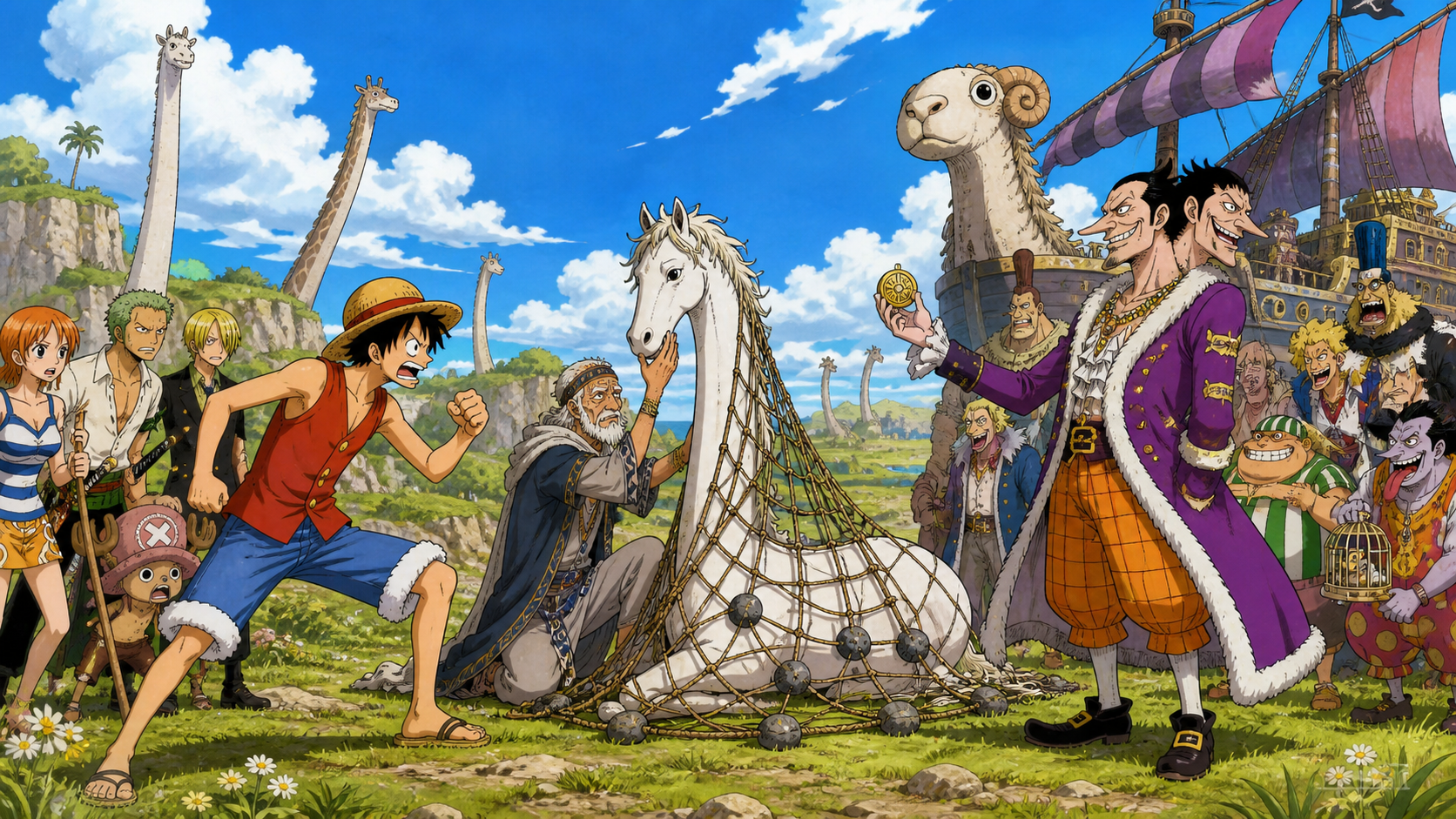
One Piece Episode 208 lets Foxy shoot Shelly, hide coercion behind pirate tradition, and bait Luffy into wagering the crew he loves.
Bottom line
One Piece Episode 208 introduces the Davy Back Fight by proving that Foxy’s idea of “fun” depends on somebody else having no safe way to refuse. Tonjit and Shelly barely finish their reunion before Foxy shoots Shelly, crowds the island with hundreds of followers, and presents a pirate tradition as though tradition erases coercion. Luffy accepts because Foxy hurt a friend and insulted his crew. That answer feels emotionally honest, tactically terrible, and completely Luffy.
The episode is loud, colorful, and stuffed with gags, but the stakes are chosen family. Winners can take opposing crewmates. A flag can be stolen. A person can become a prize because two captains agreed to a game. Every Straw Hat immediately understands why that premise is dangerous except the captain whose anger makes the decision. I laughed at Foxy’s theatrical nonsense, then spent the rest of the episode wanting somebody to take the challenge coin and throw the coin into the sea.
First watch: Foxy lost me when he touched Shelly
Foxy could have arrived with music, fireworks, and a formal invitation. Instead, gunfire interrupts Tonjit’s joy and Shelly goes down. The attack draws a moral line before the rulebook appears. Foxy wants the authority of pirate custom after behaving like a man who attacks an animal to provoke a stranger.
Luffy’s rage lands because Shelly cannot defend herself from a distant shot. He met Tonjit minutes ago, but friendship in One Piece is often measured by response rather than duration. Foxy harms someone inside Luffy’s immediate circle. From that point forward, Luffy is not listening for the safest option. He is listening for a way to answer.
Tonjit and Shelly deserved longer than five minutes
Episode 207 gave the reunion patience. Episode 208 weaponizes that tenderness. Shelly waited ten years, Tonjit finally returned to the ground, and the pair gets one ride across the grass before Foxy turns their happiness into target practice. The timing is cruel because the series has already taught the audience what the horse’s loyalty means.
Tonjit’s panic keeps the scene from becoming a disposable villain entrance. Shelly is not background livestock. The horse is his companion, his connection to the nomadic life that continued without him, and proof that somebody remembered. Foxy attacks the relationship because causing pain gives him control of the encounter.
Foxy enters as a bully with excellent branding
Silver Fox Foxy has a recognizable silhouette, a cheering crowd, an announcer, matching symbols, and enough ceremony to make aggression resemble an event. That presentation is his real strength before the Slow-Slow Fruit matters. Foxy knows how to create a room where his version of reality becomes the loudest version.
His crew laughs on cue. They celebrate his record. They fill the landscape until refusal looks like cowardice and resistance looks like breaking the rules. Foxy’s insecurity will become obvious whenever an insult lands, but insecurity does not make him harmless. A fragile ego backed by hundreds of loyal people can do enormous damage.
The Davy Back Fight is tradition without consent
The rules trace the contest to Pirate Island and Davy Jones folklore. Two crews compete across chosen events. Each victory lets the winning captain claim a member from the losing crew, and the winner may also take the opposing flag. Once claimed, a pirate is expected to swear loyalty to the new captain.
That history explains the ritual. History does not excuse the structure. Crewmates are treated as transferable property. Their own wishes disappear behind the captains’ wager. The game converts loyalty, labor, friendship, and identity into tokens that one leader can risk for pride.
Luffy accepts for the right reason in the wrong way
Luffy does not accept because he wants a new crewmate. He accepts because Foxy hurt Shelly, occupied the Merry, and mocked the Straw Hats. Defending people against a bully is the right instinct. Letting the bully choose the battlefield is the bad decision.
That contradiction makes the scene work. Luffy is brave enough to reject intimidation, but bravery does not automatically become leadership. His crew has a direct stake in the wager. He commits their freedom before giving them a vote. The story can love Luffy and still let that choice be infuriating.
Nami sees the contract hiding under the carnival
Nami reacts like the only person reading the fine print while everybody else watches the mascot dance. She understands assets, leverage, and traps. A game where the opponent writes the culture, provides the referee, fills the audience, and controls the venue does not become fair because both captains touch a coin.
Her objection also protects the crew as people. Nami knows Luffy’s confidence is sincere. She also knows sincere confidence cannot guarantee a race, a team event, or a duel against opponents whose entire identity is built around cheating with a smile.
Robin recognizes the history and the danger
Robin can explain the Davy Back Fight because she has lived inside pirate history instead of romanticizing the label. Her knowledge gives the episode weight beyond Foxy’s performance. This custom exists. Crews have been broken and rebuilt through the contest. The cheerful staging sits on top of a tradition designed to redistribute human beings.
Robin’s calm delivery does not signal approval. Calm is how Robin handles terrible information. She names the system so the crew can understand what Luffy has accepted. That role matters because Foxy would prefer the rules to arrive as spectacle rather than analysis.
Zoro hears a challenge, but he also hears disrespect
Zoro is not likely to retreat once another crew questions the Straw Hats’ strength. His pride aligns with Luffy’s anger, which helps Foxy. The Davy Back Fight survives because pirate captains and fighters would rather risk everything than allow an insult to stand unanswered.
Still, Zoro’s loyalty is not a coin. Any rule claiming otherwise misunderstands the foundation of this crew. Zoro joined through a choice renewed across battles, hunger, injury, and trust. Foxy believes a victory can transfer that history. The coming games will test how shallow that belief is.
Chopper treats the contest as a game until the rules land
Chopper’s early excitement hurts in retrospect. He responds to the costumes, noise, and promise of competition before understanding that the winners can select a person. Chopper has already spent much of his life afraid nobody would choose him. Now a pirate ritual claims choice belongs to captains instead.
The emotional threat against Chopper is different from the threat against stronger crew members. Zoro can glare at ownership language. Robin can analyze the history. Chopper still carries the fear that belonging may be conditional. A game built around being taken can reach that wound quickly.
The Foxy Pirates have turned cheating into infrastructure
Nothing about their organization suggests spontaneous competition. They have an announcer, refereeing customs, event specialists, cheering sections, equipment, and an enormous membership assembled through previous wins. The whole crew functions like a traveling sports league owned by the only team that expects to control every season.
That scale changes the stakes. Foxy is not a random captain proposing three friendly games. He operates a recruitment machine. Every claimed member increases his ability to overwhelm the next smaller crew. Winning produces the conditions for more winning.
A huge crew can still be lonely
Foxy surrounds himself with constant praise because silence might leave room for doubt. The crowd repeats his greatness, but his emotional stability depends on nobody challenging the image. One insult can collapse him. Hundreds of followers have not created the secure belonging that seven Straw Hats built through shared danger.
That contrast gives the arc an interesting foundation. Foxy can collect people. Luffy attracts people who choose him and argue with him. Collection and connection may look similar in a group portrait. Pressure reveals the difference.
The challenge coin is a tiny object carrying a giant mistake
The coin formalizes the wager. Foxy needs a ritual object because ritual makes the decision feel inevitable. Once Luffy accepts, everybody starts discussing event selections and rules instead of returning to the more basic question: why should Foxy receive authority over the Straw Hats at all?
That is how bad systems protect themselves. Procedure crowds out morality. People debate whether a move is legal while forgetting that the structure itself treats a person as a prize. Episode 208 wraps that observation in pirate comedy, but the observation remains sharp.
Three games mean three opportunities to lose a person
The agreed format creates a sequence rather than one decisive clash. Donut Race comes first, Groggy Ring follows, and Combat places the captains at the end. Each stage changes which skills matter. Sailing, teamwork, brute force, and individual endurance all enter the calculation.
Luffy’s crew has versatility, but Foxy chose this life. His members train for these events, know the local terrain, and understand how far the referee will let interference go. The Straw Hats walk into a home-field machine because their captain refuses to let cruelty pass without an answer.
Foxy’s record should scare everybody
The Foxy Pirates boast about repeated Davy Back victories and a crew expanded through conquest. Even if their numbers are presented as comedy, the record confirms experience. This opponent wins through systems rather than raw combat power alone.
The Straw Hats often beat stronger enemies because Luffy disrupts systems with direct action. The Davy Back Fight makes disruption harder by getting Luffy to promise respect for the system first. Foxy does not need to overpower the crew when he can make them police their own response.
Chosen family cannot be wagered cleanly
Every Straw Hat joined under different circumstances. Nami resisted the label until Arlong fell. Robin joined with a question. Chopper needed proof that the sea had room for him. Sanji left a father figure. Usopp brought both courage and insecurity. Zoro made a promise with his life on the line.
A captain may lead those people. A captain does not own their histories. The Davy Back Fight creates drama because Luffy temporarily accepts a rule that conflicts with the moral truth his own crew represents. The arc now has to force that contradiction into the open.
Hirohiko Kakudō keeps the exposition moving
Director Hirohiko Kakudō has to introduce Foxy, establish Shelly’s attack, explain an old pirate custom, present a huge crew, set three events, and end with the first competition ready to begin. The episode stays lively by attaching information to reactions. Nami objects. Robin explains. Chopper shifts from curiosity to concern. Foxy performs every clause as self-promotion.
The wide frame continues helping. Foxy’s numerical advantage can fill one side while the Straw Hats occupy a compact group on the other. That visual imbalance tells the audience what the dialogue keeps disguising: one crew has walked into another crew’s arena.
Kazuya Hisada gives Foxy exactly the face he needs
Animation director Kazuya Hisada leans into Foxy’s elastic vanity. The long nose, split hair, wide grin, and sudden collapse after an insult make him funny without softening the threat. His expressions advertise a man whose confidence requires an audience.
Luffy’s face carries the opposite energy. Anger simplifies him. Once Shelly falls, the surrounding pageantry becomes irrelevant. The visual contrast between Foxy performing and Luffy deciding gives the challenge scene force.
What changed when I replayed the episode
On first watch, Shelly’s shooting and Luffy’s acceptance dominated the episode. On replay, the Foxy crew’s organization became more disturbing. Every cheer, rule explanation, and prepared event demonstrates that this pattern has happened many times. New members probably arrived through the same pressure now aimed at the Straw Hats.
I also noticed how quickly the crew’s objections become logistical. Once Luffy commits, they pivot toward surviving the games. That response shows trust and exposes the cost of trust. They will protect the captain’s decision even when he made the decision without them.
What works
Shelly’s attack gives Foxy immediate moral definition. The Davy Back rules create stakes that cannot be solved by measuring combat power alone. Nami and Robin make the danger legible. Chopper gives the ownership premise an emotional target. Foxy’s giant cheering crew turns the island into hostile territory without darkening the bright visual palette.
The episode also respects tonal complexity. Foxy is funny. The rules are ridiculous. The danger remains real. One Piece does not force the audience to choose between laughing and caring.
What does not work as well
The volume of rule explanation can slow the middle, especially when Foxy’s announcer repeats information the crew has already understood. Some jokes around Foxy’s sensitivity arrive before the audience has enough distance from Shelly’s attack to enjoy them fully.
I also wanted more attention on Tonjit after the challenge begins. Foxy harmed Shelly to create this contest, yet the episode moves rapidly toward event setup. The games should never make the original cruelty disappear.
RaeRae’s verdict
Episode 208 makes me mad in the productive way. Foxy is not dangerous because he looks powerful. He is dangerous because he can shoot a horse, call the aftermath tradition, and surround the victim with enough noise that refusal becomes the alleged offense. That is bully logic wearing a pirate carnival hat.
Luffy’s answer is brave, loyal, and irresponsible. All three descriptions belong together. I believe he will fight for every Straw Hat. I also believe a captain who loves his crew should not gamble their freedom because another man baited him. The Davy Back Fight starts with a joke, a coin, and one enormous leadership mistake.
Production notes and receipts
One Piece Episode 208, “The Foxy Pirate Crew and the Davy Back,” aired in Japan on November 7, 2004. Hirohiko Kamisaka wrote the script, Hirohiko Kakudō directed, Kazuya Hisada supervised animation, and Miyuki Sato and Kunihiro Chida received the listed art credits.
The official One Piece episode record confirms the airdate, staff, Shelly’s shooting, Foxy’s challenge, and Luffy’s acceptance. The official Davy Back Fight episode index places Episode 208 directly before the Donut Race in Episode 209. Those records anchor the facts; the judgment about coercion, leadership, and chosen family belongs to RaeRae.