RaeRae Reacts · One Piece Episode 198
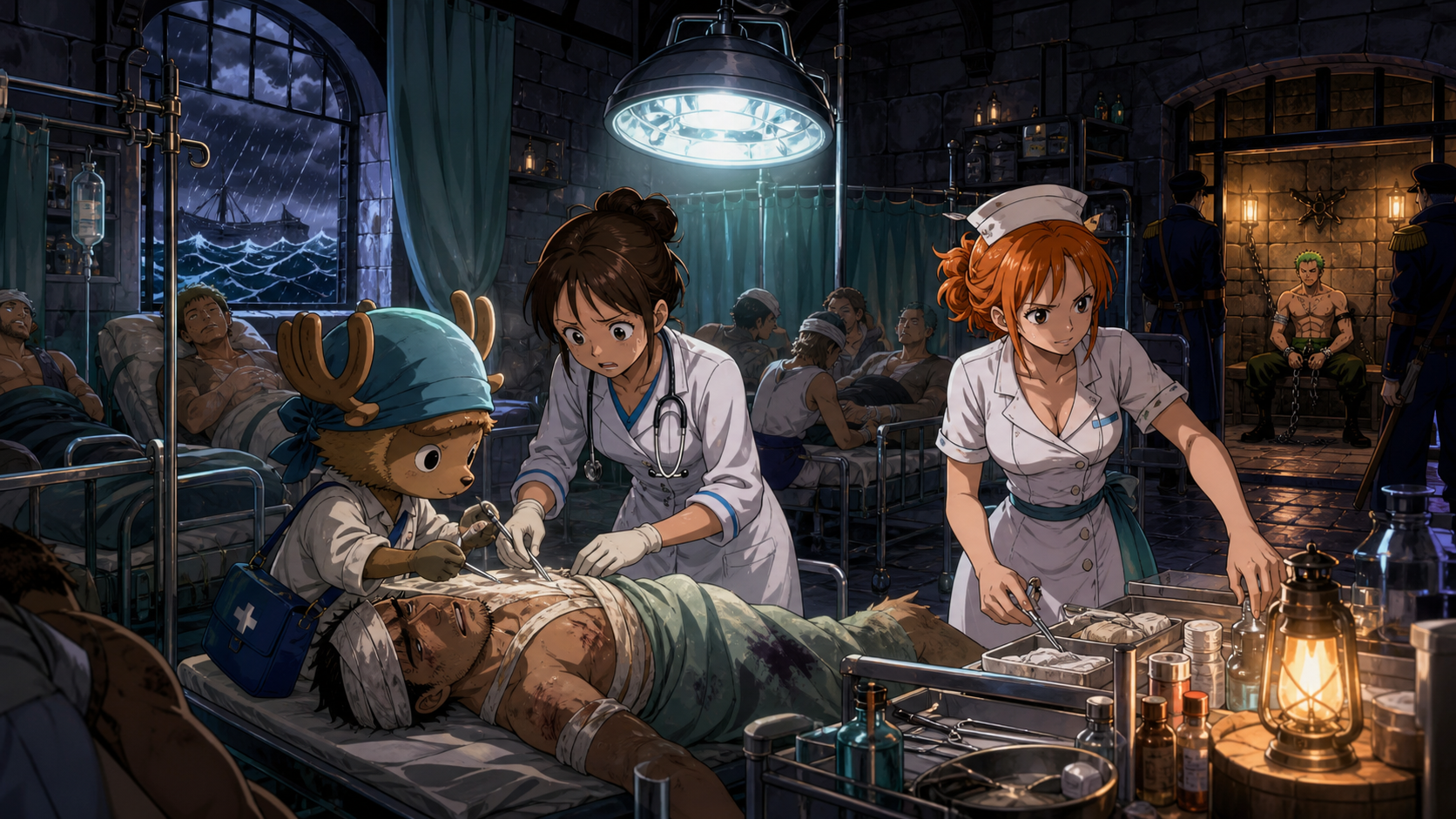
Chopper Takes Over G-8 Emergency Surgery
One Piece Episode 198 captures Zoro while Chopper helps Dr. Kobato operate on wounded Marines and Nami learns that every disguise comes with a workload.
Bottom line
One Piece Episode 198 lets Chopper save Marine lives while hiding inside the enemy’s infirmary, and the choice tells us more about his medical ethics than another giant fight could. Zoro sits in chains because the fortress caught him. Nami wears a nurse uniform because the fortress has not caught her. Chopper stops caring about cover the second wounded sailors need an operation.
This episode is G-8 at full strength. The story uses Navarone as a working institution with a real staffing failure, then places the Straw Hats inside that failure. A pirate doctor becomes the most qualified person in a Marine emergency room. The uniformed adults have authority. Chopper has the knowledge that keeps a patient alive.
Episode facts
Fuji TV broadcast Episode 198 on July 11, 2004. Junki Takegami wrote the screenplay, Hiroyuki Kakudō directed, Masayuki Takagi served as animation director, and Miyuki Sato with Michiyo Kawasaki handled the art direction. The official Japanese title translates to “Captured Zoro and Chopper’s Emergency Operation!”
The episode continues the anime-original G-8 arc. Jonathan captures Zoro. Nami escapes detection through a nurse disguise. Chopper hides inside a box of antlers that reaches the infirmary just as injured sailors arrive from a storm-damaged ship.
Zoro gets captured because strength cannot solve location
Zoro emerges inside a fortified harbor with no map, no crew, and patrols controlling the routes. Capture does not mean the swordsman suddenly forgot how to fight. He has to choose between exposing the entire crew through a major confrontation and allowing the Marines to take him.
The restraint feels stranger on him than chains. Zoro usually answers pressure with steel. G-8 forces him to protect the group through silence and delay, two tactics that give him nothing dramatic to cut.
Drake interrogates a man who has no useful answer
Major Drake wants motive, location, and plan. Zoro cannot provide any of those facts because the Straw Hats fell into Navarone by accident and scattered without a meeting. The truth sounds like mockery: a pirate ship dropped from heaven, everybody jumped, and the swordsman has no clue where his captain went.
Interrogation assumes hidden information. Zoro’s ignorance breaks that model. Drake reads refusal where the situation produced genuine uncertainty. Institutional suspicion can become self-confirming when every answer counts as evidence of a lie.
Jonathan uses Zoro as a piece, not a trophy
Jonathan does not need to beat Zoro publicly. A captured crew member changes how the others will move. The commander can watch the prison, control rumor, and let loyalty pull the Straw Hats toward a predictable location.
That patience keeps him dangerous. Jonathan knows a prisoner can become bait without ever receiving a formal announcement. The crew will discover the capture because a fortress produces gossip, orders, and visible security changes.
Nami learns that every disguise has a workload
Nami first uses labor roles as cover, then discovers that looking employed means somebody may hand her work. A nurse uniform opens doors and creates obligations. She cannot stand in a corridor collecting information while injured sailors arrive.
The joke has a sharp institutional point. Uniforms make strangers legible. People stop asking who Nami is because the hospital needs the role she appears to fill. A shortage can erase verification faster than any clever forged document.
The storm turns infiltration into triage
A damaged Marine ship sends wounded sailors into an already strained infirmary. The emergency does not care about the pirate search. Bodies arrive with injuries, pain, blood loss, and limited time. Security priorities collide with medical priorities under the same roof.
Chopper responds to the patients before he responds to faction. That instinct mirrors Sanji feeding Marines in Episode 197. The crew’s core professions carry ethical rules that survive enemy territory.
Kobato has credentials and fear
Dr. Kobato works in pediatrics and freezes around blood. The episode risks turning her into a joke about an unqualified woman, but her situation deserves a fairer reading. The base has left a pediatrician facing trauma surgery while other doctors are away. That staffing decision is the first failure.
Fear still creates danger. A patient cannot wait for the institution to become reasonable. Kobato has to act with support, and Chopper has to decide whether protecting his identity matters more than protecting a life.
Chopper refuses the mascot role
Chopper hides in a box of antlers, which is exactly the kind of visual gag that could keep him cute and irrelevant. Then wounded people arrive. His posture, voice, and attention change. The animal everybody might treat as cargo becomes the room’s clinical authority.
I love this version of Chopper. He can be frightened, young, awkward, and adorable while remaining a physician. Competence does not require the story to age him into a tiny stern adult.
Medical authority comes from knowledge in motion
Chopper does not seize the operation to prove superiority. He assesses, directs, supports, and gives Kobato enough structure to continue. Good medical leadership is not a performance of genius over helpless assistants. Good leadership helps a team make the next correct decision.
The episode shows knowledge through sequence: identify the threat, prepare instruments, control panic, assign hands, monitor the patient, and adjust. Chopper becomes believable because his care has steps.
Kobato still has to use her own hands
Chopper can coach, but Kobato must cross the distance between fear and action. That detail saves the story from making her a prop for his brilliance. She completes the operation with guidance and discovers that terror does not have to make every decision.
Courage here is not the absence of a physical reaction. Courage is continuing while the reaction remains. The distinction matters for a doctor who cannot magically rewrite her nervous system during one emergency.
Nami becomes part of the care team
Nami did not choose nursing as her infiltration strategy because she wanted a clinical shift. Once the room fills, she organizes supplies and helps the work move. Her ability to read urgency translates across jobs even when she lacks medical training.
That flexibility is one reason she survives. Nami rarely waits for ideal conditions. She identifies who knows what, what resources exist, and which immediate task buys the group more time.
The hospital exposes Navarone’s staffing problem
A major fortress should not depend on one blood-averse pediatrician during mass-casualty intake. Other doctors being away may explain the shortage, but explanation does not make the system safe. Emergency planning has to assume storms, combat, accidents, and simultaneous demand.
Jonathan runs a clever security operation. His medical coverage still has a dangerous hole. Institutions can look disciplined from the command office while workers improvise around missing capacity below.
Care crosses the pirate-Marine line
Chopper does not ask whether the injured sailors have hunted pirates. He sees patients. That response does not make the World Government innocent or erase Marine violence. Medical ethics narrows the immediate question to who needs help and what can prevent death.
One Piece often places care beside conflict without demanding moral amnesia. Chopper can save a Marine today and escape that Marine’s fortress tomorrow. A life does not become disposable because the uniform belongs to an enemy institution.
Zoro and Chopper solve opposite problems
Zoro protects the crew by refusing information and absorbing confinement. Chopper protects strangers by revealing knowledge and directing action. One holds back. The other steps forward. Both choices come from loyalty, but loyalty reaches different people in each room.
The parallel gives the episode shape. Chains test whether Zoro can wait. Surgery tests whether Chopper can act. Neither man gets the kind of challenge he would choose.
Anime-original characterization earns the runtime
The episode cannot permanently change Chopper’s medical status or Zoro’s place in the crew. The writing still finds a meaningful test by changing context. Chopper practices medicine inside a hostile institution where success may expose him. Zoro practices restraint while an officer demands a conspiracy that never existed.
Those pressures reveal established values rather than inventing temporary personalities. That is how filler becomes character work.
What worked
The triage setup works because the emergency has practical weight. Kobato’s fear creates a real obstacle, Chopper’s knowledge offers a credible route forward, and Nami’s disguise traps her inside responsibility. The episode also gives Zoro’s capture strategic meaning instead of using chains as empty cliffhanger decoration.
Most importantly, Chopper helps without humiliating the doctor who needs help. He proves competence through care, not cruelty.
What held the episode back
Kobato’s fear can slide too close to caricature. A physician fainting at blood is an easy joke, and the episode could have given more context for how she entered pediatrics, what care she handles well, and why Navarone left her alone during a storm response.
The operation also resolves with television speed. More attention to the patient’s condition and recovery would strengthen the medical stakes. The emotional victory belongs to Kobato and Chopper, but the wounded sailor should remain more than the problem on the table.
What changed on the replay
On the first watch, Chopper revealing his medical authority carries the episode. On replay, the staffing failure becomes louder. Kobato did not schedule every surgeon away from the fortress. Workers often receive blame for systems that gave them impossible coverage.
I also noticed how Zoro’s useless truth mirrors Kobato’s useful fear. Drake refuses to believe a strange answer because the answer does not fit procedure. Chopper believes a frightened doctor can still act because he responds to the person in front of him.
RaeRae’s verdict
Episode 198 gives Chopper the respect he deserves. He is not emergency comic relief with a hat. He is the doctor who sees a room failing, understands why, and helps the people inside that room move toward care.
Zoro may be the prisoner, but Navarone’s medical system is the part truly trapped. Chopper opens a route through knowledge, Kobato walks through with her own hands, and several sailors live because a pirate refused to ask whether they were worth saving.
The patient is not a lesson prop
The wounded sailor matters beyond proving that Chopper is talented or Kobato is brave. A medical story works only when the person on the table remains a person with pain, risk, and a life waiting outside the room. Chopper’s urgency keeps that fact visible. He does not perform medicine for applause. He works because delay has a human cost.
That focus also changes the pirate-versus-Marine argument. The patient cannot pause bleeding until every institution settles its moral record. Care comes first. Accountability can still come after the bandages hold.
Official source and routes
Official ONE PIECE Episode 198 guide
Previous: Episode 197 React
G-8 Episodes 196-206 Directory
Chopper Cannot Pretend a Patient Is the Enemy
Chopper’s decision in the operating room lands because nobody needs to debate his loyalty. Wounded Marines serve the organization hunting him, yet injured bodies register as patients before they register as uniforms. That order of operations defines his ethics. He does not wait for permission from the crew or calculate whether helping might improve their escape odds. A doctor sees an emergency and works. The risk makes the choice brave, but the instinct makes the choice Chopper.
Dr. Kobato gives the episode another useful layer. Her anxiety does not mean she lacks knowledge or compassion. Pressure has trapped her ability behind fear, and Chopper supplies the steadiness required to move. Their teamwork avoids the cheap joke where the local doctor exists only to make the hero look brilliant. Kobato participates, learns, and keeps caring for her people. Chopper leads because the emergency demands leadership, not because the story needs every other medical worker to become foolish.
Zoro’s captivity balances that compassion with consequences. The crew cannot forget that Navarone remains an enemy fortress just because decent people work inside the base. RaeRae verdict: Episode 198 understands that moral clarity can complicate an escape. Chopper saves lives that belong to the opposing side, reveals more of himself in the process, and still makes the only choice his dream allows. That tension is richer than a clean getaway.