RaeRae Reacts · One Piece Episode 415
Hancock Tells the Truth After Luffy Chooses Marguerite Over Escape
One Piece Episode 415 React follows Marguerite’s restoration, Hancock’s enslavement history, Fisher Tiger, and Luffy’s promise.
One Piece Episode 415 React: Luffy protects Sandersonia’s back, chooses Marguerite over his own escape, and earns the truth behind the Gorgon Sisters’ mark: three children enslaved by the Celestial Dragons and freed by Fisher Tiger.
What happened in Episode 415
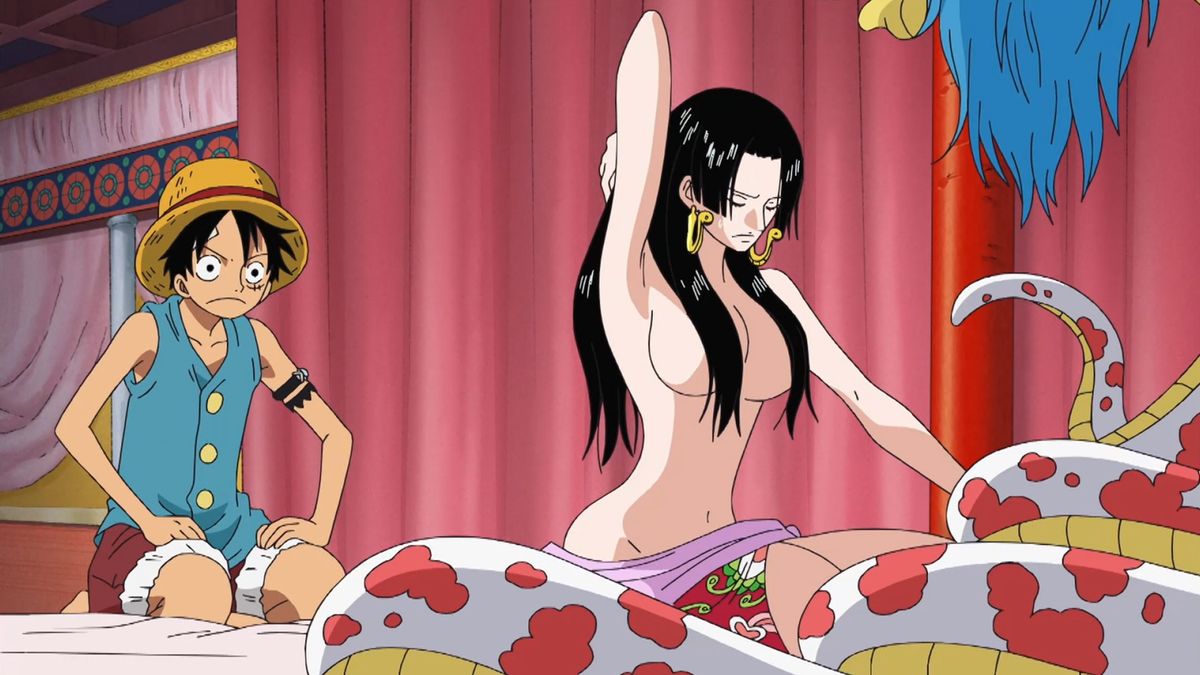
Luffy covers Sandersonia’s exposed back because he understands that she would rather die than let Amazon Lily see the mark. After defeating Sandersonia and Marigold, he faces a choice arranged by Hancock: she will either provide the ship he needs or restore Marguerite, Sweet Pea, and Aphelandra. Luffy immediately chooses the women and bows in gratitude when Hancock releases them from stone.
Hancock brings Luffy into the palace and reveals the secret shared by the three sisters. Kidnappers sold them to the World Nobles when Hancock was twelve. The Celestial Dragons branded them with the Hoof of the Soaring Dragon and forced Devil Fruits upon them for entertainment. Fisher Tiger later climbed the Red Line and freed enslaved people at Mary Geoise. The sisters returned to Amazon Lily but built the Gorgon legend to hide a mark that made them fear rejection. Luffy remembers punching a Celestial Dragon and promises he will not tell anyone.
RaeRae’s opening receipt
Episode 415 answers every performance in the arena with one unperformed choice. Hancock offers Luffy the ship he desperately needs or the lives of three women he barely knows. He chooses the women before strategy can make a speech.
That answer does not purchase Hancock’s affection. The answer proves that her history is safe enough to speak aloud. Trust enters only after Luffy refuses to turn compassion into a transaction.
Luffy keeps Sandersonia’s back hidden until safety returns
He does not expose the mark after the immediate danger passes or use privacy as leverage for surrender.
Protection continues beyond the dramatic gesture.
Sandersonia receives mercy without qualification
She threatened to shatter Marguerite moments earlier. Luffy still treats her terror as real.
Respect for bodily privacy does not depend on moral perfection.
The sisters lose the arena fight
Gear Second, disrupted coordination, and Luffy’s refusal to quit end their planned execution.
Defeat removes force without resolving the people turned to stone.
Hancock controls the restoration
Marguerite, Sweet Pea, and Aphelandra remain trapped inside her Fruit’s result. No victory over the sisters can substitute for Hancock’s decision.
Repair requires the person who caused the harm.
She offers Luffy a manufactured choice
Hancock says he may receive passage away from Amazon Lily or have the women restored, but not both.
The test asks whether urgency will make relationships expendable.
The ship represents everything Luffy came to request
Crossing the Calm Belt means returning toward Sabaody, finding his scattered crew, and correcting the failure that shattered them.
His greatest immediate goal sits inside one option.
Marguerite represents a debt nobody priced
She saved him from poison, protected his Vivre Card, made clothes, and pulled him from the sea. Her help created danger she understood.
Gratitude refuses to become a line item beneath strategy.
Luffy chooses restoration immediately
No calculation, bargaining, or dramatic hesitation appears. He asks Hancock to return the women.
Speed reveals priority more clearly than explanation.
He accepts remaining trapped
The choice may leave him without any route across the Calm Belt. He pays that cost willingly.
Freedom bought through abandoned allies would not feel like freedom to him.
Hancock expected selfishness
Her test assumes a man will value personal desire over women once forced to choose.
Luffy breaks another rule her captivity taught her.
Marguerite returns from stone
Color, movement, and life replace the statue displayed during the execution. Sweet Pea and Aphelandra return beside her.
Repair finally interrupts spectacle.
Luffy bows in gratitude
He thanks Hancock with his whole body rather than treating restoration as a prize he won.
Relief leaves no room for pride.
The bow unsettles the crowd’s hierarchy
A man with Conqueror’s Haki lowers himself freely because people he values are safe.
Kingly will does not require permanent elevation.
Hancock confronts behavior her worldview cannot explain
Luffy resisted desire, protected Sandersonia, surrendered the ship, and thanked the person who harmed his friends after she repaired that harm.
Evidence accumulates beyond dismissal.
The palace meeting replaces the arena
Hancock removes the crowd and invites Luffy into a room where performance can loosen.
Private truth becomes possible after public control fails.
The Gorgon legend reaches its real purpose
The sisters never received cursed eyes after defeating a monster. They needed Amazon Lily to stop looking at their backs.
Myth gave survivors a home without forced disclosure.
Kidnappers stole three children from a Kuja voyage
Hancock was twelve when traffickers captured the sisters and sold them into slavery.
Pirate freedom ended through an economy built around human bodies.
The Celestial Dragons claimed ownership
World Nobles treated children as property beneath inherited status. Their law made cruelty respectable at the center of the government.
The highest social rank reveals the lowest moral conduct.
The Hoof of the Soaring Dragon marked possession
A heated brand placed the Celestial Dragons’ symbol permanently on the sisters’ backs.
Ownership entered flesh after captivity already controlled movement.
The brand survived liberation
Chains could be removed and distance could grow, but scar tissue remained visible.
Freedom changes the future without rewriting the body.
Forced Devil Fruits turned abuse into entertainment
The World Nobles made the sisters eat unknown Fruits to watch what powers appeared.
Abilities admired in the arena began as violations of consent.
The Gorgon performance reclaims a weaponized body
Hancock, Sandersonia, and Marigold transformed powers forced upon them into strength protecting their nation.
Survival can repurpose harm without making the original harm necessary.
Fisher Tiger climbed the Red Line
A Fish-Man reached Mary Geoise and attacked the system where enslaved people were held.
Liberation arrived from someone the ruling world considered beneath humanity.
He freed people without sorting worthiness
Fish-Men, humans, and captives of different backgrounds escaped during the revolt.
Freedom becomes meaningful when category does not limit freedom.
The sisters returned home carrying fear
Amazon Lily offered belonging, but the mark made them believe disclosure could turn community into rejection.
Rescue did not erase the expectation of punishment.
Elder Nyon helped protect their return
Her knowledge and distance from the throne gave the sisters support when reentry required secrecy.
The woman Hancock throws from windows has guarded the family beneath the crown.
Hancock built power around never appearing vulnerable
Beauty, cruelty, and imperial distance keep people from approaching the frightened child beneath the title.
Control becomes armor worn long after captivity.
The story explains cruelty without excusing cruelty
Her history clarifies why male desire and exposure feel dangerous. Marguerite still did not deserve petrification.
Understanding should deepen judgment rather than erase victims.
Luffy recognizes the World Nobles as enemies
He remembers the slave auction and the Celestial Dragon he punched after Hachi was shot.
Hancock’s private history connects to injustice he opposed without needing a lesson in status.
He judges the perpetrators, not the branded
The mark does not make the sisters shameful in his eyes. The people who placed the mark earn his disgust.
Responsibility returns to the correct bodies.
Luffy promises silence without demanding trust in return
He will not tell the island about the brand. The promise requires no reward.
Confidentiality becomes care rather than currency.
Hancock can finally be seen without being exposed
Luffy knows the history and does not reduce her to the history. She remains empress, survivor, Warlord, sister, and the person responsible for the arena.
Recognition holds complexity where shame expected rejection.
This remains an episode React
This page responds to Sandersonia’s protected back, Luffy’s choice, Marguerite’s restoration, the sisters’ enslavement, the Celestial Dragon brand, and Fisher Tiger’s liberation. Arc-level judgment remains separate.
React classification protects the episode-versus-Review boundary.
The official local still remains canonical
The Episode 415 official still serves as featured image, hero, static directory card, and social preview through one local attachment.
Complete metadata preserves source, accessibility, filing, and unique use.
RaeRae’s final receipt
Luffy wins the arena fight with speed, but he reaches Hancock through priority. The ship could return him to the crew. Marguerite, Sweet Pea, and Aphelandra could remain stone forever. He chooses the women so quickly that Hancock’s test reveals more about her expectations than his character.
Only then do the Gorgon Sisters tell the truth. Their legendary marks are slave brands. Their celebrated Fruits were forced upon children for entertainment. Their royal distance grew around the terror that home might reject them if home saw what captivity left behind.
Luffy does not offer a perfect speech. He hates the Celestial Dragons, understands that the scar belongs to their cruelty, and promises not to tell. Episode 415 gives Hancock something power never secured: a witness who sees the mark, knows the story, and leaves ownership of that story with her.
The impossible choice fails because Hancock misreads desire
She assumes the ship represents Luffy’s deepest want and that want will outrank unfamiliar women. His desire includes returning to people, not merely reaching a place.
Relationships define the destination.
Luffy’s bow separates gratitude from submission
He lowers himself after Hancock restores the women, yet no coercion produced the gesture. Voluntary respect carries meaning forced reverence cannot imitate.
Freedom changes the posture’s entire language.
Restoration does not cancel the original abuse
Hancock reverses petrification and deserves acknowledgment for choosing repair. The three women still experienced terror because she punished compassion.
A corrected act remains part of the record.
The sisters’ history reframes their arena powers
Serpent forms helped maintain the Gorgon story, but those forms began in captivity. Every public transformation carries a private origin the crowd never sees.
Strength can contain grief without displaying grief.
The brand belongs to a political system
One cruel owner did not act outside civilization. The World Nobles’ status, markets, guards, and laws supported human ownership.
Personal trauma provides evidence against institutional innocence.
Fisher Tiger answers the Red Line with movement
The same height separating rulers from the world becomes a route climbed by a liberator. Geography designed to elevate power cannot prevent resistance forever.
Impossible architecture meets determined bodies.
Returning home required another form of courage
Escape ended captivity, while belonging required the sisters to live among people who might ask about the scars. The Gorgon story bridged that danger.
Survival continues after rescue.
Hancock’s beauty became protection and prison
Admiration gives her control over attention, yet constant performance prevents honest connection. Nobody can reject the wounded person if nobody meets her.
Armor keeps threats out and tenderness away.
Luffy offers recognition without fascination
He does not stare at the scar, romanticize suffering, or ask for details beyond what Hancock chooses.
A survivor’s history remains information rather than spectacle.
The episode changes without pretending Hancock has changed completely
One choice and one confession do not erase cruelty or resolve political danger. They create a relationship where a different choice becomes possible.
Character movement begins before redemption earns a name.
Ace’s execution still waits outside the room
Hancock knows the government summons concerns Ace while Luffy has not yet connected that prisoner to his brother. Personal trust is forming beside a global deadline.
The next destination is already pressing against the palace walls.
RaeRae’s extra receipt
The most important power in Episode 415 is not Conqueror’s Haki, petrification, or a snake transformation. The most important power is Luffy refusing Hancock’s terms. She can define the options, but she cannot make him abandon the people who helped him.
That refusal creates the room where history can be spoken. Hancock spent years ensuring nobody saw the brand. Luffy sees, understands enough, and places no claim on the secret. Trust begins because he could exploit her vulnerability and simply does not.
The next choice belongs to Hancock
Luffy has answered every test she placed before him without requesting praise. Hancock now has to decide whether old expectations will control a new relationship or whether evidence can change her response.
The ship, the government summons, and Ace’s execution wait beyond that decision.
Hancock’s confession does not turn suffering into decoration
The story behind the mark changes how Luffy understands the sisters without asking viewers to admire pain. Their strength belongs to them, not to the people who harmed them.
Fisher Tiger’s liberation matters because captivity was wrong, not because captivity eventually produced remarkable rulers. Freedom needs no inspirational outcome to justify freedom.
Hancock’s history earns care without erasing responsibility. Luffy can protect the survivor, challenge the ruler, and leave room for both truths together.