RaeRae Reacts · One Piece Episode 396
Luffy Punches Saint Charlos After the Noble Shoots Hatchan
One Piece Episode 396 React follows Charlos buying Camie beyond Nami’s reach, Hatchan taking a bullet, and Luffy breaking the rule protecting Celestial Dragons.
One Piece Episode 396 React: Charlos outbids Nami, Hatchan takes a bullet while trying to protect the plan, and Luffy finally answers a legal order built around slavery with one unforgettable fist.
What happened in Episode 396
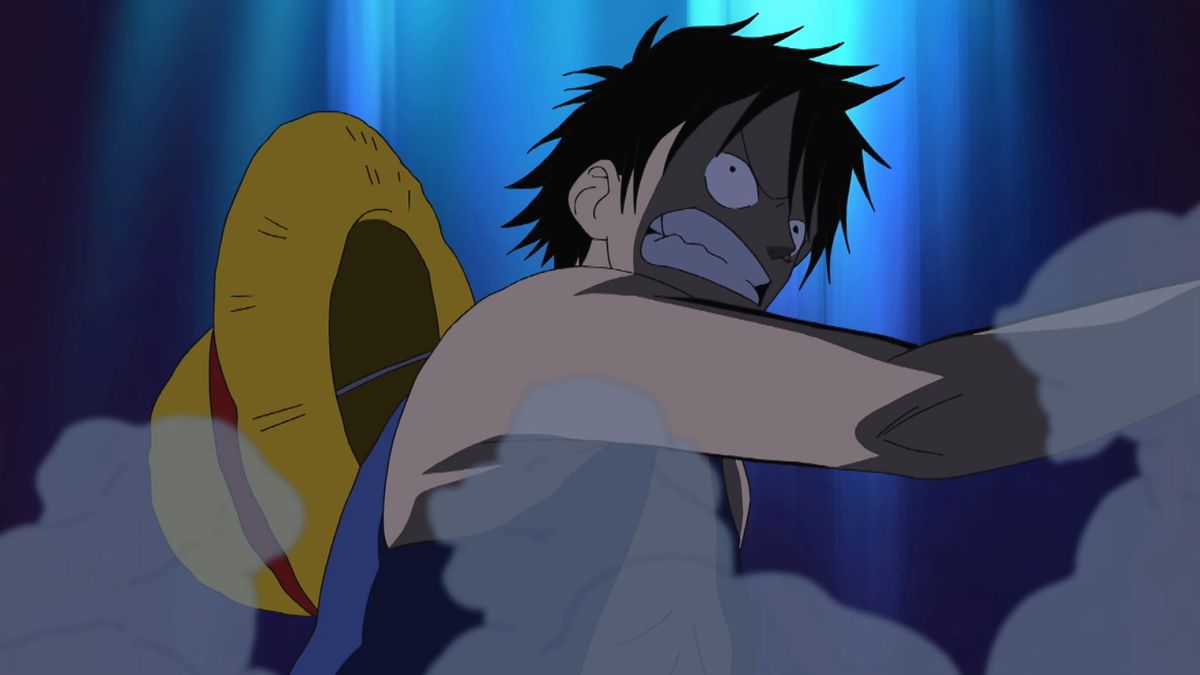
Saint Charlos arrives and bids five hundred million berries for Camie, destroying Nami’s plan to buy her freedom. Luffy crashes toward the auction with Zoro. Hatchan tries to stop him, accidentally reveals his fish-man identity, and gets shot by Charlos. While the noble celebrates gaining another slave, Hatchan apologizes for his past and begs Luffy to keep the promise not to attack. Charlos fires again, and Luffy punches him across the hall.
RaeRae’s opening receipt
The punch works because Episode 396 spends every minute proving restraint has become cooperation with cruelty. Charlos buys one friend, shoots another, calls both property, and trusts an admiral to punish anyone who objects. Luffy does not forget the consequence. He decides the consequence is no longer worse than obedience.
Charlos enters by abusing somebody already enslaved
He kicks the person carrying him and blames that captive for arriving late. Delay becomes permission for public violence.
The entrance establishes that ownership has erased every ordinary limit on his behavior.
His money destroys Nami’s tactical compromise
Five hundred million berries exceeds the crew’s available treasure before normal bidding begins. Charlos can spend beyond practical value because wealth and status protect him from consequence.
The market is not neutral when one customer can end competition through inherited excess.
Camie hears danger without controlling the room
The tank isolates her from allies and customers while displaying her body. She can see friends and call for Hatchan without reaching anybody physically.
Captivity turns relationship into forced spectatorship.
Lacuba refuses slavery through death
Another captive bites his tongue rather than accept sale. Disco hides the act behind a false explanation so the audience can continue comfortably.
When escape routes close, self-destruction becomes the final decision an owner cannot fully control.
Disco protects the show rather than the person
Blood threatens customer mood, so staff close curtains and call the crisis a nosebleed. No care reaches the captive.
Public relations becomes another layer of violence when image matters more than life.
The audience wants the interruption forgotten
Buyers came for entertainment and ownership. A captive choosing death exposes what their purchases require.
The show resumes because collective comfort depends on refusing that knowledge.
Camie’s reveal produces excitement instead of recognition
The crowd sees rarity and resale fantasy. Friends see Camie frightened inside glass.
Two readings occupy the same room, and money gives one reading official power.
Nami reaches the limit of financial rescue
She was willing to sacrifice treasure, but Charlos can erase her strategy with a number. Wealth concentration becomes direct control over freedom.
No responsible budgeting can compete with aristocratic money designed to be inexhaustible.
Luffy’s entrance rejects the room’s choreography
Auctions depend on controlled doors, timed lots, seated buyers, and one authorized voice. Luffy arrives through force and refuses every cue.
Disruption returns uncertainty to a system built around captive helplessness.
Hatchan restrains Luffy because he knows the promised consequence
An attack on Charlos will summon an admiral and place the entire crew at risk. Hatchan tries to protect Camie’s rescuers from a larger disaster.
His warning reflects care rather than respect for the noble.
The struggle exposes Hatchan’s body
His extra arms become visible, and the audience recognizes a fish-man. People react with disgust before learning any personal history.
Prejudice makes anatomy sufficient evidence for dehumanization.
Charlos shoots because he sees free inventory
He does not treat Hatchan as a threat requiring defense. The bullet becomes a claim over another person he expects to acquire without payment.
Violence and ownership merge inside one excited declaration.
Hatchan interprets the wound through guilt
He tells Luffy that past wrongdoing makes the shooting deserved and apologizes for causing trouble. Shame turns another person’s cruelty into self-punishment.
Accountability should never require accepting enslavement or execution.
His apology to Nami arrives without demand
Hatchan wanted to help the crew reach Fish-Man Island and make amends through action. He does not insist that Nami announce forgiveness while he bleeds.
Remorse sounds more credible when no reward is required.
Nami hears the reason behind his help
His guidance was not only repayment for rescue. Hatchan had been trying to respond to harm connected to Arlong Park.
Intent cannot erase the past, but intent helps explain present conduct.
Luffy refuses Hatchan’s claim that he deserved the bullet
The captain does not debate every crime from East Blue. Charlos shot a friend and celebrated slavery in the present.
Past wrongdoing does not give an abuser unlimited rights over somebody’s body.
The promise reaches its moral limit
Luffy agreed not to attack a Celestial Dragon because an admiral could destroy the crew. The promise assumed restraint might protect friends.
Once restraint requires watching friends get purchased and shot, the promise contradicts its own purpose.
Charlos fires again because impunity has never failed him
He expects bullets, wealth, and status to control distance. Nobody has taught him that another person’s anger might matter more than his title.
The second attack removes any fantasy of misunderstanding.
Luffy walks instead of shouting a speech
The scene does not need a manifesto. Every collar, bid, bullet, and kneeling body has already made the argument.
Silence keeps attention on decision rather than explanation.
The punch rejects inherited divinity
Charlos calls himself a World Noble and lives as though ordinary touch were contamination. Luffy’s fist treats his face as physically reachable.
One strike destroys the performance of untouchability before changing the larger system.
The visual shift gives the blow historical weight
The anime emphasizes impact by stripping color and echoing manga texture. Charlos appears knocked out of the polished world protecting him.
Style turns catharsis into a rupture viewers remember beyond the episode.
Catharsis does not cancel consequence
An admiral may come. Marines will surround the island. Every crew nearby faces escalation.
The punch feels right because Luffy accepts those consequences rather than pretending none exist.
Kid and Law witness another kind of captain
The rival crews see Luffy choose a friend over strategic safety and strike the person every local fears. His reputation gains lived evidence.
Rivalry begins through observation before direct competition.
The market loses control of the audience
Once Charlos falls, polite bidding cannot simply resume. The auction’s most protected customer has been treated like any other attacker.
Breaking one taboo destabilizes every rule built around that taboo.
Camie remains trapped after the punch
The blow answers Charlos but does not automatically remove her collar, open the tank, or defeat the guards.
Catharsis must be followed by practical rescue.
This remains an episode React
This page responds to Charlos’s bid, Lacuba’s refusal, Hatchan’s shooting and apology, and Luffy’s punch. A complete Sabaody Review belongs on the arc-level record.
React classification gives the breaking point room without reducing a whole arc to one famous image.
The official local still remains canonical
The Episode 396 still serves as featured image, hero, bounded-directory card, and social preview. One local attachment preserves recognition across every route.
Complete source, descriptive, accessibility, and filing metadata remain attached. No other record reuses the still.
RaeRae’s final receipt
Luffy knows the rule. Hatchan repeats the rule while bleeding. Pappag screams the rule. Everyone understands that touching Charlos invites an admiral. The punch matters because Luffy is not ignorant. He decides a promise meant to protect friends has become an order to watch friends be enslaved and shot.
Charlos bid five hundred million for Camie, treated Hatchan’s body as free merchandise, and fired because status had always protected him. Luffy walks through the bullets and reaches the face inside the air bubble. One fist cannot abolish slavery or dismantle the World Government. One fist can tell the room that inherited power failed to make this particular man untouchable. The bill arrives next episode. For this frame, every kneeling witness sees a god bleed dignity.
The five-hundred-million bid weaponizes abundance
Charlos does not negotiate against Nami. He chooses a number designed to remove everybody else from the field.
Extreme wealth becomes force because the market treats purchasing power as the only voice that matters.
Nami’s plan fails without being foolish
She selected the least violent available route and committed enormous resources. Charlos’s limitless privilege, not poor judgment, destroys the strategy.
Good plans can fail inside systems designed to privilege one participant absolutely.
Lacuba’s death attempt exposes the lie of willing labor
The auction’s employment language cannot explain why a person would rather die than accept placement. His act reveals coercion more clearly than any staff description.
Disco closes the curtain because truth threatens sales.
Hatchan places the crew above his own body
Even after being shot, he fears an admiral will destroy Luffy and everyone connected to him. He asks for restraint while receiving none from Charlos.
His concern shows present loyalty without purchasing forgiveness for the past.
Charlos reads apology as weakness
Hatchan’s remorse concerns Nami and earlier harm. Charlos interprets a wounded fish-man only as available property.
Abusers exploit vulnerability without understanding the relationship that produced honesty.
Luffy’s punch restores cause and consequence for one second
Charlos fires and receives force in return. Inherited status had interrupted that ordinary sequence by promising punishment against anyone who answered him.
The fist makes consequence physically immediate again.
The crowd learns that fear can break
Everybody was trained to kneel and watch. Seeing a Celestial Dragon struck creates evidence that obedience is enforced rather than natural.
One act cannot organize collective resistance, but the image destroys inevitability.
Law and morality separate completely in the hall
Attacking Charlos is illegal. Buying Camie and shooting Hatchan remain protected. The contrast removes any excuse that law here represents neutral justice.
Luffy chooses the moral violation of an immoral rule.
The punch belongs to friendship before symbolism
Viewers can read revolution, class conflict, and rejection of false divinity. Luffy acts because Charlos hurt people he knows.
Personal loyalty becomes politically explosive when institutions protect the person causing harm.
Hatchan’s apology refuses to purchase sympathy
He names wrongdoing while bleeding and asks Luffy to protect the crew, not to comfort him. The moment centers consequence rather than self-forgiveness.
Nami receives truth without an assigned response.
Charlos’s air bubble cannot preserve distance from consequence
The noble wears separation as proof that ordinary people cannot touch his world. Luffy crosses the final steps and treats the barrier as meaningless.
Contact destroys an ideology staged through costume.
The black-and-white impact refuses ordinary action grammar
The visual treatment pauses the colorful auction and renders the blow like judgment carved onto a page. Time stretches around contact.
Animation style marks a permanent threshold.
The crew understands the danger and supports Luffy
Nobody can pretend an admiral will ignore the attack. Friends turn toward rescue and defense rather than condemning the captain for ruining a safe arrangement.
The arrangement stopped being safe when Charlos entered.
Kid and Law learn why a bounty cannot explain Luffy
Shakky’s list presented numbers. The auction presents a captain willing to challenge the world’s protected class for a friend.
Character appears through which consequence somebody accepts.
Camie sees somebody break the rule built around her sale
The tank keeps her trapped, but the punch proves the auction’s authority can be challenged. Hope returns before practical freedom.
Symbolic rupture matters because rescue follows through the opening.
The fist rejects the audience’s purchased innocence
Every buyer sat close enough to watch Charlos bid on Camie and shoot Hatchan. The punch interrupts their claim to remain passive observers.
Once the room breaks, nobody can pretend the sale was harmless entertainment.
The blow also returns attention to the people the auction tried to classify as property. Camie and Hatchan are friends with names, histories, guilt, joy, and choices. Charlos’s title cannot outweigh those relationships merely because government force waits outside the hall.
Luffy accepts the approaching bill without asking Camie or Hatchan to praise him. The fist answers present violence. The crew still must break restraints, survive guards, and escape the forces Charlos’s status will summon. Catharsis opens the next responsibility rather than completing the rescue.
The punch creates a debt Luffy chooses knowingly
Marine retaliation, injured allies, and a blocked escape now wait outside the moment. Luffy accepts those risks because avoiding them had started requiring obedience to slavery. Consequence does not make the decision mistaken; consequence proves the decision was real.