RaeRae Reacts · One Piece Episode 377
Zoro Takes Luffy’s Pain After Kuma Tests What His Loyalty Can Survive
One Piece Episode 377 React follows Zoro offering his life for Luffy, Kuma extracting the captain’s pain, and Sanji finding the aftermath nobody will name.
One Piece Episode 377 React: Zoro offers his life for Luffy, Kuma extracts the captain’s accumulated pain and exhaustion, and Sanji later finds a blood-soaked crewmate who says nothing happened.
What happened in Episode 377
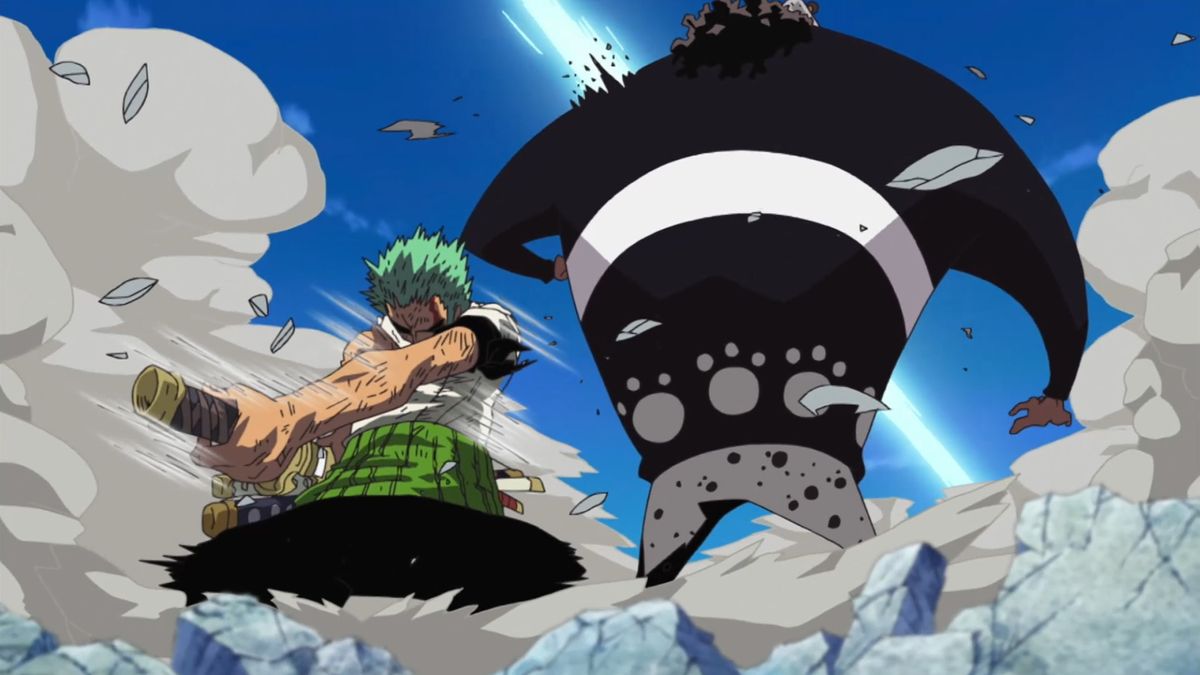
Zoro cuts Kuma and discovers machinery beneath his skin. Sanji also offers himself, but Zoro knocks him unconscious. Kuma removes Luffy’s pain, lets Zoro test a small portion, then leaves him to absorb the whole burden.
RaeRae’s opening receipt
Zoro’s silence protects Luffy from debt, but the scene also asks why love so often expects the strongest protector to disappear inside suffering.
Ursus Shock leaves survival looking like wreckage
Episode 377 begins after Kuma’s compressed air tears through Thriller Bark. Bodies cover the ground, the island is broken again, and Luffy remains unconscious through a crisis built around surrendering him.
The silence after impact makes the government order visible without showing the officials who issued the command.
Kuma walks toward Luffy because the ultimatum failed
The survivors refused to exchange their captain for their own lives. Kuma therefore returns to the original assignment and approaches a man who cannot defend himself.
Institutional violence often calls resistance unreasonable before proceeding against the vulnerable target.
Zoro moves before recovery becomes possible
His body already carries Oars, Moria, and Ursus Shock. He attacks anyway because distance between Kuma and Luffy has become the only protection available.
The choice is courageous and terrifying precisely because no healthy reserve remains.
The cut reveals machinery beneath Kuma’s skin
Zoro’s blade opens Kuma’s shoulder and finds metal rather than ordinary flesh. The discovery changes the tactical problem and expands the mystery surrounding the Warlord.
A person can be present while the body also carries architecture built by another system.
Kuma’s beam makes the mechanical revelation immediate
There is no pause for explanation. His mouth produces a blast while Zoro is still processing what the cut exposed.
Knowledge arrives as danger, which means understanding cannot be separated from survival.
Zoro recognizes that victory is unavailable
He has enough combat judgment to know his condition and Kuma’s power do not support a winning fight. That recognition does not make him retreat from protecting Luffy.
Courage here is not confidence in victory. Courage is choosing what to preserve inside likely defeat.
Offering his own life is not a casual heroic gesture
Zoro places his ambition, future duels, and promise to Kuina on the table. He does not lack reasons to live. The sacrifice matters because his life is full, not because his life is disposable.
Devotion should never require pretending the person offering everything has nothing of his own.
Zoro names Luffy’s future as larger than his own
He believes the man who will become Pirate King must survive. That judgment reflects faith in Luffy and a hierarchy Zoro voluntarily accepts in the crisis.
The choice belongs to Zoro. Nobody in the crew assigned him the role of acceptable loss.
Sanji offers the same life from another direction
Sanji interrupts and tells Kuma to take him instead. Rivalry falls away because both men understand the threat and choose protection.
Two offers do not make self-destruction healthier. They reveal how deeply both have tied worth to absorbing danger for others.
Zoro knocks Sanji unconscious to control the sacrifice
He denies Sanji the ability to make the competing choice. Zoro protects him and also removes his agency.
The scene is loving, coercive, and desperate at the same time. Clean moral labels would flatten what happens between them.
Kuma accepts a test rather than the original exchange
He removes Luffy’s pain and exhaustion, condenses the burden, and tells Zoro to experience a small portion first. The procedure turns suffering into something visible and transferable.
Power gives Kuma control over who carries consequence after the battle.
The small sample nearly destroys Zoro
A fraction of Luffy’s pain is enough to overwhelm a swordsman already near collapse. The test provides informed evidence about the full burden.
Zoro does not enter the final choice ignorant of the likely result.
Luffy’s unconscious body becomes temporarily free of pain
Kuma pushes the accumulated suffering outside him. Relief occurs without healing every wound or restoring energy through ordinary care.
The pain has not disappeared. The pain has been reassigned.
Transfer can resemble mercy while preserving total cost
Luffy wakes later without knowing what another person absorbed. Zoro carries suffering the captain never consented to give and may never understand.
No pain vanished from the moral account simply because the original body stopped feeling the weight.
Zoro steps into the full sphere alone
He moves the concentrated burden away from the crew and accepts the impact without witnesses beside him. Privacy becomes part of how he controls the sacrifice.
The location protects others from danger and protects the act from intervention.
The blood records what language will later deny
Zoro’s body stands in a field of evidence. Blood covers the ground and his clothes while he refuses to narrate the event.
Silence cannot make consequence absent. The scene lets the body testify after the speaker declines.
“Nothing happened” is loyalty and misdirection
Zoro does not want praise, repayment, or a debt placed on Luffy. The phrase protects the captain from learning that his survival required another crewmate’s near death.
The same phrase also withholds information the crew might need to care for Zoro honestly.
Secrecy preserves dignity while isolating pain
Zoro chooses how much of his own suffering to disclose. That choice deserves respect. Yet the culture surrounding strong protectors often rewards silence until care becomes impossible.
Autonomy and isolation can occupy the same answer.
Sanji becomes the witness Zoro tried to avoid
He wakes, searches, and finds the aftermath. Sanji knows enough to understand that a terrible exchange occurred even without every detail.
Witness changes private sacrifice into shared knowledge, though he also chooses silence afterward.
Sanji’s silence protects Zoro from spectacle
He does not turn the scene into public praise or use the discovery as rivalry material. Keeping confidence can honor the person who did not want performance.
The question remains whether privacy will also prevent treatment, conversation, and future boundaries.
Luffy’s leadership creates devotion he never requested
He inspires people to place their lives beside his dream, but unconsciousness removes his voice from the exchange. Luffy cannot tell Zoro that his friend’s life is not expendable.
The crew will eventually need a model of loyalty that allows protectors to survive protection.
Kuma appears to honor the agreement
After Zoro accepts the pain, Kuma leaves without taking Luffy or killing the survivors. The action suggests a personal code operating inside government obedience.
Keeping a brutal bargain does not make the terms humane, but the distinction becomes important to understanding him.
Kuma learns something about the Straw Hats
He sees a swordsman offer everything, another cook offer the same, and an entire group refuse to trade their captain. The crew’s bond survives pressure designed to turn loyalty into arithmetic.
Observation may matter later even when Kuma gives no immediate explanation.
The episode refuses a cheering audience
Zoro’s ordeal happens away from applause. No crowd validates the sacrifice, and no triumphant music can make the pain easy.
The absence of witnesses keeps attention on the cost rather than the reputation gained from paying.
Masculine devotion becomes legible through damaged bodies
Zoro and Sanji struggle to say affection directly, so protection becomes their shared language. That language can be beautiful and dangerous when injury is the only proof accepted.
Love deserves more vocabulary than bleeding alone.
The scene belongs to Zoro without making Luffy responsible
Luffy did not request the transfer and remains unaware. Blaming him would repeat Kuma’s logic by moving responsibility away from the person who designed the test.
Zoro chose. Kuma created the condition. Both facts belong in the receipt.
Survival after sacrifice is not anticlimax
Zoro remains standing, which lets fandom turn the moment into legend. Survival should not erase how close the act came to ending his future.
The impressive outcome is not evidence that the risk was small.
Episode 377 remains an episode React
This page responds to Zoro discovering Kuma’s mechanical body, offering his life, stopping Sanji, and absorbing Luffy’s pain before denying that anything happened. A complete Thriller Bark Review belongs after Brook joins and the crew leaves the island.
React classification preserves broadcast-level close reading while keeping whole-work Reviews reserved for complete arcs, seasons, series, and films.
The official local still remains canonical
The Episode 377 still serves as featured image, hero, bounded-directory card, and social preview. One local attachment preserves recognition across every discovery route.
Complete source, descriptive, accessibility, and filing metadata remain attached. No other record reuses this image.
RaeRae’s final receipt
Episode 377 gives us one of One Piece’s most famous lines and then surrounds that line with enough blood to challenge the legend. Zoro takes Luffy’s pain because he loves his captain, believes in the dream, and refuses to let Kuma erase the crew. He also removes Sanji’s choice, hides the cost, and stands alone inside suffering nobody will know how to treat. Devotion can be real without every method of expressing devotion becoming healthy.
“Nothing happened” protects Luffy from debt and Zoro from spectacle. The body tells the rest. Sanji sees the blood and keeps the confidence, which is tenderness in their private language and another locked door around care. I love the loyalty. I refuse to pretend silence makes the pain disappear. Kuma moved the burden from one body to another. Zoro made the sacrifice. The crew survived. Something absolutely happened, and the fact that Zoro asks for no applause is exactly why the receipt deserves to remain visible.
The sample gives Zoro knowledge but not a free choice
Kuma lets him experience a fraction of Luffy’s pain before accepting the full burden. Zoro now understands the scale more accurately, which makes the final step informed. The surrounding conditions remain coercive: accept likely death or watch Kuma take the unconscious captain.
Information improves consent without magically making the available options fair.
Zoro’s dream remains present inside the offer
He promised Kuina that his name would reach the heavens and built every duel toward becoming the world’s greatest swordsman. Offering his life means placing that promise at risk. The sacrifice is not noble because Zoro lacks a private future.
The sacrifice lands because he values that future and still decides Luffy’s survival matters in the immediate crisis.
Taking pain does not perform medical repair
Luffy wakes relieved of the accumulated suffering, but wounds, exhaustion, and strain still belong to the body’s recent history. Zoro receives sensation and fatigue without becoming a physician who reverses the underlying events.
Kuma changes where consequence is felt. Chopper and time will still have work after the transfer.
The crew cannot build safer habits from missing information
If nobody knows how close Zoro came to death, nobody can plan recovery around the actual damage or discuss whether a similar sacrifice should ever happen again. Silence prevents debt and praise, but silence also blocks collective learning.
Privacy belongs to Zoro. Consequences still spread through the group that depends on him.
Sanji carries knowledge without permission to resolve the contradiction
He understands enough to protect Zoro’s dignity and enough to fear what happened. Speaking could violate confidence. Remaining silent could help the crew overlook serious harm.
The episode leaves him inside a care problem with no perfectly clean answer, which feels truer than easy moral certainty.
Kuma’s departure preserves the mystery around his judgment
He could complete the extermination order after Zoro falls. Instead, he leaves the crew alive. The bargain, the test, and the decision to honor the result suggest a will operating inside the government instrument.
That complexity should deepen future reading without rewriting the pain he deliberately created here.
“Nothing happened” becomes fandom shorthand and editorial warning
The line deserves its legendary status because Zoro refuses applause after offering everything. The legend becomes thinner when repeated without the bloody scene, Sanji’s witness, and the body that may not know how to ask for care.
Admiration should keep the cost visible. Otherwise silence becomes the only part audiences learn to celebrate.
The crew survives because someone interrupts the order
Kuma arrived to erase witnesses and take Luffy. Zoro’s offer changes the path, and Kuma’s acceptance changes the outcome. Survival emerges through a morally compromised negotiation between unequal parties.
No clean victory closes Episode 377. A living crew wakes beside a debt only two conscious people can fully name.