RaeRae Reacts · One Piece Episode 375
The Shadows Return Before Kuma Receives Orders to Erase Every Survivor
One Piece Episode 375 React follows Moria’s victims reclaiming daylight before the World Government orders Kuma to hide the defeat by killing everyone.
One Piece Episode 375 React: stolen shadows return at the last possible moment, victims greet daylight again, and the World Government orders Kuma to erase every witness to Moria’s defeat.
What happened in Episode 375
Luffy, Zoro, Sanji, Robin, Lola, and the other victims survive sunrise. Celebration barely begins before Kuma reports Moria’s fall and receives an order to kill everyone on Thriller Bark.
RaeRae’s opening receipt
The government hears that one protected pirate failed and chooses witness removal over accountability. There is the institution, signing the receipt in real time.
The shadows return before disappearance becomes final
Episode 375 completes the journey Episode 374 refused to rush. Luffy, Zoro, Sanji, Robin, Lola, and the other victims begin dissolving under sunrise, then their shadows reconnect at the last possible moment.
Release becomes restoration only when the stolen part reaches the person who lived without freedom.
Daylight becomes ordinary again
Lola’s crew can stand beneath the sun without burning. The light has not changed. Their relationship to the light changes because Moria no longer controls the condition separating them from morning.
Freedom sometimes looks like an ordinary experience finally becoming safe.
The victims celebrate access rather than conquest
They do not need a throne or title from the battle. They want to travel during the day, choose their routes, and stop arranging life around somebody else’s theft.
The scale of relief reveals how much domination had entered daily routine.
Robin names the timing without romanticizing the danger
She explains that the shadows restored their bodies just before disintegration became final. Survival was real, and so was the proximity to death.
Accurate language protects rescue from becoming a story where the victims were never truly at risk.
Luffy’s unconscious body keeps the cost visible
The captain cannot join the celebration. Nightmare Luffy, Gear Second, Gear Third, and the final collision with Moria have left him unable to stand.
Victory does not refund the body that produced the opening.
Usopp worries about the enemies still ahead
Moria warned about the New World, and Luffy already needs techniques that strain him beyond ordinary recovery. Usopp’s concern looks forward without accepting Moria’s fatalism.
Love can believe in somebody and still fear the price of how they survive.
Concern is not disloyalty to the captain’s dream
The crew does not need to cheer every self-destructive choice to prove commitment. Usopp can honor Luffy’s purpose while questioning whether the body can keep paying escalating costs.
Chosen family includes people willing to notice damage after applause fades.
The lifeless zombies expose the end of fabricated personhood
Sanji observes that Moria’s creatures were manufactured through corpses and stolen shadows. Once the shadows return, the performances stop.
The silence reveals how much personality belonged to the living owners rather than the bodies Moria displayed.
Cindry’s body deserves rest after forced service
Her corpse can no longer speak or move when the shadow leaves. That stillness is sad, but continued animation under Hogback’s ownership was never true life.
Restoration for the shadow owner also means ending the theft committed against the dead.
Hogback chooses escape over accountability
He sees Thriller Bark collapsing and decides not to spend his future among the ruins. His concern centers his own comfort rather than the bodies he altered or the people harmed by Moria’s system.
Leaving a failed institution is not the same as answering for participation.
Absalom discovers that control never produced affection
The zombie Lola no longer moves, and his earlier attempt to force Nami into marriage has failed. He remains surrounded by evidence that desire cannot manufacture mutual relationship.
Possession built every role he called romance.
Spoil returns as a witness rather than a monster
The elderly man with the lantern was treated as a frightening figure inside Thriller Bark’s atmosphere. Restoration lets his actual identity and history enter the room.
Fear often grows where Moria’s system stripped people of context.
The Victims’ Association has a reason to exist beyond the battle
Shared harm brought strangers together before the Straw Hats arrived. Their organization preserved knowledge, mutual aid, and the possibility of collective action.
The heroes help finish the fight, but victims were already building survival with one another.
Zoro insists the Straw Hats earned their path
He resists language that might make their survival sound accidental. The crew studied Oars, coordinated the finishing sequence, and forced Moria to release the shadows.
Nami’s reaction keeps his solemn accounting from becoming too precious, because this family can recognize labor and still slap the drama out of the room.
The treasure offer turns recovery into material repair
Lola’s crew points the Straw Hats toward Moria’s treasure as compensation. After stolen shadows, wrecked bodies, and a devastated ship route, resources matter.
Justice is not only emotional acknowledgment. Survivors also need material means to continue.
Nami remembers Kuma before relief becomes carelessness
She knows another Warlord remains on the island and remembers Perona disappearing. Celebration does not erase unresolved threat.
The navigator keeps reading the whole environment while others understandably focus on survival.
Kuma reports Moria’s defeat to a system invested in secrecy
The World Government does not ask how many people Moria harmed under official protection. The conversation centers the political consequence of a second Warlord losing to the Straw Hats.
Institutional concern begins with reputation, not victims.
Moria must be transported because the title still matters
The government wants the defeated Warlord recovered rather than publicly abandoned. His value belongs to the arrangement and the information surrounding that arrangement.
Protection continues even after his private kingdom collapses.
The order to hide the defeat protects the Warlord fiction
Crocodile’s fall already damaged confidence in the system. Another public loss would reveal that government-authorized pirates can abuse civilians and fail against the same rising crew.
Secrecy becomes maintenance for a political brand.
Witnesses become the problem because the institution refuses truth
Everyone on Thriller Bark knows Moria lost. Rather than accept that reality, the government orders Kuma to eliminate the people capable of carrying the story elsewhere.
Erasure is cheaper than reform when authority values legitimacy over life.
The survivors are targeted for knowing what happened
Lola’s crew, the Straw Hats, and ordinary victims have just regained their futures. The government converts testimony into a death sentence before they can leave the island.
Survival itself becomes politically inconvenient evidence.
Kuma’s obedience remains difficult to read
He communicates the facts and receives the order with controlled calm. The episode does not yet reveal where duty ends and personal judgment begins.
That uncertainty makes his next movement more frightening than open enthusiasm would.
The World Government outsources another dirty task
Moria used zombies to absorb consequences. The government uses a Warlord to erase evidence created by another Warlord. Different structures repeat the same preference for distance.
Authority protects itself by making powerful intermediaries carry visible violence.
Kuma’s speed destroys the comfort of preparation
The survivors are exhausted, scattered, and barely beginning to understand the new order. Kuma crosses distance before a normal defense can form.
His movement makes institutional violence feel instantaneous after restoration’s painful delay.
The paw-shaped force reaches beyond direct contact
Kuma sends people flying through pressure that does not behave like an ordinary punch. The attack expands uncertainty around what his body can repel and redirect.
Visible pads produce invisible consequence across space.
Zoro stands because Luffy cannot
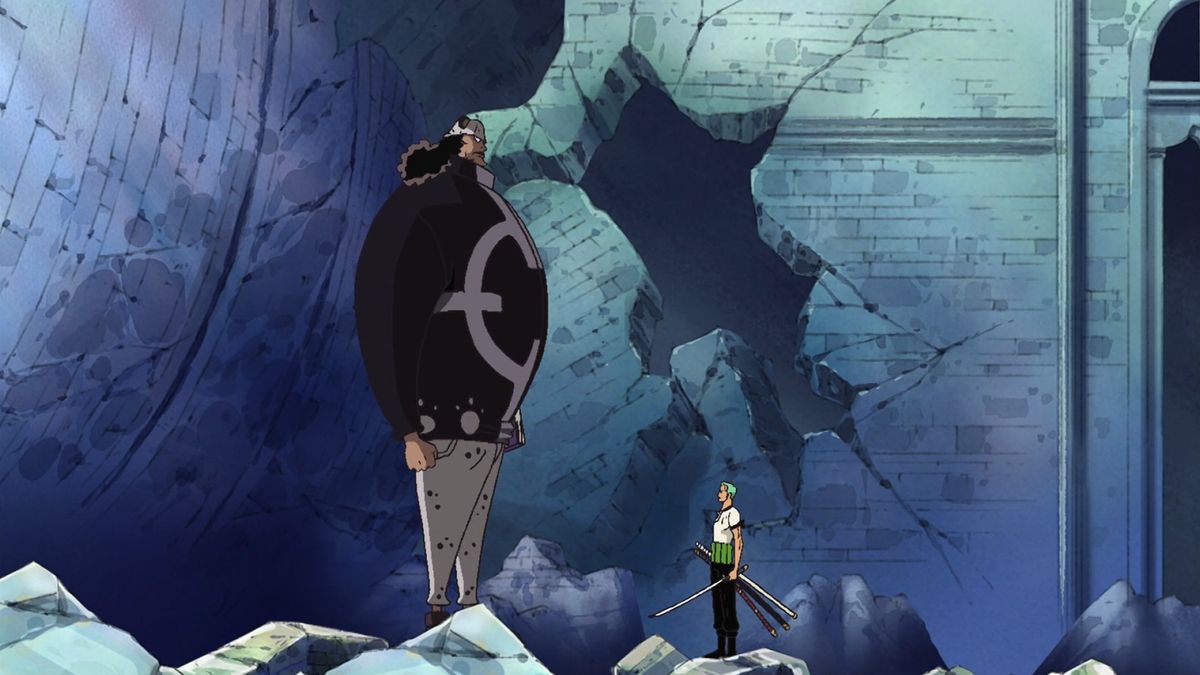
The captain lies unconscious, the crew is depleted, and another Warlord has received an extermination order. Zoro places himself between Kuma and the people who cannot rise.
His readiness is not competition with Luffy. His readiness is continuity of protection.
The episode turns celebration into a second emergency
Shadows return, sunlight becomes safe, and victims breathe as free people. Kuma’s order arrives before that freedom can become distance from Thriller Bark.
The abrupt turn does not cancel the restoration. The turn reveals how quickly power tries to reclaim control over a liberated story.
Victory over private tyranny exposes public protection
Moria’s operation looked like one pirate’s isolated horror. Kuma’s call confirms that government policy surrounds the island. Defeating the private ruler brings the official system into direct view.
The arc’s monster was never fully outside respectable authority.
Episode 375 remains an episode React
This page responds to the shadows returning, victims reclaiming daylight, Luffy’s physical cost, and the World Government ordering Kuma to erase every witness. A complete Thriller Bark Review belongs after Kuma’s intervention and the crew’s departure resolve.
React classification preserves broadcast-level close reading while keeping whole-work Reviews reserved for complete arcs, seasons, series, and films.
The official local still remains canonical
The Episode 375 still serves as featured image, hero, bounded-directory card, and social preview. One local attachment preserves recognition across every discovery route.
Complete source, descriptive, accessibility, and filing metadata remain attached. No other record reuses this image.
RaeRae’s final receipt
Episode 375 lets the shadows make the whole journey home. Lola sees the sun without burning. Robin, Zoro, Sanji, and Luffy stop disappearing. Ordinary morning becomes available again, which is the kind of freedom Moria never understood because nobody had to kneel for the sunrise.
Then the World Government hears that a protected Warlord lost and immediately asks Kuma to erase the witnesses. Not investigate Moria. Not count the victims. Not reconsider why authorized pirates keep building private kingdoms under public cover. Kill everybody who knows. The episode moves from restoration to institutional panic without losing the connection between them. Moria stole shadows to control what people could do. The government targets testimony to control what people can know. Kuma arrives at the celebration carrying the official version of the same command: return to silence or be removed.
Moria steals the trace and government orders target the account
A shadow proves that a person stands in the world. Moria removes that visible trace, assigns the trace to another body, and restricts the original owner’s access to daylight. His control operates by separating a life from evidence that naturally belongs with that life.
The World Government’s order applies the same logic to public memory. Thriller Bark’s survivors can testify that Moria abused civilians, built an undead army, and lost to the Straw Hats. Killing the witnesses would separate the event from the people capable of carrying the event into history.
Restoration creates witnesses authority cannot comfortably absorb
Lola’s crew does not emerge from the battle as a blank crowd. They remember years without sunlight, the machinery of shadow removal, and the people who helped return what Moria stole. Their freedom includes the ability to name the system.
The government treats that knowledge as a threat because official legitimacy depends on Moria remaining useful, controlled, and publicly formidable. Living testimony contradicts every part of the preferred story.
The order converts institutional embarrassment into civilian danger
Moria’s defeat may damage the Warlord system’s reputation. That reputational problem becomes a death sentence for exhausted people who never designed the arrangement. Authority transfers the cost of policy failure onto the bodies least responsible for policy.
No survivor has to publish a report before becoming inconvenient. Merely knowing the truth is enough.
Kuma receives a command built to leave no appeal
The people on Thriller Bark do not know who issued the order, cannot challenge the evidence, and receive no opportunity to explain what Moria did. The decision arrives through a Den Den Mushi and becomes force before any civilian voice enters the process.
Secrecy does not only hide the outcome. Secrecy removes the public space where accountability could begin.
Luffy’s condition reveals the cruelty of the timing
He cannot hear the ultimatum developing around him or consent to another fight. His body has already paid for the victory the government wants hidden. The order targets him when meaningful resistance is least available.
Calling the operation cleanup does not change the fact that cleanup means killing an unconscious person and everybody who protected him.
The crew has to become a shield while still needing care
Chopper should be treating injuries. Usopp and Nami should be recovering from terror and impact. Robin, Zoro, and Sanji have only just regained their shadows. Kuma’s arrival forces patients, caregivers, and witnesses back into combat roles.
Institutional violence often steals recovery time before stealing anything else.
Nami’s warning is another act of care
Remembering Kuma does not spoil the celebration. Her alertness protects people whose relief has understandably narrowed attention. The navigator notices an unresolved presence and keeps the group oriented toward danger.
Care can sound like interruption when everybody wants the crisis to be over.
Zoro stands inside the gap left by an unconscious captain
He does not claim Luffy’s role or convert protection into authority over the crew. Zoro simply recognizes that somebody must meet the next threat before Kuma reaches people unable to defend themselves.
His readiness shows how the Straw Hats distribute responsibility without flattening identity.
The episode’s second crisis proves liberation needs protection
Returning the shadows restores bodily freedom, but powerful institutions can still attack the people who regained that freedom. Liberation is not self-sealing. Survivors need routes, witnesses, material support, and protection from retaliation.
Episode 375 refuses to end at the emotional high point because systems rarely surrender control without another attempt.