RaeRae Reacts · One Piece Episode 330
A Stolen Jolly Roger Forces Puzzle to Name What His Dream Still Means
One Piece Episode 330 React turns the Phoenix Pirates’ stolen flag into an anime-original test of identity, loyalty, and courage after defeat.
What happens
The scattered Straw Hats battle Accino Family hunters across the ice while the Phoenix Pirates face the theft of their Jolly Roger. Puzzle’s damaged confidence collides with crewmates who still believe their flag represents a shared promise worth defending.
RaeRae reacts
A pirate flag is never only fabric in One Piece. The Straw Hats already taught that lesson when Luffy defended Chopper’s flag on Drum and ordered Sogeking to burn the government’s banner at Enies Lobby. Episode 330 asks Puzzle whether defeat can take the meaning away from his crew’s symbol. Shame tells him the dream ended; the people who remained beside him say otherwise.
Canon note
Episode 330 continues an anime-original arc. The emotional flag motif belongs to the television story without being misrepresented as manga canon.
The Accino Family begins collecting isolated fights
Once the Straw Hats are scattered, the bounty hunters attack each group according to terrain and matchup. The plan treats separation as a resource. A full crew can exchange information and cover weaknesses; isolated pairs must discover the rules while defending themselves.
The hunters are not waiting for fair contests. Their business rewards capture, so every advantage built into the ice becomes part of the product.
Franky versus Hockera continues the battle over hidden systems
Franky helped uncover the penguins moving the iceberg field, so Hockera confronts somebody who understands the trap is engineered. Their fight grows naturally from investigation. Silencing Franky would protect both the hunters’ control of the terrain and the secrecy behind that control.
The shipwright fights with more than personal survival at stake. He carries information the separated crew needs.
Hockera attacks the body behind the machinery
Franky’s cyborg modifications make him appear like a walking answer to physical danger. An opponent who pressures him reminds viewers that machinery is integrated with a person who feels pain, makes choices, and can be separated from support.
His strength is not less meaningful because the body is engineered. The episode lets invention become embodied courage rather than equipment worn over a replaceable fighter.
Franky’s cola economy keeps power attached to limits
His systems can produce extraordinary force, but energy remains finite. Every attack asks how much capacity should be spent now and what later danger might require. That constraint prevents cyborg spectacle from becoming consequence-free.
Resource management also connects Franky to Sunny. Builder and ship both hold specialized mechanisms whose usefulness depends on timing, knowledge, and fuel.
Sanji and Usopp face a married combat partnership
Arbell and Salchow have practiced movement together on ice that favors their style. The couple’s coordination contrasts with two Straw Hats whose temperaments regularly collide. Sanji and Usopp need cooperation quickly, not after a comfortable period of planning.
The matchup asks whether chosen family can synchronize under pressure as effectively as opponents who present themselves as one unit.
The skaters own momentum before the fight begins
Arbell and Salchow know how to accelerate, turn, and attack without losing balance. Sanji and Usopp arrive as outsiders on a surface that punishes ordinary footwork. The environment gives the couple a constant advantage that strength alone cannot cancel.
Combat becomes a lesson in who understands motion. The Straw Hats must change the rhythm rather than chase specialists inside their preferred choreography.
Sanji’s legs meet terrain that resists his identity
His fighting style depends on precise footing and explosive movement. Ice interrupts both, forcing him to respect a surface he would usually cross without thought. The challenge is technical and emotional because effortless grace is part of how Sanji presents competence.
Adaptation requires admitting the battlefield has changed before pride wastes every useful opening.
Usopp can contribute without imitating Sanji
He does not need matching speed or close-range power. His value lies in observation, distance, invention, and the willingness to weaponize details a conventional fighter dismisses. Ice offers angles, friction problems, and environmental possibilities built for creative interference.
A good partnership does not make both people equal at the same task. A good partnership connects different tasks toward one outcome.
The couple’s coordination is not proof of moral unity
Arbell and Salchow move beautifully together while participating in a business that captures vulnerable pirates for profit. Harmony inside a pair does not make the pair’s purpose ethical. People can care for one another while coordinating harm against outsiders.
Episode 330 keeps family from becoming a moral shortcut. What relationships produce matters alongside how loyal the members feel.
Luffy versus Brindo turns a bounty into a personal obstacle
Brindo approaches the captain as a valuable target. Luffy refuses that market frame. He is trying to reach his friends, recover control of the situation, and keep the crew from being processed into payouts.
The fight embodies two definitions of a person: a number transferable for reward and a relationship moving toward other relationships.
Luffy’s directness meets an opponent inside somebody else’s plan
He can focus completely on the fighter in front of him, which is usually a strength. The Accino Family benefits if Brindo keeps that attention narrow while other hunters act elsewhere. Winning one exchange will not automatically dismantle the larger trap.
Luffy needs his crew because leadership cannot see every battlefield simultaneously. Trust extends his reach beyond rubber.
Brindo’s confidence comes from a system prepared around him
A hunter can look individually fearless when terrain, family support, and a staged ambush reduce personal risk. That preparation does not make his skill fake. The preparation changes what the confrontation proves.
The Straw Hats are fighting an organization through its members. Each duel remains connected to infrastructure the hunters control.
Chopper’s presence keeps Luffy from becoming a solo story
Chopper can assess injuries, notice environmental danger, and transform according to need. His role beside Luffy is not simply to witness the captain’s power. He brings judgment the most direct fighter may overlook.
Their partnership reminds us that protection moves both ways. The captain reaches for his doctor, and the doctor helps keep the captain capable of reaching anyone.
Robin remains aboard while chaos pulls everyone outward
Sunny needs a center. Robin staying behind protects the vessel and preserves one location where information can eventually converge. The choice may look quiet compared with three fights, but a crew without a recoverable home would remain scattered even after victory.
Holding ground is an active responsibility when the enemy’s strategy depends on displacement.
Lil appears in the shape most likely to activate compassion
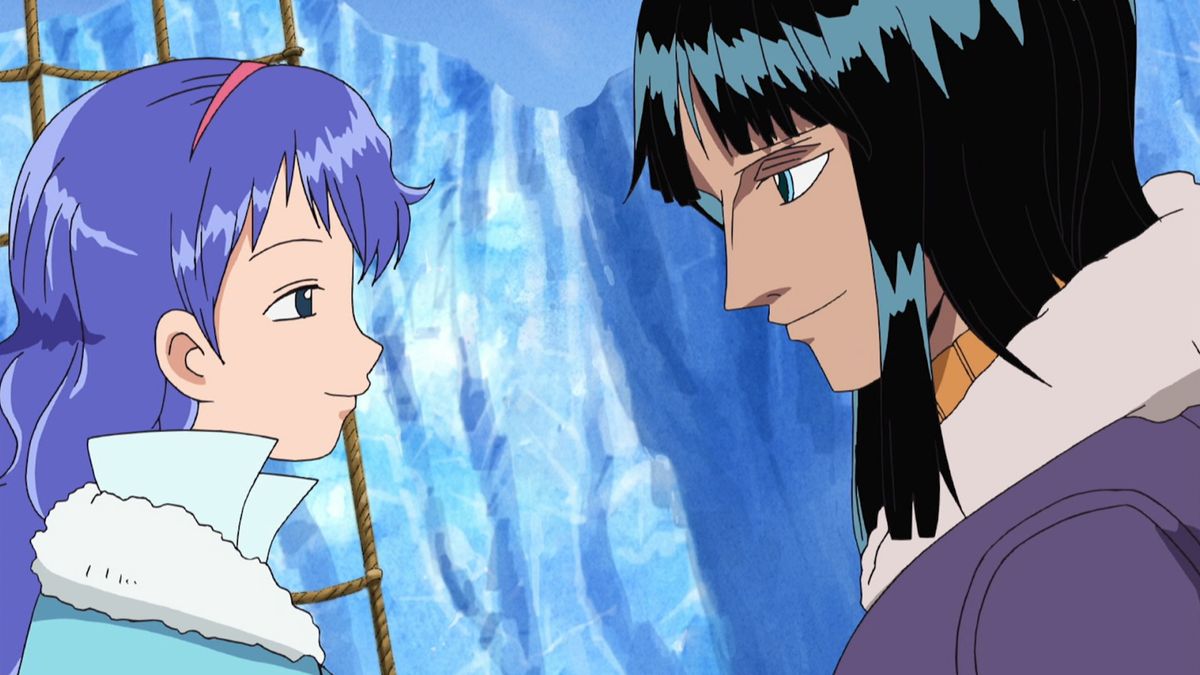
A young girl near Robin creates an immediate asymmetry of age and apparent vulnerability. After the Phoenix deception, the crew has reason for caution. Robin still knows better than most what happens when adults treat a child as guilty because danger surrounds her.
The scene asks for discernment without cruelty. Suspicion should examine behavior and context rather than erase childhood dignity.
Robin’s own childhood changes how she reads the encounter
She survived because Saul, Clover, and eventually the Straw Hats saw a person where institutions saw a threat. That history makes her capable of offering gentleness without becoming emotionally careless. She understands both the need for refuge and the ways powerful people use children.
Her calm gives Lil room to reveal herself rather than forcing a conclusion through fear.
The stolen flag makes every fight about more than escape
The Phoenix Pirates lost their Jolly Roger when the Accino Family preyed on them during retreat. Recovering the emblem cannot undo defeat, but leaving the symbol in the hunters’ possession would let exploitation define the crew publicly.
The Straw Hats know flags carry chosen identity. They burned one for Robin and defended another for Chopper. Cloth becomes serious when people place a promise beneath the image.
Puzzle must decide whether his crew is still worth representing
His followers can fight for the flag, but the captain’s despair controls whether the recovered emblem has direction. Puzzle proposed becoming a bounty hunter because piracy now feels synonymous with failure. The missing flag asks him to separate one defeat from the entire shared dream.
Leadership returns through honest choice, not through pretending fear disappeared while he was unconscious.
The Straw Hats understand why another crew’s flag matters
Helping recover the Phoenix emblem is not a declaration that Puzzle made every right decision. The aid recognizes that the Accino Family does not gain moral ownership by taking a symbol from injured people.
Accountability for the drugged trap and resistance to predatory hunters can coexist. Fandom analysis should be able to hold more than one truth without flattening either.
The episode makes family a contested word
The Accino Family hunts together. Arbell and Salchow fight as spouses. The Phoenix Pirates cling to a captain who wants to dissolve their identity. The Straw Hats struggle across separate battlefields to return to one another.
Every group claims connection, but connection produces different obligations. Family can become care, pressure, coordination, exploitation, or a reason to change.
Three fights prevent one victory from solving everything
Franky can defeat Hockera without freeing Sanji and Usopp. Luffy can overcome Brindo without explaining Lil. Robin can protect Sunny without restoring Puzzle’s courage. The episode distributes the problem so no single hero can absorb the entire story.
That structure fits the Straw Hats. Their collective identity matters because different people solve different parts of survival.
The ice rewards teamwork and punishes isolated pride
Unstable footing makes recovery harder after every mistake. A partner can warn, redirect, or create the opening that prevents a fall. Fighting alone magnifies small miscalculations into separation.
The Accino Family designed the field to isolate prey, yet the same terrain can reveal why the Straw Hats keep choosing collaboration over individual prestige.
Anime-original status stays visible without dismissing the craft
Episode 330 does not adapt a manga chapter. The Accino Family, Phoenix Pirates, and these frozen matchups belong to the television-original Ice Hunter Arc. That relationship needs clear labeling across the React and directory.
Transparency leaves room to discuss staging, character combinations, and flag symbolism honestly. Filler is a production and continuity category, not a command to stop paying attention.
The real battle is over who gets to define defeated people
The bounty hunters define pirates by capture value. Puzzle defines himself by the worst result of his voyage. His followers define him through the captain they remember. The Straw Hats offer another possibility by treating defeat as an event rather than a complete identity.
Every fight on the ice pushes against somebody else’s imposed definition, even when fists and skates make the argument loud.
RaeRae’s final receipt
Episode 330 is a family fight in every possible meaning. The Accino Family divides the Straw Hats into profitable matchups. Arbell and Salchow weaponize marital coordination. Puzzle’s crew fights for a flag their captain no longer believes he deserves. Robin stays with Sunny and meets a child whose presence demands caution without sacrificing compassion.
My receipt is simple: the hunters do not own the Phoenix identity because they stole the cloth, and Puzzle does not get to erase every follower’s dream because shame has taken over his voice. He can leave piracy after an honest decision. He cannot pretend becoming the kind of hunter who preyed on his wounded crew is neutral reinvention. Meanwhile, Franky, Sanji, Usopp, Luffy, Chopper, and Robin each protect a different part of collective survival. The Straw Hats are separated across the ice, but every choice points back toward one home. That is the difference between a family that collects people and a family that keeps reaching for them.
Recovering a symbol cannot substitute for repairing the crew
The Phoenix Jolly Roger deserves to come home because the Accino Family took the flag through predation. Bringing the cloth back will not automatically resolve Puzzle’s despair, his followers’ fear, or the betrayal used against the Straw Hats. Restoration requires more than returning an object to its old position.
The flag can become an invitation to choose again. The people beneath the emblem must decide what promise they can honestly carry forward.
Every battle points toward reunion instead of conquest
Franky, Luffy, Sanji, Usopp, Chopper, and Robin are not fighting to own the ice. They want their people, their ship, and their freedom of movement restored. That goal keeps victory relational rather than territorial.
Episode 330 understands why the Straw Hats feel different from the hunters. The crew uses strength to return choice where an extraction system tried to remove choice for profit.