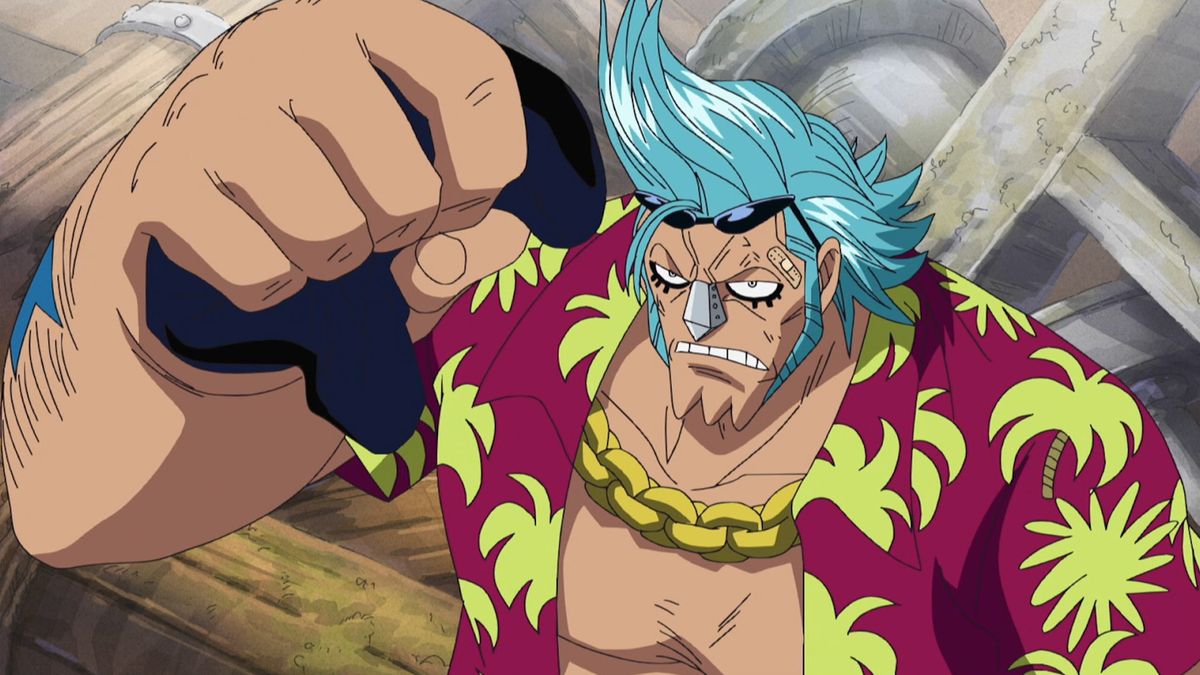
RaeRae Reacts · One Piece Episode 322
Franky’s Family Loves Him Enough to Make Him Leave
One Piece Episode 322 turns Franky’s recruitment into a painful farewell as his followers refuse to become the excuse that keeps him ashore.
The short version
Episode 322 turns Franky’s departure into a battle between chosen responsibility and the fear of leaving people who already want him to go. The Franky Family steals his trunks, Luffy offers a place aboard, and Robin applies a recruitment method nobody will ever forget.
The family pushes because Franky cannot release himself
His refusal sounds loyal, but his followers understand that staying would shrink the dream he taught them to respect.
Departure does not cancel belonging
Franky can leave Water 7 without making the family temporary. Love survives when people choose growth instead of proximity.
Robin’s intervention is funny and aggressively physical
The scene becomes iconic comedy while also deserving an honest receipt about consent and pain.
RaeRae’s receipt
Franky’s men love him enough to engineer their own heartbreak. They refuse to become the excuse that keeps their big brother from sailing.
Episode facts and receipts
Episode 322 aired September 2, 2007. ONE PIECE.com credits Ryo Suga, Yoshihiro Ueda, Takeo Ide, Miyuki Sato, and Michiyo Kawasaki.
Classification: numbered manga-canon Enies Lobby television episode and RaeRae React. Anime, Anime Series, Japanese Anime, and Anime Reacts, not Anime Reviews.
The Franky Family knows his refusal better than he does
Franky says he must remain because his followers need him. They hear the older wound hiding beneath that loyalty. He has spent years building a community from people Water 7 discarded, but he also turned responsibility for them into another reason his own dream should stay punished.
The family refuses to cooperate with that story. Their plan looks absurd because ordinary persuasion cannot reach a man who has made self-denial part of his identity.
Stealing his trunks attacks the armor he performs every day
Franky’s near-naked style usually operates as chosen spectacle. He controls the pose, the reaction, and the outrageous confidence. Removing the trunks takes control away and forces him to chase the family through public space.
The plan is invasive comedy, but the emotional purpose stays clear. His followers need to move his body toward the ship because every verbal excuse points back toward staying.
The chase turns Water 7 into a farewell route
Franky runs through streets where he built influence, caused trouble, protected outsiders, and carried guilt. Every familiar corner becomes part of the distance opening between his old life and the dock. The city does not disappear when departure becomes possible.
Leaving hurts because belonging here was real. Adventure only matters when the place behind him contains people worth missing.
Luffy invites the person, not merely the shipwright
The crew already has Sunny. A transactional captain could take the vessel and call the practical need solved. Luffy keeps pursuing Franky because technical skill was never the whole invitation. He wants the man who fought beside them, burned the blueprints, and built hope out of scrap.
That distinction protects Franky from reducing himself to usefulness. His work matters, and his presence matters separately.
Franky’s loyalty is sincere even when fear uses the same language
He genuinely loves his followers and worries about what happens after he leaves. Fear can borrow true responsibilities, making avoidance sound noble. The episode does not need to declare every concern fake to show that his conclusion remains wrong.
The family can survive because he taught them to survive. Refusing to trust their strength would turn care into permanent control.
The followers choose heartbreak over becoming his cage
They would benefit emotionally from keeping their big brother close. Instead, they push him toward the dream whose absence has haunted his life. Love becomes generous when people refuse to accept another person’s sacrifice as the price of their comfort.
Their tears prove release does not feel easy or clean. They make the right choice while hating the distance that choice creates.
Iceburg tells Franky to stop serving a sentence Tom never gave
Franky built his adult life around blame for the Battle Franky ships and Tom’s death. Iceburg understands the grief because he shared the loss and once aimed anger toward his brother. Years later, he can name the punishment Franky still performs.
Forgiveness here does not erase responsibility. Forgiveness means refusing to make permanent misery the only proof that Tom mattered.
Tom’s teaching demanded pride in creation, not fear of creating
Franky’s weapons were used against the people he loved, so he learned to associate invention with catastrophe. Sunny answers that trauma by becoming a creation offered deliberately to friends he trusts. The same gift for engineering can serve freedom instead of manipulation.
Sailing aboard her would complete the answer. He must witness his craft creating life rather than staying ashore where guilt controls every possibility.
Franky cries before his mouth admits the decision
His emotional body repeatedly tells the truth his performance tries to hide. Tears, shouting, poses, and denial collide because Franky has never been built for quiet repression, no matter how hard he pretends.
The excess makes vulnerability public. Nobody must guess whether leaving matters. His whole face announces love for Water 7 and longing for the sea at once.
Masculine performance cannot protect him from being loved accurately
Franky relies on bravado, exposed skin, mechanical strength, and the title of big brother. His family sees the frightened apprentice beneath every layer. They know which dream he buried and why.
Being known becomes dangerous because accurate love can challenge the lies a person uses for survival. They refuse the version of loyalty that keeps him small.
Robin joins the recruitment with ruthless confidence
Her power allows her to seize the most physically vulnerable target available. The scene is staged as outrageous comedy, and Franky’s reaction supplies unforgettable timing. Robin believes a direct intervention will break the final layer of resistance.
Her calm delivery makes the gag more shocking. The archaeologist who rarely wastes motion chooses a method nobody aboard can misunderstand.
The physical coercion still deserves a consent receipt
Comedy does not make unwanted pain automatically harmless. Franky has not consented to being grabbed, and Robin intentionally uses pain to force movement toward a choice. The eventual outcome may be emotionally right while the method remains invasive.
I can laugh at the cartoon extremity and still refuse to pretend every boundary disappears because friends want the same ending. Two truths can share the scene.
Robin’s action also reflects her changed place inside the crew
Earlier Robin kept distance, avoided imposing needs, and prepared to disappear for everybody else’s safety. Now she actively helps recruit another person into the family that fought for her. Participation replaces detachment.
The method is ethically messy, but the motivation reveals belonging. She is no longer watching the Straw Hats form relationships from outside.
Franky’s exposed body mirrors an exposed emotional truth
He can no longer hide behind clothes, poses, leadership duties, or a gift delivered from a distance. The chase strips every excuse until only the question remains: does he want to sail?
The answer has always been yes. Embarrassment becomes the chaotic route through which desire finally outruns punishment.
The family proves leadership succeeded by functioning without him
Franky fears departure will abandon people who depended on him. Their coordinated plan demonstrates the opposite. They organize, communicate, take risks, and make a decision for his future without waiting for commands.
A leader should eventually produce people capable of continuing. Their independence becomes evidence that his care worked.
Leaving changes Franky’s role without ending the title of big brother
Distance cannot erase the years he spent offering shelter and identity. The family will carry his habits, language, inventions, and belief in discarded people. He remains part of their story while becoming the Straw Hats’ shipwright.
Belonging can multiply. A new crew does not require declaring the old family less real.
The invitation asks him to choose joy after years of penance
Franky knows how to fight, build, protect, and suffer for other people. Accepting happiness may be the most unfamiliar demand. Sailing means admitting he deserves a future not organized around Tom’s execution.
That choice can feel selfish to somebody trained by guilt. Episode 322 reframes joy as responsibility toward the dream his mentor nurtured.
Water 7 releases a son because the sea was always inside him
Franky’s identity grew from the city, Tom’s Workers, scrap yards, sea trains, and years beside the Franky Family. None of that history points toward permanent stillness. He builds vehicles because movement has always been his emotional language.
The city does not lose meaning when he departs. Water 7 becomes the foundation carried aboard every mile.
The Straw Hats recruit through recognition rather than respectability
Franky is loud, criminal, indecent, emotional, mechanically altered, and responsible for earlier harm against Usopp. Luffy does not wait for him to become socially acceptable. He recognizes courage, craft, loyalty, and a dream aligned with theirs.
The crew grows by making room for complicated people who choose differently, not by collecting polished heroes.
His departure completes a reconciliation between brothers
Iceburg stays with Water 7. Franky sails with Sunny. Their routes diverge without repeating the bitter separation after Tom’s death. This time, difference is supported rather than weaponized.
Each brother accepts a role the other cannot perform. One protects the city. One protects the ship meant to reach the world’s end. Both carry Tom forward.
The farewell lets love sound ridiculous and devastating
Trunks, public nudity, frantic pursuit, Robin’s hands, and impossible poses keep the episode loudly comic. The Franky Family’s grief keeps breaking through every gag. One Piece understands that people often survive goodbyes by becoming ridiculous around the pain.
Laughter does not cancel sorrow. Laughter gives sorrow enough air for everybody to keep moving.
RaeRae’s final receipt
The Franky Family commits one last act of loyal chaos because their big brother cannot release himself. They steal his trunks, chase him toward the dock, cry through every insult, and refuse to let their dependence become his prison. That is messy love with a real purpose: go live the dream you taught us to believe.
I am still keeping the consent receipt on Robin’s clutch. Funny staging does not turn unwanted pain into a neutral choice. Franky deserved the invitation and the push toward self-forgiveness; his body also remained his. The episode can be iconic, emotionally right about departure, and ethically complicated in the same breath. Fandom does not require switching off discernment before laughing.
Franky does not leave because Water 7 stopped needing him
The goodbye works because nobody pretends his old life has become disposable. The Franky Family will miss the man who gathered them, gave them work, and turned a collection of castoffs into a household. Iceburg will miss the brother whose arguments kept Tom’s memory alive. Water 7 loses a loud protector whose worst manners never cancelled his loyalty. Franky chooses the sea while those bonds remain valuable, which makes the choice braver than any departure built on rejection.
Adventure is not an escape hatch from a place that failed him. Adventure becomes the future he can finally accept after helping that place survive.
The shipwright joins a crew that understands impossible dreams
Sunny is supposed to cross seas no ordinary vessel could survive. Franky needs companions reckless enough to treat that ambition as a destination instead of a fantasy. Luffy and the others already invaded a government stronghold for one friend, challenged the World Government, and trusted a ship to carry them through disaster. These are exactly the people who can give Franky’s masterpiece a life larger than a ceremonial launch.
He is not merely taking a job aboard a pirate ship. He is placing his dream beside seven other dreams and trusting their shared movement to protect every one.
The tears are not evidence that the choice is wrong
One Piece refuses the shallow idea that a correct decision should feel painless. Franky’s sobbing does not expose doubt about the crew. The tears measure everything he must carry away from the dock. His family cries because support cannot erase absence, and Iceburg’s approval cannot return the years grief already consumed.
Sometimes joy arrives tangled around mourning. Episode 322 lets both emotions stay loud instead of polishing the farewell into easy inspiration.
The real super pose is choosing a future in public
Franky has spent years turning spectacle into protection. At the dock, the performance finally changes purpose. His volume no longer hides a buried dream; his outrageous body and enormous feelings announce that dream where everyone can hear the promise. He accepts the embarrassment, the affection, and the grief together.
That is the emotional victory beneath the gag. A man who believed punishment honored his past finally allows hope to honor Tom too.