RaeRae Reacts · One Piece Episode 258
Sogeking Lets Usopp Return Before Pride Lets Him Apologize
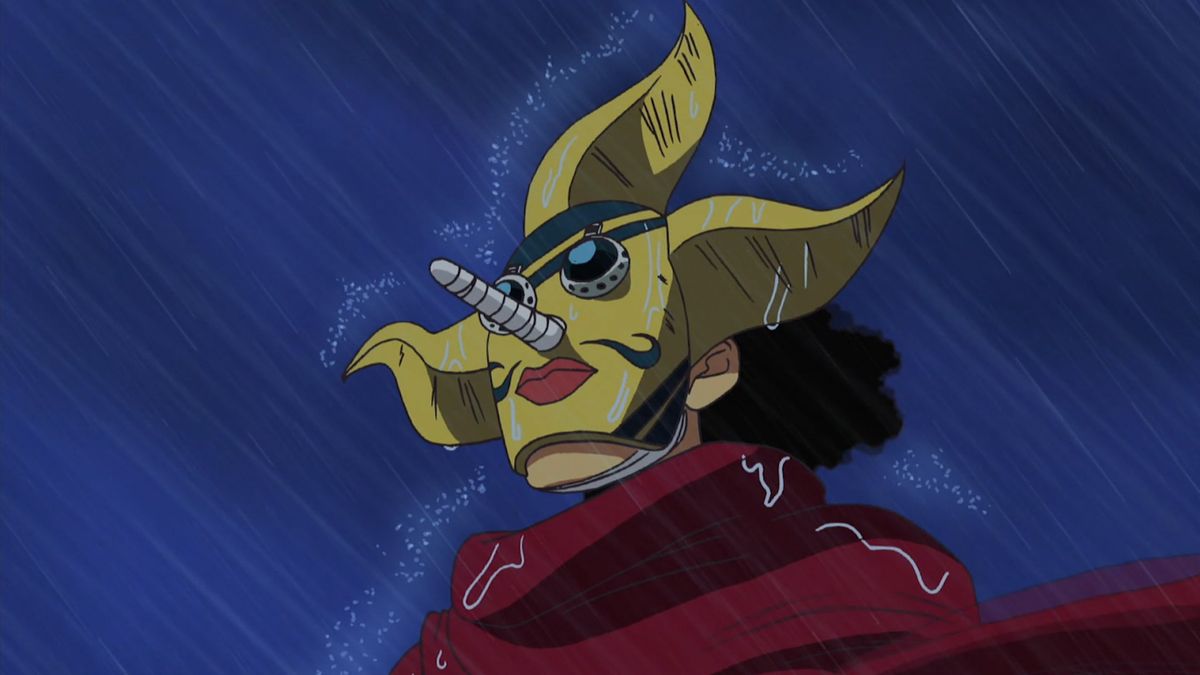
One Piece Episode 258 introduces Sogeking as Usopp’s masked bridge back into Robin’s rescue while Sanji advances through the government train.
Bottom line: Sogeking lets Usopp return to Robin’s rescue before pride lets Usopp return to the crew
One Piece Episode 258 introduces a mysterious masked hero whose voice, nose, panic, weapon, and friendship history somehow resemble Usopp. Nobody needs the disguise to be convincing for the disguise to matter. Usopp left after the duel over Merry and cannot walk back into the Straw Hats as though the argument disappeared. Robin is still being taken toward Enies Lobby, and waiting for perfect emotional readiness would mean abandoning her.
Sogeking creates a temporary identity capable of action. The mask does not cure fear or settle accountability. The mask gives courage a route through shame.
The official episode record
ONE PIECE.com lists Episode 258, “A Mysterious Man Appears? His Name Is Sogeking,” with a Japanese broadcast date of March 5, 2006. Hirohiko Kamisaka wrote the screenplay, Munehisa Sakai directed, Kazuya Hisada served as animation director, and Miyuki Sato and Fumihiro Uchida handled the credited art work.
The question mark in the title suits the joke. The identity is obvious, but the role allows Usopp to enter the sea-train battle under terms his wounded pride can survive.
Usopp’s mask is emotionally transparent and socially useful
Sanji knows who stands behind the mask. Viewers know. Any crewmate who has heard Usopp speak for more than a minute should know. Literal secrecy is not the point.
The people around him can accept Sogeking because exposing Usopp would force a reunion conversation in the middle of a government transport. Kindness sometimes means cooperating with an obvious fiction until the person can speak without the fiction.
Sogeking separates helping Robin from surrendering the Merry argument
Usopp still believes Luffy dismissed the ship and, by extension, the weakest member too easily. Luffy still believes a captain had to make the painful decision after Galley-La declared Merry unable to sail.
Joining the rescue does not resolve those positions. The disguise lets Usopp act on one shared truth: Robin did not choose government custody freely.
The mask protects dignity after public defeat
Usopp challenged Luffy, used every trick he had, and lost in front of the ship both men loved. Returning immediately could feel like admitting his grief, reasoning, and stand meant nothing.
Sogeking allows movement without demanding that humiliation become the admission price for caring about Robin.
The invented hero carries traits Usopp already possesses
Sogeking boasts, sings, poses, and claims impossible status. Under the performance, the role uses Usopp’s aim, inventions, fast reading of danger, and stubborn loyalty.
The hero is not imported from somewhere else. Usopp rearranges his own useful qualities into a character he can believe long enough to move.
Fear remains visible because courage does not require a calm body
Sogeking can shake, yell, hide, or regret the size of the enemy while continuing forward. That behavior does not cancel bravery. A fearless mask would flatten the person beneath the disguise.
Usopp’s courage has always been the decision made after fear explains every reason to run.
Sanji gives the disguise room instead of turning recognition into ridicule
He can tease Usopp later. Inside Puffing Tom, Sanji needs an ally with range and technical creativity. Respecting the temporary identity keeps that ally engaged.
The choice shows emotional intelligence through restraint. Sanji does not have to announce that he understands in order to act like he understands.
The sea train turns Sogeking from performance into responsibility
Government guards occupy multiple cars, prisoners remain restrained, and CP9 waits farther ahead. A funny name cannot defeat any of those conditions.
Usopp has to aim, plan, communicate, and accept consequences. The role earns meaning through the work performed while wearing the mask.
Sanji’s infiltration benefits from a fighter who does not fight like Sanji
Sanji controls close quarters with speed and kicks. Sogeking can strike switches, ropes, weapons, lights, and enemies from farther away. Different ranges let the pair solve problems one style alone would make harder.
The rescue improves when nobody treats physical similarity as the only form of usefulness.
Usopp can change a train car without overpowering every guard
Doors, couplings, narrow passages, windows, cargo, and communication lines create targets beyond bodies. A marksman can alter the environment and give stronger allies better positions.
That approach fits Usopp’s intelligence. He survives impossible fights by changing the terms instead of pretending he became physically invincible overnight.
Franky sees another person using performance as armor
Franky hides Cutty Flam behind a loud outlaw name, criminal reputation, speedos, poses, and a mechanical body. Sogeking uses a mask, title, cape, and heroic song.
Both men understand that an invented identity can protect a wounded history while also becoming a real tool for survival.
Franky’s chains do not make him silent
Government custody limits movement, but Franky continues reading the guards, arguing, and looking for a chance to resist. His knowledge of machinery and institutional cruelty remains active.
Sanji and Sogeking bring the opening that lets a restrained shipwright become a participant instead of cargo.
Robin remains farther ahead because CP9 understands her value differently
The government wants Franky for the blueprints and Robin for the ability to read ancient text. Agents separate valuable prisoners and surround Robin with the people most capable of reinforcing hopelessness.
Every car between the rescuers and Robin is part of a strategy to keep her from hearing the crew’s answer.
Sogeking’s arrival begins answering the weakness question from the Luffy duel
Usopp feared a crew built around extraordinary fighters would eventually leave behind anyone unable to keep pace. The rescue needs his aim, deception, inventions, and willingness to act while afraid.
His presence proves usefulness was never limited to matching Luffy or Zoro’s destructive power.
Robin and Usopp both tried to leave before the crew could choose them
Robin expected the government threat to make her an unbearable cost. Usopp expected Merry’s condition to reveal how the crew would treat a weaker member.
Sogeking helps rescue Robin while quietly confronting the same belief inside Usopp. He is still wanted in the work even after conflict, fear, and failure.
The difference is that Usopp has one silly bridge back
Robin cannot put on a mask and walk beside CP9 as a free participant. Her captors designed the bargain to make self-erasure look final.
Usopp’s disguise gives him enough control to re-enter action. The rescue must create a similar opening where Robin can choose without the government holding the crew’s lives over her.
The comedy refuses to wait for the trauma to disappear
Sogeking is funny because everybody can see Usopp and because the performance takes itself seriously. The joke exists beside grief over Merry and fear for Robin.
Humor does not erase either wound. The ridiculous role helps one wounded person keep functioning.
The theme song turns self-encouragement into public noise
Usopp has always used stories to regulate fear. Naming a hero, inventing a homeland, and singing about impossible skill create rhythm when panic would otherwise control the moment.
The song is not evidence that he believes every boast literally. The performance gives his body something to follow.
Sanji needs Sogeking to commit without demanding Usopp explain himself
The train keeps moving. A full conversation about the duel, Merry, and returning to the crew would consume time and place Sanji in a conflict that belongs mainly to Usopp and Luffy.
He accepts the help available now and leaves the relationship decision for Usopp and Luffy to make personally.
Trust begins through assigned work
Sanji can give Sogeking a target, a route, or a person to cover. Completing that task creates evidence more useful than demanding a promise about loyalty.
Usopp rebuilds connection one action at a time while the mask holds space around his pride.
The government guards underestimate comedy at their own expense
A masked man making grand claims can look unserious beside uniforms, orders, and official transport. That judgment confuses dignity with competence.
Usopp benefits whenever an opponent dismisses the slingshot, lies, and nervous body before seeing how those tools change a fight.
CP9 built a system optimized for predictable resistance
Locked cars, ranked guards, restraints, and a fixed route work well against prisoners who attack directly or wait for procedure. Sanji and Sogeking introduce improvisation from inside the transport.
One infiltrator breaks bodies. The other can break expectations, sightlines, and mechanisms.
Rocketman’s pursuit gives the advance team permission to take larger risks
Sanji and Usopp cannot see the train behind them at every moment, but they know Luffy will not accept Robin’s surrender once Nami reaches him. The possibility of support changes what they can attempt.
Resistance inside Puffing Tom no longer has to produce a complete escape alone. The job is to keep prisoners reachable until the coalition catches up.
Sogeking becomes real through consequences rather than identity paperwork
The mask may hide a name, but the choices made under the name affect Robin, Franky, Sanji, and every guard in the next car. A performed identity can carry genuine responsibility.
Usopp will eventually have to remove the mask and answer as himself. That future requirement does not make the current courage fake.
The episode preserves accountability by refusing an easy reunion
No one declares the duel forgotten. Luffy is not present to forgive Usopp, and Usopp has not apologized for the way he challenged the captain or tried to control the crew’s decision through departure.
The rescue can move forward while repair remains unfinished. Human relationships often require both truths at once.
Robin’s crisis gives Usopp a reason to become useful before he feels worthy
Waiting to feel confident, forgiven, or strong enough would leave him behind. Sogeking lets action arrive before self-belief catches up.
That order matters for people who build confidence from evidence. Usopp can look back at what he did in the mask and discover that the courage belonged to him.
A marksman gives the rescue reach that stronger fighters cannot imitate
Sanji can clear the carriage in front of him, but his legs cannot strike a distant lever around a prisoner, disable a mechanism without approaching the mechanism, or protect an ally across several lines of sight. Sogeking’s weapon extends the advance team’s influence beyond the nearest body.
That reach changes the meaning of strength inside a train. The most muscular person may control one doorway. A precise shot can open another doorway, interrupt communication, remove a key, or create an escape route before guards understand the source. Usopp’s contribution grows from accuracy and invention rather than pretending the slingshot became a sword.
The distinction answers his fear about being left behind. A crew does not need seven versions of Luffy. A crew needs different people capable of solving different distances.
The audience’s laughter becomes part of the protection around Usopp
Sogeking invites viewers to laugh because the disguise is obvious and the performance is extravagant. The joke remains affectionate when the story also respects the pain producing the performance. We can enjoy the song, mask, and impossible homeland without treating Usopp’s grief as foolish.
That balance matters for fandom writing too. Calling the character ridiculous is easy. Watching why the ridiculous choice helps him board a government train requires more attention. Humor and compassion can occupy the same paragraph without one apologizing for the other.
The result is one of those One Piece ideas that sounds like pure nonsense and then carries real emotional weight for years. Sogeking works because Usopp needed him, even when every friend already knew who was underneath.
RaeRae verdict: the disguise fools nobody, and that is exactly why the kindness around Sogeking matters
Episode 258 gives Usopp one of the funniest and most emotionally accurate coping strategies in the series. He cannot return as Usopp yet, so he invents a hero who can stand beside Sanji, help Franky, and keep moving toward Robin.
I do not need the mask to be convincing. I need the people who recognize him to understand why he needs the mask for one more train car. Sogeking is ridiculous, brave, useful, and painfully Usopp. The government should worry less about the name and much more about the slingshot.