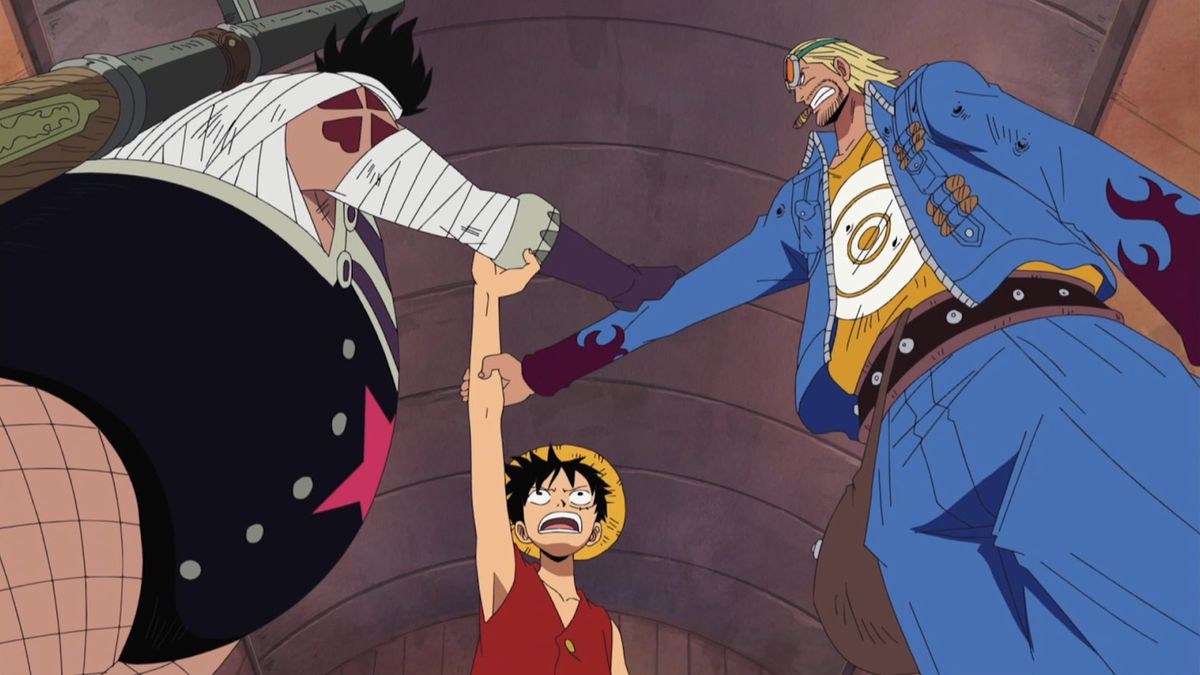
RaeRae Reacts · One Piece Episode 256
Former Enemies Board One Train Without Pretending the Past Vanished
One Piece Episode 256 puts Straw Hats, Galley-La shipwrights, and the Franky Family aboard Rocketman because saving their friends matters before forgiveness.
Bottom line: the Rocketman alliance works because former enemies share the danger without demanding instant forgiveness
One Piece Episode 256 packs pirates, shipwrights, dismantlers, Water 7 workers, and one deeply questionable prototype onto the same ocean rail. These people did not become best friends at the station. The Franky Family beat and robbed Usopp. The Straw Hats destroyed Franky House. Galley-La workers hunted the crew after Iceburg’s shooting. Every group has receipts.
They board anyway because Robin and Franky are being carried toward Enies Lobby by the organization that manipulated all of them. Cooperation does not erase the past. Cooperation decides which emergency must be faced first.
The official episode record
ONE PIECE.com lists Episode 256, “Rescue Our Friends! A Bond Between Enemies Sworn with Fists,” with a Japanese broadcast date of February 4, 2006. Hirohiko Kamisaka wrote the screenplay, Hiroaki Miyamoto directed, Takeo Ide served as animation director, and Miyuki Sato and Michiyo Kawasaki handled the credited art work.
The title identifies the alliance through action rather than sentiment. People who became enemies through violence now use the same fists, tools, and loyalty to reach friends held by the government.
Rocketman does not provide enough room for private grudges
The prototype throws bodies together while racing through storm water. Passengers cannot maintain elegant distance from people they resent. Everyone has to hold on, communicate, secure equipment, and avoid knocking an ally into the ocean.
Physical crowding makes the emotional reality visible. The coalition is uncomfortable because the conflict was real, not because the writers forgot to make everyone friendly.
The Franky Family joins for Franky before joining for Robin
Franky gave his followers work, belonging, protection, and a loud identity inside a city that often treated them as disposable troublemakers. Government custody threatens the center of their chosen family.
They do not need to understand Robin’s full history to help the Straw Hats. Their devotion points toward the same train for a different person.
Luffy accepts the Family’s help without rewriting what happened to Usopp
Usopp was beaten, humiliated, and robbed of the crew’s money. Luffy answered by destroying Franky House and fighting everyone he could reach. The injury does not become harmless because the attackers now want their boss back.
Accepting assistance means the rescue is larger than one grievance. Accountability can wait without being cancelled.
The Galley-La workers have to face how easily CP9 used their trust
Lucci, Kaku, Kalifa, and Blueno earned access through daily competence, shared labor, and professional familiarity. Their betrayal made Galley-La’s own workplace part of the assassination plan.
Paulie and the shipwrights join the pursuit because loyalty to Iceburg and Water 7 now requires acting against former colleagues they once respected.
Paulie’s anger toward the Straw Hats changes when the evidence changes
He believed Robin and the crew attacked Iceburg because the crime scene and eyewitness story pointed in that direction. CP9’s reveal exposed the manufactured case.
Changing his position is not weakness. Refusing to update after learning the truth would make pride more important than the injured person he wants to protect.
The coalition has no time for a ceremonial peace agreement
Aqua Laguna is striking the rails, Puffing Tom has a lead, and Enies Lobby is getting closer. Nobody can pause for a long meeting where every accusation receives equal speaking time.
The ride itself becomes the temporary agreement. Keep Rocketman moving. Reach the prisoners. Fight the government escort. Survive long enough to argue later.
Nami manages personalities as carefully as weather
She has to track the storm, the train, the route, and a carriage full of men who solve discomfort by shouting or punching. Navigation includes social obstacles when social conflict can destabilize the vehicle.
Nami’s authority comes from knowing which argument matters now and which argument can wait until nobody is being kidnapped.
Kokoro remains the person whose instructions cannot be treated as suggestions
Rocketman has excessive speed and poor control. Passengers who ignore Kokoro can injure themselves, shift weight at the wrong moment, or create a new mechanical problem during the storm.
Her age and drinking habits may invite jokes, but the train answers to her knowledge. Expertise does not disappear because the expert looks unconventional.
Chopper sees former enemies as patients before the fight is settled
Injured shipwrights and dismantlers are still bodies that can bleed, break, and collapse. Chopper’s medical duty does not require him to approve of every choice they made in Water 7.
Treating someone during a shared emergency is not forgiveness. Care can be morally necessary before trust becomes emotionally available.
Zoro keeps the alliance functional by refusing decorative friendship
He does not need everyone to exchange compliments or promise eternal loyalty. Zoro cares whether the people aboard can follow the objective and avoid becoming liabilities.
His bluntness helps because fake warmth would invite more argument. A narrow working relationship is enough for the route ahead.
Luffy understands coalition through shared direction
The captain rarely needs formal political language. If a person wants to save someone on the train ahead and is willing to help, that person belongs in the current effort.
The simplicity works because Luffy does not demand control over every motive. He wants Robin. The Family wants Franky. Both goals require reaching Enies Lobby.
Former enemies still watch one another for betrayal
Trust cannot become complete during one noisy departure. People check weapons, positions, and reactions. The memory of recent violence keeps every promise provisional.
That caution feels earned. One Piece does not have to turn suspicion into cruelty or pretend trust should arrive on command.
Shared danger creates evidence faster than speeches can
A person who steadies another passenger, secures a rope, follows Kokoro’s order, or shields the train from debris contributes something observable. Reliable action begins replacing assumptions formed during the earlier conflict.
Trust grows through repeated usefulness under pressure, not one beautiful declaration about unity.
The Franky Family’s ridiculous presentation hides real organizational skill
They run a dismantling operation, move heavy material, manage salvage, and respond quickly when their boss disappears. Matching clothes and dramatic poses do not make them incompetent.
The rescue benefits from people accustomed to physical work, dangerous equipment, and loyalty outside respectable institutions.
Galley-La brings construction knowledge to a vehicle likely to break something
Shipwrights understand stress, fast repairs, ropes, structural failure, and the behavior of wood and metal under water pressure. Rocketman is exactly the kind of machine that may demand those skills without warning.
The alliance becomes stronger because different workers carry different practical knowledge, not because everyone can throw the same punch.
On Puffing Tom, Sanji keeps converting infiltration into access
Sanji has already entered the government train and begun removing guards between the rear cars and the prisoners. His work prevents CP9 from using travel time as a calm transition into Enies Lobby custody.
Each opened passage gives Usopp and Franky more room to communicate, plan, and create trouble from inside.
Usopp’s Sogeking identity allows cooperation without a false reunion
Usopp still believes he left the crew, and Luffy still has not repaired the break. The mask creates enough emotional distance for him to assist Robin without asking everyone to ignore the duel over Merry.
Sanji can work with the obvious disguise because preserving Usopp’s courage matters more than exposing him for a joke.
Franky begins seeing the Straw Hats through what they risk for Robin
He watched their internal conflict over Merry and fought Luffy during the city’s chaos. The sea-train rescue shows another part of the crew. They chase a woman who tried to make herself impossible to save.
That stubborn loyalty matters to a man whose own family was shaped by Tom’s refusal to abandon difficult children.
Robin remains the person most likely to misunderstand the coalition
She expects her danger to drive people away. A train filled with Straw Hats, Franky Family members, and Galley-La workers contradicts the survival pattern she learned across twenty years.
Robin has not seen the whole group yet. The rescue will need to become visible enough that she cannot dismiss one infiltrator as an uninformed exception.
The World Government accidentally united people CP9 worked hard to divide
The assassination frame turned Water 7 against the Straw Hats. The blueprint hunt separated Iceburg and Franky. Robin’s coercion isolated her from the crew. Each tactic depended on controlled suspicion.
Once CP9 revealed itself, those divisions began collapsing into a shared account of who engineered the crisis.
The alliance exposes the cost of secret policing
CP9 agents entered civilian workplaces, built relationships under false identities, and used those relationships to access political and technical targets. Their method damaged community trust beyond the immediate mission.
Water 7’s coalition becomes a response to that damage. People compare what happened and discover that separate injuries came from the same hidden operation.
Rocketman carries laborers against an institution collecting knowledge
The government wants Robin’s ability to read ancient text and Franky’s possession of Pluton’s plans. CP9 treats knowledge as a resource to seize while treating the knowledgeable people as containers.
The rescuers bring another relationship to skill. Shipbuilding, navigation, medicine, cooking, combat, and salvage belong to people who use those abilities for communities they chose.
The episode makes solidarity messy enough to believe
People interrupt, argue, boast, and misunderstand one another. Nobody discovers perfect language for collective action between two waves.
The uneven behavior makes the commitment stronger, not weaker. They are not cooperating because every personality suddenly fits. They are cooperating because the people ahead matter more than comfort.
The fists in the title carry history as well as promise
These groups met through violence, and their bodies still carry evidence of those meetings. A fist can injure, defend, threaten, or seal a rough agreement depending on the person and moment.
The alliance does not romanticize every punch. The same physical force once used against one another is being redirected toward the system that exploited their conflict.
The rescue will test whether the coalition can survive a larger enemy
Working together inside Rocketman is one challenge. Enies Lobby will bring soldiers, agents, gates, command structures, and public government authority. Stress will expose every weak agreement.
The group does not need permanent unity. They need enough trust to keep moving when the institution ahead tells each faction to save itself.
The coalition also challenges Water 7’s respectable and disposable labels
Galley-La workers occupy admired positions inside the city’s central company. The Franky Family survives through dismantling, theft, intimidation, and work Water 7 prefers to keep at the edge of polite civic identity. The Straw Hats arrived as outsiders and became convenient suspects as soon as Iceburg was attacked.
CP9 used those divisions because a city finds hidden power harder to recognize while residents are busy sorting one another into trustworthy workers, criminal troublemakers, and foreign pirates. The agents wore respectable jobs. The people now chasing them include nearly everyone the respectable story told Water 7 to distrust.
Rocketman does not solve inequality through one exciting ride. The carriage creates a temporary place where status matters less than skill, loyalty, and willingness to carry risk. Paulie’s ropes, the Family’s muscle, Nami’s weather judgment, Chopper’s medicine, Kokoro’s driving, and Luffy’s commitment all become necessary. Nobody can purchase a better seat in the rescue by looking respectable.
The storm measures contribution with brutal honesty. A useful hand matters more than a clean reputation when the rail disappears beneath another wall of water.
RaeRae verdict: nobody aboard Rocketman owes instant friendship, but everybody owes the rescue honest work
Episode 256 understands that a common enemy does not clean old wounds. Usopp was hurt. Franky House was destroyed. Galley-La trusted assassins. Robin and Franky are prisoners. Those facts can stand together without one cancelling another.
The coalition earns my support because the members stop demanding emotional perfection before action. They can apologize later, fight later, and decide who trusts whom later. Right now, Kokoro needs people to hold on, Nami needs them to listen, and two families need Rocketman to catch the government train.