RaeRae Reacts · One Piece Episode 253
Sanji Turns the Sea Train into Contested Ground
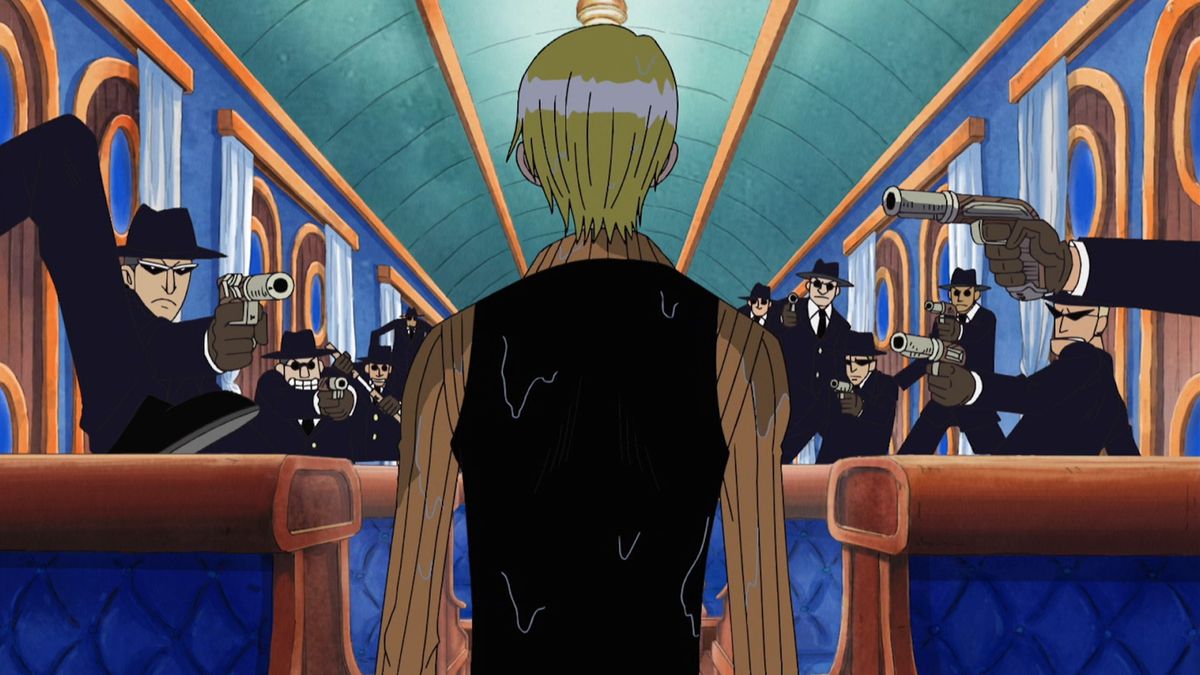
One Piece Episode 253 has Sanji board Puffing Tom and begin dismantling the government escort while Robin and Franky remain prisoners ahead.
Bottom line: Sanji boards the sea train and proves government custody is only secure until a Straw Hat gets inside
One Piece Episode 253 turns Puffing Tom from a symbol of separation into the first battlefield of Robin’s rescue. Sanji does not wait for Luffy, a citywide plan, or permission from a captain currently trapped between buildings. He boards the moving train because Robin is aboard, Franky is aboard, and every mile toward Enies Lobby makes the government’s advantage harder to reverse.
The decision is reckless in the exact way the emergency requires. CP9 controls the route, guards, prisoners, and destination. Sanji changes one fact. The train now carries an enemy who chose his position instead of being placed there.
The official episode record
ONE PIECE.com lists Episode 253, “Sanji Barges In! Sea Train Battle in the Storm,” with a Japanese broadcast date of December 11, 2005. Hirohiko Kamisaka wrote the screenplay, Yoko Ikeda directed, Kazuya Kubo served as animation director, and Miyuki Sato and Fumihiro Uchikawa handled the credited art work.
The title states the new phase plainly. The story leaves the mystery of Robin’s motives behind and begins fighting across the government train carrying her toward Enies Lobby.
Sanji chose the station before the crew understood why Robin left
He followed movement, timing, and suspicion rather than waiting for complete information. That choice placed him near Puffing Tom when CP9 departed. The same habit that makes Sanji disappear during group confusion lets him reach the machinery behind a crisis.
Good instincts do not replace teamwork forever. In this moment, the instincts buy the crew something more valuable than a clean explanation: a person inside the moving target.
Boarding Puffing Tom requires commitment without an exit plan
A train crossing open water does not offer side streets, rooftops, or easy retreat. Once Sanji gets aboard, every guarded car sits between him and Robin. The storm makes outside rescue uncertain and falling from the train potentially fatal.
He accepts those limits because waiting at the station would make Robin’s removal easier for CP9. Risk becomes the cost of refusing their timetable.
The government agents mistake procedure for control
Prisoners have been loaded, doors secured, guards posted, and the route cleared toward Enies Lobby. Each completed step tells the agents the operation has passed beyond ordinary interference.
Sanji’s presence exposes the weakness inside that confidence. Procedure works when nobody violates the expected sequence. A pirate climbing onto the train during Aqua Laguna was not included in the sequence.
Puffing Tom was designed to defeat the sea, not protect CP9 from Sanji
Tom built an engine capable of crossing dangerous water and reconnecting isolated islands. Strength, speed, and stability serve transportation. Government custody benefits from those features without owning the purpose behind them.
Sanji uses the train’s enclosed structure against its guards. Narrow cars reduce escape routes, but they also force opponents to meet him in controlled spaces where his kicks can end a fight quickly.
The storm turns every carriage into a moving pressure chamber
Rain and waves strike outside while bodies collide inside. Windows and doors frame the ocean close enough to make every broken barrier dangerous. The train never stops carrying everyone toward the judicial island.
The movement keeps combat tied to time. Sanji cannot win one encounter, rest, and decide what comes next tomorrow. Every delay belongs to CP9.
Sanji attacks the escort system before reaching the strongest agents
Government transport depends on layers. Ordinary guards control doors and prisoners while elite agents remain closer to the highest-value targets. Removing the outer layer gives Sanji room to move and creates uncertainty farther up the train.
The approach fits his best crisis work. He does not announce himself at the hardest door first. He changes conditions until the hardest door becomes less protected.
His fighting style suits a train full of people he cannot casually endanger
Sanji relies on close-range precision rather than explosives or wide attacks that could damage the track, engine, or prisoner cars. The restraint is not softness. Protecting the transport long enough to rescue Robin is part of winning.
A fighter who ignores the environment could defeat guards and still deliver everyone into the ocean.
The kitchen-trained body remains part of the rescue
Sanji’s legs carry the physical argument, but his profession shapes how he reads enclosed rooms, tools, heat, timing, and human needs. He is not a generic martial artist wearing a suit. The cook and the fighter remain the same person.
That connection matters because his loyalty began through food and care long before Robin’s crisis. Sanji protects a crew by feeding them, planning around them, and kicking through anyone who tries to remove them.
Robin’s location is still protected by distance inside the train
Getting aboard does not mean reaching her. Several cars, guards, locked doors, and CP9 members remain between Sanji and the prisoner whose decision started the chase.
The structure gives the episode a clear practical problem. Rescue requires advancing without warning the entire escort too early or damaging the route needed to carry Robin back.
Franky is not a passive prisoner waiting for a Straw Hat hero
Franky understands the sea train, the government’s interest in Pluton, and the personal history attached to Spandam. Captivity limits his movement, not his judgment. He watches, argues, and waits for a useful opening.
Sanji’s infiltration matters partly because a person already inside can turn a small opening into a larger revolt.
Franky and Sanji have different reasons to save Robin
Sanji acts because Robin is his crewmate and because her surrender was coerced. Franky sees a fellow prisoner targeted for knowledge connected to the Ancient Weapons and understands the institution collecting both of them.
The reasons do not need to match. Cooperation can begin with a shared enemy and become trust through the work of escape.
Usopp’s presence keeps the crew’s unresolved wound on the train
Usopp has not repaired the duel with Luffy or accepted Merry’s condition. He still moves toward Robin because leaving the crew did not erase years of attachment. The crisis catches him between pride and love.
Sogeking gives him a way to act without pretending the previous conflict disappeared. The mask is comedy built around a genuine emotional need.
Sanji recognizes Usopp because friendship is not defeated by a mask
The disguise changes the name, posture, and performance. Familiar speech and familiar panic remain underneath. Sanji can accept the role without humiliating the person using the role to return.
That quiet cooperation is kinder than ripping off the mask for a joke. Usopp showed up. The emergency can let that fact matter before demanding a confession.
Sogeking allows courage to arrive before confidence
Usopp does not suddenly stop fearing CP9, the storm, or Enies Lobby. He creates a character who can move while the fear remains. Performance becomes a tool rather than proof of dishonesty.
The bravest part is not believing the invented hero is invincible. The bravest part is using the invention to board the rescue anyway.
The train group becomes an accidental advance team
Sanji has combat skill and tactical instincts. Usopp brings range, inventions, and an ability to create confusion. Franky understands machinery and carries enormous physical power even under restraint. Robin knows CP9’s objective and the cost of failure better than anyone.
The group is not organized yet, but the ingredients for disruption are already riding together.
CP9’s hierarchy creates blind spots between cars
Elite agents expect ordinary guards to manage ordinary resistance. Guards expect orders to flow from people farther ahead. That division makes each layer slower to understand a threat that entered from behind.
Sanji benefits from the delay. Every defeated guard creates a pocket where prisoners and rescuers can communicate before the strongest opponents fully respond.
The episode rewards observation more than loud confidence
Sanji succeeds because he noticed the departure plan, chose the station, and read the train one car at a time. He does not need to declare that strategy makes him smarter than everyone else. The useful position proves the point.
Competence feels human when decisions, timing, and correction carry the result instead of a speech about genius.
Robin still does not know the whole crew rejected her bargain
Sanji’s presence may show that one crewmate followed, but Robin has spent twenty years expecting small acts of care to end when institutional danger becomes clear. She can interpret an infiltrator as another person who has not understood the full cost yet.
The rescue needs more than physical proximity. Robin must hear an answer from people who know exactly why she surrendered.
Sanji cannot force Robin to want rescue on his timetable
He can defeat guards and open doors. He cannot kick twenty years of survivor guilt out of her. Treating emotional resistance as another obstacle to overpower would repeat the denial of agency that CP9 already uses.
The crew must create safety for Robin to speak, disagree, fear, and finally choose life without making the choice for her.
Enies Lobby remains the real deadline
The train battle can free space and slow the escort, but the judicial island concentrates government forces around a gate designed to move prisoners deeper into state custody. Every rail marker brings that machinery closer.
Sanji’s advance team needs the rest of the crew behind them. One fighter inside cannot carry Robin, Franky, Usopp, and a train full of enemies through the entire operation alone.
Water 7 still has to produce a pursuit vehicle during Aqua Laguna
Luffy, Zoro, Nami, Chopper, and their allies remain behind in a city under evacuation. Catching Puffing Tom requires more than desire. They need transport capable of following sea rails through the storm.
The practical problem makes Tom’s engineering legacy central again. Rescue depends on people who understand machines, routes, weather, and the risks of open water.
The sea train battle changes the emotional meaning of departure
Episode 252 used the whistle to announce separation. Episode 253 places resistance inside the thing doing the separating. Puffing Tom still moves toward Enies Lobby, but the journey no longer belongs entirely to CP9.
That change does not erase the danger. The train becomes contested territory, which is the first believable step toward taking a prisoner back.
Sanji’s rescue instinct works best when romance talk stays out of the way
Sanji cares deeply about Robin, and his exaggerated devotion to women can become exhausting comedy. This episode is stronger when action carries the feeling. He noticed she was in danger, followed the route, and boarded the train.
No flowery declaration could improve the evidence already provided by his body moving through the storm.
The fight preserves the ICONIC pleasure of a competent entrance
Sanji showing up where the government assumes no Straw Hat could be feels good because the story built the position honestly. He did not teleport into the carriage. Earlier choices placed him near the station, and the dangerous boarding completes those choices.
The entrance earns style through preparation. That is the kind of cool I will happily replay.
The episode keeps the rescue collective even while Sanji leads this phase
Sanji gets the immediate spotlight, but Nami uncovered Robin’s motive, Chopper carried the truth, Usopp chose to return under a mask, Franky waits inside the escort, and the rest of the crew is fighting to begin pursuit.
No single hero owns Robin’s rescue. Each person solves a different piece of the distance she created to protect them.
RaeRae verdict: Sanji does not stop the train, but he ends CP9’s clean getaway
Episode 253 gives Sanji exactly the kind of assignment that makes him shine. He reads the crisis early, takes a dangerous route alone, works through confined spaces, and turns a secure transport into a problem before the government understands the size of the problem.
Robin is still moving toward Enies Lobby, and the crew behind her still needs a miracle with an engine. The important change is simple. She is no longer traveling only with captors. A cook, a masked liar, and one furious shipwright are now inside the story CP9 thought they controlled.