RaeRae Reacts · One Piece Episode 243
The Government Hid Its Assassins Inside Everybody’s Workday
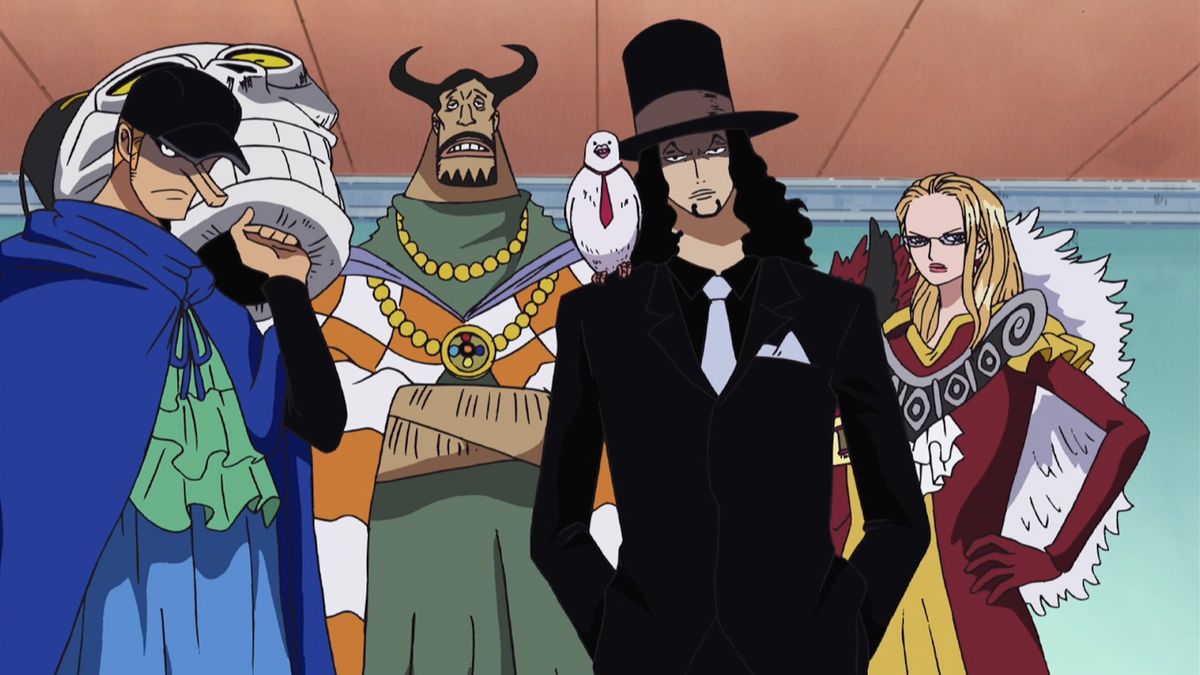
One Piece Episode 243 reveals Lucci, Kaku, Kalifa, and Blueno as CP9 agents who spent five years using Galley-La and Water 7 as operational cover.
Bottom line: CP9’s faces are shocking because Water 7 already trusted the hands
One Piece Episode 243 removes the masks and reveals Rob Lucci, Kaku, Kalifa, and Blueno as CP9 agents. The surprise works because these people did not hover around Galley-La like obvious spies. They worked. Kaku inspected ships. Kalifa managed Iceburg’s office. Lucci built vessels beside the men now bleeding on the floor. Blueno poured drinks while Water 7 talked.
The betrayal is institutional before the episode becomes physical. CP9 did not steal trust in one clever conversation. The agents earned access through years of competent labor, then used every relationship as intelligence in the end.
The official episode record
ONE PIECE.com lists Episode 243, “CP9 Unmasked! Their Shocking True Faces,” with a Japanese broadcast date of September 4, 2005. Hirohiko Kamisaka wrote the screenplay, Konosuke Uda directed, Kazuya Hisada served as animation director, and Miyuki Sato and Kumiko Fukuzawa handled the credited art work.
The official summary centers the agents removing their masks before Iceburg and exposing familiar Water 7 faces. The episode adapts material from the Water 7 manga sequence collected around Volume 36, where the mansion raid becomes an internal betrayal rather than an outside assault.
Luffy is still trapped because urgency cannot squeeze through masonry
Luffy struggles between two buildings while the rest of the crew reaches the mansion grounds. His absence is funny until the reveal begins without him. The captain wanted answers first and managed to remove himself from the room where the answer is speaking.
The delay reinforces Water 7’s central rule. Strength does not replace route knowledge. Luffy can defeat guards and shatter stone, but a bad approach wastes time the crew does not have.
Nami, Zoro, and Chopper enter through people who think they are murderers
The three Straw Hats face Galley-La shipwrights protecting Iceburg. Neither side entered the courtyard wanting this particular fight. The crew needs Robin. The workers believe Robin’s crew attacked their mayor.
CP9 designed that collision. Every guard occupied by Zoro or Chopper is one fewer defender near the real agents. Every Straw Hat attack makes the frame look more convincing to witnesses outside.
Paulie realizes the papers in his hands are bait
Masked agents corner Paulie after he retrieves the documents from Iceburg’s safe. He sees injured workers behind them and understands that the raid targets the plans rather than revenge against the Straw Hats.
Paulie’s loyalty put him exactly where Iceburg intended and where CP9 predicted. The decoy protects the deeper secret for another moment, but Paulie paid for the deception without knowing the terms.
Iceburg recognizes a government operation too late to preserve ordinary trust
Iceburg understands that the attackers belong to CP9 and seek blueprints tied to Pluton. He also understands that the organization may have lived inside his company. Suspicion reaches backward through years of meetings, repairs, schedules, and private conversations.
That retroactive damage is part of espionage. Discovery does not only threaten tonight. Discovery contaminates memory. Iceburg must reconsider every helpful gesture as a possible collection method.
The masks come off in the order of access
Lucci, Kaku, Kalifa, and Blueno reveal themselves. Each face explains a different breach. Lucci and Kaku lived among the shipwrights. Kalifa controlled office access and records. Blueno operated a bar where workers and residents spoke freely.
The team covered technical, administrative, social, and physical space. CP9 did not need one perfect spy. The government built a network that watched Iceburg from every ordinary angle.
Lucci’s silence was never inability
Water 7 knew Lucci as a ventriloquist whose pigeon spoke for him. The reveal exposes that silence as camouflage. He chose not to use his own voice while people built assumptions around the harmless performance.
Hattori helped turn a dangerous man into an eccentric coworker. Comedy became cover. Lucci could observe, judge, and withhold reaction while the room underestimated how much he understood.
Kaku’s cheerfulness made the ship inspection feel safe
Kaku inspected the Going Merry, ran across Water 7’s rooftops, and delivered the devastating keel diagnosis with professional seriousness. Nothing about the verdict needed to be false for the cover to work.
That truth makes the betrayal worse. Kaku’s expertise was genuine. Usopp’s grief was genuine. CP9 let him perform honest labor because competent work purchased trust more effectively than constant lying.
Kalifa had Iceburg’s calendar before CP9 needed his room
As Iceburg’s secretary, Kalifa knew appointments, correspondence, access patterns, office habits, and the people he called when frightened. Administrative labor placed her near every piece of information an infiltration team would value.
The role also made her presence invisible. A secretary entering an office does not trigger alarm. CP9 weaponized the social habit of treating administrative access as background.
Blueno listened while Water 7 relaxed
Blueno’s bar gave him access to conversations outside formal work. People reveal different information over drinks than they do in meetings. Complaints, rumors, loyalties, and old grudges collect around a bartender who appears neutral.
His Door-Door Fruit adds physical access to social access. Blueno can hear the route, learn the wall, then create an entrance where no door existed.
Paulie sees coworkers and receives proof that proximity is not loyalty
Paulie’s shock carries years of shared labor. These are not strangers wearing stolen faces. He worked beside them, argued with them, trusted their skill, and believed their concern for Iceburg.
The agents respond through mission language rather than apology. Their lack of emotional explanation protects the operation and denies Paulie a relationship he can mourn properly. CP9 treats the years as a deployment. Paulie lived them as life.
Iceburg asks why the government wants a weapon while pretending to protect the world
The Pluton blueprints represent catastrophic power. CP9 frames acquisition as government necessity, but the covert raid exposes how little lawful restraint surrounds the pursuit.
The World Government criminalizes forbidden research while sending assassins after forbidden engineering. Safety is not the consistent principle. Monopoly is. Knowledge becomes acceptable when authority controls the hands holding the page.
Robin stands beside the reveal without becoming part of their trust
Robin appears aligned with CP9, but she did not spend years embedded in Galley-La. Her role is leverage, archaeology, and visible blame. The agents use her reputation while withholding membership in their real circle.
That distinction limits the simple betrayal reading. Robin participates in the raid and causes harm. CP9 still treats her as an instrument rather than a colleague with equal information.
The Six Powers turn ordinary bodies into government weapons
CP9 techniques allow agents to move through air, harden bodies, strike with concentrated force, and exceed normal human limits through training. The system matters because the power does not come from one rare Devil Fruit.
The government can train agents in a repeatable combat discipline, then insert them into civilian institutions. CP9’s danger is organizational. A powerful pirate may be unique. A state can build a program.
Galley-La’s defenders lose without becoming foolish
The shipwrights fought masked intruders with weapons, numbers, and knowledge of the mansion. CP9 possessed better intelligence, specialized techniques, surprise, and trusted positions. Defeat does not erase the workers’ competence.
The episode protects their dignity by showing how thoroughly the operation was prepared. Water 7 did not fail because nobody cared. The people who cared were mapped and redirected.
The reveal rearranges every earlier scene
Lucci’s quiet strength, Kaku’s impossible rooftop movement, Kalifa’s access, and Blueno’s calm observation now carry second meanings. The arc planted capability in public before naming the private purpose.
Good foreshadowing does not make the answer obvious. The clues looked like colorful character traits because Water 7 is filled with eccentric, skilled people. CP9 hid inside the genre’s normal abundance.
Konosuke Uda lets recognition land before the next blow
The direction gives the familiar faces space. Masks lower. Paulie and Iceburg react. The episode does not rush past identity to reach a fight. Betrayal needs a beat where memory catches up.
Once the names settle, movement resumes with a different emotional weight. A punch from Lucci is no longer an impressive shipwright defending his boss. The same hand belongs to the man who helped create the threat.
Kazuya Hisada preserves the cover identities inside the agents
The revealed characters remain visually recognizable. CP9 does not transform them into unrelated villains. Posture, gaze, and clothing shift enough to expose purpose while the faces stay familiar.
That continuity matters. The betrayal belongs to these exact coworkers. A dramatic redesign would let viewers separate the friendly Kaku from the agent too easily.
Hattori becomes evidence of how carefully Lucci managed attention
The pigeon routine encouraged coworkers to treat Lucci’s silence as an eccentric personal limitation. People directed conversation toward Hattori, laughed at the act, and stopped expecting Lucci to reveal much through speech. He could remain present without becoming socially exposed.
The cover also shows patience. Lucci accepted looking strange and harmless because the performance served the mission. CP9 does not require agents to dominate every room. Sometimes the most dangerous person is the man everybody has politely stopped asking to speak for himself.
Water 7’s pride in talent created a blind spot
Galley-La recruits exceptional workers and celebrates unusual skill. Kaku’s rooftop speed, Lucci’s strength, Kalifa’s precision, and the foremen’s combat ability all fit a workplace where greatness is normal. Extraordinary movement did not automatically signal espionage because the whole company ran on larger-than-life competence.
That culture is not wrong. Water 7 should value craft. CP9 exploited the assumption that anybody who worked brilliantly for the company must share the company’s loyalties. Skill proves ability. Skill does not prove allegiance.
Paulie’s anger deserves more than a betrayal reaction shot
Paulie is not only embarrassed that spies fooled him. His coworkers used his devotion to Iceburg as a predictable mechanism. They knew he would take the papers, defend the room, and risk his life before surrendering something his boss asked him to protect.
CP9 turns his best quality into a route toward the safe. That violation explains why the reveal cuts deeper than professional rivalry. Paulie’s loyalty was real, and the agents studied the real thing closely enough to weaponize the timing.
That pride was earned through real work, which makes the abuse worse. CP9 borrowed Galley-La’s reputation without contributing loyalty to the community that reputation supported. The agents collected trust as operational equipment and abandoned the people who supplied that cover.
What changed after another watch
The first watch asks how Lucci, Kaku, Kalifa, and Blueno could be CP9. Another watch asks how many useful things they did while waiting. Every repair, schedule, drink, and conversation made the cover stronger.
Kaku’s Merry inspection becomes especially uncomfortable. He told the truth about the ship. The moment proves that spies do not need every interaction to be fake. Honest expertise can be the most effective disguise.
RaeRae verdict: the government did not hide monsters under masks, the government hired coworkers
Episode 243 earns the reveal because Water 7 had reasons to trust these people. Lucci, Kaku, and Kalifa contributed real labor. Blueno provided a familiar public space. Their usefulness was not a side effect of the mission. Usefulness was the method.
The result is more frightening than four strangers breaking through a wall. An outside enemy tests locks. CP9 learned who carried the keys, who checked the safe, who loved Iceburg, and which employee would run toward an explosion. Then the agents clocked in until the signal came.
Receipts and where to watch
The official ONE PIECE.com Episode 243 record supplies the Japanese title, September 4, 2005 broadcast date, Water 7 placement, story summary, and official image used on this page. Credited production staff include Hirohiko Kamisaka, Konosuke Uda, Kazuya Hisada, Miyuki Sato, and Kumiko Fukuzawa. Crunchyroll carries licensed One Piece streaming availability by region.
This React stops with Episode 243 knowledge. Later episodes expand CP9’s mission, Pluton, Franky’s identity, Robin’s bargain, and the agents’ full abilities. The honest shock here is enough: Water 7’s trusted workers were the masked organization the city believed was outside.