RaeRae Reacts · One Piece Episode 1000
The Straw Hats Reunite on the Live Floor as Luffy Marks Episode 1000 by Naming Kaido as the Target
One Piece Episode 1000 React follows King and Queen blocking the roof, Franky defeating a Number, and all ten Straw Hats assembling around Luffy.
One Piece Episode 1000 React: Episode 1000 celebrates endurance by bringing the Straw Hats into one frame without pretending the road here was smooth. Luffy and Zoro try to reach the roof, Queen takes brachiosaurus form, and King locks down the air with flying Gifters. Their failed shortcut drops them back onto the live floor, where another Number rises and the war threatens to scatter everyone again. Franky answers by combining the Black Rhino and Brachio Tank into General Franky, turning years of shipwright invention into room for his captain to keep moving.
RaeRae’s opening receipt
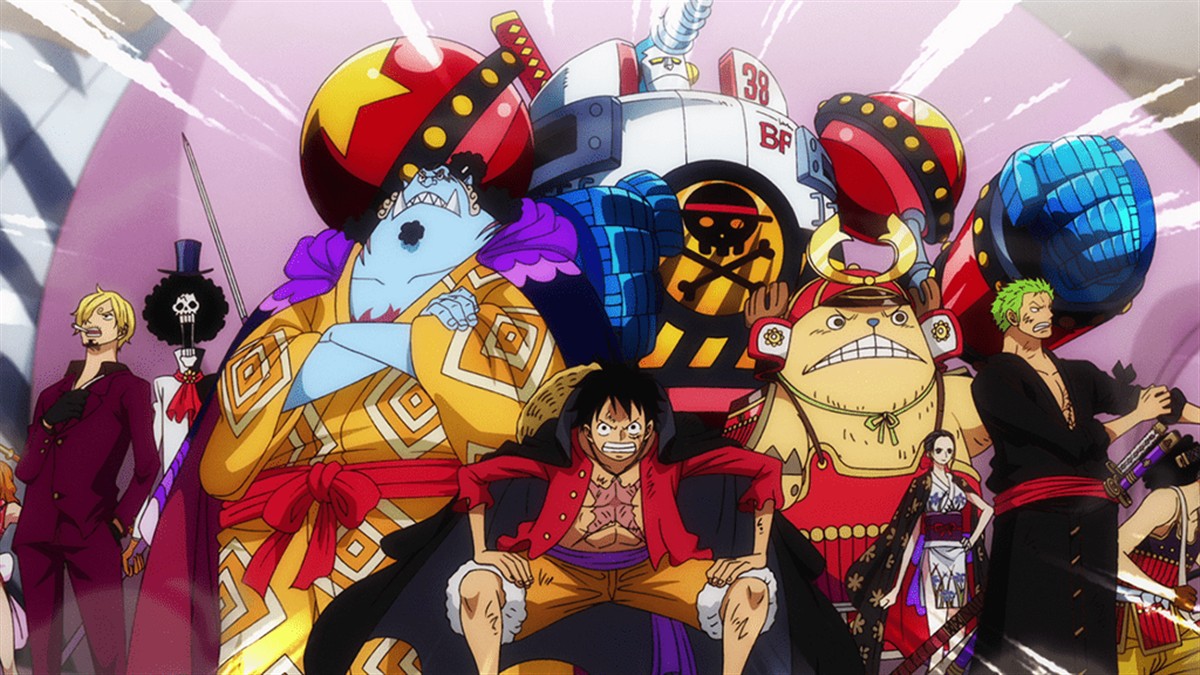
Sanji frees himself from the wall and the crew gathers by skill, history, and stubborn timing: Zoro, Nami, Usopp, Sanji, Chopper, Robin, Franky, Brook, Jinbe, and Luffy. The anniversary staging recalls earlier formations without flattening how much has changed. Robin asked to live at Enies Lobby. Franky became family after beginning as an enemy. Brook crossed decades of solitude. Jinbe arrived after promises, delay, and a war that took Ace. Their lineup carries every island where belonging had to be chosen again. Luffy does not deliver a retrospective speech. He says he is going to knock Kaido down. The simplicity fits. One thousand episodes matter because the crew still converts impossible declarations into shared labor. The pose is celebratory, but the celebration points forward toward a roof none of them can yet reach easily.
Queen blocks the direct climb
Brachiosaurus scale turns the route upward into a mouth capable of ending the attempt immediately.
The staircase gains teeth.
The direction gives the reaction enough room to land before the next piece of information arrives. Faces, pauses, and changes in posture carry political meaning because One Piece understands that world news matters through the people forced to live beneath each headline.
King controls the air above
Flying Gifters extend the commander’s defense beyond a single body and close the obvious aerial answer.
The roof keeps a winged gate.
This scene changes the practical map rather than decorating an explanation. A name gains danger, a promise gains labor, or an old story gains consequences that somebody in the present must now carry.
Luffy and Zoro fall together
Their shortcut fails without changing the destination or producing shame about trying.
Momentum returns to the floor.
Nothing here offers a clean heroic reward. Courage can arrive beside arrogance, loyalty beside terrible judgment, and comedy beside a threat capable of remaking several nations. That contradiction gives the episode fandom texture instead of museum polish.
A Number rises into the chaos
Giant force makes the live floor dangerous even before the All-Stars descend personally.
Scale interrupts the route again.
The performances refuse emotional minimalism. Voices crack, eyes widen, bodies take up ridiculous space, and the score lets astonishment become public. The excess works because every loud choice rests on a specific political or personal consequence.
Franky assembles General Franky
Separate vehicles become a larger answer because engineering was always part of the crew’s combat language.
The machines remember their design.
Wano has spent twenty years teaching people to mistake survival for consent. Each recovered memory or repaired relationship pushes against that lesson and gives the coming raid more than a military reason to exist.
The shipwright clears room for the captain
Franky treats defeating the Number as division of labor rather than a demand for Luffy’s attention.
Support wears armor.
The episode also asks who gets to control the official version. Newspapers, government briefings, inherited legends, and public accusations all compete with the knowledge held by people who were actually present.
Sanji returns from King’s attack
The cook rejoins after absorbing the price of Momonosuke’s rescue and surviving transformed force.
The relay runner comes back bruised.
One Piece makes connective tissue behave like an event. A conversation can redirect an army, reclassify a former ally, or turn a half-remembered pirate into the missing center of modern history.
Jinbe completes the ten-person lineup
His presence closes a promise that crossed Fish-Man Island, Whole Cake Island, and delayed reunion.
The helmsman reaches the portrait.
The consequence remains active after the scene ends. Lost time, damaged trust, hidden loyalty, and inherited obligation travel into the next decision, preventing a gorgeous frame from becoming an isolated clip.
Every crewmate carries a chosen belonging
The formation holds former enemies, survivors, runaways, dreamers, and people once convinced solitude was safer.
Found family earns the wide shot.
The direction gives the reaction enough room to land before the next piece of information arrives. Faces, pauses, and changes in posture carry political meaning because One Piece understands that world news matters through the people forced to live beneath each headline.
Episode 1000 looks backward through staging
Visual echoes reward memory without turning the current war into a clip show.
Anniversary lives inside action.
This scene changes the practical map rather than decorating an explanation. A name gains danger, a promise gains labor, or an old story gains consequences that somebody in the present must now carry.
Luffy names Kaido as the next task
The captain reduces monumental history to a promise the crew can help make true.
Celebration points toward the roof.
Nothing here offers a clean heroic reward. Courage can arrive beside arrogance, loyalty beside terrible judgment, and comedy beside a threat capable of remaking several nations. That contradiction gives the episode fandom texture instead of museum polish.
The world outside Wano keeps moving
The closed country can delay outside news, but the Reverie, the Marines, the Emperors, and the Revolutionary Army continue changing the conditions waiting beyond the raid.
Isolation protects secrets without stopping history.
The performances refuse emotional minimalism. Voices crack, eyes widen, bodies take up ridiculous space, and the score lets astonishment become public. The excess works because every loud choice rests on a specific political or personal consequence.
Power depends on the story people believe
A title such as Warlord, Emperor, shogun, criminal, or hero can organize public behavior before anybody tests the person carrying that title.
Reputation becomes infrastructure.
Wano has spent twenty years teaching people to mistake survival for consent. Each recovered memory or repaired relationship pushes against that lesson and gives the coming raid more than a military reason to exist.
Inherited will is never passive
Names and promises survive only because somebody chooses new work in the present. Memory without action would become another ornament controlled by whoever already owns the room.
Legacy demands hands.
The episode also asks who gets to control the official version. Newspapers, government briefings, inherited legends, and public accusations all compete with the knowledge held by people who were actually present.
The episode respects political confusion
Characters receive incomplete reports, react from personal history, and make urgent choices before every fact becomes available. The mess feels human because global change never arrives as a tidy reference page.
News creates several truths at once.
One Piece makes connective tissue behave like an event. A conversation can redirect an army, reclassify a former ally, or turn a half-remembered pirate into the missing center of modern history.
Comedy keeps the exposition alive
A strange face, an argument, or an oversized reaction opens breathing room without erasing the danger underneath. Laughter helps the audience absorb information while remaining attached to the people affected.
The joke carries a receipt.
The consequence remains active after the scene ends. Lost time, damaged trust, hidden loyalty, and inherited obligation travel into the next decision, preventing a gorgeous frame from becoming an isolated clip.
The camera watches the witnesses
Who flinches, celebrates, denies, or goes quiet can matter as much as the speaker. Reaction shots turn background figures into a chorus measuring how far one revelation travels.
Information becomes communal.
The direction gives the reaction enough room to land before the next piece of information arrives. Faces, pauses, and changes in posture carry political meaning because One Piece understands that world news matters through the people forced to live beneath each headline.
Wano turns preparation into character
Ships, swords, codes, disguises, and gathering places reveal who plans for other people and who assumes force can replace trust. Logistics become another form of personality.
The raid is built before the battle.
This scene changes the practical map rather than decorating an explanation. A name gains danger, a promise gains labor, or an old story gains consequences that somebody in the present must now carry.
Violence cannot settle every inheritance
A powerful strike may end the immediate obstacle, but family history, state propaganda, and betrayal keep asking for answers after the dust clears. One Piece lets the emotional bill outlive the spectacle.
Victory does not erase context.
Nothing here offers a clean heroic reward. Courage can arrive beside arrogance, loyalty beside terrible judgment, and comedy beside a threat capable of remaking several nations. That contradiction gives the episode fandom texture instead of museum polish.
RaeRae keeps the side-eye with the love
I can celebrate the craft and still question the choice, especially when a character calls recklessness destiny or authority calls fear justice. Fandom devotion becomes stronger when admiration leaves room for argument.
Affection does not cancel judgment.
The performances refuse emotional minimalism. Voices crack, eyes widen, bodies take up ridiculous space, and the score lets astonishment become public. The excess works because every loud choice rests on a specific political or personal consequence.
The next episode inherits this pressure
The final beat does not close the subject so much as transfer responsibility. Somebody now knows more, owes more, fears more, or has fewer places left to hide.
Momentum carries a cost.
Wano has spent twenty years teaching people to mistake survival for consent. Each recovered memory or repaired relationship pushes against that lesson and gives the coming raid more than a military reason to exist.
This remains an episode React
This page responds to the choices, performances, pacing, and consequences contained inside One Piece Episode 1000. The larger Wano, Reverie, or series verdict belongs on an arc or series Review. Keeping that line clear matters because one episode can thrill, frustrate, or completely rearrange the board without pretending to judge the entire saga. An episode-specific receipt also preserves pacing and performance choices that disappear when hundreds of chapters collapse into one verdict. The reaction belongs to this hour, this arrangement of scenes, and this exact stopping point. That boundary keeps praise and criticism accountable to what viewers actually watched rather than memories borrowed from later revelations.
The official local image remains canonical
The official Episode 1000 story still is stored inside the local WordPress media library. One attachment serves as the featured image, top hero, static directory card, and social preview. No reused feature art and no remote image dependency sit behind the card.
What stays with me after the credits
The strongest One Piece episodes leave me holding several reactions at once. I can love the scale, laugh at the audacity, distrust the institution delivering the news, and worry about the person who will pay for a decision made three oceans away. That emotional overlap feels right for a story where private promises keep colliding with public history. Nobody receives the luxury of acting from complete information. People move with loyalty, grief, ego, rumor, and whatever courage remains after the first plan breaks.
That is why this episode earns a specific React instead of disappearing into one giant Wano summary. A single look can revise a relationship. One line can expose the machinery beneath a familiar title. A joke can make the following cruelty hit harder because laughter lowered the guard for half a second. I want room to praise those choices, argue with them, and remember which consequence belongs to which hour. The episode does not need artificial perfection to matter. The rough edges, impossible personalities, political mess, and sincere feeling are exactly where fandom conversation begins.
My other lasting receipt concerns scale. One Piece can place an island-erasing secret beside a friend waiting at a port, then insist both deserve attention. The world may be enormous, but consequence still reaches a particular kitchen, newspaper, prison cell, ship, or grieving face. That grounding keeps lore from becoming trivia. History matters because somebody inherits the missing explanation, and politics matter because somebody loses safety when a title changes. I keep returning to the witnesses for that reason. Their confusion gives the revelation weight before a narrator can convert emotion into a fact list. Their laughter prevents the story from turning homework. Their fear reminds me that a thrilling announcement can be catastrophic for the people living beneath powerful names. Fandom conversation needs all three reactions. Wonder without consequence becomes empty hype, while consequence without personality turns a living story into a report. This episode holds the messy middle, where information changes relationships and every new answer creates a sharper question.