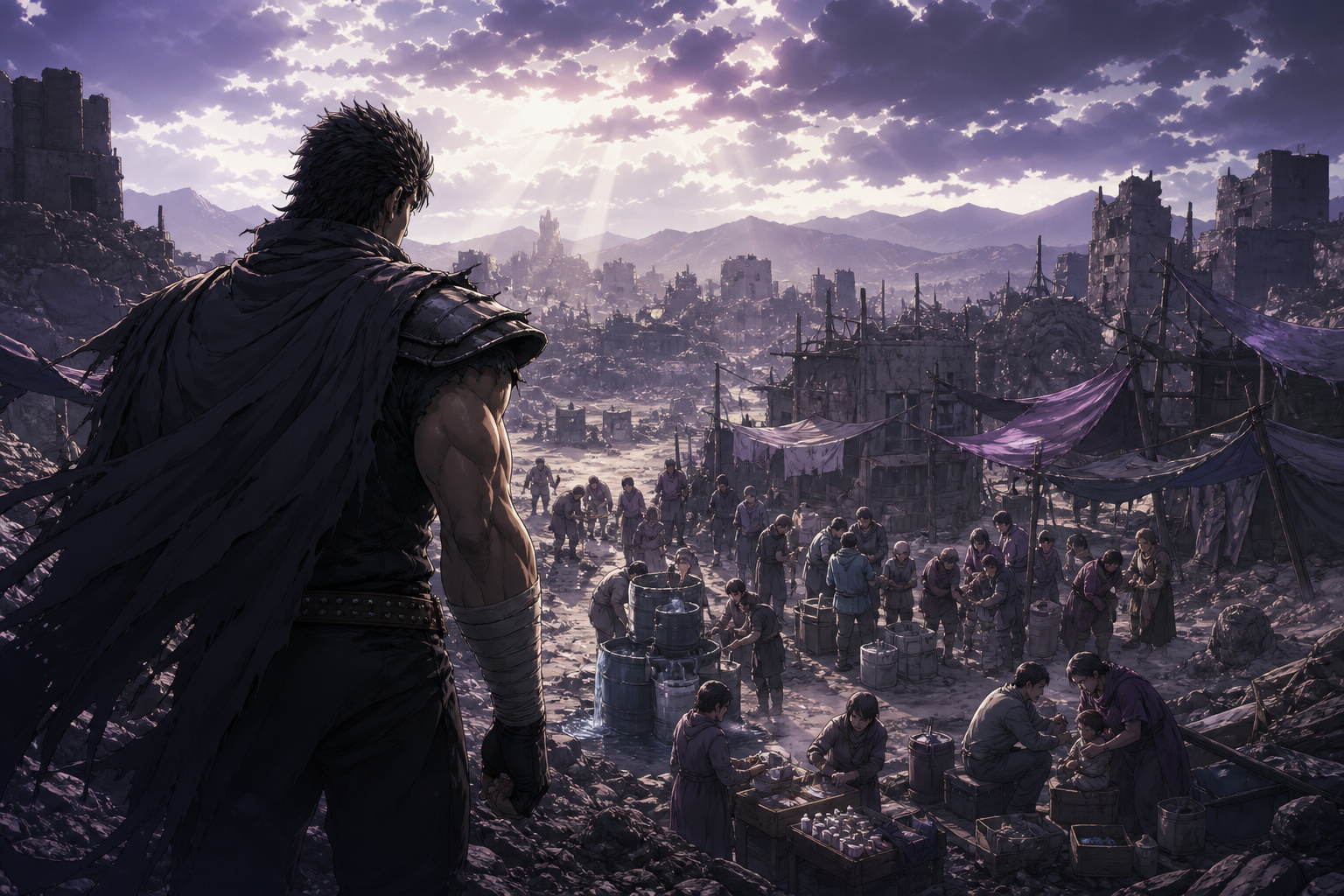
Fist of the North Star Original Series Review: The Wasteland Is a Government
The complete 109-episode Review follows Kenshiro through power, grief, masculinity, community, and the cost of waiting for one savior. Spoilers: This Review discusses the original series through the completion of the Raoh conflict.
The wasteland is a government, and every fist is a policy
Fist of the North Star is much stranger, sadder, and more politically alert than the exploding-body reputation suggests. The original 109 episodes build a world where the apocalypse did not end government. It removed the polite language. Wells become borders. Medicine becomes leverage. Prisons become warehouses for useful bodies. Uniforms turn hunger into procedure.
Kenshiro walks through those arrangements with enough power to end almost any immediate threat. The series stays interesting when it admits that destroying the man guarding a well does not teach a village how to share water tomorrow. Its greatest episodes make ordinary people part of liberation. Its weakest let everybody wait while one legendary body solves history.
One hundred nine episodes belong to the first verdict
Toei Animation records the combined television production as 152 episodes broadcast on Fuji TV from October 11, 1984 through March 5, 1987. This Review covers the first 109-episode phase commonly identified as the original Fist of the North Star, ending with the completion of the Raoh conflict. The 43-episode Fist of the North Star 2 phase receives a separate season Review.
Toyoo Ashida served as chief director, Masami Suda designed the characters, Mitsuki Nakamura handled art design for the first phase, and Nozomi Aoki composed the music. Writers credited across the television production include Shozo Uehara, Toshiki Inoue, Hiroshi Toda, Yuho Hanazono, and Tokio Tsuchiya. The weekly series is a collective production, not one unbroken authorial voice.
A seed tells us more about the series than a catchphrase
The early journey establishes its moral grammar before the famous brothers occupy the horizon. Kenshiro meets people whose lives have been reduced to resources somebody else controls. The seed carried toward tomorrow matters because it represents labor that cannot be replaced by a savior. Kenshiro can protect the carrier. He cannot grow the future for them.
That distinction keeps the series from becoming empty revenge. “You are already dead” provides release after cruelty has made negotiation meaningless. The seed asks what release is for. Violence becomes interruption, not destination. The best episodes never forget the difference.
His restraint is the character, not decoration around his power
Kenshiro is nearly unbeatable, which means suspense cannot depend only on whether his body survives. The real tension lies in judgment. Whom does he believe? When does he intervene? Can overwhelming skill enter a vulnerable community without becoming another form of ownership?
His silence carries meaning through attention. He changes pace around children, listens before announcing, recognizes fear before adults name it, and treats small promises as seriously as succession. He is not emotionally empty. He is a man whose world gives tenderness too few protected places to exist.
The children keep the legend answerable to ordinary life
Bat and Lin prevent Kenshiro’s journey from floating completely into martial mythology. They need food, rest, safety, explanations, and evidence that adults can be trusted. Their vulnerability is not only a device that generates rescue. It is the measurement by which every ruler’s claim becomes legible.
Lin’s moral clarity can become symbolic, while Bat’s practicality can be reduced to comedy. The series is strongest when both remain people learning skills, forming judgment, and affecting outcomes. A future represented only by children waiting to inherit is not yet a future.
Southern Cross turns rejected love into public infrastructure
Shin’s feeling for Yuria is real and irrelevant to the question of consent. She says no. He responds by kidnapping her and building magnificence around the belief that spectacle can overwrite an answer. Southern Cross is entitlement with zoning authority.
Kenshiro’s conflict with Shin works because the men do not merely want the same person. They embody different definitions of love. Shin treats intensity as permission. Kenshiro’s better moments protect Yuria’s will even when grief makes that protection painful.
A stolen name damages people far from the original wound
Jagi cannot tolerate a world in which Kenshiro’s selection means something about his own limits. He copies the scars, steals the name, and uses reputation as a weapon. The fraud works because stories travel faster than verification in the wasteland.
His arc turns identity into infrastructure. People harmed by “Kenshiro” may never meet the real man. Repair requires more than defeating Jagi. A name must become trustworthy again through repeated choices. Resentment can impersonate authority faster than integrity can rebuild it.
Beauty, vengeance, and the slow correction of loyalty
Rei enters as a dangerous unknown with a technique whose grace makes brutality look weightless. His search for Airi has narrowed his future into one wound. That purpose keeps him moving and leaves him vulnerable to anyone who can manipulate the wound.
His alliance with Kenshiro matters because trust survives situations designed to weaponize the people they love. His relationship with Mamiya matters because protection repeatedly risks becoming another decision made over a woman’s voice. Rei becomes iconic when loyalty changes him rather than merely proving he was noble all along.
The story wants a woman fighter and keeps negotiating against her
Mamiya insists on entering danger as a decision-maker, not as the emotional receipt for male heroism. Her competence forces Kenshiro and Rei to encounter a woman whose survival plan includes her own action. That should be ordinary. In this franchise, it becomes a continuing argument.
The writing admires her courage and repeatedly pulls her toward symbolic femininity, romantic protection, and suffering organized around men. She is not weak because the narrative is inconsistent. The inconsistency reveals how badly the series wants agency and traditional gender order at the same time.
Hokuto becomes medicine when knowledge answers to care
Toki proves that pressure-point mastery is not born only to kill. The same attention to breath, muscle, pain, and internal structure can relieve suffering. His presence prevents the inheritance conflict from collapsing into a contest between different styles of domination.
Radiation illness turns his time into a limited resource, and the series risks romanticizing the sacrifice. Toki deserved a future beyond being useful to everyone else. His generosity matters because it is chosen. It should not be used to claim that losing his future was spiritually appropriate.
Imitation becomes medical abuse when expertise loses accountability
Amiba’s fraud is more frightening than simple disguise because he performs healing authority while treating vulnerable bodies as experimental material. Desperate people cannot meaningfully consent when the person controlling treatment lies about identity, method, and risk.
The arc exposes how reputation creates access to bodies. Toki’s name opens doors because it has earned trust. Amiba treats trust like laboratory equipment. Kenshiro’s anger is not only personal insult. It is a response to care being converted into domination.
The Fist King turns fear of weakness into everybody else’s government
Raoh builds an answer to collapse: concentrate power, eliminate uncertainty, and make resistance impossible. The answer has emotional logic because he has seen vulnerability exploited. It becomes tyranny when his private terror of helplessness becomes law for people who never chose it.
His charisma matters. Empire cannot survive on fear alone. Raoh offers certainty, scale, and the promise that chaos will end beneath one unquestioned authority. The series gives him grief, love, admiration, and a code. Those qualities explain allegiance. They do not refund freedom.
Moral centrality does not replace dramatic agency
Yuria carries compassion, memory, and the possibility that power might recognize something beyond itself. Men organize rivalry, redemption, and destiny around her. The more spiritually central she becomes, the greater the danger that personhood will disappear inside symbolism.
Everyone tells us what Yuria means. The series gives her fewer opportunities to define what meaning costs, what she wants beyond male survival, or how she understands being moved between captors, protectors, and prophecies. Reverence can become a beautiful cage.
Six stars prevent rival technique from becoming one generic opposite
Nanto Seiken matters because it contains different disciplines, personalities, duties, and relationships to violence. Shin, Rei, Yuda, Shu, Souther, and Yuria cannot be understood as interchangeable representatives of one rival school.
The constellation structure gives the series variety and creates another destiny system capable of explaining people too neatly. The useful reading keeps technique and choice together. A star may name a role. It does not make the ethics of everyone beneath that star inevitable.
A child taught that love creates pain may decide pain proves authority
Souther’s cruelty grows from an emotional wound the series frames as formative without allowing it to become absolution. He converts vulnerability into architecture, ritual, and the labor of children. The pyramid makes private grief physically public.
Shu’s resistance exposes the political cost of Souther’s philosophy. Compassion is not merely a feeling between named men. It becomes protection, sacrifice, and collective refusal. The arc is strongest when the suffering children remain people rather than props proving two masters disagree.
Catharsis works when the harmed people remain visible
The series turns bodily reversal into a moral joke. A man who treated other bodies as disposable discovers his own body is not exempt. The release can feel righteous because cruelty receives consequence after ordinary resistance has been made impossible.
Repetition creates risk. When victims disappear before the explosion, punishment becomes product. The best episodes return to the people who needed interruption and show what victory changes. Violence has context only when survival remains on screen.
The men are allowed to cry after their bodies have paid admission
Fist of the North Star gives enormous men permission to love, mourn, fear, admire, and collapse. That remains emotionally powerful. It also makes vulnerability easiest at death, defeat, or the moment physical dominance has already been certified.
Kenshiro’s care in action provides another model. Toki’s healing makes expertise gentle without making it weak. Rei’s loyalty revises vengeance. Raoh and Shin show what happens when emotion claims authority over others. The series expands masculinity and keeps violence as its primary translator.
Courage is present; narrative ownership is distributed less generously
Lin, Mamiya, Yuria, Airi, and other women carry courage, judgment, survival, political meaning, and emotional consequence. The problem is not absence of value. It is how often their value becomes evidence inside a man’s transformation.
A woman suffers and a man learns what kind of man he is. A woman refuses and a man builds a city around ignoring her. A woman acts and the story negotiates whether action threatens femininity. The pattern does not erase powerful moments. It gives those moments something structural to fight.
The detours sometimes understand society better than the mythology does
Anime-original episodes and expanded conflicts can interrupt momentum, repeat a familiar gang structure, or delay a confrontation viewers already want. They can also give the wasteland social density the central saga rushes past.
A detour earns its place when it shows how ordinary people organize, collaborate, betray, heal, or inherit after violence. It fails when a disposable villain appears only to trigger another technique demonstration. “Filler” names production relationship. It does not finish the quality judgment.
The songs turn survival into collective memory
Crystal King’s “Ai wo Torimodose!!” gives the series an opening declaration large enough to match its bodies, while “Yuria… Eien ni” carries the mournful register beneath the violence. Later theme changes mark the story’s shifting phase rather than merely refreshing packaging.
Nozomi Aoki’s score supports threat, grief, movement, and myth with recurring emotional language. Music helps weekly production feel continuous even when animation resources fluctuate. A familiar cue can make a return feel like history arriving.
The series survives because tenderness keeps refusing the world built to kill it
The original 109 episodes are uneven, repetitive, visually inconsistent, emotionally excessive, and far more thoughtful than their meme reputation. The long form gives rivalry time to become history and gives communities enough space to expose the politics beneath martial mythology.
Its greatest belief is that strength matters only when it refuses ownership. The series violates that belief, rediscovers it, and asks why domination feels comforting when the world is unsafe. Kenshiro’s fist ends immediate danger. The people who plant, organize, heal, and remember decide whether tomorrow exists.
Zeed makes water ownership visible before the mythology arrives
The opening conflict establishes the series in material terms. A village does not need a philosopher-king. It needs water, food, safety, and the right to plant without armed men converting survival into tribute. Zeed’s gang rules because violence controls access, not because anybody believes in a sophisticated ideology.
Kenshiro’s arrival interrupts the immediate threat, but the seed carried toward tomorrow prevents the episode from pretending interruption is enough. Growth belongs to people willing to remain, cultivate, distribute, and remember. The hero protects possibility. He does not manufacture it.
A uniform turns cruelty into procedure
God Army expands the threat from gang appetite into institutional discipline. Training, rank, obedience, and punishment let violence reproduce itself even when one officer is absent. The uniform tells recruits that responsibility belongs upward and suffering belongs downward.
Kenshiro can defeat the Colonel, but the arc’s sharper observation lies in how ordinary men learn to perform cruelty as duty. Systems become durable when participants treat orders as moral outsourcing. The series keeps returning to that excuse under different banners.
A predator understands hope well enough to weaponize it
Jackal survives through opportunism rather than grand philosophy. He reads what people need, waits for trust to form, and attacks the relationships most likely to produce hesitation. His intelligence makes him uglier than a brute who only charges.
Devil Rebirth escalates physical scale, but Jackal’s real weapon remains manipulation. He treats another being’s captivity, rage, and need for recognition as material. Kenshiro’s victory feels cathartic because it stops someone who converted every available vulnerability into leverage.
Repetition becomes useful when each town reveals a different institution
The first stretch can feel like a sequence of gangs waiting to announce a gimmick. That repetition is the cost of weekly structure and an opportunity. A well, prison, bell, military base, false miracle, or trade route reveals a different way scarcity becomes authority.
Detours fail when a villain exists only to die in a novel shape. They succeed when people living under the villain possess routines, loyalties, and choices. Social specificity turns formula into a map of collapse.
Shin’s private obsession requires public labor
Southern Cross makes possession architectural. Shin’s city is not a love letter. It is a workforce, security apparatus, and resource pipeline organized to convince one captive woman that grandeur has changed the meaning of refusal.
The series gives this machinery more room than the movie, which makes Shin more politically grotesque. Every tower is proof that private entitlement becomes public policy when nobody can challenge the person who wants it.
Family loyalty becomes monstrous when outsiders stop counting as people
The Fang Clan presents collective identity without universal ethics. Members understand loyalty, grief, hierarchy, and protection inside the group. They simply refuse to extend personhood beyond it. That boundary lets affection coexist with atrocity.
Fang King weaponizes hostages and family bonds because he knows love changes calculation. The arc tests whether Kenshiro and Rei can trust one another when an enemy designs evidence to make trust look foolish. Their answer turns alliance into history.
Rescue begins where the adventure story wants to end
Finding Airi resolves Rei’s search and begins Airi’s recovery. Captivity, fear, and loss do not disappear because a loved one arrives. The series sometimes understands this through her hesitation and need to regain agency, then moves attention back toward the men protecting her.
Airi matters beyond motivating Rei. Her future tests whether rescue restores choice or merely changes who manages her safety. The distinction should remain visible whenever devotion starts sounding like ownership.
A prison is a library of knowledge Raoh refuses to let the world read
Cassandra holds martial artists, teachers, bodies, and techniques that could complicate Ken-Oh’s monopoly. The prison does not merely punish enemies. It controls circulation. Knowledge becomes dangerous when people can compare rulers, methods, and possibilities.
Uighur turns confinement into spectacle, while guards and systems make cruelty routine. Liberation becomes stronger when prisoners and surrounding people act beside Kenshiro. A savior can open the gate. People inside have to decide what freedom organizes next.
Shared lineage does not create an obligation to obey a corrupted teacher
Raiga and Fuga confront the claim that martial ancestry should outrank conscience. Sōjin invokes lineage as ownership, expecting knowledge given in the past to dictate action forever. The brothers refuse to let gratitude erase judgment. Their choice matters because institutions survive through emotional debts. A teacher can become abusive while insisting history makes disobedience betrayal. Loyalty remains ethical only when it can say no.
The healer returns to a world that already consumed his future
Freeing Toki restores a moral alternative to Raoh’s power and exposes the cruelty of a system that imprisons care. His body carries radiation, lost succession, forced absence, and the knowledge that liberation cannot return stolen time.
The series sometimes treats his decline as beautiful destiny. I reject that comfort. Toki’s generosity becomes meaningful because he continues choosing it under loss. The loss itself remains an injustice, not a spiritual promotion.
Raoh’s army converts one man’s certainty into thousands of daily decisions
Raoh becomes empire through organization. Commanders, guards, messengers, prisons, supply control, and stories of invincibility extend him beyond his body. Defeating one unit does not erase the incentives and fears keeping the machinery active.
The series often personifies systems because named villains provide dramatic focus. Its better episodes keep showing the people who enforce, comply, resist, defect, and survive. Empire requires participation even when one silhouette dominates the poster.
Loyalty tests become cruelty when other lives are treated as laboratory material
Ryuga wants certainty about Kenshiro’s worth and subjects others to violence to obtain it. The test assumes a legendary question deserves ordinary casualties. That assumption is the problem before the answer arrives.
Fist repeatedly lets elite men turn communities into evidence for private conclusions. Kenshiro’s character may be revealed by response, but the harmed people did not consent to become an examination. A moving result cannot clean the method.
Resistance becomes credible when sacrifice is not the only thing it knows how to praise
Shu’s compassion, leadership, and relationship with children give the Nanto resistance a social purpose beyond defeating Souther. He represents power organized around protection and shared risk rather than personal glory.
His suffering is iconic and dangerously easy to romanticize. A resistance that celebrates martyrdom without protecting its people can reproduce the same economy of disposable bodies it opposes. Shu matters most as a leader before sacrifice turns him into a monument.
The Holy Emperor builds grief into a labor system for children
Souther converts emotional injury into political doctrine. Love caused pain, so vulnerability must be destroyed. His pyramid makes that doctrine material through forced child labor and ritualized authority. Private trauma becomes public architecture again.
Kenshiro’s confrontation matters because understanding Souther does not require forgiving the system built from that wound. Pain explains why domination feels safer to him. It does not make dominated children less real.
The giant who protects children terrifies Raoh more than another conqueror
Fudo’s power carries a history of violence, but his present identity is organized around care. He demonstrates that physical scale does not dictate political purpose. Children approach the body others fear because experience has taught them it will not demand ownership.
Raoh’s fear exposes a weakness empire cannot solve. Fudo commands loyalty without coercion. That authority cannot be manufactured through armor, titles, or punishment. It has to be earned through repeated safety.
Freedom without responsibility can become another privilege
Juza’s refusal of structure makes him charismatic in a world crushed by obligation. He resists being owned by destiny, command, and social expectation. That refusal contains truth and becomes incomplete when other people bear the cost of his detachment.
His eventual commitment gains weight because it is chosen rather than automatic. The series romanticizes his wildness and recognizes that freedom becomes ethically meaningful only when it can answer someone beyond the self.
Strategy fails when people become pieces and information becomes confidence
Rihaku represents planning against overwhelming force, but strategy does not become wise merely because it opposes Raoh. Plans can misread people, create unintended danger, and treat women or younger allies as assets rather than decision-makers.
The series needs intelligence beyond the fist. It also needs accountability for intelligence. A strategist should be judged by what the plan asks others to risk and whether those people had a voice in the asking.
The Nanto structure turns protection into both duty and secrecy
The revelation around the final Nanto general reorganizes earlier relationships and intensifies Yuria’s symbolic role. Secrecy may protect a vulnerable figure from enemies, but it also lets institutions make decisions around her without her participation.
Protection becomes paternalism when the protected person cannot meaningfully shape the plan. The series gives the duty grandeur and leaves us to question the structure that made concealment look like the only available care.
The horse understands grief more honestly than several rulers do
Kokuoh is not merely scale attached to Raoh. The animal carries presence, loyalty, memory, and a relationship not built through speeches about destiny. That bond lets Raoh appear capable of connection without making conquest disappear.
Fist often finds emotional truth through beings who cannot participate in its ideological declarations. A horse, child, or ordinary survivor reacts to what power does rather than what power calls itself.
The final duel matters because both men have already answered what strength is for
The confrontation works after one hundred episodes because technique is no longer the whole argument. Kenshiro and Raoh have built histories through how they treat grief, loyalty, weakness, love, and people without comparable power.
Victory becomes the physical conclusion of accumulated ethics, not proof that the winner was automatically right. Kenshiro’s path matters because restraint, relationship, and sorrow changed him. Raoh’s grandeur remains real and insufficient.
A tyrant can die magnificently without empire becoming innocent
Raoh’s final recognition and death produce one of the franchise’s defining emotional images. The series grants him dignity because he is fully human, not because conquest has been reimbursed.
Fandom often turns a beautiful ending into retroactive defense. Resist that. Grief can coexist with judgment. We can mourn the person he might have been and remember the people who lived under the person he chose to become.
The long road earns what the film has to borrow
The original series gives relationships accumulation, institutions repetition, and communities enough time to become more than scenery. Its length creates redundancy and creates history. Rei’s loyalty, Toki’s care, Raoh’s threat, and Kenshiro’s restraint deepen because we see them tested repeatedly.
The cost is pacing, inconsistent animation, anime-original material of uneven quality, and emotional beats stretched past their strongest point. The reward is a world inhabited enough for legend to have consequences.
Consistency is not the same as sameness
A weekly television anime cannot place theatrical resources into every cut. The series relies on held drawings, repeated movement, pans, impact frames, stock effects, and strategically concentrated animation. Variation between episodes is visible and should not be treated like a scandal discovered forty years late.
The useful question is whether an episode spends its limited movement where emotion and action need it. A held face can carry grief. Rei’s technique needs directional precision. Raoh can dominate through stillness. Economy becomes artistry when form matches purpose.
Character design makes philosophy visible before dialogue
Masami Suda’s designs give the anime bodies that communicate different relationships to power. Kenshiro is controlled mass. Raoh expands into hierarchy. Rei becomes dangerous elegance. Toki’s gentleness changes how similar knowledge occupies the body.
The designs are exaggerated enough to become icons and specific enough for performance. That balance lets tiny changes in eyes, mouth, or posture matter inside anatomy already operating at mythic scale.
The wasteland needs evidence of use, not only evidence of destruction
Mitsuki Nakamura’s credited art design for the first phase helps the series turn ruins into recurring social spaces. The strongest backgrounds show how survivors repurpose remains: a wall becomes defense, scrap becomes housing, an old road becomes a supply line, and a tower becomes authority.
Generic desert corridors appear too, especially when weekly production needs movement between conflicts. The difference matters. Ruins become political when we can see who lives in them and who controls passage.
The series refuses to paint every apocalypse the same brown
Television color gives villages, fortresses, prisons, deserts, and night battles distinct emotional temperatures even when materials repeat. Bruised skies, harsh reds, cold cells, sickly interiors, and sudden softness help the anime move between threat and mourning.
Limited palettes sometimes flatten detail, while strong episodes use contrast to make impact readable. Color becomes most effective when it separates ordinary life from the theatrical environments rulers build around themselves.
The delay between strike and consequence is the whole sentence
Hokuto violence depends on timing. Kenshiro strikes, the opponent remains confident, a statement names what has already happened, and the body discovers it no longer belongs to the person who used it as authority.
That delay creates dread, comedy, and moral reversal at once. Repetition can reduce it to catchphrase machinery. Variation in performance, victim context, and aftermath decides whether an explosion lands as consequence or content.
Stylization can obscure gore and intensify imagination at the same time
The television production uses silhouettes, light, color, framing, and reaction to present extreme bodily destruction within broadcast constraints. Obscuring detail does not necessarily reduce intensity. Suggestion can make the viewer complete the transformation.
The method also gives violence a graphic language distinct from anatomy. Bodies become symbols of arrogance collapsing. That stylization remains ethically dependent on whether the people harmed before retaliation still matter afterward.
The narrator supplies propulsion without standing outside the joke
Shigeru Chiba’s narration turns exposition, escalation, preview, and recap into performance. His energy tells the audience that this world’s impossible certainty should be felt sincerely and enjoyed with awareness of its theatricality. That balance is difficult. Mockery would puncture emotion. Flat solemnity would let excess become accidental parody. Chiba occupies the charged space between them.
Kenshiro’s voice uses restraint as pressure
Akira Kamiya does not make Kenshiro compelling by shouting every line into greatness. Quiet control gives the explosive moments somewhere to rise from. A low statement can feel more dangerous than a speech because the character does not need to persuade himself. The performance also protects tenderness. Grief enters through breath, pause, and softened address before tears receive the frame. Silence becomes expressive rather than empty.
Raoh sounds like command before the army confirms it
Kenji Utsumi gives Raoh weight without making every declaration identical. Authority, anger, recognition, grief, and fear occupy the same massive instrument with different pressure. The voice contributes to imperial charisma, which means criticism must remain awake. A magnificent performance can make domination emotionally attractive. That attraction is part of the character’s weapon, not evidence that the empire was secretly kind.
Rei’s elegance survives because the voice keeps an edge
Kaneto Shiozawa gives Rei refinement without fragility. The performance can move from suspicion to wit, fury, loyalty, and pain while preserving the character’s precision. Rei’s beauty becomes compelling because it never promises safety. Voice and design agree that grace is a method of force and an emotional defense built around a desperate search.
An opening can become part of how a generation remembers courage
“Ai wo Torimodose!!” does more than announce a program. Its scale, urgency, and melodic confidence turn survival into a collective ritual repeated each week. The song enters memory beside the characters. Later themes alter the emotional register as the journey deepens. Openings and endings frame what viewers carry into an episode and what grief follows them out.
Weekly memory has to be managed without flattening suspense
Recaps help viewers returning after seven days and can feel redundant in modern consecutive viewing. Previews build ritual and sometimes reveal more than contemporary spoiler culture expects. The format belongs to broadcast life. A fair review distinguishes structural repetition designed for weekly access from repetition inside the episode that fails to create new meaning.
Arrival, oppression, revelation, retaliation, aftermath
Many episodes organize around a recognizable rhythm. Kenshiro encounters a community, oppression becomes visible, a villain reveals the rule, resistance fails, and Hokuto interrupts the system. Formula provides accessibility and risks predictability. The variable is aftermath. When people act, mourn, reorganize, or preserve something beyond Kenshiro, the episode becomes a story. When the frame leaves after the explosion, formula remains exposed.
Death noises let arrogance collapse before solemnity takes over again
The series sits close to comedy because villains perform certainty at impossible volume and bodies answer with impossible consequence. Laughter releases tension and punctures authority. Comedy becomes lazy when unusual bodies are the joke or suffering loses context. The strongest humor targets confidence, hypocrisy, and the gap between a tyrant’s self-image and physical reality.
Expansion should reveal the world, not merely delay the manga
The anime adds and stretches material to serve broadcast needs and avoid overtaking its source. Some additions deepen villages, side characters, institutions, and the sense that Kenshiro crosses an inhabited world. Other additions repeat disposable threats without changing anyone. Fidelity cannot judge those episodes by itself. Their value lies in whether new time creates new consequence.
Adaptation changes duration before it changes plot
Animation adds voice, music, color, motion, broadcast rhythm, and literal time. A panel a reader controls becomes a scene whose pause, sound, and repetition belong to a production team. The television series can make grief linger and can stretch a reveal until power becomes theater. It can also exhaust material the page delivered with brutal speed. Comparison should name the changed experience, not only the changed event.
Old animation should be contextualized, not apologized for
Modern viewers may encounter dated compositing, recurring stock footage, inconsistent drawing, gender assumptions, or pacing built for weekly broadcast. None requires pretending the series secretly looks current. Age supplies production context and historical distance. It does not prohibit judgment. The work deserves attention precise enough to identify achievement without nostalgia and harm without condescension.
The series turns constraint into ritual often enough to outlive its roughness
The original anime is not visually flawless. It is visually authored. Design, voice, music, narration, timing, and selective animation create an identity powerful enough to survive inconsistent episodes. Its production language supports the editorial core: monumental bodies remain vulnerable to grief, and a ruined world remains worth rebuilding through ordinary acts the legend cannot perform alone.
The series understands coercion clearly and applies the lesson unevenly
Shin’s treatment of Yuria, Amiba’s treatment of patients, hostage strategies, forced labor, and Raoh’s rule all depend on converting another person’s inability to refuse into permission. The series recognizes these acts as villainy when domination is explicit. Its heroes become more complicated when protection lets them make choices over women, children, patients, or communities without consultation.
Good intentions change motive and do not automatically change outcome. Kenshiro, Rei, Toki, and resistance leaders earn trust when they return decision-making to people whose choices were stolen. They reproduce part of the problem when expertise or affection becomes a reason not to ask.
A damaged body is not a moral verdict
Toki’s radiation illness, Airi’s trauma, blinded characters, injured fighters, and people altered by captivity reveal a world where bodies carry history. The series often grants dignity through endurance and risks implying that dignity must be proven through extraordinary usefulness. Toki deserves care even if he never heals another person or completes another martial task.
Villain design sometimes uses bodily difference as shorthand for corruption, while heroic injury becomes beautiful sacrifice. That distribution teaches viewers which altered bodies may receive interiority. The story is strongest when condition and character remain distinct.
The future should not have to earn protection by becoming brave enough for war
Lin, Bat, Shu’s children, forced laborers, orphans, and village children repeatedly face adult systems that demand courage before providing safety. Their resilience is moving and should not be mistaken for evidence that exposure was good for them. A child surviving danger does not make the danger developmentally appropriate.
The series sometimes praises children most when they become useful to resistance. Its deeper promise appears when adults act because children deserve ordinary futures, including play, learning, food, grief, and mistakes that do not determine whether a village survives.
Every philosophy becomes honest when somebody asks who controls the well
Water turns abstract power into daily consequence. A ruler who speaks of order while monopolizing a well has already explained the system. Control over access decides who can remain, who must travel, who labors, and whose child becomes bargaining material.
Kenshiro can break the body enforcing monopoly. Durable justice requires rules for distribution, maintenance, contamination, drought, and disagreement. The series repeatedly opens access and moves onward, leaving communities to perform the political work the hero’s technique cannot complete.
Agriculture is the least glamorous and most revolutionary act in the wasteland
A seed refuses the logic of immediate consumption. Planting requires confidence that the planter will remain alive, retain access to land, and share a future with people who may not yet exist. That makes cultivation politically radical in a world where raiders convert every resource into short-term control.
The series understands this symbol early and returns to food as proof of safety. A feast after liberation matters less than a field that can survive the next season. Heroism creates time. Farmers, builders, and organizers decide what time becomes.
Healing creates dependence, which is why trust must be more than reputation
Toki shows medical knowledge answering to care. Amiba shows the same access converted into experimentation. Patients cannot easily evaluate specialized expertise, especially when illness and scarcity remove alternatives. That imbalance makes honesty, consent, and accountability part of treatment rather than optional bedside kindness.
The wasteland magnifies a problem that exists in functioning societies: people needing care are vulnerable to anyone who controls diagnosis, information, and relief. The series becomes psychologically sharp whenever a body is not merely a battlefield but a place another person has been invited to touch.
Cassandra turns captivity into knowledge policy
Cassandra stores people Raoh considers dangerous, including martial artists whose knowledge could disrupt his monopoly. The prison therefore controls bodies and circulation. A teacher, technique, or witness becomes politically threatening because information lets people compare the ruler’s claim with another possibility.
Uighur’s spectacle makes brutality personal, while the institution makes it repeatable. Liberation must address guards, records, gates, food, trauma, and the question of where former prisoners go. The episodes are strongest when freedom becomes collective movement rather than one lock broken by one fist.
Protection becomes authority only when people can question it
Shu, Fudo, Mamiya, village elders, resistance organizers, and Kenshiro offer models of leadership different from Raoh’s command. The crucial distinction is not gentleness. It is whether people beneath the leader remain participants capable of disagreement.
A beloved protector can still become paternalistic. A strategist can still turn allies into pieces. Leadership earns legitimacy through information, consent, responsibility for consequences, and structures that survive the leader. Charisma without accountability remains a prettier route to dependence.
The series keeps rebuilding the social world its fights threaten to erase
Named men dominate memory, but communities give every conflict scale. Villagers hide one another, share food, betray under pressure, organize defense, mourn, and decide whether to trust the next traveler. These choices reveal social life persisting beneath mythology.
When the series gives a town no identity beyond victimhood, the fight becomes interchangeable. When people act before and after Kenshiro, liberation acquires history. A world worth saving has to contain more than admirers waiting for a savior.
Kenshiro is most heroic when the story proves he is insufficient
The title promises a savior, and the narrative repeatedly demonstrates that salvation cannot be one body. Kenshiro can interrupt execution, defeat an army, free a prisoner, and protect a road. He cannot restore the dead, cure every illness, grow crops, create accountable institutions, or remain in every village.
His legend becomes healthy when it helps people imagine resistance and dangerous when it teaches them to wait. The series occasionally recognizes that contradiction with unusual honesty. Strength should create room for agency, not replace it.
The stars can organize memory and excuse responsibility
Hokuto, Nanto, destiny, and celestial roles give conflict mythic coherence. They let characters feel connected to histories larger than immediate desire. They also make avoidable choices sound prewritten. If a star required tragedy, the person producing tragedy gains an alibi.
The Review treats prophecy as pressure rather than command. Shin, Rei, Shu, Souther, Yuria, Kenshiro, and Raoh still choose how a role enters the world. Symbol explains the arena. Ethics belongs to action.
Brotherhood is not ownership disguised as shared history
Kenshiro, Toki, Raoh, Jagi, Ryuken, and the wider inheritance structure turn family into training ground, wound, obligation, and political succession. Shared upbringing creates intimacy and cannot require obedience after conscience separates their paths.
Jagi experiences selection as annihilation. Raoh experiences limitation as threat. Toki converts loss into care. Kenshiro carries the burden of being chosen. The tragedy belongs to each decision and to a system that gave brothers too few ways to remain family without becoming rivals.
The series asks whether devotion leaves the beloved free
Love motivates rescue, sacrifice, conquest, patience, grief, and coercion. Intensity cannot distinguish them. Shin feels deeply and refuses Yuria’s answer. Raoh can love and still construct empire. Rei’s devotion to Airi becomes ethical when recovery belongs to her rather than to his completed quest.
Kenshiro’s love is strongest when it does not demand performance, possession, or repayment. The story repeatedly approaches this standard and retreats into symbolic women whose main function is to reveal men. That contradiction deserves analysis because love is the franchise’s stated answer to violence.
Mourning becomes dangerous when it is allowed to govern strangers
Nearly every major figure carries loss. Grief can deepen compassion or narrow the world until everyone else becomes material inside one person’s wound. Souther, Shin, Jagi, and Raoh demonstrate different versions of pain becoming policy.
The series gives grief dignity and sometimes treats emotional origin as moral mitigation. Explanation should sharpen responsibility. A person who knows suffering possesses more evidence about what not to reproduce.
Not killing everyone is not the same as having a consistent theory of justice
Kenshiro distinguishes frightened participants, coerced people, minor opportunists, and committed predators more often than the catchphrase reputation suggests. His mercy matters because inaction can abandon victims and indiscriminate punishment can reproduce tyranny.
Weekly formula makes those judgments inconsistent. Famous rivals receive biography, regret, and dignified endings. Disposable enemies receive instant grotesque consequence. Narrative attention becomes an unequal mercy the Review must acknowledge.
Catharsis cannot substitute for deciding what consequence is for
The series excels at making an abuser’s certainty collapse. Punishment protects people when it stops active harm, removes control, and makes retaliation less likely. It becomes entertainment when the harmed community disappears and bodily destruction provides the only closure.
Justice should ask what consequence repairs, deters, reveals, or prevents. Kenshiro’s lethal interventions occur in extreme conditions and still deserve more than automatic applause. The work is dark enough to survive the question.
Someone has to remain after Kenshiro walks toward the next horizon
Survivors need food, treatment, burial, safety, testimony, decisions about former guards, and room for grief that does not become another command. The series often gives a closing image or promise and trusts viewers to imagine that labor.
Aftercare is not narratively smaller than combat. It is the proof that combat created possibility instead of another vacancy. Lin, Bat, healers, farmers, and community organizers carry that proof more often than the legend remembers.
Kokuoh and other creatures react to power without respecting its titles
Animals enter the series as companions, scale, labor, danger, and witnesses. Kokuoh especially gives Raoh a relationship not mediated through speeches about destiny. Loyalty remains visible without becoming ideological endorsement.
Animals also expose the material world beneath martial myth. Horses need water, rest, care, and trust. The body carrying a conqueror cannot be reduced entirely to the conqueror’s symbol.
Final words are powerful and suspiciously efficient
Death clarifies loyalty, reveals regret, resolves misunderstanding, and gives men permission to say what they resisted while life still offered revision. Those scenes can be devastating. They can also make dying the easiest route to complete interiority.
A character should not need a beautiful death before the narrative listens fully. The series turns mortality into emotional architecture and repeatedly asks living people, especially women and children, to carry the lesson afterward.
Legends become public property after the people inside them lose control
Kenshiro, Raoh, Toki, Rei, Shu, and others survive through stories told by witnesses, enemies, children, and institutions. Memory can preserve ethics, simplify contradiction, or turn a tyrant into a magnificent image detached from those beneath him. The anime participates in that selection through repeated poses, music, recaps, and iconic last moments. Critical fandom remembers the image and restores the context the image tends to erase.
The wasteland keeps asking whether survival can become citizenship
People repeatedly move from subject, prisoner, hostage, laborer, or victim toward collective decision. The series rarely uses the language of citizenship, but the political question remains: can a person have rights not dependent on one protector’s presence?
The original run imagines liberation more easily than administration. Its recurring villages show why administration matters. Freedom becomes durable when access, knowledge, voice, and safety belong to people rather than to whoever currently controls the strongest body.
Every scar is evidence, but evidence does not explain itself
Fist of the North Star makes history visible on skin. Kenshiro’s seven scars become a public story other people believe they understand; Toki’s illness records a sacrifice he did not advertise; Rei’s wounds chart the narrowing time between devotion and death; enslaved workers carry the ordinary damage that imperial legends exclude from their monuments. The body is never merely a vehicle for technique. It is an archive written by lovers, enemies, radiation, labor, hunger, and choices that arrived before language could make them orderly.
An archive still requires interpretation. A scar can prove that violence occurred without proving the story the survivor should tell about it. Jagi treats Kenshiro’s scars as a usable symbol, while Kenshiro refuses to let their origin dictate every future action. That refusal is one of the series’ quietest forms of agency. The body remembers, but memory does not have to become obedience. Survival becomes meaningful when a person can decide what the evidence means now.
The strongest men are the ones the series permits to remain emotionally legible
The franchise is often described as exaggerated masculinity, which is true only if masculinity means much more than muscle. Kenshiro cries openly, Toki heals with tenderness, Rei allows loyalty to reorganize his life, Shu builds resistance around care, and Fudo turns gentleness into a form of enormous physical presence. Their bodies satisfy the genre’s demand for spectacle, yet their moral force comes from remaining reachable by other people. Strength becomes admirable when it protects permeability instead of sealing it off.
Raoh and Jagi expose the fear beneath the opposite model. They experience dependence, grief, limitation, and comparison as threats to personhood, then force the world to absorb emotions they refuse to metabolize. The series sometimes romanticizes this damage because wounded power looks magnificent in silhouette. Its better judgment is less flattering: pain does not become profound because a powerful man distributes it widely. Masculinity matures when sorrow can be witnessed without becoming somebody else’s sentence.
The series gives women moral authority and too often withholds narrative sovereignty
Yuria, Mamiya, Airi, Lin, and the many unnamed women of threatened villages carry distinct kinds of courage, but the narrative frequently routes their meaning through men. Yuria becomes the measure of Shin’s desire, Kenshiro’s constancy, and Raoh’s buried tenderness. Mamiya receives unusual tactical agency, then finds her future negotiated inside Rei’s devotion. Airi’s recovery matters deeply, yet the camera often values it because it completes her brother’s mission. Women are present at the emotional center while being denied equal control over the plot’s grammar.
This is not an argument that courage requires martial equivalence. Agency can mean choosing refuge, withholding forgiveness, organizing food, naming harm, leaving, mourning, or refusing to turn survival into gratitude. Lin’s importance grows because she observes the distance between legends and the people beneath them. The series already contains the materials for richer female interiority. A responsible reading does not invent perfection; it notices where women exceed the functions assigned to them and treats that excess as part of the text.
Spectacle decides whose pain becomes iconic and whose pain becomes scenery
The anime’s visual language loves impact: impossible musculature, rupturing stone, pressure-point delay, the held face before recognition, and the widening frame that turns a fighter into weather. That grammar creates unforgettable television. It also distributes attention politically. A named warrior’s death receives music, close-ups, memory, and final testimony, while villagers killed to establish a tyrant’s cruelty may exist only as a rapid field of bodies. The difference is not suffering. It is whether the camera grants a person duration.
Critical viewing can enjoy the spectacle without pretending framing is neutral. The most affecting episodes let consequence remain after the finishing move, holding on a survivor, a ruined home, an unfinished task, or Kenshiro’s inability to restore what victory arrived too late to protect. Those pauses prevent violence from becoming a closed visual joke. They tell us that the exploding body is not the moral endpoint; what matters is the life the explosion interrupted or made possible.
The soundtrack builds a legend, then silence lets the human being escape it
Theme music and martial cues teach the viewer how to anticipate Kenshiro before a fight resolves. Repetition turns entrance into ritual and ritual into reassurance: the wasteland may be unstable, but this musical promise will eventually arrive. Villains receive their own sonic architecture, communities receive fragile melodic space, and grief often enters through a change in texture before dialogue admits what has happened. The score is not decoration. It organizes emotional citizenship by telling us whose arrival can reshape the world.
Silence becomes equally important because it interrupts that certainty. Kenshiro’s quiet responses, the breath after a revelation, the space surrounding a dying character, and the absence following combat allow emotion to remain unresolved. A louder series would turn every feeling into declaration. This one occasionally trusts stillness to expose what its heroes cannot phrase. The contrast between anthem and silence gives the original run its strange tenderness: legend speaks at full volume, while personhood returns in the gaps.
Formula becomes both the weakness of weekly television and its ethical laboratory
The series repeats arrival, oppression, witness, confrontation, technique, punishment, mourning, and departure often enough that viewers can predict the skeleton of an episode. Repetition can flatten communities into interchangeable suffering and teach us to wait for Kenshiro instead of attending to local agency. It also allows the anime to vary one moral element at a time. What changes when the apparent villain is coerced, when a child initiates resistance, when the victim refuses rescue, or when victory cannot repair the central loss?
Seen across the complete run, formula becomes a record of the story arguing with itself. Early solutions often imagine cruelty as a single body waiting to be defeated. Later arcs recognize networks of loyalty, prisons, succession, ideology, and grief that survive one death. The television schedule demands recurrence; the writers sometimes use recurrence to deepen diagnosis. Binge viewing makes the repetition obvious, but it also makes the evolving questions visible.
Anime-original material matters when it gives ordinary life more than a waiting room
Not every expansion deserves defense merely because it lengthens the journey. Detours can dilute momentum, repeat threats without adding interpretation, or produce antagonists whose only purpose is delaying a canonical meeting. Yet anime-original episodes also create opportunities the central inheritance plot routinely neglects. They can show how villages organize, how children understand Kenshiro, how minor fighters rationalize service, and what survival looks like when no famous brother occupies the center.
The useful standard is not fidelity as obedience. It is whether added material reveals a pressure already present in the world. An episode earns its place when a local conflict changes how we understand protection, complicity, scarcity, or legend, even if no major succession fact advances. It fails when people become disposable scenery around another variation of the same execution. Expansion should widen humanity, not simply increase runtime.
Cruelty is taught, rewarded, and made ordinary long before a boss enters the frame
The wasteland contains spectacular tyrants, but their power depends on minor participants: guards, scouts, informants, merchants, jailers, frightened villagers, and opportunists who learn which behavior earns food or avoids punishment. The series sometimes reduces these people to comic grotesques, yet their existence reveals an institutional truth. Raoh cannot personally occupy every road. Shin cannot monitor every cell. Empire scales when ordinary people convert somebody else’s command into routine.
This does not dissolve responsibility into a system so abstract that nobody is guilty. It clarifies different responsibilities. A coerced guard, an enthusiastic torturer, a silent beneficiary, and an architect of policy do not make identical choices, though each affects the victim. Kenshiro’s most interesting judgments recognize those distinctions. The franchise becomes politically serious whenever it asks how violence recruits labor and whether leaving the machine requires more than fearing a stronger fist.
Laughter keeps the wasteland inhabited, but humiliation is not harmless relief
Bat’s opportunism, exaggerated henchmen, sudden reversals, and the theatrical certainty preceding an enemy’s collapse keep the series from becoming emotionally airless. Humor gives characters a social register beyond prophecy and combat. It can mark intimacy, puncture a tyrant’s self-image, or let frightened people recover a moment of ordinary life. In a narrative saturated with death, laughter is evidence that survival still contains pleasure rather than merely postponing loss.
The ethical line appears when comedy borrows the logic of domination. Humiliation based on weakness, bodily difference, gender, or terror can ask viewers to rehearse the contempt the episode otherwise condemns. The series crosses that line, especially with disposable enemies. Its best humor travels upward, exposing inflated authority or the absurdity of men who mistake fear for devotion. Relief should return dignity to the room, not identify a new person whose dignity can be spent.
The remake cannot make the old series obsolete because age is part of what it records
A contemporary adaptation can refine pacing, broaden interiority, revisit gender, and render martial movement with tools unavailable to the television production of the 1980s. It may also produce smoother surfaces that hide the industrial and cultural conditions visible in the original. Limited animation, repeated footage, broadcast structure, censorship strategies, and vocal performance are not simply defects waiting to be corrected. They are evidence of how this story first became communal media.
The healthiest relationship between versions is conversation rather than replacement. New character art can invite viewers who find the older designs distant, while the classic series preserves choices a remake may streamline or reject. Character profiles should therefore distinguish eras without treating one face as the authentic soul and another as cosmetic repair. Continuity lives in decisions, relationships, and consequences as much as design. A remake inherits an argument; it does not receive permission to end it.
Faithfulness is not accuracy to panels; it is responsibility to consequence
An adaptation chooses duration, emphasis, voice, color, motion, omission, and sequence. Even a scene reproduced panel for panel changes when performance determines the length of a hesitation or music tells us how to judge a character. The original anime’s changes should be evaluated by what they do to the story’s moral relationships, not by a simple ledger of additions and deletions. A rearranged event can preserve consequence, while an exact quotation can flatten it.
The central question is what the adaptation believes the wasteland is for. Is it a runway for heroic iconography, a political collapse, a grief machine, a spiritual trial, or a collection of communities attempting to become societies? The series answers differently across arcs. That inconsistency is productive when it enlarges the work and frustrating when spectacle erases what earlier episodes taught us to notice.
Loving an iconic work means refusing to protect it from serious attention
Fandom often mistakes criticism for disloyalty because beloved images become attached to memory, identity, friendship, and formative discovery. A question about gender or punishment can feel like an accusation against the viewer who found comfort here. That defensiveness makes the work smaller. Fist of the North Star survives close examination precisely because its contradictions open meaningful arguments about grief, care, authority, masculinity, and the price of heroic certainty.
Affection should increase the precision of our attention. We can celebrate a voice performance, laugh at a pressure-point reversal, admire the compositional grandeur of Raoh, and still ask who was excluded from the emotional accounting. The goal is not to purify enjoyment. It is to let enjoyment mature into relationship. A classic remains alive when viewers can bring new ethical language to it without pretending the original context never existed.
The series lasts because tenderness keeps surviving inside a machine built for impact
The famous elements are easy to list: exploding enemies, impossible bodies, secret techniques, prophetic stars, and men speaking as if every encounter has already become scripture. Those elements made the franchise recognizable. They are not sufficient to explain its endurance. Viewers return because Kenshiro kneels beside frightened people, because Toki’s hands can heal, because Rei chooses devotion without losing elegance, because Lin watches carefully, and because a seed carried through disaster can matter as much as a named technique.
Tenderness does not erase the work’s failures, and critique does not erase its beauty. The original series remains powerful where the two occupy the same frame: a hero capable of catastrophic force handling another person gently; a magnificent rival revealed as morally limited; a devastated village choosing tomorrow without assurance. The wasteland is not meaningful because suffering purifies people. It is meaningful because suffering fails to eliminate their capacity to care.
A landmark action epic whose deepest subject is what power owes after victory
Fist of the North Star is uneven, repetitive, politically contradictory, visually audacious, emotionally sincere, and far more interested in care than its reputation for exploding heads suggests. Its original television run turns martial inheritance into an inquiry about rule: who controls water, medicine, roads, knowledge, bodies, memory, and the right to define another person’s future. Kenshiro’s answer is never simply that he should control them instead. At his best, he breaks the claim that anyone may own them.
The series does not consistently imagine the institutions required after liberation. Women carry too much symbolic labor, communities sometimes disappear behind famous men, and punishment can become spectacle without adequate aftercare. Those limits are part of the verdict, not footnotes beneath nostalgia. Even so, the work repeatedly returns to a humane proposition: strength gains meaning only when it makes another person’s life more possible. That proposition remains worth entering the wasteland to test.
Lin is not merely the conscience beside the hero; she is the audience learning what legends omit
Lin begins with vulnerability the world expects to remain silent, then steadily becomes one of its clearest witnesses. She watches adults convert fear into obedience, sees Kenshiro’s violence protect rather than possess, and notices forms of courage too small for martial history. Her presence keeps asking whether the next generation will inherit only stories of great men or also the practical knowledge required to recognize coercion when it returns wearing a new uniform.
Calling Lin a symbol of hope is accurate and incomplete. Hope can become another burden adults place on children after damaging the world they expect children to repair. Her value lies in judgment, relationship, and growing capacity to act—not in remaining pure enough to redeem everyone else. The series is most generous when it lets her be frightened, angry, perceptive, and unfinished at once. A future worthy of her should not require sainthood as the price of safety.
Bat turns survival intelligence into responsibility without losing the rough edges that made it intelligence
Bat understands scarcity through appetite, speed, suspicion, and improvisation. Those qualities can look unserious beside Kenshiro’s ritual gravity, yet they are forms of knowledge the successor needs. Bat reads rooms, bargains, detects opportunity, and knows that moral purity cannot feed a traveler. His development matters because the story does not simply punish those instincts out of him. It gradually connects them to loyalty and responsibility, showing that survival skills can serve community once fear no longer owns their direction.
He also protects the series from treating heroism as a quality available only to chosen bloodlines and perfected bodies. Bat can be petty, funny, brave, jealous, practical, and loyal without becoming a miniature Kenshiro. That difference is political. A reconstructed society will need people who repair machines, negotiate routes, stretch supplies, and remain beside frightened friends. The legend travels on feet; everyday competence makes the road usable.
Understanding a tyrant is valuable until understanding becomes a ritual that eclipses the people he harmed
The series gives major antagonists memory, grief, teachers, lovers, brothers, and philosophies. This emotional generosity distinguishes them from disposable henchmen and allows conflict to become tragedy rather than pest control. Yet narrative empathy has a recurring imbalance: the powerful man who caused suffering receives an operatic interior life, while those beneath his rule may remain a crowd. The viewer is invited to understand the person most capable of forcing his feelings into history.
Ethical interpretation can hold explanation and judgment together. Raoh’s fear of weakness, Shin’s desperate attachment, Souther’s wounded relationship to love, and Jagi’s humiliation explain the shape of their choices. They do not reimburse anyone. Empathy should increase the accuracy of accountability by showing precisely where another path remained possible. When sorrow becomes an exemption, the story teaches that sufficient charisma can make victims disappear twice—first from safety, then from memory.
Walking away is not abandonment when departure returns the center to the people who must live there
Kenshiro’s recurring departure can resemble the fantasy of intervention without responsibility: arrive, destroy the visible evil, accept gratitude, and leave before administration becomes difficult. The critique is necessary. It is also possible to read the walk toward the horizon as a refusal to become the next permanent ruler. He does not convert rescue into ownership or demand that a village organize itself around his presence. His absence creates risk and preserves political space.
The unresolved tension is the point. Communities need protection long enough to rebuild and freedom from protectors who become sovereign. Kenshiro cannot solve that contradiction through purity. He can only judge when staying supports agency and when staying replaces it. The final image of the traveler therefore carries both romance and warning. Salvation is not the man receding into light. It is whether the people behind him possess water, memory, voice, and one another when his silhouette disappears.
Official production and episode record
Toei Animation’s official television record supplies the combined broadcast dates, episode count, Japanese cast, principal staff, music, and theme-song credits. Toei Animation’s official episode directory anchors episode order and official synopses. All analysis of gender, masculinity, politics, violence, adaptation structure, and character ethics is CVM Sekai editorial criticism rather than an official production claim.