RaeRae Reacts · One Piece Episode 419
Chopper Escapes the Stew Pot While Sanji’s Pink Paradise Changes Shape
One Piece Episode 419 React follows Torino’s giant birds, Chopper’s capture, Elizabeth, Momoiro Island, and Kamabakka Kingdom.
One Piece Episode 419 React: Hancock turns Marine rations into a secret one-hundred-kilo meal for Luffy, Chopper escapes a Torino Kingdom stew pot, and Sanji’s imagined pink paradise becomes Kamabakka Kingdom’s relentless dress fitting.
What happened in Episode 419
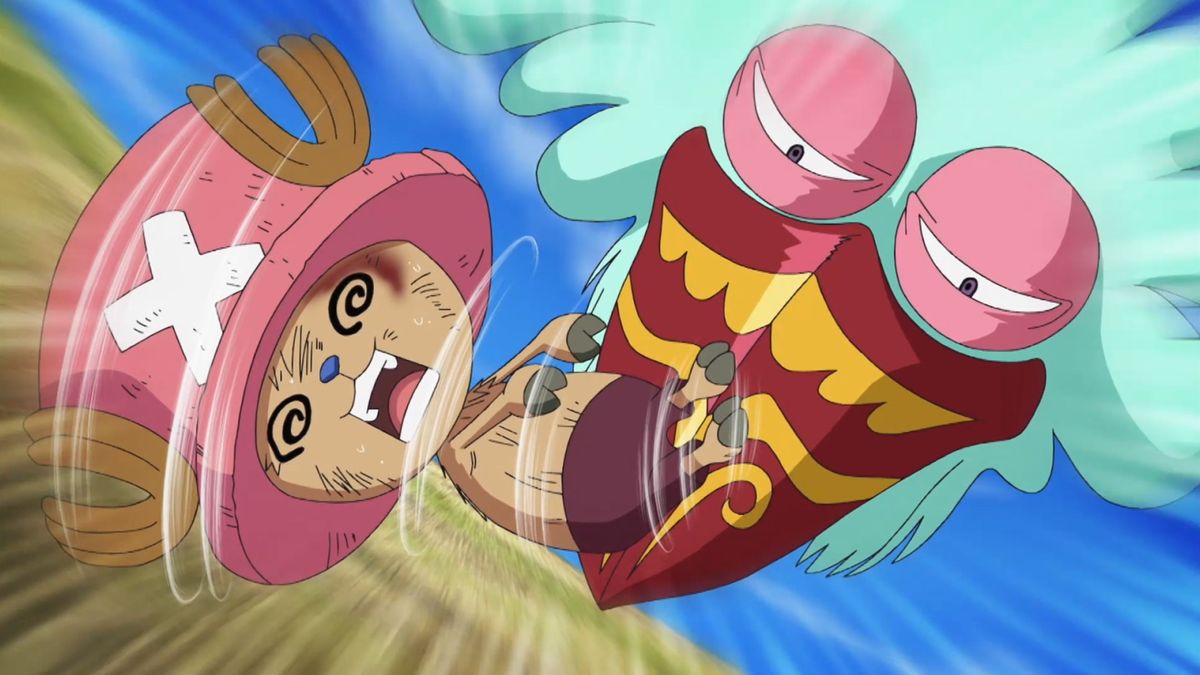
Aboard Momonga’s ship, Hancock demands enormous meals so she can secretly feed Luffy. Two Marines try to peek into her cabin and become stone. The story then checks on Chopper, who wakes in a giant bird nest, gets treated like a toy, and falls into Torino Kingdom’s forest. Natives capture him for tanuki hot pot, but a bird attack gives him time to transform into Heavy Point and escape.
Sanji lands on pink Momoiro Island and wakes beside a shy rescuer named Elizabeth. Chasing her to return a handkerchief, he reads the island’s frills and beautiful silhouettes as paradise. Elizabeth offers him a dress, and Sanji realizes she and the other residents are okama. The Kamabakka Kingdom chases him through the pink landscape, determined to dress him, while Sanji renames paradise as hell.
RaeRae’s opening receipt
Episode 419 gives Chopper and Sanji destinations designed to insult their first assumptions. Chopper, the doctor regularly mistaken for a pet, becomes a toy and then dinner. Sanji, who organizes half his personality around women, lands in a kingdom where gender refuses his easiest categories.
Both men survive the joke. Their future growth will depend on seeing past the joke.
Hancock converts royal appetite into cover
She orders meals weighing at least one hundred kilos because Luffy must remain hidden and fed.
Privilege becomes supply chain for a stowaway.
The Marines read excess as personality
Hancock’s reputation makes an absurd food demand believable enough to avoid investigation.
Performance creates operational camouflage.
Luffy receives care without seeing the labor around care
Food appears inside the cabin while Hancock manages servants, sailors, and suspicion.
Love becomes logistics before he recognizes love.
Two sailors violate the cabin boundary
Curiosity about the beautiful Warlord outweighs orders and privacy.
Desire again imagines access as permission.
Hancock petrifies the intruders
Her response protects Luffy and punishes men who tried to spy.
A justified boundary still arrives through frightening force.
Chopper dreams of reunion before waking
His mind places the crew together because reality offers no location for them.
Hope rehearses the home separation removed.
Giant birds interrupt the dream
Beaks, feathers, and enormous eyes replace familiar faces.
The new island introduces itself through scale.
The birds treat Chopper as a toy
They roll, peck, toss, and study a small body that looks harmless inside their nest.
The crew’s doctor becomes somebody else’s novelty.
His protests cannot cross the species gap
Chopper can speak to animals, but play has already become the birds’ decision.
Communication does not guarantee respect.
A fall from the nest returns him to the forest
Escape arrives without control when the birds drop him below.
Freedom can still hurt on landing.
Rayleigh’s Vivre Card gives Chopper direction
The paper points toward a person connected to Sabaody and confirms reunion remains navigable.
A small object holds the crew’s shared future.
Food becomes the next medical necessity
Chopper needs strength before he can cross an unknown island or plan a voyage.
Survival precedes strategy.
The Torino natives see tanuki instead of doctor
Chopper’s familiar misidentification becomes lethal when hunters classify him as food.
A wrong name produces material danger.
He wakes above a boiling pot
Rope suspends him as the planned center of dinner.
The person who preserves life enters somebody else’s recipe.
The scene makes objectification literal
Neither his language nor his profession matters once the community decides what his body is for.
Category erases personhood again.
The giant birds attack the village
The same creatures that played with Chopper disrupt the people preparing to eat him.
One threat creates space inside another.
Heavy Point breaks the restraint
Chopper changes size and strength, destroying the assumption built around his small form.
Transformation restores authorship over his body.
Escape does not explain the island’s conflict
Birds and humans already treat each other as enemies, and Chopper has met cruelty from both sides.
Survival provides facts without a moral map.
Torino Kingdom belongs to birds in practice
The giant nest and repeated attacks place humans beneath another species’ power.
A kingdom’s title does not reveal who controls the sky.
Rumored treasure adds another hidden motive
The island’s hostility may protect resources or knowledge neither visitor nor audience understands yet.
Conflict often grows around stories of possession.
Sanji lands inside visual wish fulfillment
Pink grass, frilled scenery, and gentle silhouettes resemble the paradise he imagines women should create.
Aesthetic expectation writes the answer before introduction.
Elizabeth offers care while he is unconscious
She supports his head and wipes his face with a handkerchief.
Kindness arrives before Sanji can perform charm.
Shyness lets fantasy fill missing information
Elizabeth runs before Sanji sees her clearly, and he supplies every detail he hopes to find.
Desire becomes an unreliable narrator.
Returning the handkerchief gives pursuit a courteous reason
Sanji wants to thank the person who helped him, even while romance accelerates the chase.
Gratitude and projection travel together.
The animals share the island’s presentation
Pink bodies, styled hair, and decorative movement suggest the entire ecosystem follows one aesthetic.
Kamabakka refuses neutral scenery.
Sanji calls the island heaven before learning its name
He mistakes alignment with fantasy for proof of safety.
Paradise becomes a conclusion reached without consent from reality.
A closed door extends the misunderstanding
Sanji speaks to Elizabeth without seeing her face and interprets every answer through expectation.
Limited information rewards confident error.
Cooking creates genuine common ground
Elizabeth learns Sanji is a cook, a craft with meaning beyond flirtation.
A real identity appears inside the imagined romance.
The dress question divides interpretation
Elizabeth asks whether Sanji likes flowered clothing. He imagines appreciating the garment on her.
One sentence holds two incompatible fittings.
Elizabeth offers the dress to Sanji
The garment is not a visual gift for his admiration. She expects him to wear the dress.
Fantasy receives a hanger and instructions.
Sanji finally sees what expectation excluded
Elizabeth is an okama, and the island’s residents do not fit the women-only paradise he invented.
Recognition arrives as shock because his categories were too narrow.
Kamabakka Kingdom names itself proudly
The residents describe a land of girlish hearts rather than apologizing for Sanji’s confusion.
Community identity does not require his approval.
The dress chase makes pressure visible
Residents pursue Sanji and insist on transforming his presentation against his refusal.
Playful intent does not replace consent.
Sanji calls the island hell
The location has not changed. His expectation lost authority.
Paradise and hell reveal more about the viewer than the landscape.
The episode’s comedy carries dated framing
Sanji’s panic and caricature drive the sequence, while the residents’ joy and community remain visible beneath the gag.
A fandom React can laugh and still notice whose identity becomes the punchline.
This remains an episode React
This page responds to Hancock’s hidden meals, Chopper’s bird nest and stew-pot escape, Torino Kingdom, Elizabeth’s rescue, the offered dress, and Sanji’s arrival in Kamabakka Kingdom. Arc-level judgment remains separate.
React classification protects the episode-versus-Review boundary.
The official local still remains canonical
The Episode 419 official still serves as featured image, hero, static directory card, and social preview through one local attachment.
Complete metadata preserves source, accessibility, filing, and unique use.
RaeRae’s final receipt
Hancock orders enough food for a small army because one hidden man eats like a small army. Her public entitlement hides private care until two spying sailors learn that her cabin boundary has consequences.
Chopper wakes as entertainment and nearly becomes dinner. Heavy Point saves him, but Torino Kingdom has already shown a conflict between birds and humans that neither side’s first cruelty explains. The doctor will need more than escape to understand where Kuma sent him.
Sanji builds paradise from pink scenery and a handkerchief before Elizabeth finishes introducing herself. Kamabakka Kingdom destroys the fantasy and then ignores his refusal during the dress chase. Episode 419 works best when the joke does not erase the boundary: Sanji’s assumptions deserve correction, and his body still belongs to him.
Hancock’s meal request mirrors Luffy’s concealment
Both hide inside something associated with her public excess: royal clothing and royal appetite.
Reputation becomes practical resistance.
Chopper encounters the same problem from opposite species
Birds treat him as a toy while humans treat him as food. Neither group begins by asking who he is.
Different uses share the same denial of personhood.
Heavy Point changes perception through scale
The small tanuki-shaped meal becomes a body capable of breaking rope and frightening captors.
Power forces recognition that language failed to earn.
The bird attack complicates easy alliances
The birds accidentally help Chopper escape while endangering the villagers. Rescue and threat occupy the same wings.
Conflict resists a clean hero category.
Sanji’s gratitude is genuine before fantasy overwhelms evidence
He follows Elizabeth to return what she used to care for him. Courtesy provides the best part of his motive.
Projection turns that courtesy into a story she never promised.
The dress becomes a consent test for everybody
Sanji can reject clothing he does not want. Kamabakka residents can reject his demand that their identity serve his fantasy.
Mutual freedom requires both boundaries.
The island’s joy survives his panic
Pink animals, expressive residents, and collective play continue whether Sanji calls the kingdom heaven or hell.
His judgment never becomes the community’s definition.
Kuma sends the cook toward another food tradition
Kamabakka will eventually offer recipes and physical training connected to survival. The destination fits Sanji beyond the gender joke.
Purpose waits behind discomfort.
RaeRae’s extra receipt
Episode 419 puts two Straw Hats inside cultures they misunderstand and lets the misunderstandings become physical. Chopper enters a pot. Sanji enters a dress chase. Both need the right to control their own bodies.
The stronger future question is what happens after escape. Torino Kingdom holds medicine and ecological knowledge. Kamabakka holds cuisine and training. Kuma did not send either man toward comfort. He sent each toward a lesson hidden inside the first insult.
Rayleigh’s card changes panic into direction
Chopper cannot locate the crew individually, but the Vivre Card preserves a shared point where survival can become reunion.
Orientation matters before transportation becomes possible.
The pot repeats Chopper’s oldest wound
People regularly call him a pet, mascot, or tanuki despite his words and medical skill. Torino turns that dismissal into planned consumption.
A running label reveals its violence when consequences grow.
The doctor survives without forgetting fear
Heavy Point gives Chopper the body needed for escape, yet transformation does not make the capture harmless.
Power after violation never retroactively creates consent.
Torino’s people live beneath an aerial threat
The birds control height, surprise, and repeated access to the village. Human aggression grows inside that unequal ecology.
Context can explain hostility without making Chopper’s stew pot acceptable.
Elizabeth’s rescue deserves identity beyond the reveal
She finds an unconscious stranger, offers physical care, and leaves a handkerchief behind. Those choices remain kind after Sanji revises his fantasy.
A person does not become a trick because another person assumed incorrectly.
Sanji’s category error belongs to Sanji
Elizabeth never promises to be the woman he imagines. Pink scenery and a shy voice become evidence only because he wants that conclusion.
Expectation manufactures betrayal where none occurred.
The chase creates a second category error
Kamabakka residents assume Sanji’s resistance should become playful permission. His refusal remains valid even when their proposed clothing carries communal joy.
Freedom cannot require forced participation.
The episode holds two criticisms together
Sanji’s panic relies on caricature and deserves scrutiny. The residents’ pressure crosses his bodily boundary and deserves scrutiny too.
Editorial voice becomes sharper when nobody receives automatic innocence.
Separation reveals each Straw Hat’s unfinished education
Chopper understands medicine but not Torino’s ecology. Sanji understands cuisine but not the kingdom’s culture. Survival begins before either can access the knowledge Kuma placed nearby.
Growth requires relationship rather than extraction.
Neither island owes its visitor a comfortable lesson, but both destinations hold knowledge capable of strengthening the returning crew.
Both destinations challenge who gets to define a body
Birds and villagers assign Chopper the roles of toy and food. Sanji assigns Elizabeth a role inside his fantasy, while Kamabakka residents assign Sanji a dress despite his refusal.
The comedy becomes richer when every character retains the same right to self-definition instead of receiving that right selectively.
Chopper and Sanji each need escape first, understanding second, and enough humility to discover why these uncomfortable destinations matter. Their first reactions are not their final education, which leaves room for both comedy and meaningful growth.