RaeRae Reacts · One Piece Episode 404
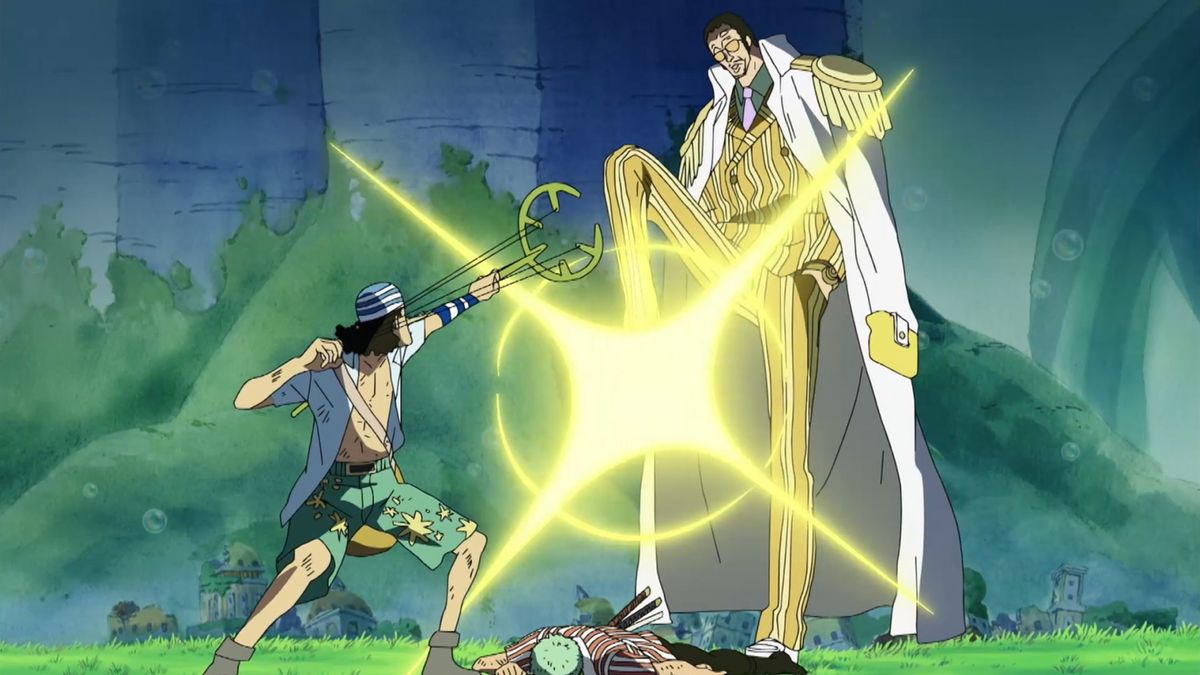
Rayleigh Stops Kizaru’s Light-Speed Execution Over a Fallen Zoro
One Piece Episode 404 React follows Kizaru reaching the exhausted crew, Rayleigh saving Zoro, and Sentomaru closing the remaining routes.
One Piece Episode 404 React: Kizaru reaches the exhausted Straw Hats, Rayleigh stops a light-speed execution, and Luffy’s order to run becomes desperate as Sentomaru and a second Pacifista close every route.
What happened in Episode 404
Kid and Law’s crews destroy their Pacifista while the Straw Hats try to escape Sentomaru and PX-1. Zoro’s injuries leave him unable to keep pace. Kizaru appears and prepares to finish him with a light-speed kick, but Rayleigh intercepts the attack and fights the admiral. Sentomaru reveals that the Kuma-shaped enemies are Pacifistas and that the real Kuma is elsewhere. Despite Rayleigh’s help, the crew remains trapped between Kizaru, Sentomaru, and the machines.
RaeRae’s opening receipt
Episode 404 does not ask whether the Straw Hats can win. Luffy already answered that question when he ordered retreat. The episode asks whether nine exhausted people can escape a battlefield where an admiral crosses distance faster than their bodies can react.
Zoro becomes the cruel center because accumulated sacrifice finally collects payment.
Kid and Law earn their Pacifista victory
Both crews combine abilities and persistence to destroy the unit hunting them. The win confirms that Luffy’s rivals command serious crews rather than decorative entourages.
Destroying one machine still leaves the government program intact.
The parallel victory shows a generational pattern
Multiple rookie crews can overcome Pacifistas through costly teamwork. None finishes fresh enough to challenge an admiral comfortably.
Sabaody measures promise and unreadiness at the same time.
Luffy’s group begins from depletion
PX-4 demanded nearly every major technique. Sentomaru arrived before stamina returned.
Retreat is not a convenient change of genre. Retreat is the only plan their bodies can support.
Zoro cannot make pain private anymore
Thriller Bark taught him to absorb suffering silently. Sabaody makes that silence visible through slowed steps and collapsing balance.
A body eventually tells the truth a swordsman refuses to announce.
Sanji recognizes the emergency around Zoro
Rivalry stops mattering when movement fails. Sanji’s attention turns toward keeping another crewmate alive.
Care arrives without requiring either man to soften their usual language.
Chopper reads damage without enough time to treat damage
Medical knowledge identifies danger, but lasers and pursuit deny a proper intervention.
Knowing what a body needs can become agony when the battlefield prevents care.
Sentomaru controls the ground route
His defense blocks Luffy while PX-1 threatens from range. The crew cannot simply choose another direction without exposing a slower member.
Competent coordination transforms open groves into an enclosure.
PX-1 brings replacement pressure
The Straw Hats know how much one Pacifista costs to destroy. Another unit makes repetition impossible at current stamina.
Mass production defeats a strategy through resource exhaustion.
Kizaru arrives after everyone else spent their strongest answers
The admiral does not face the confident crew from the auction door. He reaches injured pirates already fighting two threats.
Institutional force chooses no fair starting line.
Light-speed movement makes rescue feel late before anyone moves
Kizaru crosses the distance toward Zoro faster than ordinary intention can become action.
The scene stretches emotional time while physical time collapses.
Zoro faces an execution he cannot parry
His swords, will, and loyalty remain present. His body cannot produce the required response.
The strongest private sacrifice has left him publicly defenseless.
Luffy watches consequence approach somebody who protected him
Zoro carried Luffy’s pain at Thriller Bark and said nothing. Now Luffy cannot reach him quickly enough.
Captaincy becomes helpless witness for one unbearable beat.
Kizaru’s foot turns casual posture into a death sentence
The admiral speaks softly and raises light over a fallen man. No fury is necessary.
Calm violence feels colder because the target cannot affect the attacker’s mood.
Rayleigh intercepts the kick at the last possible instant
A blade meets light before Zoro disappears beneath the attack. The old pirate converts impossible speed into a contest.
Experience creates an opening where youth had none.
The interception confirms Rayleigh’s legend through action
Titles said he was Roger’s right hand. Stopping an admiral shows what that history means under pressure.
Lore becomes physically useful to people trying to live.
Rayleigh chooses Zoro without abandoning the larger crew
Saving one member preserves the retreat’s weakest point. The intervention does not solve every threat, but solving the immediate execution matters.
Protection becomes precise rather than theatrical.
Kizaru finally receives an opponent who changes his tempo
The admiral cannot treat Rayleigh like another rookie. Sword and light require real attention.
Forcing concentration becomes the opening the Straw Hats need.
Rayleigh’s age does not erase mastery
Years away from active piracy may affect stamina, but technique and judgment remain extraordinary.
The series treats experience as accumulated power rather than faded decoration.
Their duel divides one impossible threat
Rayleigh can occupy Kizaru. Sentomaru and PX-1 still control the escape zone.
A rescue can reduce danger without pretending danger vanished.
Sentomaru explains the Pacifista program under pressure
He confirms the serial-numbered Kumas are human weapons and distinguishes them from the real Warlord.
The crew receives clarity when clarity offers almost no comfort.
The real Kuma’s absence creates a new question
If these bodies are copies, the person who spared them at Thriller Bark remains unaccounted for.
Identity separates just as danger multiplies.
Knowledge changes fear without reducing force
The Straw Hats now understand that PX-1 cannot use Kuma’s paw ability exactly as the original can. Lasers and armor remain lethal.
Accurate naming improves decisions but does not restore stamina.
Luffy repeats the retreat order because love requires clarity
Chaos tempts every member to turn back for someone else. The captain insists that nobody seek victory.
Repetition transforms panic into one shared objective.
Running away contradicts Luffy’s usual visual language
His body normally moves toward danger. Here leadership points everyone outward.
The reversal marks a threshold no punch can solve.
Nami cannot navigate around opponents who control distance
She can identify routes through groves, but Kizaru and Pacifista beams redraw safe space instantly.
Maps remain necessary and insufficient.
Usopp’s instinct to help becomes another risk
He cannot watch Zoro fall without moving toward him. Care pulls the crew back into the zone Luffy wants them to leave.
Friendship complicates every rational escape order.
Brook’s speed cannot carry every injured person
He can move quickly and distract enemies, yet the crew’s needs exceed one body.
Individual gifts reach painful limits during collective collapse.
Franky confronts machines beyond his current engineering scale
PX-1’s durability and lasers represent state resources far beyond workshop improvisation.
Admiration for technology yields to the need to survive its purpose.
Robin understands what government erasure looks like
Ohara taught her that overwhelming force does not require a fair charge or proportional response.
Sabaody carries the early shape of another Buster Call in miniature.
The crew cannot convert Rayleigh into a permanent solution
He must hold an admiral and cannot fight every machine, officer, and route simultaneously.
Mentorship offers time, not dependency.
Kizaru and Rayleigh embody two histories
One serves the institution protecting Celestial Dragons. One sailed with the man whose last words destabilized that institution.
Their blades and light carry political memory alongside combat skill.
The episode refuses relief after the interception
Zoro survives the kick, but nobody reaches safety. Sentomaru advances, PX-1 fires, and the real Kuma remains a possibility.
Hope arrives as a second, not an ending.
The Sabaody arc breaks the crew through layers
The auction exposed moral horror. Pacifistas exhausted strength. Sentomaru blocked technique. Kizaru removed reaction time.
Defeat becomes credible because every layer attacks a different advantage.
This remains an episode React
This page responds to the rival crews’ Pacifista victory, Zoro’s collapse, Kizaru’s attempted execution, Rayleigh’s interception, and Sentomaru’s revelation. Arc-level judgment remains separate.
React classification preserves the episode-versus-Review boundary.
The official local still remains canonical
The Episode 404 official still serves as featured image, hero, static directory card, and social preview through one local attachment.
Complete metadata records source, context, accessibility, and unique use.
RaeRae’s final receipt
The most painful thing about Episode 404 is that everybody makes sensible choices and the battlefield remains impossible. Luffy orders retreat. The crew tries to move. Zoro’s body refuses because loyalty already spent what recovery needed. Kizaru finds that exact weakness.
Rayleigh’s interception is glorious without becoming cheap salvation. He gives Zoro one more breath and occupies the admiral. Sentomaru and PX-1 remain. A legend can open a door, but nine exhausted people still have to reach the door.
Sabaody has stopped rewarding courage with progress. The crew is brave, coordinated, and loved. None of those truths makes state force proportional. Luffy can see every friend and cannot guarantee any route. The real collapse begins inside that helplessness.
Kid and Law’s win cannot reach the Straw Hats
Separate crews solve parallel crises without gaining a shared communication network. Success in one grove does not travel quickly enough to rescue another.
Scattered survival keeps the generation from becoming an easy alliance.
Rayleigh spends his freedom on intervention
He could preserve anonymity and continue coating the Sunny quietly. Stopping Kizaru places him directly inside government attention.
Care gives legendary freedom a present cost.
Zoro’s stillness reverses his usual role
The swordsman normally becomes the wall between danger and crewmates. Now everyone else tries to form a wall around him.
Mutual protection proves the crew never treated sacrifice as a one-way duty.
Kizaru’s interrupted kick restores possibility, not control
Rayleigh prevents one death. The Straw Hats do not suddenly command the battlefield.
Precise rescue remains valuable even when complete rescue exceeds one person’s reach.
Sentomaru’s explanation makes the copied bodies more disturbing
Knowing they are manufactured does not remove Kuma’s face. The state chose a human template and turned resemblance into standardized fear.
Classification clarifies the violation.
The crew’s retreat becomes a test of distributed judgment
Luffy cannot personally guide every member through every grove. Each person must interpret the shared order amid changing threats.
Leadership survives distance through trust.
RaeRae’s extra receipt
Rayleigh stopping Kizaru should feel like the cavalry arrived. Episode 404 refuses that comfort. One legend can hold one admiral. The remaining battlefield still contains Sentomaru, PX-1, exhaustion, and a swordsman whose body has finally reached the edge.
That refusal makes the rescue better. Rayleigh does not erase consequence. He buys a breath. Sometimes one breath is the most honest miracle a story can offer.
The rival crews’ victory creates no shared safe zone
Kid and Law can destroy their Pacifista and remain separated from the Straw Hats by groves, pursuit, and incomplete information. Nobody has a map showing which battlefield needs help most.
Parallel courage cannot become coordination without communication.
Kizaru chooses the weakest body because efficiency replaces honor
Zoro is injured, grounded, and unable to defend himself. The admiral does not wait for recovery or seek a ceremonial duel.
State violence values completion over fairness.
Rayleigh’s blade proves light can be contested
Kizaru appeared almost elemental while attacking rookies. A veteran with Haki turns the untouchable body into an opponent who must block.
Mastery changes natural-looking inevitability back into combat.
The interruption gives Luffy evidence of a future answer
He cannot copy Rayleigh during crisis, but he sees that Kizaru’s power has rules and counters. The admiral is overwhelming rather than divine.
Witnessing possibility may matter after survival.
Sentomaru’s honesty about the Pacifistas carries no mercy
He explains the distinction between copies and the real Kuma because secrecy is no longer required for domination. Knowledge arrives as another display of confidence.
An enemy can tell the truth while maintaining complete tactical advantage.
PX-1 makes previous effort feel stolen
The crew earned every crack in PX-4. A fresh serial number appears and treats that labor as locally irrelevant.
Industrial replacement attacks morale by denying closure.
Retreat becomes harder after Rayleigh offers hope
Seeing Kizaru stopped could tempt the crew to regroup and fight. Luffy must distinguish an opening from a reversal.
Good leadership refuses optimism unsupported by the whole field.
Zoro’s rescue creates obligation without debt
Rayleigh does not demand a favor before protecting him. The older pirate acts because a life can still be saved.
Help remains freedom when repayment is not the entry price.
The crew needs seconds more than victory
Every moment Kizaru spends with Rayleigh is a moment somebody might reach another grove. Time becomes the scarce resource shared across separate routes.
Combat matters through the escape window combat produces.
Episode 404 turns spectacle into triage
Light swords, lasers, Haki, axes, and cyborg bodies fill the frame. Under every effect sits one practical question: who can still move?
Triage keeps the emotional scale human.