RaeRae Reacts · One Piece Episode 403
Sentomaru Arrives With Another Pacifista After PX-4 Finally Falls
One Piece Episode 403 React follows the exhausted crew defeating PX-4, Sentomaru blocking Luffy with Haki, and a necessary retreat order.
One Piece Episode 403 React: the Straw Hats destroy one Pacifista with everything they have, Sentomaru arrives with another unit, and Luffy learns that even Gear Second cannot solve a defense built on advanced Haki.
What happened in Episode 403
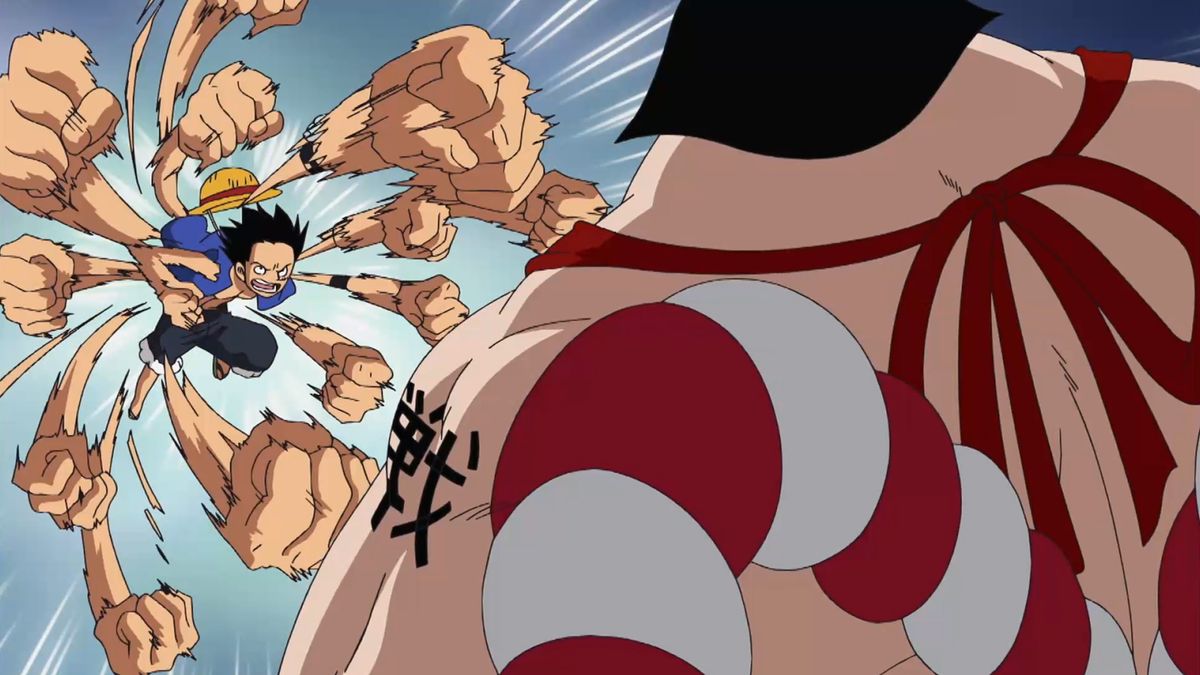
The Straw Hats combine their strongest techniques and finally destroy Pacifista PX-4, but the victory leaves them exhausted. Kid and Law’s crews fight another unit elsewhere. Sentomaru arrives carrying a massive axe and leading PX-1. He blocks Luffy’s attacks without a Devil Fruit and strikes through the rubber captain’s defenses using advanced Haki. Luffy recognizes the widening power gap and orders his crew to split up and escape rather than continue an unwinnable battle.
RaeRae’s opening receipt
PX-4 falls, and nobody gets time to celebrate properly. That cruelty defines Episode 403. The crew spends everything to defeat one manufactured weapon, only to watch the government arrive with another copy and a handler who can hurt Luffy without touching him normally.
Victory becomes evidence of how little reserve remains.
The final combination belongs to the whole crew
Every prior opening leads toward concentrated force. The machine falls because attacks accumulate across different bodies and skills.
No single member owns the result, which makes the victory feel properly Straw Hat.
PX-4’s collapse confirms progress without confirming readiness
The crew defeated technology that once looked impossible. They also needed nearly every major technique to accomplish that result.
Capability and vulnerability arrive in the same wreckage.
Exhaustion becomes the true aftermath
Breathing, posture, and delayed movement reveal the cost. A clean battlefield would allow recovery.
Sabaody supplies another enemy before bodies can reset.
Kid and Law face the same industrial problem
Their combined crews also attack a Pacifista. Rival captains discover that government replication can distribute elite pressure across multiple groves.
No crew receives the dignity of a singular chosen opponent.
The rookies damage machines without reaching the system
Destroying one unit matters for survival. Vegapunk’s program, Marine logistics, and production capacity remain elsewhere.
Battle victory cannot automatically become institutional victory.
Sentomaru enters carrying certainty
His axe, posture, and command over PX-1 identify somebody who belongs beside the technology rather than fears the technology.
He arrives as a human authority over manufactured force.
The claim of strongest defense becomes immediate character
Sentomaru announces toughness without waiting for rumor. Confidence sounds different after viewers watched the crew exhaust itself against his equipment.
The boast gains credibility from context.
PX-1 erases the emotional value of uniqueness
PX-4’s destruction should remove the problem. Another identical body stands ready.
Mass production turns a hard-won enemy into a replaceable inventory number.
The serial name matters
Letters and numbers replace personhood. The label tells viewers that government science counts units rather than lives.
Standardization makes the copied face colder.
Luffy attacks because retreat has not yet become emotionally available
His crew just won together, and another threat stands close. Instinct tells him to protect the route through force.
The first collision proves instinct needs revision.
Sentomaru stops Luffy without a Devil Fruit reveal
The defense does not depend on obvious transformation or machinery. Skill directs force through a method Luffy cannot fully read.
Unknown technique creates a sharper gap than raw size.
Rubber cannot dismiss the impact
Luffy has survived blunt attacks through elasticity. Sentomaru’s strike bypasses that familiar protection.
A body advantage stops functioning as a universal answer.
Advanced Haki arrives before the vocabulary becomes comfortable
Rayleigh’s presence and Sentomaru’s palm both suggest force can travel through will and discipline. Luffy experiences the lesson through pain.
The power system develops as mystery anchored in consequences.
Sentomaru refuses to call the technique magic
He presents his defense as trained capability and superior control. No mystical title excuses the practical result.
The challenge becomes something Luffy may eventually learn rather than an arbitrary exception.
PX-1 attacks while Sentomaru controls the tempo
The crew cannot focus on one target. Beams create range pressure while the handler intercepts direct answers.
Combined enforcement defeats the strategy that worked against PX-4.
The enemy learned nothing from the crew because the enemy brought redundancy
The Straw Hats revealed their strongest combinations. Sentomaru can observe those techniques with another machine available.
Winning the first round gave the system data.
Zoro has no recovery left to borrow
Thriller Bark pain, PX-4, and continuing pursuit stack inside one body. Determination cannot manufacture healed tissue.
The episode respects cumulative damage.
Chopper sees the medical reality before pride accepts the tactical reality
His crew cannot sustain another full combination safely. Protecting life means acknowledging limits.
A doctor’s judgment supplies moral weight to retreat.
Nami understands that the route matters more than the battlefield
Defeating Sentomaru would mean nothing if nobody reaches the Sunny alive. Navigation begins with choosing which fight belongs on the journey.
Leaving can protect the destination.
Luffy makes the hardest captain’s decision so far
He orders everyone to run. The man who meets danger head-on accepts that continuing would sacrifice his crew for pride.
Retreat becomes leadership rather than failure.
The order acknowledges unequal power without surrendering the dream
Luffy does not abandon Pirate King. He protects the people required to keep sailing toward that goal.
Long ambition sometimes needs immediate refusal.
Splitting up creates survival routes and emotional danger
Smaller groups may escape pursuit more easily. Separation also prevents members from seeing who needs help.
The plan trades concentrated vulnerability for uncertain distance.
Every Straw Hat must trust the reunion
Running in different directions works only if everyone believes the ship remains their shared destination.
Crew identity becomes invisible connective tissue across the groves.
Sentomaru’s authority is practical rather than ceremonial
He knows the Pacifistas, understands the mission, and can fight personally. Unlike the nobles, he does not depend on status alone.
Competent enforcement becomes more dangerous than entitled enforcement.
The axe is almost a distraction
Viewers expect the huge weapon to define his threat. His palms and defense matter more.
Visual expectation hides the technique capable of changing Luffy’s future.
The Pacifista battle reframes crew growth
They have new members, new moves, and the Sunny. One unit still consumes nearly everything.
Progress remains real even when the next threshold exposes insufficiency.
Sabaody refuses the normal arc victory rhythm
A boss does not fall and release celebration. Each solved problem reveals stronger enforcement already present.
The arc builds defeat through accumulation rather than one surprise.
Kid and Law cannot rescue Luffy’s crew from their own identical crisis
Rivals who looked powerful together at the auction now fight separate survival battles. Shared generation does not guarantee available aid.
Every crew must confront the same structural trap locally.
The World Government can afford replacement pressure
Pirates spend stamina and injuries. The state sends another numbered machine.
Resource asymmetry becomes the central opponent.
This remains an episode React
This page responds to PX-4’s destruction, the parallel Pacifista fight, Sentomaru’s arrival, Haki-based defense, and Luffy’s retreat order. Arc judgment remains separate.
React classification maintains the site’s episode-versus-Review rule.
The official local still remains canonical
The Episode 403 official still serves as featured image, hero, static card, and social preview through one local WordPress attachment.
Metadata covers source, alternative text, caption, description, and unique filing.
RaeRae’s final receipt
The broken PX-4 is one of the cruelest victory images in Sabaody because the crew absolutely earned that wreckage. Every Straw Hat contributed. Every signature move carried history. Then Sentomaru walks in with PX-1 and turns triumph into a receipt for spent stamina.
His palms matter more than his axe. Luffy’s rubber defense fails against force he cannot understand, and another piece of Haki enters the story through pain. The future training need is no longer theoretical.
The real growth arrives before training. Luffy tells everyone to run. Pride would keep fighting until nobody could stand. Leadership recognizes that a dead crew cannot reach the next island. Episode 403 makes retreat brave because the captain has to admit love requires leaving a battle unfinished.
The machine’s destruction remains morally different from a person’s defeat
PX-4 shows no independent choice or fear. The crew disables an instrument actively designed to kill them.
The copied human appearance complicates emotion without changing immediate necessity.
Sentomaru turns science into field command
Weapons become more effective when somebody understands placement, timing, and target priorities. He connects laboratory output to battlefield purpose.
Institutions need operators as much as inventions.
Luffy learns defense can become offense
Sentomaru’s block does not merely stop momentum. Controlled force returns through Luffy’s own approach.
The exchange punishes familiar aggression at the point of contact.
The crew’s strongest sequence cannot become a reusable answer
Stamina costs and exposed techniques prevent endless repetition. Another Pacifista arrives before recovery.
A strategy can succeed once and still fail as a system.
Retreat protects future mastery
Surviving Sentomaru means Luffy may later understand the invisible force that hurt him. Dying for pride would end the lesson.
Humility keeps growth possible.
The order to scatter tests obedience under fear
Every crewmate wants to help the others and must also create distance. Following the captain can feel like abandonment for several painful minutes.
Trust becomes hardest when care points in conflicting directions.
RaeRae’s extra receipt
Episode 403 gives the Straw Hats a deserved win and refuses to lie about what the win cost. PX-4 falls. Their knees, breath, and injuries tell the rest of the story before PX-1 appears.
Luffy’s retreat order is not glamorous, which makes the choice more important than another attack name. He wants every friend alive more than he wants the island to call him fearless. That priority is the captain’s strongest move in the episode.
PX-1 converts replacement into intimidation
The unit does not need to attack immediately. Standing beside the wrecked PX-4 already tells the crew that the government can replace what pirates barely destroyed.
Supply becomes psychological force.
Sentomaru knows the machines as equipment
He distinguishes serial numbers, issues directions, and treats copied Kumas as a managed arsenal. Familiarity removes the mystery that burdens his opponents.
Operational knowledge widens the combat gap.
The crew’s breathing becomes a tactical fact
Exhaustion is not decorative animation after a victory. Slower reactions, weaker attacks, and delayed choices shape every new exchange.
The body keeps a ledger even when ambition refuses accounting.
Haki appears as contact without ordinary contact
Luffy receives force before his rubber defense can process a normal blow. Sentomaru’s palm demonstrates that distance can exist inside impact.
The strange sensation gives future training a concrete question.
Luffy’s confusion matters more than embarrassment
He does not know why a defense failed. Naming that gap would require knowledge unavailable during pursuit.
Retreat preserves time to turn confusion into understanding later.
Running protects the crew from the captain’s strongest flaw
Luffy often converts danger into a personal challenge. Sentomaru and PX-1 could tempt him to keep proving himself.
The order to scatter interrupts his own appetite for confrontation.
Each crewmate hears the same order from a different body
Zoro hears retreat through injury. Nami hears a navigation problem. Chopper hears medical urgency. Sanji hears people he cannot guard together.
Shared command produces distinct emotional burdens.
The New World requires choosing survival without shame
Dreamers who cannot revise tactics become easy targets for larger systems. Luffy’s ambition remains huge because he refuses to spend his crew for one street.
Humility protects audacity across time.
The episode breaks the simple escalation fantasy
A stronger attack will not solve endless replacement machines, a Haki specialist, and an admiral. The problem has become structural.
Growth must include knowledge, endurance, and coordination beyond damage output.
The coming separation begins with a rational order
Episode 405 will feel catastrophic, but the crew first separates because staying clustered is already unsafe.
Tragedy often enters through a choice that made sense under the evidence available.
The retreat order protects more than immediate survival
Every Straw Hat carries a dream that joined Luffy’s voyage voluntarily. Refusing a hopeless stand protects those separate promises alongside the shared destination.
A captain honors his crew by remembering that their futures do not belong to his pride.
Sentomaru exposes the difference between winning a fight and escaping a system
PX-4 is destroyed, but another serial number, a trained handler, Marine pursuit, and Kizaru remain. The crew solved one target while the structure supplied replacements.
Luffy’s retreat order recognizes that distinction before pride can convert a victory into nine preventable losses.
Retreat preserves the knowledge gained from PX-4 and Sentomaru. Survival lets the crew carry that hard measurement toward the training their future now clearly requires.