RaeRae Reacts · One Piece Episode 398
Kizaru Deploys as Luffy, Kid, and Law Walk Into the Marine Cordon
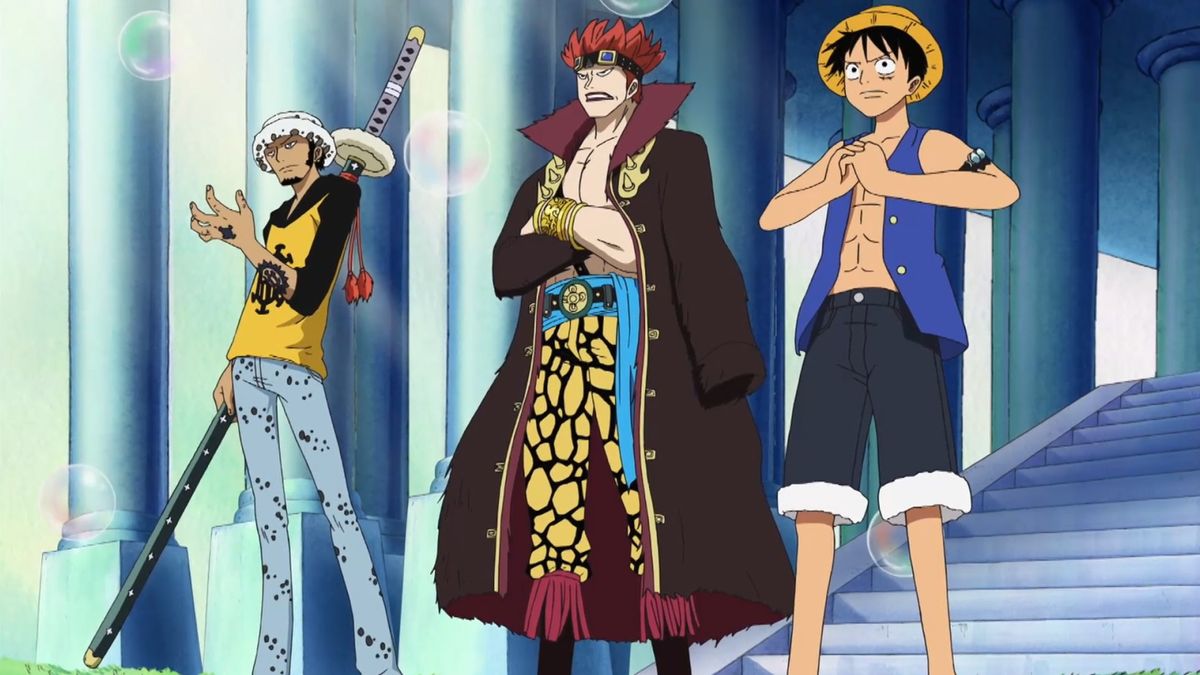
One Piece Episode 398 React follows Sabaody panicking over Charlos, Kizaru volunteering to respond, and three rival captains opening the front door.
One Piece Episode 398 React: Sabaody panics over Luffy’s attack, Kizaru volunteers to answer the Celestial Dragons, and three rival captains walk out of the auction house to meet the Marine cordon on their own terms.
What happened in Episode 398
News that a World Noble has been struck spreads across Sabaody. Sengoku receives the report at Mary Geoise, and Admiral Kizaru offers to handle the response. Rayleigh confirms Camie is safe while the Straw Hats prepare to escape. Outside, Marines surround the auction house. Luffy, Kid, and Law refuse to hide behind one another, step forward together, and begin breaking the blockade as Kizaru reaches the archipelago.
RaeRae’s opening receipt
The punch lasted one second. The state response begins before the dust settles. Episode 398 understands power through speed: a noble is struck in Grove 1, panic spreads across an island, Sengoku gets a report, and an admiral volunteers.
Accountability never moved that quickly for Camie, Hatchan, or the captives sold every day. Enforcement becomes efficient when privilege experiences pain.
Sabaody has memorized the punishment
Residents do not need a Marine announcement to understand what follows. They know an admiral comes when someone touches a Celestial Dragon.
Fear works best when communities police themselves before authority arrives.
The panic proves Charlos was never merely one cruel customer
His family can summon military force across institutional distance. The bubble, gun, money, and auction seat all connect to government power.
Luffy struck a man, but the whole structure feels the challenge.
Sengoku receives crisis without surprise
The Fleet Admiral recognizes another impossible problem attached to the Worst Generation. His frustration shows a government accustomed to protecting nobles regardless of cause.
No inquiry asks why Charlos was buying a mermaid or shooting a fish-man.
Kizaru volunteers with unsettling ease
He does not arrive through fury. His relaxed manner makes the threat colder because overwhelming force has become routine work.
A casual voice can carry an institution’s most disproportionate answer.
Light-speed power begins with bureaucratic permission
Kizaru’s Devil Fruit will produce spectacular violence, yet the first decisive move is administrative. He is authorized, assigned, and transported.
Systems convert extraordinary individual strength into repeatable enforcement.
The Marines mobilize around noble injury, not captive suffering
Human auctions operate openly on Sabaody. A mermaid can be displayed, and nobody deploys an admiral to free her.
The contrast tells viewers exactly which bodies the state recognizes as worthy of emergency response.
Rayleigh restores calm without promising safety
Camie is free, Hatchan remains alive, and the immediate purpose has succeeded. None of those facts removes the coming blockade.
Good news and danger can occupy the same room without canceling each other.
The Straw Hats prepare to move as a crew
The auction house cannot become shelter. Every extra minute gives Marines more time to close routes.
Survival now depends on leaving together rather than admiring what they accomplished.
Kid refuses to let Luffy own the rebellion
He will not accept the role of spectator while another rookie captain gets remembered for defiance. Pride sends him toward the front door.
Competitive ego becomes useful when the same blockade threatens everyone.
Law refuses both gratitude and subordination
Law helped preserve Camie’s life, but he keeps emotional distance and mocks the other captains. Cooperation never becomes obedience.
The episode lets alliances remain sharp around the edges.
Luffy responds to rivalry with immediate appetite
He does not build a political coalition or negotiate rank. If Kid and Law are going outside, Luffy plans to be there.
His simplicity turns competitive energy into forward movement.
Three captains share a doorway without sharing command
The composition matters. None stands behind another. Each crew watches its own leader cross the threshold.
The Worst Generation becomes visible as multiple centers of ambition rather than one hero and supporting pirates.
The Marine cordon makes the state physically legible
Uniforms, rifles, ranks, and blocked streets transform distant authority into bodies surrounding an exit.
The auction’s private guards have failed, so public force takes their place.
Ordinary Marines inherit a noble’s consequences
Most soldiers outside did not bid on Camie or shoot Hatchan. They still become the human barrier protecting those actions.
Institutions distribute risk downward while preserving comfort above.
Luffy’s power remains direct
He stretches, strikes, and clears space through momentum. There is no mystery about where his anger points.
Directness becomes a moral contrast against the layered excuses surrounding the auction.
Kid turns metal and debris into a declaration
His magnetic power gathers the material of enforcement and reorders the field around his body.
The environment that confined pirates becomes ammunition against confinement.
Law turns the battlefield into a room
His ability establishes a controlled space where ordinary physical rules answer to surgical intention.
The calm precision distinguishes him from both Luffy’s momentum and Kid’s aggressive mass.
Devil Fruits reveal personality through method
Three captains face one obstacle and solve the problem in three recognizable languages.
Power design becomes characterization rather than decoration.
The captains perform for one another
Every attack clears Marines and sends a message sideways. Nobody wants a rival to think the sea ahead belongs to him.
Competition raises the spectacle without erasing the shared need to escape.
Their crews understand the danger behind the fun
Subordinates cheer, worry, and prepare. The captains can posture because loyal crews hold the larger survival problem.
Leadership remains relational even when the frame centers three stars.
Rayleigh does not take command of the young pirates
He could dominate the room through reputation and strength. Instead he lets each crew choose its next move.
An older legend respects freedom by refusing unnecessary control.
The coming admiral changes every victory’s scale
Defeating auction guards and a Marine line proves the rookies are dangerous. Kizaru belongs to another level of institutional force.
The episode lets confidence bloom just before testing how fragile confidence can become.
Kizaru’s travel carries absurdity and dread together
One Piece often introduces terrifying figures through eccentric behavior. The humor lowers defenses without lowering power.
A strange entrance can make violence less predictable rather than less serious.
Sabaody’s geography becomes a pressure map
Groves, mangroves, bubbles, harbors, and routes matter because crews need somewhere to disappear.
The colorful resort becomes a maze shaped by policing.
The World Government protects symbolism
Charlos’s injury matters beyond his health. Allowing a common pirate to strike a supposed god could teach witnesses that status is enforced rather than natural.
Kizaru comes to repair fear as much as to arrest one crew.
The episode asks who receives urgency
Camie’s abduction required friends to search the entire island. Charlos’s punch activates global command immediately.
Response time becomes a receipt for institutional values.
Freedom creates responsibility after rescue
Camie is no longer collared, but everyone connected to her escape now faces pursuit. The crew accepts that cost without blaming her.
Real rescue does not hand the rescued person a bill for the danger oppressors created.
The three-captain scene earns its swagger
The poses work because viewers know what each captain risks. An admiral is coming, ships may be trapped, and the New World waits beyond the island.
Style carries substance when danger remains visible.
This remains an episode React
This page responds to Sabaody’s panic, Sengoku’s report, Kizaru’s deployment, the Marine blockade, and the three captains stepping forward. The whole arc receives separate guide treatment.
React classification keeps an installment response out of the Anime Reviews directory.
The official local still remains canonical
The Episode 398 official still serves as featured image, hero, directory card, and social preview through one local attachment.
Complete metadata preserves source, accessibility, social parity, and unique use across the One Piece ecosystem.
RaeRae’s final receipt
Episode 398 places two kinds of power on parallel tracks. The World Government moves downward from Mary Geoise through Sengoku, Kizaru, orders, ships, and Marines. The rookies move outward from friendship, ambition, insult, and refusal.
The contrast has no fake balance. One side is answering a public slave auction by protecting the buyer. The other side contains reckless pirates with enormous egos, yet those pirates are the people walking through gunfire after Camie gets free.
Luffy, Kid, and Law do not become saints because Marines surround them. They become legible. Each captain refuses the cordon in his own language, and each refuses to let another man own the moment. Kizaru is already coming to remind Sabaody how fear works. For now, three young captains open the front door anyway.
Panic travels faster than truth
Residents hear that a Celestial Dragon was struck before they hear why. The missing context protects the hierarchy by turning resistance into senseless danger.
Rumor can enforce power when cause gets stripped from consequence.
No official report centers Camie’s rescue
Government communication records noble injury and pirate identity. The freed captive becomes administratively invisible.
Archives often preserve what power fears rather than what vulnerable people survived.
The captains reject a single-file escape
A quiet rear exit might reduce spectacle, but pride and blockade make confrontation unavoidable.
The front door becomes a contest over who controls public space.
Kid’s brutality does not erase his disgust
His methods and record remain dangerous. He can still recognize the obscenity of protected nobles.
One Piece allows moral clarity to appear in compromised people.
Law’s smile protects information
He gives rivals no easy access to fear, calculation, or admiration. Expression becomes strategy.
The audience reads interest without receiving a confession.
Luffy does not understand prestige as restraint
Titles make other people cautious. Luffy evaluates behavior and relationship instead.
That refusal creates danger and makes him uniquely difficult for hierarchy to control.
Marine numbers cannot create moral legitimacy
A full cordon looks official, organized, and lawful. None of those qualities answers why the auction operated safely before the punch.
Order can defend injustice with excellent logistics.
Kizaru’s calm forecasts unequal combat
He does not sound like a man approaching a difficult fight. Confidence comes from demonstrated power and institutional backing.
The rookies celebrate before understanding the scale arriving.
The episode ends confidence on borrowed time
Three captains look spectacular against the blockade. Viewers know an admiral is closing the distance.
Triumph becomes suspense because the next opponent changes the measurement.
RaeRae’s extra receipt
The funniest part of the three-captain breakout is how none of these men can tolerate being mistaken for somebody else’s follower. The scariest part is how quickly the government proves the noble class has an entire military reflex.
Episode 398 lets both truths breathe. Ego helps crack the cordon. State power keeps moving. The pirates win the doorway, while Kizaru approaches to contest the whole island.
The auction survivors need routes, not applause
Camie, Pappag, and wounded Hatchan cannot remain beside a battlefield built around captain pride. Their safety depends on crews remembering the rescue after the spectacle changes location.
Success gets measured by who reaches shelter, not by who looked strongest at the door.
Rayleigh’s calm comes from knowing the power scale
He does not confuse defeated guards with safety. Experience tells him what an admiral can bring and why immediate movement matters.
Veteran confidence includes accurate fear.
The Marines restore a border around privilege
The auction’s walls failed to contain resistance. The cordon redraws that boundary across public streets.
Authority expands space whenever the smaller enclosure breaks.
Kid’s metal answers the rifles’ claim to distance
Guns allow soldiers to threaten from formation. Magnetism turns their equipment into a liability before bullets can settle the argument.
His Fruit attacks the system of force, not only individual bodies.
Law’s Room makes rank irrelevant inside its boundary
Officers can issue commands, but position and anatomy stop obeying familiar expectations.
A hierarchy loses confidence when control of space changes hands.
Luffy gives the Marines no dignified version of surrender
He meets ceremony with stretching limbs and direct refusal. The visual mismatch punctures official self-importance.
Comedy helps reveal that uniforms cannot make the mission righteous.
The three captains create a temporary public
Marines, crews, residents, and fleeing buyers all witness their refusal. A private rescue becomes a story the island will repeat.
Reputation grows through shared witnesses before newspapers formalize the account.
Kizaru approaches as the answer to memory
The government needs people to remember that nobles remain protected after one of them falls. An admiral can overwrite a rebellious image with mass fear.
The coming violence is communication as much as capture.
The admiral deployment reveals the government’s actual emergency system
Sabaody tolerated kidnappers, collars, armed sales, and aristocrats shooting people in public. One noble receiving a punch activates command across the sea. The contrast functions as evidence, not background.
Institutions show their priorities through response time and resource scale. Kizaru’s arrival says protected prestige matters more than every captive who passed through that auction house.