RaeRae Reacts · One Piece Episode 364
Oars Accepts Moria as Master and Uses Wanted Posters to Turn Luffy’s Shadow Against the Crew
One Piece Episode 364 React watches Oars accept Moria’s command, identify the Straw Hats from wanted posters, and crash into Chopper and Robin’s battlefield.
One Piece Episode 364 React: Luffy’s shadow settles into Oars, who recognizes Moria as master and receives the order to destroy the Straw Hats by matching faces to wanted posters.
What happened in Episode 364
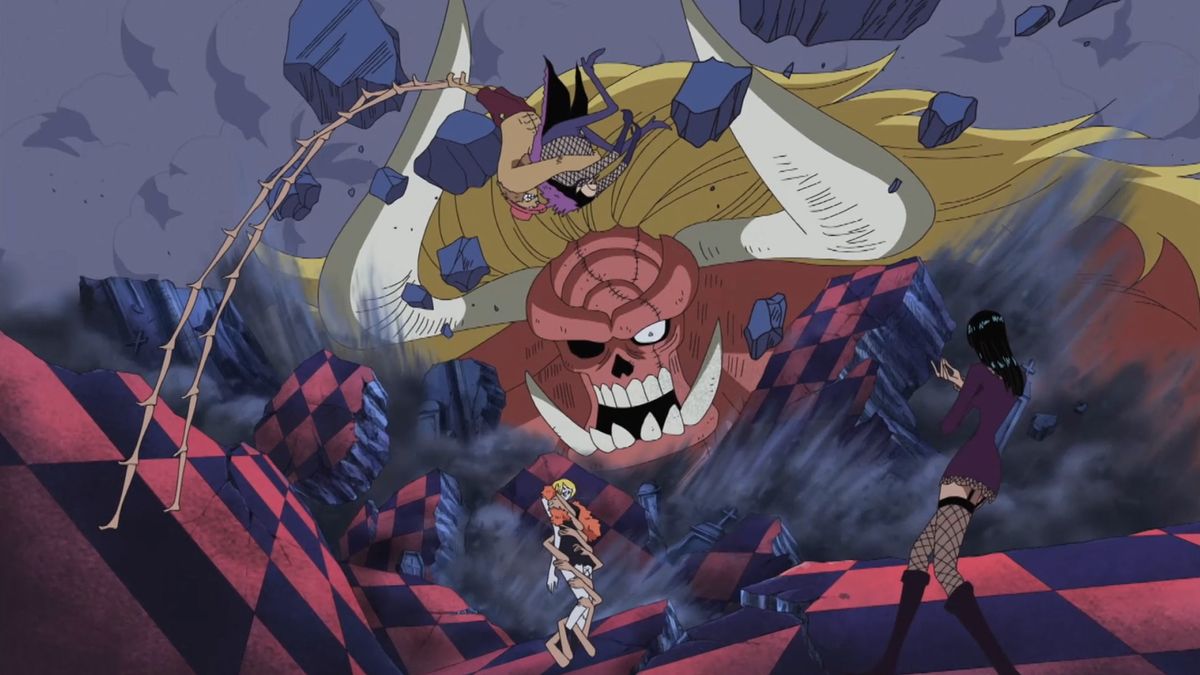
Oars attacks Luffy beside Moria and brings the building down into Chopper and Robin’s confrontation with Hogback. The stolen captain’s impulses become a weapon aimed at his own family.
RaeRae’s opening receipt
Moria copied recognizable behavior and added obedience. The missing relationships are exactly what made Luffy’s strength protective instead of indiscriminate.
Oars finally recognizes Moria as master
Luffy’s shadow has settled far enough into the giant corpse for Moria’s command structure to take hold. The unruly appetite remains, but the zombie now understands who owns the orders.
The transition shows personality being retained only where personality can serve obedience.
Familiar behavior becomes more frightening after submission
Oars still sounds and moves in ways the crew can associate with Luffy. Those echoes once produced comedy because they were disconnected from Moria’s plan. Once the same body accepts the mission, recognition becomes threat.
Moria has turned pieces of the captain into a weapon aimed at the captain’s family.
The first order defines the purpose of the resurrection
Moria does not awaken Oars to restore a lost life, preserve history, or offer freedom. He gives the corpse an assignment: destroy the Straw Hats. Movement exists to extend the master’s control.
Hogback’s medical spectacle becomes military infrastructure the moment the order lands.
Wanted posters become a targeting database
Oars compares faces against the images attached to his arm. Government documents created to identify and punish pirates now assist a private ruler hunting the same people.
The posters move from public criminalization to operational surveillance without changing their basic assumption that a face can be converted into a target.
A bounty image reduces a person to recognizability
The poster does not contain Nami’s navigation, Chopper’s medicine, Robin’s history, Sanji’s care, or Luffy’s promises. The poster supplies a face, name, and price useful to institutions.
Oars needs only the reduction because his assignment does not require understanding the people he attacks.
Moria borrows the World Government’s classification work
He did not build the wanted-poster archive or determine which faces should be marked as criminal. Another power performed that labor. Moria repurposes the same categories for personal violence.
Systems of surveillance become portable when records outlive the purpose used to justify collecting them.
Luffy confronts his own outline without his own choice
Oars carries recognizable impulses inside a giant body while attacking Luffy on command. The captain sees behavior derived from his life operating against everything he values.
The encounter makes shadow theft feel like more than lost power. Identity has been turned outward as hostile labor.
The stolen shadow cannot reproduce loyalty
Luffy’s devotion to the crew was built through meals, arguments, rescues, losses, and promises. Those relationships are not detachable settings stored beside appetite and fighting habits.
Moria copied useful output while discarding the social history that taught Luffy where to direct strength.
Obedience is not the same as identity settling naturally
Moria treats Oars recognizing him as master as proof that the process has succeeded. Success is measured by command compliance rather than the well-being or autonomy of the created being.
A stable servant can still be the product of violence.
Oars’s body adds scale to an incomplete copy
Luffy’s shadow already contains immense physical imagination. Inside the ancient giant, familiar impulses gain reach and destructive force beyond the original body.
The mismatch makes extraction profitable for Moria and dangerous for everybody near the experiment.
The attack on Luffy reveals the absence of recognition
A whole Luffy would understand his own face, history, and crew. Oars reads Luffy only as a picture matching the mission. The shadow’s source has become another target.
Mechanical identification replaces personal recognition.
A poster can identify appearance without identifying personhood
Oars successfully locates Luffy through the image and still knows nothing meaningful about him. Accuracy at the level of face coexists with total failure at the level of person.
Episode 364 distinguishes identification from understanding.
The building collapse spreads one experiment’s cost
Oars attacks near Moria and brings architecture down into Chopper and Robin’s confrontation with Hogback. Damage refuses to remain inside the battlefield where Moria issued the order.
Powerful experiments create consequences for people who never consented to participate.
Chopper’s medical reckoning is interrupted by Moria’s product
He is confronting Hogback over bodies treated as material when the largest body in the project crashes into the room. Oars becomes physical proof of everything Chopper has accused the doctor of enabling.
The institution answers ethical criticism with collateral danger.
Robin sees classification become enforcement again
She has lived under a wanted poster since childhood. Watching Oars use posters as a hunting tool confirms that the image was never neutral documentation.
A record created by authority can follow a person across decades, institutions, and unrelated forms of violence.
Wanted posters carry stories their subjects did not write
The World Government assigns criminal identity and monetary value through each image. The Straw Hats may reclaim the posters as symbols of adventure, but hostile users can still activate the original function.
Reappropriation does not erase surveillance risk.
Moria’s army depends on administrative violence
Thriller Bark looks chaotic, yet the operation relies on collection, classification, matching, assignment, and command. Bodies and shadows are cataloged as resources; enemies are cataloged as targets.
Bureaucratic organization makes supernatural exploitation scalable.
Oars receives no reason to hate the crew
The order alone is sufficient. He does not need evidence that the Straw Hats harmed him or threaten his freedom. Moria’s authority supplies both target and purpose.
Obedience allows violence to proceed without a personal grievance.
The crew must fight a body carrying a loved one’s mannerisms
Recognizable gestures can create hesitation or grief even when everybody understands that Oars is not Luffy. Moria benefits from the emotional confusion produced by stolen identity.
Appropriation harms through resemblance as well as force.
Luffy’s face becomes an enemy without making Luffy the enemy
The distinction protects accountability. Oars carries his shadow; Moria and Hogback created the arrangement. The crew can resist the familiar movements without blaming the person robbed of them.
Victims should not inherit guilt for what stolen parts are forced to do.
The mission exposes Moria’s fear of collective resistance
He does not order Oars toward random destruction alone. He specifically targets the crew capable of challenging his ownership system. Their relationships make them dangerous because they coordinate restoration.
A ruler built on isolated victims fears people who refuse isolation.
Oars is powerful because several violations accumulate
An ancient corpse, Luffy’s shadow, Hogback’s technique, Moria’s command, and government images all contribute to the attack. No single element explains the threat.
Episode 364 shows systems combining resources taken from different people and institutions.
The giant’s awakening does not make him free
Oars moves, speaks, chooses small preferences, and experiences excitement. The central purpose remains assigned by Moria. Animation can coexist with profound unfreedom.
Visible agency in minor behavior should not obscure the command governing the body’s violence.
Adventure language is redirected into enforcement
Luffy uses adventure to pursue the unknown and oppose cages. Oars carries the excitement while serving a master’s list of targets. The same energy now enforces captivity.
Context determines whether movement expands freedom or destroys somebody else’s.
Chopper and Robin inherit danger created elsewhere
They did not participate in Luffy and Moria’s immediate clash, yet the collapsing building carries the outcome into their room. Parallel storylines become materially connected.
The episode refuses the fantasy that one abuse can be contained away from every other person in the system.
Oars makes Moria’s theory visible at maximum scale
Moria believes useful traits can be removed from individuals, installed in stronger bodies, and controlled through ownership. Oars is the theory’s grandest demonstration.
The missing consent and relationships are not minor defects. They are the reason the creation becomes destructive.
Episode 364 remains an episode React
This page responds to Oars accepting Moria as master, using wanted posters to identify the Straw Hats, attacking Luffy, and collapsing the building into Chopper and Robin’s fight. A complete Thriller Bark Review belongs after the arc resolves those systems.
React classification preserves broadcast-level close reading and keeps whole-work Reviews distinct.
The official local still remains canonical
The Episode 364 still serves as featured image, hero, bounded-directory card, and social preview. One local attachment provides consistent recognition across every discovery route.
Complete source and accessibility metadata remain attached, and no other record reuses the image.
RaeRae’s final receipt
Episode 364 turns a wanted poster into a weapon and Luffy’s shadow into an enemy uniform. Oars recognizes Moria as master, receives the order to destroy the Straw Hats, and checks faces against government images attached to his arm. The posters identify people perfectly for a system that does not care who those people are.
Moria copied Luffy’s appetite, swagger, and fighting imagination. He did not copy the crew that argues with Luffy, feeds him, trusts him, and gives his power moral direction. Oars attacks Luffy because a picture matches, then brings a building down on Chopper and Robin because collateral consequence means nothing inside the command. The stolen shadow does not make Luffy responsible for the violence. Moria and Hogback created a giant servant from a corpse, a stolen identity, and administrative targeting. Every recognizable piece is present except consent, relationship, and the right to choose what strength is for.
A surveillance record can outlive the institution that created the immediate threat
The World Government printed the wanted posters to circulate criminal identities and bounty values. Moria does not need official permission to reuse the images. Once the records exist, a private army can turn the same faces into an attack list.
Episode 364 makes data reuse brutally simple. A picture collected for one enforcement purpose travels into another system and continues exposing the person long after the original observer leaves the room.
Matching a face is not evidence of guilt
Oars does not investigate what any Straw Hat did, why a bounty exists, or whether Moria’s command is justified. Visual correspondence supplies enough certainty for violence. The target’s identity becomes the offense.
That reduction matters because classification often presents itself as neutral accuracy. The poster may accurately depict Luffy while the conclusion attached to the image remains entirely controlled by hostile authority.
Luffy remains the victim of the shadow’s forced violence
Oars uses mannerisms, instincts, and physical imagination derived from Luffy. Moria may benefit if the crew begins to experience those familiar traits as betrayal. The responsibility still belongs to the people who stole, installed, and commanded the shadow.
A victim does not become an accomplice because appropriated labor resembles the victim. Keeping that boundary clear prevents Moria from outsourcing blame along with force.
Collateral damage reveals who never entered Moria’s calculation
The building falls into Chopper and Robin’s confrontation because Oars’s attack values the assigned target and ignores everybody occupying the surrounding structure. Moria measures success through destruction of enemies rather than safety of bodies nearby.
The people below become invisible inside the plan even before rubble reaches them. Physical collapse merely makes the earlier moral omission visible.
The wanted posters cannot recognize chosen family
Each image isolates one face and assigns an individual price. The crew exists through relationships no poster can display: Robin was rescued, Usopp returned, Franky built the Sunny, and every member accepted obligations beyond personal survival.
Moria’s targeting system sees separate units. The Straw Hats answer as a network, which is why classification alone cannot predict how they will protect one another.
Oars proves that obedience can coexist with personality fragments
He eats, boasts, moves creatively, and calls destruction adventure. Those recognizable preferences may look like individuality, yet the central mission remains Moria’s order. Limited expression does not make the arrangement free.
The episode warns against treating surface personality as proof of consent. A servant can sound lively while the governing purpose of the body has still been imposed.
Moria’s success contains the reason his system will fail
He wanted Luffy’s force separated from Luffy’s attachments. That separation gives Oars destructive scale and removes the judgment, correction, and loyalty that make coordinated action sustainable.
The giant can hunt faces from a list. The crew can understand why those faces matter to one another. Moria built the stronger body and left out the relationship capable of giving strength direction.