RaeRae Reacts · One Piece Episode 358
Sanji Interrupts Absalom’s Coerced Wedding While Moria’s Doppelman Keeps Luffy Away
One Piece Episode 358 React separates rescue from possession as Sanji attacks Absalom and Luffy discovers that Moria’s shadow double can absorb every strike.
One Piece Episode 358 React: Sanji reaches Nami and attacks the false wedding, while Luffy learns that beating Moria requires getting past the shadow double intercepting every blow.
What happened in Episode 358
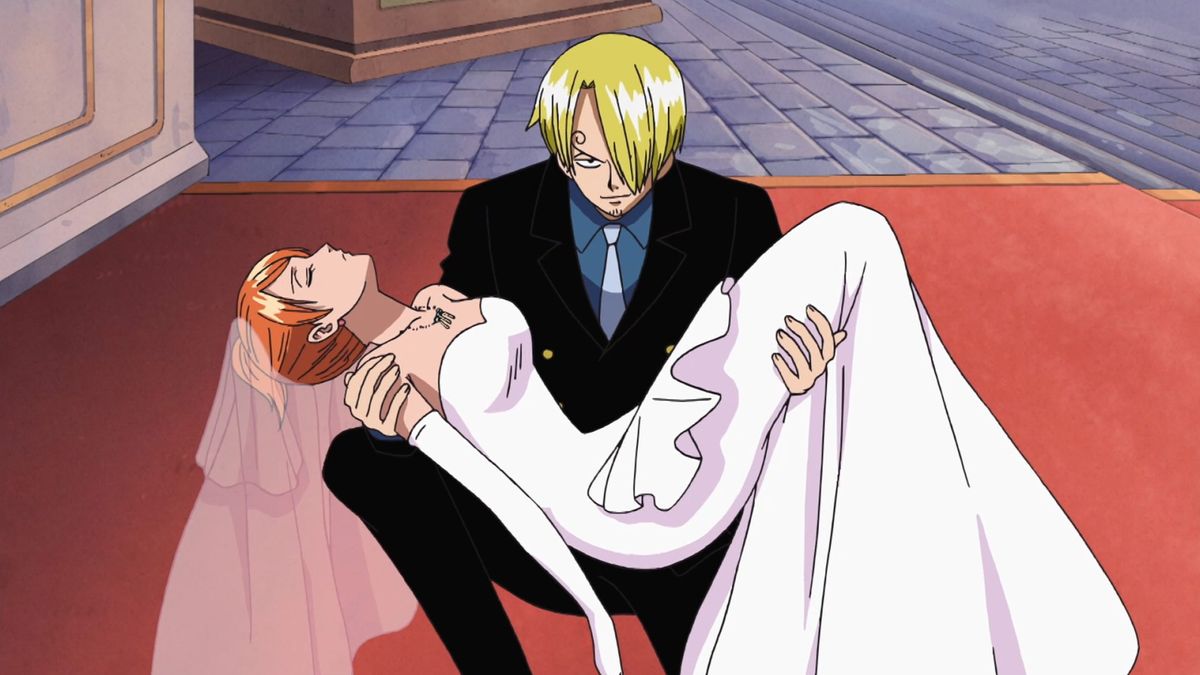
Absalom’s ceremony tries to turn captivity into romance through costume and staging. Sanji interrupts the performance as Doppelman keeps Luffy from touching Moria.
RaeRae’s opening receipt
A wedding without Nami’s consent is not a wedding, and a ruler who makes a stolen shadow absorb consequences has built cowardice into his defense.
Sanji interrupts a ceremony that never had a bride’s consent
Absalom has arranged clothing, witnesses, vows, and spectacle around an unconscious woman. None of those objects can produce the answer Nami was prevented from giving. The ceremony is coercion wearing romantic decoration.
Sanji’s arrival matters because the staged performance finally meets somebody willing to name force as force.
A wedding costume cannot create a wedding
The dress changes how the room looks without changing the power relationship. Nami was abducted, rendered unable to leave, and assigned a future by the man controlling her body. Beautiful symbolism cannot sanitize those facts.
Episode 358 asks viewers to keep consent visible beneath the visual language meant to conceal its absence.
Nami remains the authority over what happens to Nami
Sanji may rescue her, but he cannot become the owner who replaces Absalom. The ethical outcome is restoration of Nami’s agency. Her voice, choices, work, friendships, and future belong to her.
A rescuer succeeds by ending captivity, not by winning a woman from another man.
Absalom mistakes desire for permission
He wants marriage and treats wanting as proof that the marriage should occur. Nami’s refusal becomes an inconvenience to bypass rather than information about another person’s will.
That logic defines possession. Affection worthy of the name would require the freedom to hear no.
Unconsciousness cannot be converted into agreement
Nami’s inability to respond is precisely why the ceremony must stop. Silence under incapacity does not carry consent. Absalom exploits the absence of an answer and writes the answer he prefers.
No fantasy setting makes that distinction negotiable.
Sanji’s fire should illuminate the violation
His anger is most defensible when directed toward the kidnapping, forced costume, surveillance, and attempted marriage. Jealous competition can pull attention toward masculine pride, but Nami’s stolen autonomy remains the actual harm.
The React keeps the victim’s experience at the center even when the episode invites louder jokes around the men.
Rescue and romance are not the same action
Sanji can love Nami, desire her attention, and still owe her help without repayment. Rescue becomes ethical when safety is not conditional on affection being returned.
Friendship creates responsibility. Responsibility does not create entitlement.
Absalom built an audience to validate private violence
The ceremony turns witnesses into scenery supporting his preferred story. Public ritual gives coercion the appearance of social legitimacy. Everybody present is expected to perform as though Nami’s participation were voluntary.
Interrupting the ritual breaks not only the marriage attempt but the collective lie surrounding the ceremony.
The false wedding mirrors Moria’s shadow system
Moria places stolen identity inside bodies and declares the resulting arrangement useful. Absalom places Nami inside a bridal role and declares the resulting arrangement romantic. Both men overwrite personhood with a function.
Thriller Bark’s officers share an ideology of possession even when their individual appetites differ.
Luffy reaches Moria and still cannot reach him
Physical proximity does not become access while Doppelman intercepts every attack. Moria lies down with theatrical ease because a shadow double carries the danger for him.
The defense transforms stolen power into insulation from consequence.
Doppelman is privilege made physical
Moria can provoke, command, and profit while another form absorbs retaliation. The arrangement resembles every authority that keeps distance from the harm enabling comfort.
Luffy’s fists hit the barrier between decision and consequence before they can hit the person making decisions.
The shadow double separates command from vulnerability
Moria expects obedience without exposure. He orders zombies, controls shadows, and confronts Luffy through a substitute body. Leadership becomes the right to create risk for others while remaining relaxed.
Luffy’s captaincy works differently because he repeatedly places his own body inside the danger his decisions create.
Defeating Moria requires more than impact
Luffy cannot solve the system by striking the nearest visible target if Doppelman continues redirecting force. He must understand how Moria’s power allocates movement and consequence.
Strength remains necessary, but interpretation determines where strength can become meaningful.
Returning shadows requires an order from the owner
Simply knocking Moria down will not automatically send every stolen shadow home. He must command the shadows to return. The rule complicates the rescue because victory must force restoration, not merely produce unconsciousness.
The victims need their property returned through the mechanism Moria monopolized.
Moria controls both theft and the language of release
He designed a condition in which stolen shadows answer his command. Even liberation appears to require the oppressor’s words. That structure makes restoration harder than identifying wrongdoing.
Luffy has to break enough control that the command can no longer serve Moria’s interests.
A shadow becomes labor shielding management
Doppelman performs defense and counterattack while Moria rests. The stolen form does dangerous work without consent, compensation, or independent purpose.
Thriller Bark repeatedly turns pieces of people into labor assets. The visual joke of a reclining boss contains a sharp account of exploitation.
Luffy’s frustration comes from blocked accountability
He has found the person responsible and cannot make responsibility land. Every punch redirected into Doppelman preserves the gap between Moria’s choices and Moria’s body.
The fight becomes satisfying only when that gap closes and the person exercising power must experience consequence directly.
Sanji enters consequence on Absalom’s behalf
Absalom expected an unconscious captive and compliant ceremony. Sanji’s kick brings the outside world crashing into the private fantasy. The room can no longer pretend nobody objects.
Interruption is the first restoration because coercive rituals depend on continuing without resistance.
Nami’s body should not be the battlefield prize
The choreography risks framing her as an object positioned between two men. RaeRae’s reading refuses that frame. Nami is the person whose autonomy gives the fight moral meaning.
Sanji’s victory matters only insofar as the victory creates conditions for her to choose again.
The episode pairs two men hiding behind substitutes
Absalom hides coercion behind wedding imagery. Moria hides vulnerability behind Doppelman. Both defenses rely on appearance separating them from the truth of their actions.
Sanji and Luffy have to break through performance before direct accountability becomes possible.
Fire and shadow express opposite relationships to consequence
Sanji’s burning anger makes his commitment visible through his own body. Moria’s shadow defense removes his body from exposure. One fighter carries emotion into risk; the other turns appropriated power into distance.
The contrast explains why spectacle alone cannot determine courage.
Urgency follows both confrontations
Dawn remains fatal to the shadowless crew, and every minute Nami remains captive extends Absalom’s control. Neither route has time for ceremonial pacing or endless testing of defenses.
The episode’s parallel structure keeps personal rescue and collective restoration inside the same countdown.
The crew divides responsibility without dividing values
Sanji focuses on Nami while Luffy focuses on Moria. Different targets do not imply competing priorities. Both men oppose a system that treats another person’s will as material available for use.
Shared ethics allow separate action to remain coherent.
The scene needs Nami awake, not merely recovered
Carrying her away would end immediate access, but full restoration requires the return of her voice and ability to direct what happens next. Safety includes participation.
A person is not restored when others continue making every decision around her, even for protective reasons.
Moria’s confidence reveals dependency
He appears untouchable because Doppelman catches everything. That confidence depends completely on the continued service of a separate shadow form. The relaxed pose is supported labor disguised as personal superiority.
Luffy’s task is to expose the dependency and reach the person benefiting behind the shadow defense.
Episode 358 remains an episode React
This page responds to Sanji interrupting Absalom’s coerced wedding, Nami’s suppressed consent, and Luffy discovering Moria’s Doppelman defense. A complete Thriller Bark Review belongs after the arc resolves those structures.
React classification preserves broadcast-level analysis and keeps whole-work Reviews distinct.
The official local still remains canonical
The Episode 358 still serves as featured image, hero, bounded-directory card, and social preview. One local attachment provides consistent recognition across every discovery route.
Complete source and accessibility metadata remain attached, and no other record reuses the image.
RaeRae’s final receipt
Episode 358 gives two powerful men elaborate ways to avoid the word no. Absalom dresses an unconscious Nami as a bride and surrounds captivity with wedding language. Moria lies down while Doppelman absorbs every punch meant for the person who stole hundreds of shadows. One hides coercion behind romance, and one hides consequence behind appropriated labor. The performance changes nothing underneath.
Sanji’s best reason for burning is not romantic competition. Nami never agreed, and rescue should return her choices rather than transfer possession. Luffy’s problem is similarly specific. Knocking Moria around means nothing if the shadows remain stolen and a double keeps responsibility away from Moria’s body. Both fights require more than impact. They require breaking the mechanism that lets a man exercise control while somebody else carries the cost. The dress is not consent. Doppelman is not innocence. Episode 358 begins forcing both lies into the open.
Ritual becomes dangerous when appearance replaces participation
A wedding derives meaning from people choosing a commitment together. Absalom keeps the clothing, setting, witnesses, and scripted language while removing the mutual choice that gives every other element purpose. The result resembles a ceremony and functions as captivity.
That distinction matters beyond this scene. Institutions often preserve respectable forms after abandoning the people those forms were meant to serve. Episode 358 makes the emptiness visible by placing an unconscious woman at the center of a ritual supposedly celebrating her decision.
Interrupting the wedding returns reality to the room
Absalom’s performance depends upon everyone behaving as though his desire settled the question. Sanji’s arrival introduces an external witness who refuses the premise. The kick says that Nami’s silence under incapacity cannot be interpreted for Absalom’s convenience.
Interruption is not the complete rescue, but interruption stops coercion from continuing under ceremonial cover. Reality enters when somebody names the absence of agreement and acts accordingly.
Doppelman lets Moria treat consequence as somebody else’s assignment
Moria’s relaxed posture communicates more than confidence in a technique. He has designed a hierarchy where control belongs to him and exposure belongs to a subordinate form. Every attack Luffy launches becomes labor for Doppelman to absorb.
The defense resembles the larger Thriller Bark operation. Moria takes identity from victims, installs that identity inside bodies, and orders the resulting workers to protect his comfort. Doppelman is the arrangement reduced to one visible barrier.
Luffy needs restoration language, not only victory language
A defeated opponent can remain the owner of stolen resources if the rules supporting ownership survive the fight. Learning that Moria must order shadows home changes the objective. Luffy needs an outcome that returns people to themselves.
That requirement makes liberation more precise than domination. The Straw Hats do not seek control over Moria’s inventory. They reject the premise that people’s shadows should be inventory at all.
Nami’s recovery must end the story others wrote over her
Absalom selected the dress, ceremony, role, and imagined future. Sanji can remove immediate danger, but only Nami can determine what comes after waking. The rescue should reopen choice rather than supply a kinder script.
Her navigation has always represented active authorship. She reads conditions, names destinations, and corrects men who charge forward without understanding the route. Returning Nami means returning the person who decides, not preserving the silent bridal image.
The episode places responsibility behind two beautiful distractions
A wedding is visually ornate, and a shadow double is visually spectacular. Both can pull attention away from the person benefiting. Absalom benefits from Nami’s incapacity; Moria benefits from Doppelman’s exposure. The decorative surface distributes sympathy and consequence incorrectly.
Sanji and Luffy make progress when they stop responding to the performance alone and pursue the authority arranging the performance.
Agency is the destination of the rescue
Nami’s place on the Sunny depends on choices she keeps making, not a role somebody assigned while she could not answer. Returning her to the crew means returning the navigator to her own route, anger, judgment, and ability to say where she will go next.