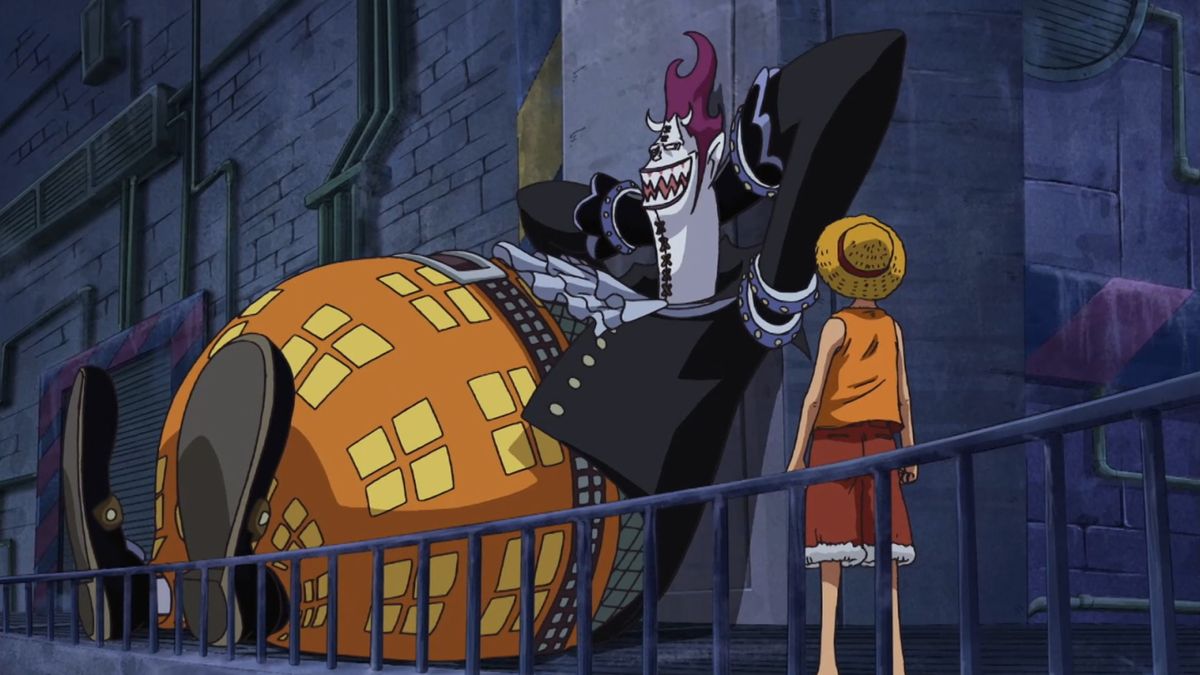
RaeRae Reacts · One Piece Episode 357
Oars Crushes the General Zombies While Usopp’s Negativity Becomes the Crew’s Unlikely Advantage
One Piece Episode 357 React watches Oars treat Moria’s General Zombies as disposable scenery while Usopp learns that surviving Perona is only the first problem.
One Piece Episode 357 React: Usopp’s resistance to the Negative Hollows does not make the animal zombies disappear, and Oars treats Moria’s supposedly elite General Zombies as obstacles in his private adventure.
What happened in Episode 357
Usopp remains behind while Sanji, Franky, and Zoro continue toward their assigned rescues. Oars awakens with Luffy’s appetite for adventure but none of Luffy’s loyalty to the people around him.
RaeRae’s opening receipt
Moria wanted Luffy’s power without Luffy’s relationships. Oars immediately demonstrates why those relationships were never optional decoration.
Oars carries Luffy’s appetite without Luffy’s ethics
Moria wanted the force attached to Luffy’s shadow, but a shadow cannot reproduce the web of promises that directs Luffy’s force. Oars wakes with familiar hunger, confidence, and appetite for adventure while lacking loyalty to the crew those traits usually protect.
The resemblance is recognizable enough to be funny and incomplete enough to become dangerous.
Personality fragments are not a whole person
The zombie can echo habits stored in a stolen shadow. Those habits do not include every memory, relationship, judgment, and decision that made Luffy himself. Moria treats a person as extractable features and receives a crude composite.
Episode 357 turns that reduction into a management disaster. Power stripped from context refuses to behave like the owner.
The General Zombies discover their rank means nothing to Oars
Moria’s elite undead represent the hierarchy he built through stolen bodies and shadows. Oars crushes them without recognizing the status they were supposed to carry. The newest weapon does not respect the older weapons.
An organization founded on possession cannot demand genuine solidarity from its possessions.
Moria built obedience instead of belonging
The Thriller Bark army follows commands because shadows and corpses have been forced into service. Nobody chose the mission, trusted the leader, or developed mutual responsibility. Control creates compliance until competing impulses arrive.
The Straw Hats survive chaos through attachment. Moria’s army has rules without relationship, so strength can turn inward immediately.
Luffy’s recklessness normally has people around it
Luffy can destroy a room, abandon a careful plan, or chase an appetite without warning. His crew argues, redirects, feeds, rescues, and challenges him. Their presence does not erase the consequences, but their relationship gives recklessness boundaries and repair.
Oars receives the impulse without the social practice that has taught Luffy when another person’s freedom matters.
Extraction cannot copy accountability
Moria believes the useful part of Luffy is force. Accountability appears inefficient because accountability limits what force may do. Yet limits are precisely what keep strength from treating everybody nearby as scenery.
Oars demonstrates that stolen capability without responsibility becomes indiscriminate damage.
The giant calls destruction an adventure
Luffy uses adventure to describe movement toward freedom, friendship, food, danger, and discovery. Oars uses the same appetite inside a body directed by Moria’s ownership. The word survives while the moral orientation disappears.
Language can sound familiar after the meaning has been hollowed out.
Moria cannot manufacture a captain by stealing a shadow
A captain is not the loudest appetite or strongest strike. Luffy’s authority grows through promises kept, risks shared, and repeated recognition of what his friends choose. Oars has no history with anybody expected to follow him.
The zombie can imitate a gesture. The zombie cannot inherit trust that was built through experience.
Usopp’s victory over negativity creates a second problem
Negative Hollows cannot lower him because he already speaks from an internal basement. That immunity gives Usopp a unique opening, but the surrounding animal zombies still have bodies, numbers, and teeth.
A perfect counter to one power does not convert the whole room into an easy fight.
Usopp knows the difference between surviving and controlling
He can resist Perona’s emotional attack while remaining honestly afraid of her physical forces. The distinction keeps his triumph human. He has not become invulnerable; he has discovered one place where his familiar pain changes the matchup.
Useful self-knowledge includes both the advantage and the remaining danger.
Staying behind becomes a deliberate contribution
Sanji, Franky, and Zoro continue toward other rescue routes while Usopp occupies Perona and her zombies. His position prevents one threat from following the others unchecked.
Fear does not cancel the choice. The choice matters because Usopp understands exactly how frightened he is.
The crew trusts a matchup no power ranking would predict
Perona dropped stronger fighters through emotional control. Usopp alone remains functional because his inner life breaks the mechanism. A conventional ranking would send the wrong person.
The Straw Hats’ diversity becomes tactical infrastructure. Difference provides answers raw strength cannot supply.
Usopp’s pessimism contains observation
He imagines every way a plan can fail, which often sounds exhausting or ridiculous. The same habit makes him sensitive to hidden conditions and secondary threats. He rarely assumes one breakthrough has solved everything.
Episode 357 rewards that wary attention when the animal zombies remain after the ghosts fail.
Perona’s organization depends on predictable emotions
Her power assumes people value themselves enough to experience a dramatic collapse. Usopp violates the assumption, and the surrounding forces must compensate physically.
A system designed around one model of human response becomes fragile when somebody arrives with a different emotional history.
Oars and Usopp reveal opposite truths about weakness
Oars possesses enormous physical power and lacks the relationships that make borrowed behavior coherent. Usopp possesses limited physical power and carries relationships strong enough to keep him participating through fear.
The episode refuses to let scale determine usefulness or humanity.
The shadow system mistakes memory for programming
Moria expects a shadow’s traits to operate like commands installed in a body. Lived behavior is messier. Appetite, humor, ambition, and instinct developed alongside experiences the corpse did not share.
The result can reproduce recognizable patterns without understanding why those patterns once mattered.
General Zombies become victims of the hierarchy they enforced
The elite corps helped maintain Moria’s control over weaker bodies and intruders. Oars now treats them as disposable because a hierarchy based on usefulness always permits a stronger asset to replace an older one.
Serving domination offers no permanent safety from domination.
Oars exposes Moria’s contempt for his own army
Moria values zombies as accumulated force, not as beings deserving protection. If the newest creation destroys existing soldiers, their loss becomes acceptable collateral inside his larger ambition.
The army’s supposed importance lasts only while Moria finds every component useful.
Luffy’s shadow still carries resistance indirectly
Oars does not consciously rebel for Luffy, yet Luffy’s unruly appetite makes the body difficult to contain. The stolen material refuses to become perfectly obedient because the source was never shaped for submission.
Moria can command the shadow, but command cannot remove every contradiction embedded in the life that formed the shadow.
The crew’s parallel routes make Oars more dangerous
Sanji, Zoro, Franky, Chopper, Robin, and Usopp are divided across urgent confrontations. A giant carrying Luffy’s shadow can disrupt every route by moving through the island without loyalty or restraint.
The threat is not merely size. Oars can collide with a plan already operating under dawn’s deadline.
Comedy keeps the critique visible
Oars behaving like an exaggerated Luffy is funny because the borrowed habits are familiar. The destruction stays unsettling because familiarity lets viewers identify exactly what is missing.
Humor becomes diagnostic. We laugh at the imitation and notice how much of Luffy was never stored in appetite alone.
Adventure without consent becomes invasion
Luffy’s adventures often begin by entering places where powerful people deny freedom, and his arrival can still be disruptive. Oars treats every space and body as available for his excitement because Moria created him inside an ownership system.
Calling destruction an adventure cannot excuse the people forced to absorb the damage.
Usopp practices courage without emotional transformation
He does not become confident before staying behind. No speech removes his fear, and no sudden power makes the animal zombies harmless. He takes responsibility from inside the same nervous body.
That pattern is more useful than perfection. People can act before their feelings become convenient.
The episode shows why chosen crews outperform collections
Moria has assembled corpses, shadows, specialists, and ranks. The Straw Hats have assembled people who can disagree, choose, and still coordinate around shared obligations. One group is large because resources were taken; the other is resilient because relationships were built.
Oars crushing allies makes the difference physical.
Episode 357 remains an episode React
This page responds to Oars destroying the General Zombies, the incomplete copy of Luffy inside him, and Usopp’s unresolved fight after resisting Perona’s ghosts. A complete Thriller Bark Review belongs after those systems reach resolution.
React classification preserves broadcast-level analysis and keeps whole-work Reviews distinct.
The official local still remains canonical
The Episode 357 still serves as featured image, hero, bounded-directory card, and social preview. One local attachment provides consistent recognition across the hub, Episode index, search, and shared links.
Complete source and accessibility metadata remain attached, and no neighboring record reuses the image.
RaeRae’s final receipt
Episode 357 lets Moria discover that Luffy’s power was never a clean product he could remove from the person and install somewhere bigger. Oars has the appetite, swagger, and hunger for adventure. He does not have the promises, arguments, meals, rescues, or accumulated trust that teach Luffy why another person’s freedom matters. The General Zombies learn the difference first when Moria’s newest weapon crushes the army he was supposed to strengthen.
Usopp carries the opposite lesson. He has no giant body and no confidence worth stealing, yet relationship keeps him in the room. Perona’s ghosts cannot manufacture a despair he has not already rehearsed, but animal zombies remain dangerous and he knows the danger. Staying behind is brave because fear survives the decision. Moria collected useful parts and expected obedience. The Straw Hats chose complicated people and learned where each person can matter. One model produces Oars trampling allies. The other leaves a terrified sniper standing exactly where his crew needs him.
The missing crew is the missing restraint
When Luffy charges toward a dangerous impulse, somebody usually understands the pattern well enough to intervene. Nami can demand practical sense. Sanji can feed the hunger before hunger becomes everybody’s crisis. Zoro can recognize the line between reckless confidence and a fight the captain has chosen for a reason. Usopp can name every disaster approaching. Those corrections are part of how Luffy exists socially.
Oars has none of them. Moria extracted behavior and removed the people who have spent years answering that behavior. The result is not a purer Luffy. The result is an appetite denied the relationships that make correction possible.
A stolen trait cannot carry the consent surrounding its original use
Luffy chose where to direct his body, and his friends chose whether to follow, object, or drag him away. Oars carries related impulses inside a corpse that never chose the shadow, serving a ruler the shadow never accepted. Every layer of the creation depends on overwritten will.
That coercion explains why the imitation feels wrong even when a joke sounds perfectly familiar. Recognition is not consent, and resemblance does not make Moria’s construction legitimate.
The General Zombies receive no loyalty dividend
Hierarchy promised them status above ordinary zombies, but status cannot protect them from a stronger asset inside an extractive system. Oars does not owe them fellowship, and Moria never built fellowship into the arrangement. Their rank only described current usefulness.
Episode 357 lets the army experience the insecurity imposed on every victim beneath them. Domination cannot guarantee safety to its functionaries because the same logic always permits replacement.
Usopp’s fear preserves information Oars lacks
Usopp constantly tracks who might be hurt, what might fail, and where escape may remain possible. The habit can become self-defeating, but the habit also keeps other people present in his calculations. Oars moves with enormous confidence and almost no awareness of consequence.
The comparison gives fear a social dimension. Usopp worries because the world contains people and outcomes he cannot control. Oars treats the world as scenery because borrowed appetite arrived without shared responsibility.
Moria copied output and lost the reason for the output
Luffy’s strength becomes meaningful when he uses strength to break another person’s cage or protect a chosen promise. Moria sees the strike and ignores the decision behind the strike. Oars can reproduce spectacular output while the moral reason remains absent.
That failure reaches beyond one zombie. Any system that values people only for measurable output eventually loses the knowledge, trust, and judgment that made the output valuable.