RaeRae Reacts · One Piece Episode 340
Mini Merry Carries Nami, Usopp, and Chopper to Hogback’s Mansion
One Piece Episode 340 React sends Mini Merry II into Thriller Bark, past Cerberus and Hildon, toward Dr. Hogback’s gothic mansion.
What happens
Nami, Usopp, and Chopper take Mini Merry II despite having no desire to land, then reach Thriller Bark first. Cerberus chases them through the foggy forest before Hildon offers a carriage ride to the mansion of the celebrated surgeon Dr. Hogback.
RaeRae reacts
Mini Merry begins as joyful proof that Franky understood the crew’s grief, then becomes the vehicle carrying three cautious people into danger before Luffy. Hogback’s reputation activates Chopper’s professional admiration, which makes the invitation more persuasive than a generic promise of shelter.
Canon note
Episode 340 adapts manga-canon Thriller Bark material.
Mini Merry II delivers joy directly into a nightmare
Nami, Usopp, and Chopper begin the outing aboard a craft designed to preserve affection for Going Merry. The small boat should represent freedom, memory, and Franky’s care. Thriller Bark immediately surrounds that joy with a landscape designed to make visitors feel hunted.
The contrast gives the episode emotional texture. Horror does not arrive in an empty life; horror intrudes on something the crew was enjoying.
The trio lands before the rest of the crew can provide backup
Separation changes every calculation. Nami has navigation and tactical judgment, Usopp has inventions and suspicion, and Chopper has medical skill and physical power. None of them has the comfort of knowing Luffy, Zoro, Sanji, Robin, or Franky can step into the next frame.
Their fear reflects real vulnerability, not a failure to be brave enough.
Thriller Bark’s forest behaves like a staged threat
The path offers ominous shapes, impossible creatures, and convenient movement toward the mansion. Random wilderness would scatter encounters. This landscape feels arranged to keep frightened guests moving along somebody else’s route.
Once again, architecture and environment perform control before the controlling figure identifies himself.
Cerberus turns mythology into a stitched experiment
The three-headed guard dog should be a legendary monster. Thriller Bark’s version looks assembled, irregular, and darkly comic. The design tells viewers that bodies inside this arc may have been treated as components.
Laughter does not neutralize the violation. The creature can be ridiculous and still point toward a laboratory ethic that values novelty over consent.
Nami responds by trying to preserve a route out
Her attention returns to movement, distance, and how the group might reach safety. She understands that surviving one creature means little if the surrounding territory continues directing them deeper inward.
Nami’s fear coexists with command. The trio depends on her ability to convert panic into the next viable action.
Usopp’s alarm system is permanently set to haunted island
Every shadow confirms the story he already expects, and the episode mines his escalating reactions for comedy. Yet Thriller Bark rewards suspicion more often than ordinary islands do. The danger is deciding which impossible warning needs immediate action.
Usopp remains useful because fear makes him scan constantly. His imagination overproduces answers, but the observation beneath the answers catches real threats.
Chopper sees animals and medicine where others see only monsters
His identity lets him read Cerberus as both threat and altered living body. Soon Hogback’s name will transform the mansion from generic shelter into the home of a medical hero. Chopper enters the situation with professional hope alongside terror.
That hope creates a vulnerability more intimate than being chased.
Hildon’s carriage offers rescue too conveniently
A polite guide appears when the trio needs movement away from the forest. The carriage looks safer than running among stitched creatures, but accepting the ride hands direction to a stranger who knows the territory.
Thriller Bark repeatedly disguises lost agency as assistance. The offered solution determines where the guests will go.
Courtesy becomes another costume worn by control
Hildon can speak gently while transporting people deeper into danger. The manners resemble Brook’s courtesy, but the surrounding choices differ. Brook shared information and tried to warn the crew away. Hildon withholds context while selecting the route.
The episode asks viewers to judge hospitality by whether guests retain meaningful choice.
The carriage ride makes escape harder to map
Moving quickly through fog and forest prevents Nami from building a reliable mental route. Speed feels like protection from pursuing creatures while also erasing landmarks needed for an independent return.
A ride can save energy and steal orientation in the same motion.
Hogback’s mansion promises civilization inside manufactured wilderness
Walls, lights, rooms, and a famous doctor’s name seem to offer order after the chaotic forest. The mansion becomes appealing because the exterior has made nearly any human structure look safe.
That emotional setup is part of the trap. Threatening surroundings lower the threshold for trusting whoever controls shelter.
Chopper recognizes Hogback as a medical legend
Admiration changes the trio’s internal balance. A destination Nami and Usopp read with suspicion becomes deeply meaningful to Chopper. Hogback represents achievement, saved lives, and knowledge a young doctor could scarcely imagine accessing.
The episode makes reverence visible before giving Chopper evidence capable of challenging reverence.
A famous name can function like a locked door
Once a person becomes an icon, followers may struggle to ask ordinary ethical questions. Chopper knows Hogback through reputation, not relationship. The name arrives already wrapped in authority.
Thriller Bark will test whether medical brilliance deserves trust when the work treats bodies as raw material.
Chopper’s admiration deserves tenderness rather than ridicule
He became a doctor through grief, discipline, and faith that medicine could protect people. Of course a celebrated surgeon fascinates him. The mistake would not be caring about knowledge. The mistake would be allowing prestige to replace evidence forever.
Growing past a hero can hurt precisely because the original admiration was sincere.
Nami and Usopp cannot borrow Chopper’s trust
They hear the name without sharing the same emotional history. Their caution provides a necessary counterweight inside the trio. Friendship does not require everyone to feel identical confidence.
Good group judgment emerges when one person’s expertise and another person’s unease both remain speakable.
The mansion extends the arc’s obsession with assembled bodies
Cerberus announces that biological boundaries have been ignored. A doctor’s residence suggests the alterations may not be supernatural accidents. Medical space, graveyard imagery, and stitched creatures begin forming one disturbing pattern.
The audience can connect those clues before Chopper is ready to connect them because admiration delays suspicion.
Medicine without consent becomes another form of possession
A doctor receives extraordinary access to bodies because healing requires trust. Thriller Bark corrupts that access when bodies become experiments or tools. Skill cannot excuse the absence of permission.
The episode has not yet revealed the entire operation, but the creature designs make the ethical question impossible to ignore.
The trio’s comic panic never makes the threat unreal
One Piece allows screaming faces, bizarre animals, and slapstick timing to share space with a deeply coercive system. Humor regulates tension so viewers can remain close to the characters. Humor does not certify that everyone is safe.
The best Thriller Bark comedy often sharpens the horror by showing how absurd the violation has become.
Mini Merry’s absence from the mansion matters
The little boat represented a direct line back to Sunny. Once the trio accepts Hildon’s route, that line feels less accessible. Physical distance grows alongside informational dependence on the host.
A crew can own excellent escape technology and still lose access when an environment controls the path between person and tool.
The episode gives Chopper an intellectual threshold
Entering Hogback’s home means entering a confrontation between the idea of medicine Chopper loves and a famous doctor’s actual practice. The threshold is not merely architectural. Chopper is approaching evidence that may require him to revise part of his professional mythology.
That kind of revision can be more frightening than any animal in the woods.
Hildon delivers guests like inventory
The carriage frames the trio as passengers, yet the larger system treats arrivals as resources moving toward processing. The lack of informed consent changes the ride’s meaning after the fact.
Thriller Bark specializes in turning people into objects while keeping enough ceremony to disguise the transaction.
Episode 340 remains an individual React
This article responds to Mini Merry II’s landing, Cerberus, Hildon’s carriage, the mansion, and Chopper’s admiration for Hogback. A completed assessment of Thriller Bark belongs in a separate arc or series Review.
That distinction keeps episode pages in Reacts and preserves Reviews for works judged as wholes.
The official story image provides visual continuity
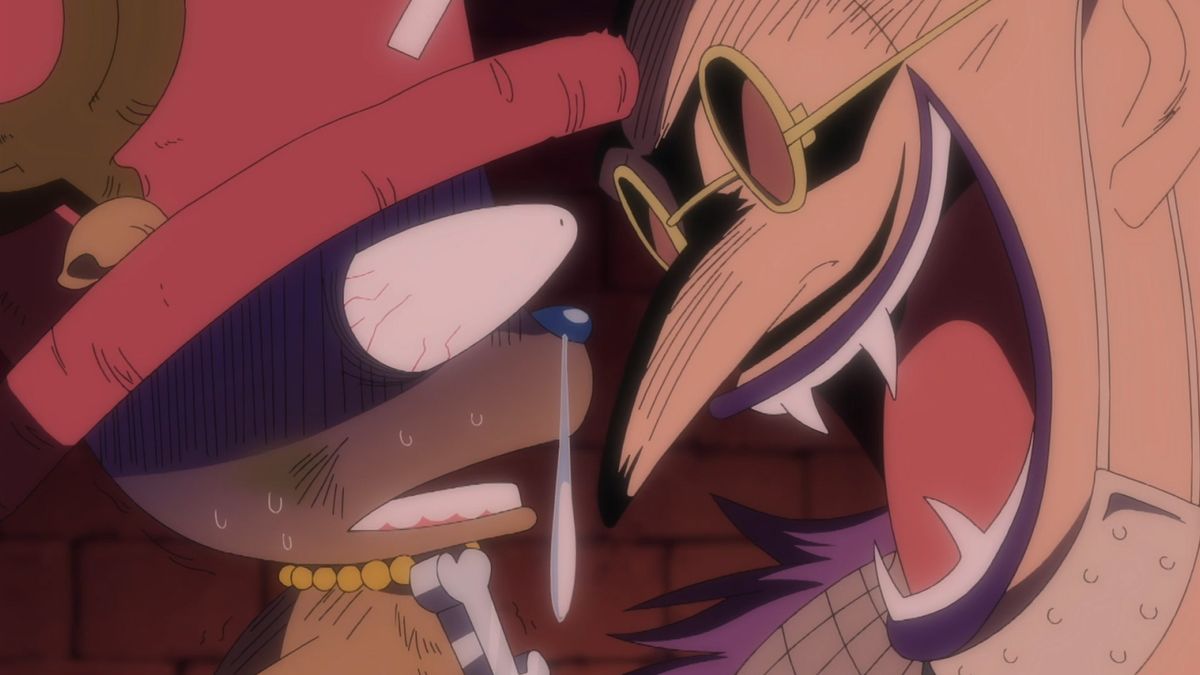
The locally stored Episode 340 still serves as featured image, hero, directory card, and social preview. The consistent image makes the card’s promise match the page readers open.
Episode-specific metadata describes the actual scene, and no neighboring React reuses the asset.
RaeRae’s final receipt
Episode 340 takes the sweetest piece of Sunny’s new design and drives Mini Merry II straight into a lesson about deceptive hospitality. Nami, Usopp, and Chopper meet a stitched Cerberus, accept a carriage from a suspiciously convenient guide, and arrive at the mansion of a doctor Chopper has admired from a distance. Every step looks like movement toward safety while handing somebody else more control over direction.
Chopper’s excitement is the emotional center because admiration is not stupidity. He believes medicine can save people, and Hogback’s reputation represents knowledge he longs to understand. That sincerity makes the stitched bodies around the mansion more disturbing. A famous name cannot wash consent out of the profession. Nami’s caution, Usopp’s fear, and Chopper’s hope all deserve space as the trio crosses the threshold. Thriller Bark has already trapped their ship. Now the island begins working on trust itself, wrapping a route in courtesy and a laboratory in prestige until the guests must decide which evidence matters more than the welcome.
Fear and professional wonder can occupy Chopper at once
Chopper does not stop being frightened when Hogback’s name appears. Admiration simply adds another current to the moment. He wants knowledge from a doctor whose public achievements seem enormous, while the forest keeps presenting evidence that something around the mansion is profoundly wrong.
That emotional conflict feels true to fandom and mentorship. People can love what a creator, teacher, or public figure once represented and still face facts that demand a harsher judgment.
The trio needs disagreement because certainty would be dangerous
If everybody adopted Usopp’s worst prediction, panic might prevent useful observation. If everybody adopted Chopper’s admiration, prestige could silence obvious warnings. If everybody relied only on Nami’s practical route-finding, the mansion’s moral problem might remain unnamed.
Their competing instincts create a living audit. Friendship gives each person permission to challenge the story somebody else most wants to believe.
Hogback’s reputation arrives ahead of his accountability
Public fame can preserve accomplishments while hiding the conditions under which later work occurs. Chopper knows the celebrated record. The bodies outside the mansion suggest another record is waiting to be read.
Episode 340 places those archives beside each other without resolving the contradiction too quickly. The next ethical move is not automatic condemnation or automatic defense. The next move is looking closely enough that admiration cannot edit the evidence.
The mansion is a promise the episode already taught us to question
A home promises shelter, a doctor promises care, a carriage promises safe transport, and a guide promises direction. Thriller Bark dresses control in the language of help. Each promise must be measured by what happens to a guest’s choices after acceptance.
By the time the doors open, the trio has traveled from free exploration to a destination selected by the island. The decor may change, but the trap has never stopped moving them.
The mansion tests whether wonder can survive scrutiny
Chopper does not need to abandon wonder in order to ask who benefited, who consented, and who paid for a celebrated breakthrough. Those questions protect the meaning of medicine he inherited from Hiriluk and Kureha. Knowledge worthy of admiration should withstand attention to the people inside the experiment.
Episode 340 leaves him at the door between reputation and evidence. The emotional suspense comes from knowing that a good doctor will eventually have to choose the patient over the legend.
The mansion may offer answers, but Chopper must decide whether the answers honor life or merely animate what powerful people claimed.
Chopper carries compassion into the encounter, which means genuine learning must deepen his respect for autonomy rather than teach him to excuse violations performed beneath a medical title. That standard belongs at the center of every discovery waiting beyond Hogback’s door.