RaeRae Reacts · One Piece Episode 339
Thriller Bark Traps Sunny While Brook Runs Back Toward the Danger
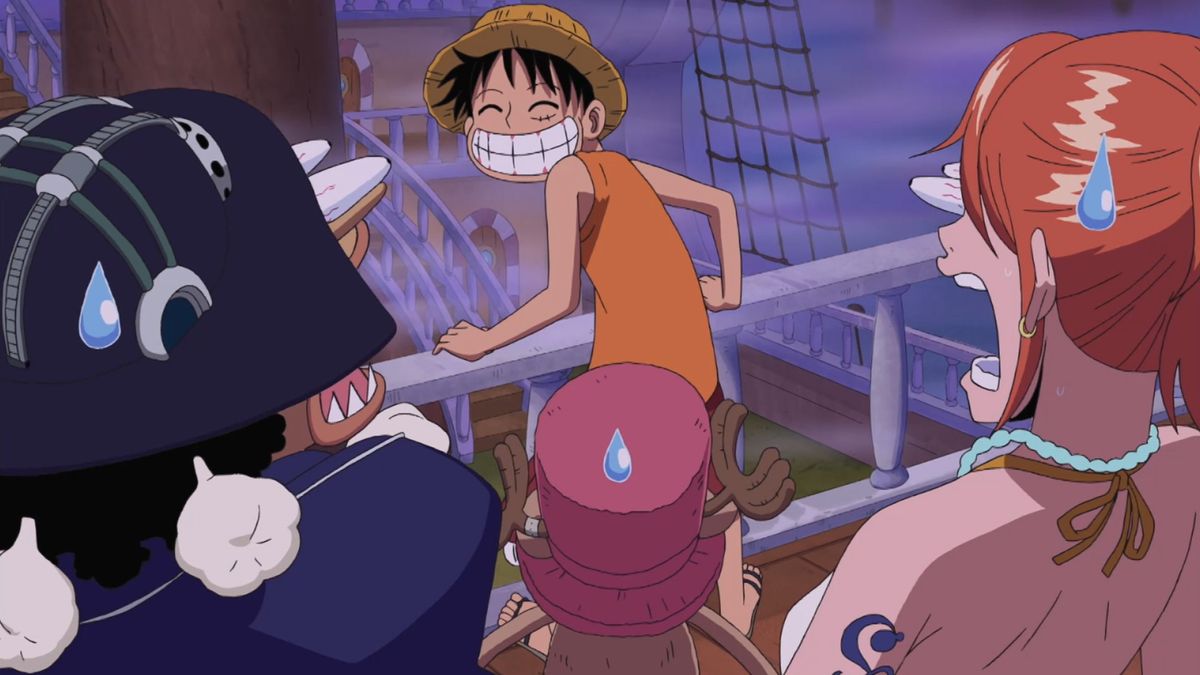
One Piece Episode 339 React traps the Thousand Sunny inside Thriller Bark as Brook warns the crew away and Luffy chooses to land.
What happens
Sunny becomes trapped inside Thriller Bark, the enormous ghost island wandering the sea. Brook warns the Straw Hats to escape and runs across the water toward the island. Nami favors caution, while Luffy is already determined to land and investigate.
RaeRae reacts
Brook’s warning matters because the man most desperate for company still chooses distance when staying might endanger the people who welcomed him. Luffy hears mystery as invitation; Nami hears environmental evidence. The crew needs both impulses if curiosity is going to survive contact with the trap.
Canon note
Episode 339 continues the manga-canon Thriller Bark Arc.
Thriller Bark appears less like an island than a mouth
The enormous gate closes around Sunny and changes the crew’s relationship to the landscape. They have not simply reached shore. A constructed territory has admitted them and then removed the easy route back out.
The visual turns arrival into consumption. Thriller Bark feels capable of swallowing ships because every boundary belongs to somebody else.
Sunny becomes trapped before the crew understands the captor
The Straw Hats know the vessel cannot leave freely, but they do not yet know the full mechanism or command structure. That gap matters. Confinement arrives as a fact before the responsible person becomes visible.
The episode continues the arc’s surveillance pattern. Somebody controls access, timing, and geography while the visitors struggle to identify who is operating the system.
A massive roaming island breaks Nami’s normal map logic
Thriller Bark is not a stable piece of geography waiting where charts say land should be. The structure moves, carries architecture, and surrounds ships. Navigation expertise remains vital, but the object being navigated refuses a familiar category.
Nami must treat built environment, vessel, and island as one hostile problem.
The closed gate turns Sunny from transportation into hostage
Sunny is the crew’s home and their means of choosing the next horizon. Trapping the ship threatens both mobility and belonging. The danger is not only that people may be attacked ashore. The crew’s shared future can be held in place.
After Water 7 made the meaning of a ship emotionally explicit, this entrapment carries more weight than a blocked exit.
Brook runs across the sea because urgency outranks explanation
His movement looks impossible even after the audience accepts a living skeleton. Brook does not pause to display the technique as spectacle. He uses speed to return toward the place connected to his stolen shadow.
The choice tells us that his departure from dinner was not aimless wandering. A conflict has been waiting inside the fog.
Running on water gives freedom a cruelly limited form
Brook can cross a surface most people cannot stand upon, yet sunlight still bars entire routes and a stolen shadow keeps him tethered to danger. Extraordinary mobility coexists with profound restriction.
One Piece refuses to confuse a spectacular ability with actual freedom. Capability does not cancel coercion.
Brook returns alone because isolation has become his method
Years without reliable companionship teach a person to confront problems without expecting backup. Brook leaves the crew before a bond can become a plan. Self-reliance looks brave and also reveals what loneliness has trained him to believe.
Luffy’s invitation may have reached him, but one meal cannot immediately rewrite survival habits built across years.
Luffy hears a warning and identifies an adventure
Brook tells the crew not to enter, and the sealed gate supplies additional evidence that retreat would be wise. Luffy still wants to land. His response creates the familiar collision between a captain drawn toward people in trouble and crewmates responsible for keeping everyone alive.
The impulse is reckless, but the story rarely treats abandonment as the morally neutral option.
The desire to explore includes a desire to understand Brook
Luffy is curious about zombies and haunted territory, yet Brook has already personalized the destination. Somewhere inside Thriller Bark lies the force that stole a potential crewmate’s shadow.
The island is no longer merely strange. The island contains an answer to a harm the crew has witnessed.
Nami, Usopp, and Chopper separate through a seemingly ordinary experiment
Mini Merry II gives the crew a chance to test Sunny’s Soldier Dock System, and the smaller vessel carries three people away from the main deck. Exploration technology becomes the path to separation.
The scene does not make invention a mistake. Useful tools still create new choices, and hostile territory can exploit any moment when a crew divides attention.
Mini Merry II proves Franky’s design contains joy as well as force
The little craft is not a cannon or escape burst. Mini Merry preserves the face and spirit of the previous ship inside Sunny’s larger design. Testing the vessel should be playful.
Thriller Bark corrupts that pleasure by turning a joyful outing into isolation, which makes the danger feel invasive rather than merely atmospheric.
The name Merry carries continuity into unfamiliar water
The Straw Hats did not leave every trace of their former home behind. Franky’s design gives memory a working form instead of a museum display. Mini Merry moves, carries friends, and participates in new adventures.
That continuity makes the separation especially tender. A symbol of remembered care now transports vulnerable crew members into a space built around stolen bodies and shadows.
Chopper boards as doctor, admirer, and frightened friend
Chopper’s fear never removes his professional curiosity. The prospect of Doctor Hogback will soon touch his deepest respect for medicine. For now, he rides beside friends whose responses to danger differ sharply from his own.
The trio works because courage circulates. Each person can panic and still provide something the others need.
Usopp recognizes the shape of a horror story before anyone has proof
His imagination anticipates traps, monsters, and terrible outcomes. The crew often laughs because his predictions become excessive. Thriller Bark is exactly the kind of place where exaggerated fear may accidentally resemble accurate forecasting.
The tension comes from knowing that panic can be emotionally honest without being a reliable map.
Nami carries practical authority into the smaller boat
She reads environment and risk while also enjoying the freedom of the new craft. Nami is not simply the sensible person dragged by two frightened companions. Her decisions place her inside the adventure as an active navigator.
That agency makes later violations against her more important to name. The story establishes a woman choosing movement before an attacker tries to seize choice.
Separation lets Thriller Bark tailor fear to different groups
The crew aboard Sunny confronts the island as an enormous strategic trap. The Mini Merry trio will encounter a more intimate path through woods, creatures, carriages, and a mansion. Scale changes while the same controlling territory surrounds everyone.
The structure resembles a haunted attraction only because somebody has designed routes for unwilling guests.
The island’s apparent passivity is a performance
Buildings sit still, fog hangs, and gates look mechanical. Yet every feature guides bodies toward selected spaces. Thriller Bark does not need to chase prey openly when architecture can do the directing.
The episode teaches viewers to read scenery as an active participant in the antagonism.
Brook’s warning gains credibility from the gate
The crew barely knows him, so a warning could be misdirection. Then the island closes around Sunny. Material evidence supports the claim that this place takes control away from visitors.
Trust develops through corroboration. Brook’s story and the crew’s experience begin to occupy the same world.
The Straw Hats cannot treat Brook as a curiosity and ignore his crisis
Dinner created a relationship, however new. Once the crew understands that Thriller Bark is linked to his missing shadow, approaching the island carries responsibility alongside appetite for adventure.
One Piece repeatedly turns friendship into obligation. Knowing somebody means their stolen future is no longer somebody else’s problem.
The episode changes the arc from encounter to entry
Episodes 337 and 338 introduced fog, Brook, and the consequence of shadow theft. Episode 339 crosses the threshold. The ship is enclosed, Brook heads inward, and part of the crew leaves the main deck.
The story now has multiple routes through one controlled space, allowing discoveries to arrive from different emotional angles.
Thriller Bark weaponizes curiosity without condemning curiosity
The barrel exploited the urge to open a gift. Brook’s ship rewarded the urge to approach a stranger. Mini Merry invites exploration while enabling separation. Curiosity produces risk and human connection in the same arc.
The answer is not permanent suspicion. The answer is collective care strong enough to survive what openness reveals.
The crew’s new ship is still learning how this crew uses home
Sunny has crossed storms, ice, and pursuit, but Thriller Bark tests whether the crew can protect a home after spreading across its many tools. Every feature Franky built expands possibility. Coordination must expand with that possibility.
A larger dream requires new habits of attention, especially when enemies can control the surrounding terrain.
Episode 339 is a React and belongs outside Reviews
This article responds to one broadcast episode: the closing gate, Brook’s sea run, Luffy’s choice, Mini Merry II, and the crew’s separation. The finished Thriller Bark arc requires a later whole-series judgment.
Precise classification keeps individual reactions discoverable without misrepresenting them as completed reviews.
The official image remains the visual receipt
The locally stored official story still appears as featured image, hero, directory card, and social preview. That one-to-one relationship lets the episode keep a recognizable identity across every entry point.
The asset includes episode-specific alt text, caption, description, and title, and no other post reuses the same featured image.
RaeRae’s final receipt
Episode 339 closes a gate and quietly changes the meaning of the entire voyage. Sunny is not parked beside an island. The crew’s home has been swallowed by a moving territory that controls who enters and who gets to leave. Brook can run across the ocean like gravity forgot to collect its fee, but that spectacular freedom cannot undo the shadow theft governing his life. He runs back alone because isolation taught him to solve pain without expecting anybody to follow.
Then Mini Merry II carries Nami, Usopp, and Chopper away from the deck. The little boat holds memory, invention, and pure Straw Hat joy, which makes the coming separation sting before danger even shows its face. Thriller Bark keeps taking good things and using their openings: curiosity, hospitality, exploration, a new ship’s possibilities. The episode never argues that openness was foolish. The episode asks whether the crew can stay connected when a hostile world designs every route to pull them apart. Luffy’s answer is predictable and necessary. Brook is inside, the truth is inside, and the Straw Hats do not leave people alone with stolen futures once they know their names.
A sealed harbor makes consent the episode’s hidden subject
The Straw Hats choose to approach mystery, but they never choose to surrender their exit. Thriller Bark accepts their arrival and changes the terms after the ship crosses the threshold. That difference separates adventure from captivity. Exploration requires the continuing ability to revise a decision. The gate removes that ability before anybody aboard understands the bargain.
The architecture therefore announces the villain’s ethics long before the villain speaks. Other people’s bodies, shadows, ships, and choices are materials to capture and arrange.
Following Brook means refusing the logic that kept him alone
Brook warns them away because he has learned to treat his suffering as a private burden. The crew’s movement inward challenges that lesson. Friendship does not wait for a perfectly worded request when the evidence of coercion is already visible.
Luffy’s pursuit can be impulsive, but the deeper promise is deliberate: a person who shared a table with the Straw Hats does not disappear back into danger without being remembered. Episode 339 turns one strange dinner into a claim on collective responsibility.
The gate also changes what victory will require
Defeating one creature or escaping one room cannot restore freedom while Sunny remains enclosed. The crew must understand and dismantle the system controlling the boundary. Episode 339 therefore establishes an arc-sized objective beneath the immediate scares: recover stolen agency, reconnect separated friends, and return their home to open water.
That responsibility turns the island entrance into a rescue mission before the crew knows the enemy’s name.