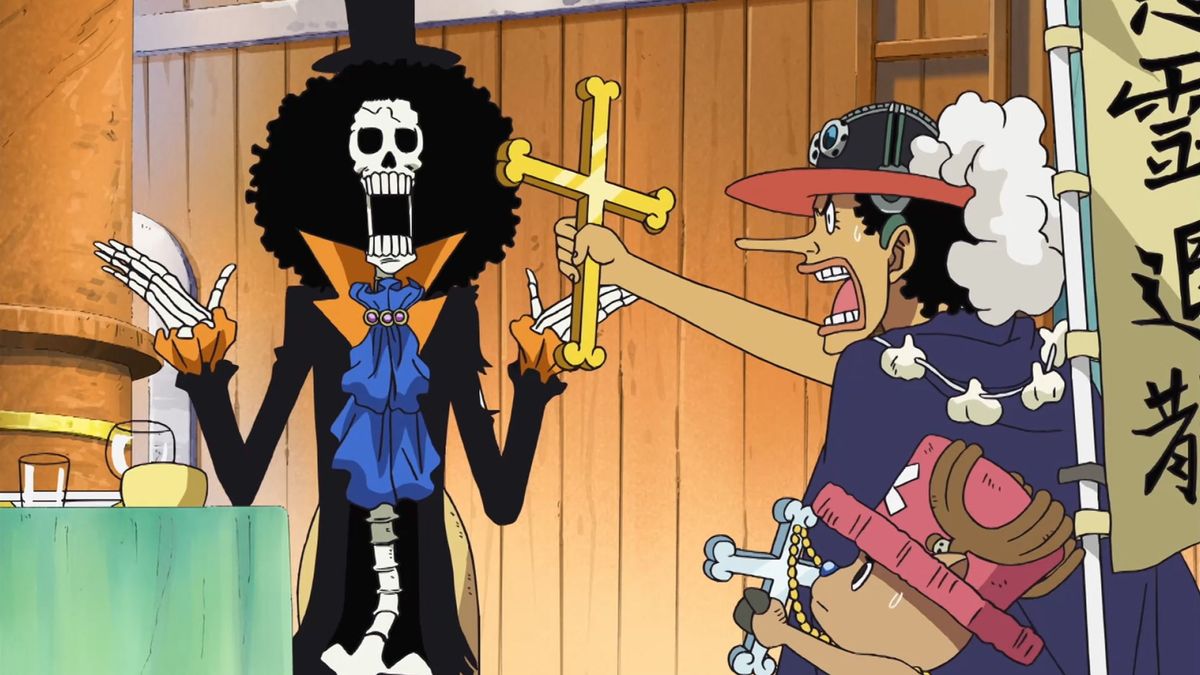
RaeRae Reacts · One Piece Episode 338
Brook Laughs Because Human Company Has Finally Reached His Ghost Ship
One Piece Episode 338 React introduces Brook, Luffy’s immediate invitation, a shared dinner, and the Revive-Revive Fruit beneath the skeleton body.
What happens
The ghost ship carries Brook, a cheerful living skeleton whose delight at meeting people arrives with unusual manners. Luffy immediately invites him to join the crew. Over dinner aboard Sunny, Brook explains that the Revive-Revive Fruit returned his soul after death.
RaeRae reacts
Luffy sees a person before demanding a complete explanation, while Brook treats shared food and conversation as evidence that isolation has finally broken. His comedy is loud because silence has lasted too long. The skeleton body creates the mystery; joy at human company reveals the wound underneath.
Canon note
Episode 338 adapts the manga-canon Thriller Bark story.
Brook laughs because the impossible has finally answered him
The laugh sounds like a gag when the skeleton steps aboard, but the episode gradually reveals its ache. Brook has spent an unbearable stretch without ordinary human company. A ship full of loud strangers is not an interruption to him. Their arrival is proof that the world still contains voices capable of answering back.
That emotional fact arrives before the audience knows his full history. One Piece lets joy testify first.
Luffy skips fear and recognizes a possible crewmate
Luffy does not conduct an interview, verify the Devil Fruit, or consult the frightened people standing beside him. He asks Brook to join the crew almost immediately. The speed is absurd, funny, and completely consistent with how Luffy recognizes people.
He responds to presence rather than presentation. Brook looks like death, but he speaks as somebody alive, curious, hungry for company, and capable of choosing. Luffy trusts that contradiction faster than everyone else.
The invitation is reckless and still contains moral clarity
The captain absolutely creates operational chaos by inviting a stranger aboard. His crewmates have legitimate safety questions. Yet the invitation also refuses to make an unfamiliar body prove personhood before receiving hospitality.
That instinct matters in an arc built around stolen shadows, controlled bodies, and identities reduced to useful parts. Luffy’s first move is to address the whole person.
Brook’s manners turn the ghost ship into a social space
He welcomes conversation, sits for food, and performs courtesy with theatrical delight. Those gestures keep the encounter from becoming a monster inspection. The Straw Hats are guests and hosts at the same time, navigating a relationship rather than containing a specimen.
Politeness cannot guarantee safety, but the episode uses manners as evidence of a life practiced among other people.
Dinner gives Brook a place at the table before lore gives him a category
Food is one of One Piece’s clearest languages of belonging. Sharing dinner places Brook inside the crew’s daily rhythm, however briefly. The meal says somebody can be frightening to look at and still deserve a plate, a seat, and questions asked without cruelty.
Sanji’s cooking and the crew’s noisy reactions restore ordinary social texture to a man stranded inside the extraordinary.
The Revive-Revive Fruit explains survival without explaining loneliness
Brook tells them that his soul returned after death and found his body only after too much time had passed. That account solves the skeleton mechanism. The explanation does not solve what waking into bones feels like to wake into bones, remain conscious, and continue across an empty sea.
One Piece is careful here. A Devil Fruit can answer how. Character writing must answer what the experience cost.
Finding his body late turns resurrection into imperfect rescue
Revival usually promises restoration. Brook’s return gives life without returning the body he remembers. Fog delays the soul, decay changes the vessel, and survival arrives altered.
The detail fits a series interested in damaged futures. Being saved does not mean emerging untouched. A person can receive another chance and still carry visible evidence of the interval when help failed to arrive.
Afro jokes cannot erase the fact that Brook protects one remaining piece of himself
His hair survives when almost everything else about his appearance has changed. The afro becomes comic silhouette and personal continuity at once. Brook guards an artifact of the man he was because identity sometimes needs a physical anchor.
The audience does not yet possess every reason that hair matters, but the insistence tells us not to dismiss the attachment.
Nami’s caution is not prejudice
Nami evaluates the risks of a stranger appearing inside a zone famous for missing ships. She does not owe instant trust because Luffy enjoys the encounter. Her questions protect a crew whose captain regularly treats danger like an invitation.
The episode works because openness and caution both contain wisdom. Hospitality without boundaries becomes vulnerability; boundaries without curiosity can become isolation.
Usopp and Chopper react to the body they can see
Their fear is loud because Brook violates every familiar rule of anatomy. They are not given the audience’s later context. Panic becomes an honest first response, followed by the possibility of listening.
Courage here does not mean pretending a talking skeleton looks ordinary. Courage means remaining in the conversation long enough for a person to emerge from the shock.
Robin treats death as a question with historical texture
Robin’s calm makes room for Brook’s account without demanding that the supernatural become simple. She knows bodies, institutions, and official explanations can all conceal histories. A bizarre claim deserves examination, not automatic ridicule.
Her presence changes the temperature of the exchange. Curiosity becomes more than Luffy’s appetite for novelty.
Franky meets another survivor built from what remained
Franky reconstructed his own body after catastrophic injury. Brook inhabits a body transformed by death and delayed return. Their circumstances differ, yet both complicate any easy line between original body and continuing self.
The episode does not force that parallel into dialogue. The crew’s composition already lets the visual idea resonate.
Brook’s missing shadow places a limit on his freedom
He can speak, sail, and laugh, but direct sunlight will destroy him because somebody stole his shadow. The condition turns daylight into a border. Resurrection did not produce unlimited life; another person’s violence has narrowed where that life can safely exist.
The missing shadow also confirms that Thriller Bark’s threat reaches inside identity and removes something that should be inseparable.
A stolen shadow is more intimate than stolen property
A ship, weapon, or treasure can be separated from its owner without changing the owner’s physical relationship to the sun. Brook’s theft follows him everywhere. The harm becomes environmental, dictating when he may stand outside and which routes remain survivable.
That is control disguised as absence. The stolen thing is invisible until its consequences govern every choice.
Brook leaves because the invitation reaches a wound he cannot ignore
Joining would mean company, music, meals, arguments, and a future beyond drifting. Refusing cannot be read as indifference. His shadow and unfinished obligations make acceptance more complicated than desire.
The departure protects the crew while exposing how badly he wants what Luffy offered. Distance becomes evidence of stakes rather than rejection.
Luffy’s disappointment confirms the invitation was sincere
The captain was not performing a joke for the skeleton reveal. He genuinely wanted Brook aboard. Luffy’s emotional simplicity can look childish, but that simplicity prevents social calculation from diluting welcome.
Once he identifies somebody he likes, appearance and reputation carry remarkably little weight. The rest of the arc will test whether that instinct can survive the dangers attached to Brook.
The ghost ship stops being scenery once Brook becomes legible
At first the vessel functions as a haunted object emerging from fog. After dinner, every empty board suggests isolation. The same ship becomes a record of how one person has endured time.
Good gothic storytelling changes architecture through biography. Nothing physical needs to move for a room to become sadder after we learn who has been waiting inside the vessel.
Comedy protects the episode from turning Brook into misery alone
Skull jokes, blunt questions, and Luffy’s recruitment speed let Brook participate in humor rather than exist only as an object of pity. He controls timing, provokes reactions, and enjoys making people laugh.
Respecting pain does not require stripping a survivor of absurdity. Brook’s comedy is part of his agency.
The crew’s reactions create an argument about personhood
Some see danger, some see scientific impossibility, and Luffy sees a musician-shaped opening in the roster. No single reaction resolves Brook. The group must hold several truths: his body is alarming, his story may be incomplete, and his loneliness is plainly human.
The episode trusts viewers to arrive at recognition through relationship rather than a lecture.
Thriller Bark introduces its central victim before its ruling villain
We understand a consequence of shadow theft before meeting the person responsible. That order centers harm. The villain will not define why the conflict matters; Brook’s restricted life already does.
One Piece often builds moral stakes this way. Power becomes hateful because we first meet the people forced to organize life around its damage.
The Sun becomes a threat because somebody weaponized absence
Sunlight should represent freedom after oppressive fog. For Brook, escape into daylight means annihilation. Thriller Bark corrupts the most obvious route toward safety.
The condition produces a cruel map: darkness shelters him while also belonging to the territory of the person who harmed him. Every exit carries another form of danger.
Episode 338 expands the arc without rushing the mansion
The story pauses for conversation while Nami, Usopp, and Chopper move elsewhere. That pause matters. Brook needs enough room to become a character before plot machinery turns him into a quest objective.
Without dinner and testimony, recovering the shadow would feel mechanical. With them, the coming fight already has a face, a laugh, and a desired future.
This remains an episode React rather than a Review
The page follows Episode 338’s invitation, dinner, Devil Fruit account, stolen shadow, and departure. A full Thriller Bark review must judge the completed arc after its themes and outcomes are visible.
Keeping the content type precise protects the shared Reviews directory from episode recaps and gives the Reacts directory an honest record.
The canonical image keeps every entry point aligned
The local official story image is the featured image, hero, landing card, and social preview for this React. Readers see the same episode-specific promise from the directory through the article.
The image is not reused for another post, and its metadata names Episode 338 instead of relying on a generic franchise label.
RaeRae’s final receipt
Episode 338 introduces Brook with one of One Piece’s favorite tricks: the loudest joke in the room is guarding a devastating truth. A skeleton laughs, Luffy asks him to join the crew before anybody can process the bones, and dinner becomes the first ordinary human evening Brook has touched in far too long. The Revive-Revive Fruit explains why he walks. The explanation cannot measure the silence he survived.
Luffy’s invitation is reckless in every practical sense and beautiful in the one sense that matters most here. He recognizes a person before demanding that the person look familiar. Brook cannot simply accept because his stolen shadow makes sunlight fatal and ties his freedom to an unfinished fight. His departure is not a rejection of belonging. His departure proves how much the theft controls. Thriller Bark gives us the victim before the villain, the laugh before the lament, and the person before the puzzle. That order is the whole heart of the episode.
Listening changes the meaning of every bone
The crew first encounters a silhouette assembled from horror imagery. Brook’s account replaces abstraction with sequence: death, a wandering soul, a delayed return, an altered body, continued consciousness, and years governed by a missing shadow. Each detail gives the visible skeleton a lived cause. Listening does not make the sight less strange. Listening makes strangeness an inadequate verdict.
That distinction carries the episode. Empathy is not pretending difference disappears. Empathy is refusing to let difference become the only information considered.
The episode makes belonging sound ordinary on purpose
Brook does not need a grand institution to restore him. He needs people who will answer a joke, argue about manners, pass food, ask questions, and notice when he leaves. Ordinary fellowship becomes almost sacred after prolonged isolation.
Luffy offers that future in one impulsive sentence. Brook cannot claim the offer yet, but the possibility now exists, and possibility changes the emotional weather of the entire ghost ship.