RaeRae Reacts · One Piece Episode 332
Don Accino’s Heat Turns Lovely Land Into a House Built for Capture
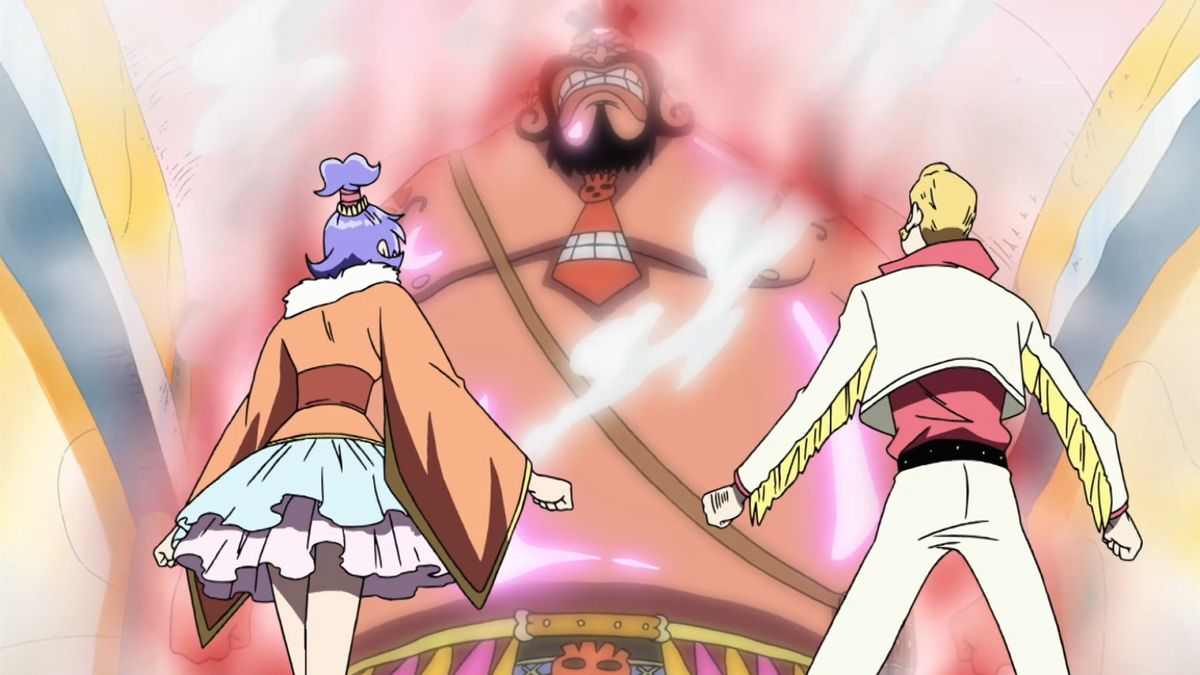
One Piece Episode 332 React pits Zoro against Don Accino’s melting heat before a floor trap reunites him with the prisoners below Lovely Land.
What happens
Zoro confronts Don Accino, whose Heat-Heat Fruit can melt nearly anything he touches. Heat overwhelms Zoro’s ranged attack, and a floor trap drops him into the underground room holding Nami and the others while Lovely Land descends into confusion.
RaeRae reacts
Don Accino controls a frozen kingdom through heat, which makes the stronghold an extension of his body and authority. Zoro can cut obstacles, but the encounter punishes treating the visible opponent as the entire system. Falling among the prisoners reconnects separated crew members and turns an apparent failure into new collective possibility.
Canon note
Episode 332 and the Heat-Heat Fruit conflict are anime-original.
Don Accino embodies the unstable center of Lovely Land
The frozen stronghold depends on a patriarch whose body produces overwhelming heat. His power can melt nearly anything he touches, making the landscape around him both fortress and fuel. The family built an extraction business around a man capable of destroying its foundation.
That contradiction is not subtle, and the clarity works. Control organized around unchecked appetite eventually threatens the structure meant to display control.
The Heat-Heat Fruit turns touch into environmental authority
Accino does not simply strike harder. Contact changes material conditions, removes safe surfaces, and makes ordinary defenses unreliable. Heat radiates beyond the boundary of his body, so proximity itself becomes dangerous.
The power gives him authority over what can remain solid nearby. Lovely Land stays frozen only while his temper and temperature remain managed.
Zoro confronts a power his swords cannot safely approach
Close combat usually lets Zoro translate conviction into decisive cuts. Accino’s heat makes the distance between blade and body hazardous before an attack lands. The challenge is not whether Zoro possesses courage. The challenge is whether his usual relationship with distance remains possible.
A strong fighter can be forced into strategic revision without becoming weak.
Thirty-Six Pound Phoenix tries to solve danger from range
Zoro sends a flying slash rather than walking directly into the heat. The adjustment shows tactical awareness. He recognizes that touching Accino could damage both body and weapons, so he attempts to preserve offense while respecting the new rule.
Adaptation begins before success. Choosing a reasonable response still cannot guarantee the opponent lacks an answer.
Accino’s hot wind reverses the ranged advantage
The heat does not remain waiting around his skin. He converts temperature into a blast that throws Zoro backward and disrupts the attack. Space no longer protects the swordsman because Accino can project the environment his power creates.
The reversal expands the problem from dangerous contact to dangerous atmosphere. Zoro must understand the full range before another direct answer can matter.
The failed attack gives information instead of humiliation
A strike that does not land can still reveal how an opponent responds, how far power travels, and which assumptions need revision. Zoro’s setback becomes evidence if pride allows him to read the result.
One Piece fights stay interesting when failure produces knowledge rather than serving only as a pause before a larger number.
Zoro’s instinct is immediate counterattack
Being blown away sharpens his determination. He prepares to answer before Accino can frame the exchange as dominance. That refusal to remain down is central to Zoro’s identity and useful to the crew.
The same instinct can narrow attention. A fighter focused on the body ahead may miss the architecture waiting beneath his feet.
The floor trap proves Lovely Land is fighting too
Before Zoro can retaliate, the ground opens and removes him from the duel. The stronghold contains mechanisms designed to isolate, redirect, and collect intruders. Accino never needs to rely only on personal heat.
The episode keeps returning to system-level danger. A family built this place so that walls and floors continue the hunt.
Falling interrupts the story Accino wanted to tell
The Don can interpret the trap as another sign of control: an opponent disappeared before threatening him again. The fall also carries Zoro directly toward captured crewmates. Infrastructure performs its intended action and creates an unintended reunion.
No system controls every consequence. Efficiency can concentrate the very resistance the system was designed to divide.
The underground room contains skills Lovely Land underestimated
Nami, Franky, Sanji, and Usopp are not interchangeable prisoners. A navigator reads routes, a shipwright reads mechanisms, a cook-fighter reads bodies and timing, and a sniper-inventor reads weak points. Adding Zoro introduces overwhelming cutting power.
Confinement places complementary capacities within speaking distance. The hunters see bounty totals where viewers see an escape team assembling.
Zoro’s arrival changes captivity into tactical possibility
The prisoners already carry information about the field, vehicles, hunters, and restraint methods. Zoro brings the ability to destroy barriers that planning alone cannot remove. Neither side of that equation is sufficient by itself.
Reunion works because knowledge and force can finally coordinate. The trap floor accidentally reconnects parts the Accino plan worked hard to separate.
Nami can explain the mechanism beneath the ice
Her underwater investigation revealed that penguins move the icebergs. Sharing that fact changes how Zoro interprets the maze above. Walls that seemed like random nature belong to a designed hunting environment.
Information becomes valuable when another person can act differently because of the truth. Captivity cannot neutralize Nami while communication remains possible.
Franky can read the machinery around their prison
A constructed facility gives the shipwright material clues. Hinges, doors, mechanisms, weak points, and energy systems speak a language he understands. Lovely Land may be unfamiliar, but engineering leaves traces of purpose.
The family captured the person most capable of recognizing where the architecture’s performance differs from its structure.
Usopp turns confinement into an inventory of overlooked options
Fear makes him scan for exits, tools, distances, and threats. In a room designed to make people feel powerless, that anxious attention can become resistance. He does not need to cut the wall if he can identify the mechanism controlling the wall.
His contribution begins with refusing the captors’ claim that no option exists.
Sanji protects people while frustration searches for an outlet
Cold exposure, capture, and separation from Robin and Nami give Sanji plenty of reasons to rage. Useful protection requires converting that emotion into timing rather than reckless impact against the first visible surface.
The prison group needs his speed and combat skill, but also needs him to hear what Nami and Franky discovered before acting.
Lovely Land’s confusion reveals a brittle operation
The Accino Family appears coordinated while prey follows expected routes. Once captives reunite, guides are taken, and simultaneous fights spread across the stronghold, household efficiency begins producing noise. Central control struggles to process too many deviations.
A system optimized for compliant inventory has fewer answers for people who keep restoring one another’s agency.
Don Accino’s anger functions as both weapon and liability
Rage increases the pressure surrounding him, making direct confrontation more dangerous. Rising temperature also threatens floors, ice, equipment, and family members who depend on Lovely Land remaining usable.
Power tied to emotional escalation rewards the very loss of regulation that can destroy long-term goals. The Don mistakes intensity for mastery.
The family organizes itself around managing one man’s heat
Accino’s relatives benefit from his power and participate in his bounty business. Their loyalty can require accommodating moods capable of changing the physical environment. Household hierarchy becomes climate.
That arrangement complicates the image of unified villains. Cooperation may include fear, normalization, and learned strategies for surviving the person called leader.
Zoro and Accino represent different relationships with excess
Zoro pushes his body through impossible training and battle, but discipline directs that extremity toward a chosen promise. Accino’s heat expands with anger and demands the environment absorb the consequence.
Both men are excessive. One attempts to govern himself for a goal; the other treats ungoverned escalation as evidence of authority.
The trap floor changes leadership across the separated crew
Luffy remains elsewhere confronting the route toward his friends. Underground, nobody waits passively for the captain to solve the room. Nami, Franky, Sanji, Usopp, and Zoro can organize around present knowledge and capacity.
Luffy’s leadership succeeds partly because his crew can act without requiring his permission for every responsible decision.
Escape will not erase the consent violations that created captivity
The Phoenix trap began with concealed drugs, and the Accino Family continued through freezing, forced transport, and imprisonment. A triumphant breakout should not make those methods retroactively harmless adventure mechanics.
Fandom can enjoy the exaggerated action while keeping a clear receipt: immobilizing people to turn them into bounty inventory removes choice for profit.
The episode builds a prison break without reducing prisoners to waiting
Each captured Straw Hat retains knowledge, relationships, and a role in changing the situation. Zoro’s arrival helps, but the swordsman does not become a lone rescuer descending among helpless people.
The distinction preserves ensemble dignity. Liberation is something they can build together from inside the room.
Anime-original status remains part of the record
Don Accino, the Heat-Heat Fruit, Lovely Land, and this underground reunion belong to the television-original Ice Hunter Arc. No manga chapter contains the fight. The React labels that production relationship directly.
Clear sourcing does not prevent serious discussion of power, setting, or crew dynamics. Transparency makes the discussion trustworthy.
The stronghold contains the conditions of its own collapse
Ice supports a facility ruled by extreme heat. Traps meant to divide intruders reunite five Straw Hats. Capturing specialized people places those skills beside one another. Every source of Accino control carries an opposite possibility.
The family built Lovely Land to convert pirates into profit. Episode 332 shows how the same architecture can concentrate resistance faster than the Don notices.
RaeRae’s final receipt
Don Accino can melt nearly anything he touches, blow back Zoro’s Thirty-Six Pound Phoenix, and make proximity feel impossible. The power is loud enough to disguise a more revealing truth: he lives in a frozen kingdom that his own escalation can destroy. Lovely Land is an extraction machine built around a patriarch whose anger threatens the machine every time somebody refuses him.
Zoro’s failed attack is not filler humiliation. He learns the heat travels, prepares to counter, and drops through a trap floor into the room holding Nami, Franky, Sanji, and Usopp. The family mechanism performs perfectly and makes the worst possible organizational mistake. The mistake reunites navigation, engineering, invention, speed, and cutting power. That is why the underground scene matters more than a clean duel. Accino thinks capture turns people into isolated bounty amounts. Episode 332 answers by putting five relationships in one room and letting the prison discover that collected people can collect their power too.
Accino mistakes destructive capacity for durable leadership
Melting a weapon, floor, or wall can end an immediate challenge. Melting every condition that allows followers to live and work would leave a ruler surrounded by proof of power and nothing stable to rule. The Heat-Heat Fruit makes that political failure physical without requiring a separate speech.
Authority lasts when people and structures can survive contact with the leader. Accino’s version demands that everything else absorb his escalation.
The prisoners can turn captivity into a planning room
The underground chamber blocks movement while restoring communication. Nami can explain the penguins, Franky can examine the mechanism, Usopp can identify improvised tools, Sanji can coordinate timing, and Zoro can provide force once a target becomes clear. The same walls meant to neutralize them create privacy from the family above.
Captors often assume restraint ends agency. Episode 332 shows agency changing form until action becomes possible again.
Zoro reaches his crew by failing to reach Accino
The irony deserves room. A successful counterattack would have kept Zoro alone with the Don. The trap that interrupts his pride delivers him to the people who can help dismantle Lovely Land. Outcome and value stop lining up neatly.
A setback can become the correct movement without becoming secretly planned. Zoro did not intend the fall, and the crew can still use where he landed.
Heat cannot keep every relationship separated
Accino controls temperature and Lovely Land controls routes, yet neither power decides what the Straw Hats do once they share a room. Their bond survives freezing, capture, and failed attacks because belonging was chosen before the stronghold tried to process them.
The prison contains bodies. The prison never acquires authority over the direction those people face together.