RaeRae Reacts · One Piece Episode 308
The Crew Defends Robin and the Ship While Waiting for Luffy
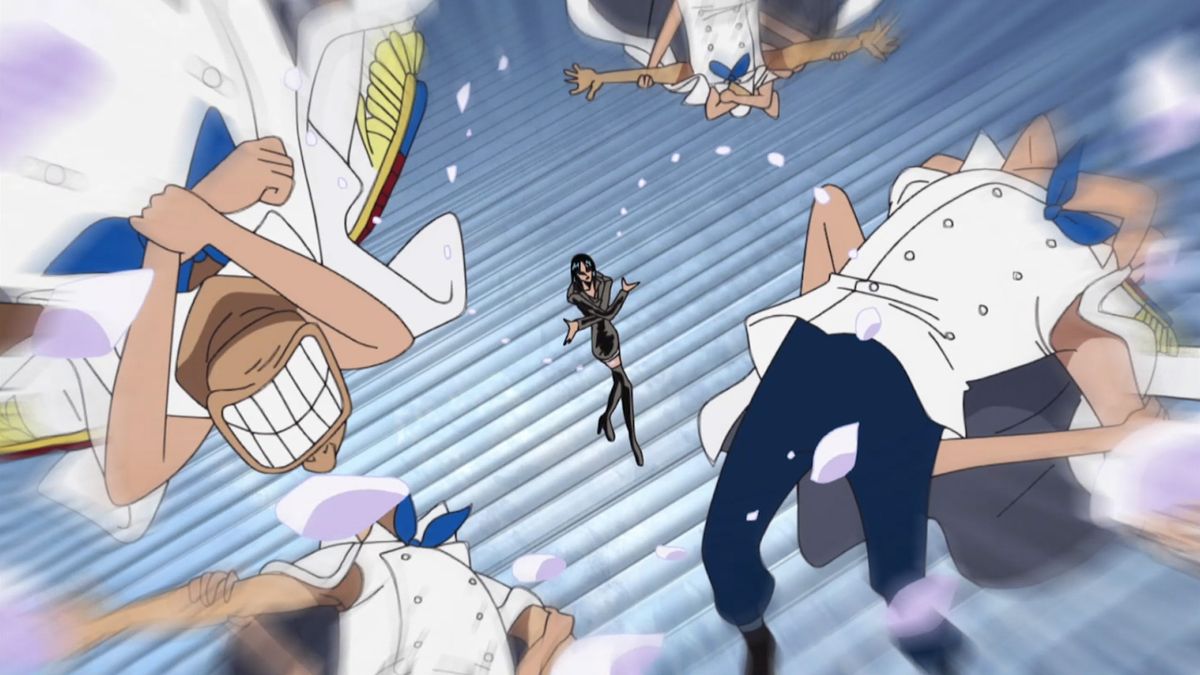
One Piece Episode 308 sends two hundred elite Marines onto the Bridge of Hesitation as the Straw Hats defend Robin, the vessel, and Luffy’s route home.
The short version
Episode 308 asks the crew to defend Robin and the escape ship against two hundred elite Marines while Luffy continues fighting Lucci. The Bridge of Hesitation collapses under cannon fire, but the Straw Hats refuse to let the final route become another government cage.
The bridge earns its name
Robin once hesitated between surrender and trusting the people calling her back. Now the battlefield itself carries that word while she stands among allies who chose her. The symbolic geography becomes almost painfully direct.
Waiting for Luffy is active work
The crew cannot simply watch the hole where their captain fights. Marines board the escape vessel and target Robin. Protecting the ship keeps Luffy’s possible route home alive.
Two hundred elite soldiers change the scale
CP9 duels exhausted nearly everyone. The next wave arrives organized, armed, and supported by a fleet. Numerical pressure forces the crew to coordinate rather than chase individual showcases.
Robin is not returned to the role of helpless prisoner
She has her hands, her voice, and people fighting beside her. Protection does not erase agency. The difference from Spandam’s corridor is that Robin now participates inside a shared defense rather than enduring solitary control.
The ship becomes temporary territory
Holding the vessel means holding the possibility of a future beyond Enies Lobby. Every Marine who boards threatens more than wood and sails. The attackers threaten the crew’s ability to convert rescue into departure.
Luffy needs the others to protect his victory condition
He can stop Lucci, but he cannot guard Robin and the vessel simultaneously. Captaincy depends on delegation. The crew’s stand proves that trust travels both directions.
RaeRae’s receipt
I love an episode that makes “wait for Luffy” sound like a battle order. Loyalty is not standing still. Loyalty means keeping Robin alive, keeping the ship available, and refusing to let two hundred uniforms redefine the outcome.
The crew holds the line because nobody gets left behind after coming this far.
Episode facts and receipts
Episode 308 aired May 6, 2007. ONE PIECE.com credits Ryo Suga for the script, Hiroyuki Sato for direction, Masayuki Takagi for animation direction, and Miyuki Sato with Hiromitsu Shiozaki for art.
Classification: numbered manga-canon Enies Lobby television episode and RaeRae React. Anime, Anime Series, Japanese Anime, and Anime Reacts, not Anime Reviews.
The Bridge of Hesitation becomes a place of decision
The name belongs to prisoners approaching a point beyond ordinary return, but Robin’s story transforms the symbolism. She already made the decisive statement: she wants to live. The hesitation now belongs to everyone asked whether the government can still reclaim her.
The Straw Hats answer through position. They stand between Robin and the arriving force.
A bridge built for state power becomes the ground where chosen family contests that power.
Two hundred elite Marines are not anonymous difficulty points
The force arrives trained, armed, and coordinated to recover Robin. Numbers matter because the Straw Hats are exhausted after individual CP9 battles. Each new body consumes time and attention while the Buster Call narrows escape.
The soldiers also represent the depth of institutional investment in controlling one scholar.
Robin’s knowledge frightens the government enough to spend lives, ships, and an island preventing her freedom.
The crew fights after the dramatic victories are over
Zoro defeated Kaku. Sanji defeated Jabra. Nami defeated Kalifa. Chopper survived Monster Point. Genre rhythm might promise recovery after those climaxes. Episode 308 delivers another organized assault.
That exhaustion makes the defense meaningful. Nobody has a fresh body or unlimited signature attacks.
Commitment has to operate after adrenaline, surprise, and personal spotlight have already been spent.
Holding the vessel protects an unwritten future
The ship is wood, rope, sail, and temporary opportunity. On that deck, Robin can imagine tomorrow outside government custody. Losing the vessel would collapse possibility back into capture or bombardment.
Defending transportation sounds less glamorous than defeating CP9, but escape logistics decide whether the earlier victories become a life.
The crew understands that freedom needs somewhere to go.
Robin is the reason and a member of the defense
Everyone fights because the Marines came to seize her, yet Robin is no longer an object passed between sides. Free hands restore her ability to resist, observe, and choose beside the group.
Protection does not require infantilizing the person in danger. The crew creates space around Robin while recognizing her competence.
That relationship is the opposite of Spandam’s claim that custody gave him authority over her body.
Nami keeps crisis legible
A battle involving hundreds of enemies, damaged structures, artillery, and an absent captain can dissolve into noise. Nami’s awareness of routes, timing, and group condition helps preserve the escape objective.
Her strength is not limited to weather attacks. She understands what information people need in order to move together.
Navigation remains leadership even when the “sea” is a collapsing battlefield.
Zoro and Sanji convert rivalry into coverage
Their insults never stop, but neither man lets competition interfere with protecting Robin or the route. Each covers openings the other cannot reach while exhausted.
Functional trust survives the argument because shared responsibility outranks ego.
Episode 308 shows why their rivalry works best as seasoning, not the foundation of their bond.
Sogeking continues acting like the crewmate behind the mask
Usopp has already proved his range by stopping Spandam. The bridge defense asks for continued courage after the signature moment. Heroism becomes endurance rather than one perfect shot.
The persona still gives emotional cover, but every choice reveals attachment to Robin and the crew.
Returning is happening through repeated action before the name “Usopp” can return openly.
Chopper’s condition shows the cost of earlier protection
Monster Point saved friends from Kumadori and left Chopper unable to participate normally. His exhausted body remains part of the group’s responsibility. The crew must protect the protector while facing another wave.
That reversal prevents power from erasing vulnerability.
Every transformation invoice eventually reaches the ensemble, and family means carrying one another through the aftermath.
Franky guards the outcome Tom’s memory helped create
Franky crossed Enies Lobby partly to stop Spandam and partly to prevent Robin’s knowledge from becoming another tool of government control. Reaching the bridge joins those purposes.
He now protects a scholar, an escape mechanism, and the people who fought beside him.
Tom’s legacy survives through what Franky builds and whom he refuses to surrender.
The Marines obey a mission whose premise is already broken
They arrive to “recover” Robin as though she were stolen property. Her declaration, resistance, and free movement contradict that language. Recovery means restoring government possession against her will.
Official terminology hides kidnapping inside procedure.
The crew’s supposedly criminal defense is the side respecting Robin’s stated choice.
Waiting becomes an act of faith with a deadline
Nobody knows whether Luffy can defeat Lucci or reach the bridge before the fleet destroys the route. Waiting forever would kill everyone. Leaving too early would abandon the captain who stayed for them.
The crew balances hope against real tactical pressure.
Faith here is not passive certainty. Faith fights, plans, and keeps an exit open for as long as bodies can hold the line.
Luffy sees proof that the others survived
Through the damaged structure, communication reaches the captain. Knowing the crew and Robin are alive gives his duel renewed direction. He does not have to imagine whether his sacrifice bought anything.
The exchange also works in reverse. The crew knows Luffy still fights and can organize around his possible arrival.
Information becomes emotional oxygen across separated battlefields.
The production turns crowd combat into readable teamwork
Hiroyuki Sato’s direction has to establish enemy numbers without letting individual Straw Hats disappear into visual clutter. Masayuki Takagi’s animation direction keeps attacks, reactions, and spatial pressure legible across the bridge.
The goal is not to showcase two hundred detailed duels. The sequence must show a coordinated force pressing toward Robin and a battered crew redirecting that pressure.
Clarity keeps the defense attached to stakes.
No one victory can finish an ensemble rescue
Luffy cannot leave Lucci. The crew cannot defeat Lucci for him. Robin cannot sail the vessel alone while fighting two hundred Marines. Each part depends on another part succeeding elsewhere.
That interdependence is not weakness. The Straw Hats become formidable because nobody has to contain every answer inside one body.
Episode 308 turns trust into battlefield architecture.
RaeRae’s second look
I love that “wait for Luffy” becomes one of the hardest jobs on the island. The crew does not stand around chanting his name. They defend Robin, absorb another military wave, preserve the ship, and keep believing the captain will use the route they protect.
That is chosen family without sentimental shortcuts. Love looks like exhausted people doing necessary work before reassurance arrives.
The Marines have numbers. The Straw Hats have a shared reason nobody in uniform can manufacture.
The defense turns exhaustion into collective technique
No fighter has enough reserve to dominate two hundred elite Marines alone. The crew survives by covering angles, interrupting advances, and letting each specialty buy another person time. Coordination becomes the strongest move available.
The scene rewards everything the arc established about their relationships. They know who can hold a line, who needs protection, and which opening matters more than personal credit.
Robin watches people choose the danger she feared
Her surrender began with the belief that association with her would destroy the Straw Hats. The bridge defense places that fear in front of her as visible risk. The crew knows exactly why the Marines came and continues fighting.
Their choice does not prove Robin was foolish to fear loss. The choice proves fear cannot make decisions on everybody else’s behalf.
The Marines cannot manufacture the crew’s reason
Training, rank, weapons, and numerical superiority produce coordinated force. None produces the personal commitment holding the Straw Hats together. Orders send the Marines toward Robin. Love keeps the crew between them.
That difference does not guarantee easy victory. The difference explains why exhausted people continue moving after ordinary calculation says stop.
The absent captain remains part of the formation
Luffy occupies another battlefield, yet his decision shapes the bridge. He trusted the crew to defend Robin while he contained Lucci. They trust him to finish and reach the route they preserve.
Leadership becomes distributed. The captain’s absence does not create a vacuum because everybody understands the shared objective.
The crew does not wait for instructions. They carry the promise forward.
Escape requires refusing the government’s final definition
The state calls Robin a prisoner, calls the ship stolen, calls the defenders criminals, and calls cannon fire justice. Reaching open water would reject all four labels through lived reality.
Robin would become a free scholar traveling with chosen family. The vessel would become transportation rather than government property. The “criminals” would become the people who respected her will.
The bridge is where those competing definitions fight for material control.
RaeRae’s final receipt
Episode 308 makes loyalty muscular without making loyalty mindless. The crew evaluates the threat, protects the vessel, guards Robin, communicates with Luffy, and keeps the departure window open. Every action has a reason.
Waiting becomes worthy of an action episode because they are not waiting for rescue. They are building the conditions that allow their captain to rejoin them.
Nobody gets abandoned, and nobody gets reduced to cargo. That is the standard Enies Lobby keeps forcing the Straw Hats to prove.
The bridge defense protects more than one departure
If Robin escapes with the Straw Hats, the World Government loses control of her knowledge, her story, and the example her survival creates. Other people branded disposable can see that official judgment is not destiny.
The Marines therefore defend an ideology as much as a prisoner transfer. The Straw Hats defend the possibility that one person’s declared will can outrank the institution claiming ownership.
Every exhausted body becomes a promise kept
Nobody on the vessel looks untouched by Enies Lobby. Bruises, depleted strength, fear, and uncertainty travel with them. Continuing to guard Robin does not prove pain disappeared. Continuing proves the promise remains active inside pain.
Episode 308 gives loyalty a physical cost and refuses to make that cost glamorous. They are tired, surrounded, and still choosing one another.
The defense succeeds one protected second at a time. Each second keeps Robin free and gives Luffy another chance to reach them.