RaeRae Reacts · One Piece Episode 291
Boss Luffy Turns a Rigged Lottery Into a Grand Jipang Reckoning
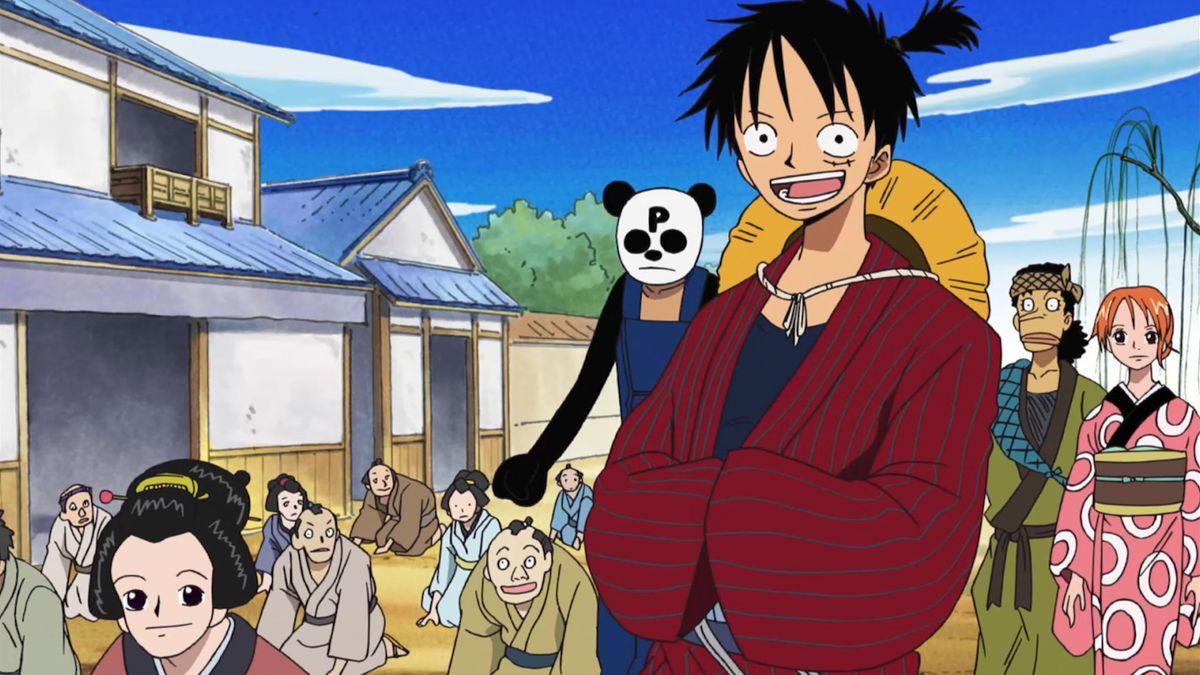
One Piece Episode 291 leaves Enies Lobby for a Grand Jipang television special about Boss Luffy, a rigged lottery, and alternate-world community.
The short version
One Piece Episode 291 leaves Enies Lobby for Grand Jipang and turns the Straw Hats into an Edo-town ensemble built around a rigged lottery. Boss Luffy eats at the Pinwheel restaurant, Chopper works as the blue-nosed doctor, and familiar faces occupy new social roles. The holiday special is openly non-canon, but the remix reveals which character traits survive when piracy disappears.
I understand why the interruption can frustrate anyone waiting for Robin’s rescue. Placement matters. A playful alternate world arrives immediately after Chopper’s dangerous second Rumble Ball. The tonal jump is part of the viewing experience and deserves critique alongside the special’s charm.
Grand Jipang is character remix, not random costume play
The cast receives period roles that translate familiar functions. Luffy remains an appetite-driven protector. Nami runs a business and reads every transaction. Sanji cooks and performs devotion. Chopper heals people. The setting changes, but relationships retain recognizable rhythms.
That continuity makes alternate-universe storytelling satisfying. Viewers can discover the character through difference. If every role were arbitrary, the episode would offer only costumes.
Boss Luffy carries authority without bureaucracy
Enies Lobby presents authority through rank, uniforms, courts, and gates. Boss Luffy holds social authority because neighbors know what he will do when someone vulnerable needs help. He has no institutional polish and no patience for procedure.
The contrast is playful and political. A person can become legitimate through consistent care rather than appointment. Grand Jipang trusts the hungry nuisance because his loyalties are public.
The lottery turns hope into a market
A lottery sells possibility to people who lack reliable routes toward security. Tickets make hope portable, countable, and easy to manipulate. A rigged drawing steals more than money. The scheme steals permission to imagine a changed life.
One Piece understands treasure as emotional language. The prize matters because people attach needs and dreams to the chance. Fraud targets those attachments.
Nami knows that every festive system has a ledger
Nami’s alternate role preserves commercial intelligence without reducing her to greed. She notices value, scarcity, suspicious behavior, and who absorbs a loss. A celebration full of money and tickets naturally activates her strongest reading skills.
Her attention also protects the restaurant community. Counting can become care when numbers reveal exploitation.
Chopper’s doctor role lands differently after Episode 290
The schedule places a cheerful town doctor immediately after the main story pushed Chopper toward bodily disaster. That echo gives the special an accidental tenderness. Grand Jipang lets him practice medicine without becoming his own emergency.
The alternate world imagines professional belonging. Neighbors call for the blue-nosed doctor because difference has become expertise rather than evidence of monstrosity.
Familiar faces become a social map
The pleasure of the special includes recognition. Pirates, Marines, villains, and allies can appear as townspeople without carrying every original allegiance. Casting becomes a joke shared with the audience.
The device also tests character essence. A familiar face may change occupation while posture, vanity, kindness, or appetite remains readable.
Holiday programming explains the interruption but does not erase the interruption
The episode aired on December 24 as a television special. Broadcast context explains why the production chose seasonal comedy. Viewers watching weekly in 2006 encountered a holiday event. Marathon viewers encounter an abrupt halt in Enies Lobby.
Both experiences are real. Editorial writing should distinguish production logic from narrative effect. Explanation is not a command to enjoy the placement.
Non-canon does not mean meaningless
Canon determines continuity, not automatic quality. A non-canon story can reveal performance chemistry, genre flexibility, cultural framing, and audience expectations. The special matters as television even though the main plot will never reference the lottery.
Classification should remain honest. Episode 291 belongs in the numbered React sequence and the Special relationship. The record should never pretend to advance manga canon.
The episode trades urgency for community texture
Enies Lobby narrows every action toward Robin. Grand Jipang widens attention across a neighborhood. Food service, medical calls, street gossip, and gambling create an everyday world worth protecting.
That texture reminds viewers why adventures need ordinary life. Freedom means little if characters never have a town where they can waste time, eat too much, and know the people behind nearby doors.
Adaptation and performance
Writer Ryo Suga and director Munehisa Sakai introduce the alternate continuity quickly through roles and behavior rather than a heavy explanation. Kazuya Hisada’s animation direction keeps the ensemble recognizable inside period design. Miho Shiraishi and Michiyo Kawasaki provide the festive town’s visual warmth.
Mayumi Tanaka makes Boss Luffy familiar without treating him as the exact pirate captain dropped into costume. The performance leans into neighborhood mischief and dependable courage.
RaeRae’s final reaction
Episode 291 is charming television and brutal placement. I enjoy the Grand Jipang remix, especially Chopper receiving a community that simply needs their doctor. I also feel the Enies Lobby cliff edge underneath every joke.
The honest reaction can hold both. A holiday special does not owe manga-canon progress. A numbered series placing the special here still asks a weekly audience to put Robin’s emergency on a shelf.
Episode facts and receipts
One Piece Episode 291 aired in Japan on December 24, 2006. ONE PIECE.com labels the broadcast a television special and credits Ryo Suga for the script, Munehisa Sakai for direction, Kazuya Hisada as animation director, and Miho Shiraishi with Michiyo Kawasaki on art.
Classification: numbered television episode, anime-original Grand Jipang alternate-setting special, RaeRae React. This record belongs in Anime, Anime Series, Japanese Anime, Anime Reacts, and Special. This record does not belong in Anime Reviews.
The alternate world asks what makes Luffy recognizable
Remove the sea, pirate title, wanted poster, and dream of finding the One Piece, and Luffy remains legible within minutes. Appetite, impatience with status, instinctive loyalty, and immediate anger at exploitation survive the translation. Those traits form a stronger core than costume or occupation.
Boss Luffy therefore works because the special does not confuse character with résumé. He can become a neighborhood authority without becoming disciplined, polished, or interested in governing daily life. People trust him for intervention, not administration.
A town boss is not the same thing as a state official
Grand Jipang draws on period-drama archetypes where social order includes formal authority and locally recognized figures. Boss Luffy occupies the second category. His power depends on relationships and reputation rather than a court capable of declaring itself just.
That distinction feels especially sharp after Enies Lobby. The World Government possesses legal machinery without moral legitimacy. Luffy possesses no legal machinery and repeatedly earns moral legitimacy through action.
The Pinwheel restaurant anchors the social world
Sanji and O-Nami’s restaurant is more than a background set for Luffy’s appetite. Food service becomes a neighborhood information network. People arrive with news, needs, debts, celebrations, and complaints. The room converts individual lives into community knowledge.
Luffy’s habit of eating there also shows belonging through dependence. He does not perform the self-sufficient hero. Somebody cooks. Somebody tracks the tab. Somebody tolerates his presence because the relationship contains value beyond payment.
Lottery stories expose unequal access to hope
People buy tickets because ordinary labor does not guarantee the future they need. The chance of sudden relief becomes attractive when stable routes remain closed. Fraud enters through that vulnerability.
A rigged lottery is therefore not merely theft from gamblers. The scheme monetizes inequality, invites people to disclose their dreams, and uses those dreams as the mechanism of extraction. Grand Jipang places light comedy over a recognizable economic wound.
Nami’s relationship with money remains morally specific
Nami likes money. The statement is true and incomplete. She also understands what money can protect because Arlong turned currency into the price of her village’s freedom. Numbers carry survival history.
In Grand Jipang, she can appreciate a prize and still oppose a rigged system. Desire for money does not make every method equivalent. Her moral line concerns who consents, who lies, and who absorbs the loss.
Chopper receives the professional recognition Drum Island denied
The blue-nosed doctor is busy because people seek his care. That simple premise reverses a childhood built around rejection. Difference becomes part of the trusted public identity rather than a reason to chase him away.
The special does not need a speech about belonging. A full schedule proves belonging materially. Neighbors know where to find him, expect competence, and make room for his work inside ordinary town life.
Period comedy can preserve modern character politics
Costumes and social roles evoke another era, but the episode’s questions remain contemporary: who controls money, how communities recognize trustworthy authority, and why public optimism attracts fraud. Genre distance makes those questions easier to approach through comedy.
The risk lies in using the setting as decoration without understanding social hierarchy. Episode 291 works when role assignments illuminate relationships rather than treating historical imagery as a costume rack.
The familiar cast rewards long-term viewers
Alternate casting operates like a conversation between production and audience. Recognition creates jokes before dialogue completes the setup. A face associated with danger may become a merchant, official, neighbor, or schemer.
That pleasure depends on memory. New viewers can follow the local plot, while returning viewers receive an extra layer built from previous emotional investment. The special becomes fandom television in the most literal sense.
Robin’s absence haunts the broadcast position
The main story has spent weeks teaching viewers that every minute matters. Episode 291 then stops the clock. Robin does not become safer because the schedule changed genres. Marathon viewing keeps her danger emotionally adjacent.
I do not blame the alternate cast for the placement. The programming decision deserves its own analysis. A special can be delightful and still arrive at the point of maximum serialized frustration.
Christmas Eve changes the intended viewing mood
The original audience encountered the episode on December 24. Family schedules, seasonal advertising, and holiday programming shaped expectations. A self-contained communal story made practical broadcast sense.
Archive viewing removes that frame unless editorial context restores the date. Recording the broadcast context is not trivia. The date explains why the episode values festivity over cliffhanger resolution.
Filler language can hide meaningful distinctions
Calling every non-manga broadcast filler groups together expansions, continuity detours, recaps, adaptations of side material, promotional tie-ins, and alternate-world specials. Those formats do different work.
Episode 291 is best described precisely: an anime-original, alternate-setting television special placed inside the numbered run. Precision helps viewers decide expectations without treating non-canon as a synonym for worthless.
Community justice still needs scrutiny
Boss Luffy’s moral instinct is attractive because the villains are obvious. Informal authority can also become dangerous when reputation replaces accountability. The special does not explore that risk deeply, but the contrast with Enies Lobby should not produce blind worship of any unofficial strongman.
Luffy earns trust through repeated choices and a refusal to dominate ordinary life. That behavior, not strength alone, separates protective community power from another hierarchy.
RaeRae’s second look
I came away more interested in the town than the lottery mechanics. The Pinwheel, Chopper’s practice, and Luffy’s unpaid meals create a web of ordinary dependence. That web gives the scam something real to threaten.
The special works when Grand Jipang feels like a place people inhabit between adventures. My irritation belongs to the schedule. My affection belongs to a blue-nosed doctor too busy helping neighbors to stop for lunch.
Grand Jipang offers celebration without institutional spectacle
Enies Lobby stages authority through monumental architecture, uniforms, flags, and a court whose outcome was decided before Robin arrived. Grand Jipang stages community through a restaurant, medical work, street conversation, and a lottery that becomes dangerous when private actors corrupt shared trust.
The contrast helps explain why the town feels warm even when trouble begins. Public life exists before the villain and will continue after the scheme. Enies Lobby exists to process bodies for government power. Grand Jipang exists because people eat, work, gamble, gossip, and depend on neighbors.
The special gives viewers a different kind of treasure
No ancient weapon or forbidden history drives the episode. The valuable things are a fair chance, a functioning neighborhood, a meal, and confidence that public rules mean what organizers claim. Smaller stakes do not mean nonexistent stakes.
One Piece often expands treasure beyond gold. Episode 291 shrinks the scale and keeps the principle. Fraud becomes villainy because ordinary hope deserves protection too.
RaeRae’s placement verdict
I would not tell a first-time viewer that the special advances Enies Lobby. I would tell them the broadcast preserves character chemistry in a playful alternate city and documents how Toei programmed the series for Christmas Eve. Watching now means choosing whether to follow broadcast order or defer the detour.
The hub should make that choice visible. Honest classification respects viewers more than pretending every numbered episode carries identical continuity weight.