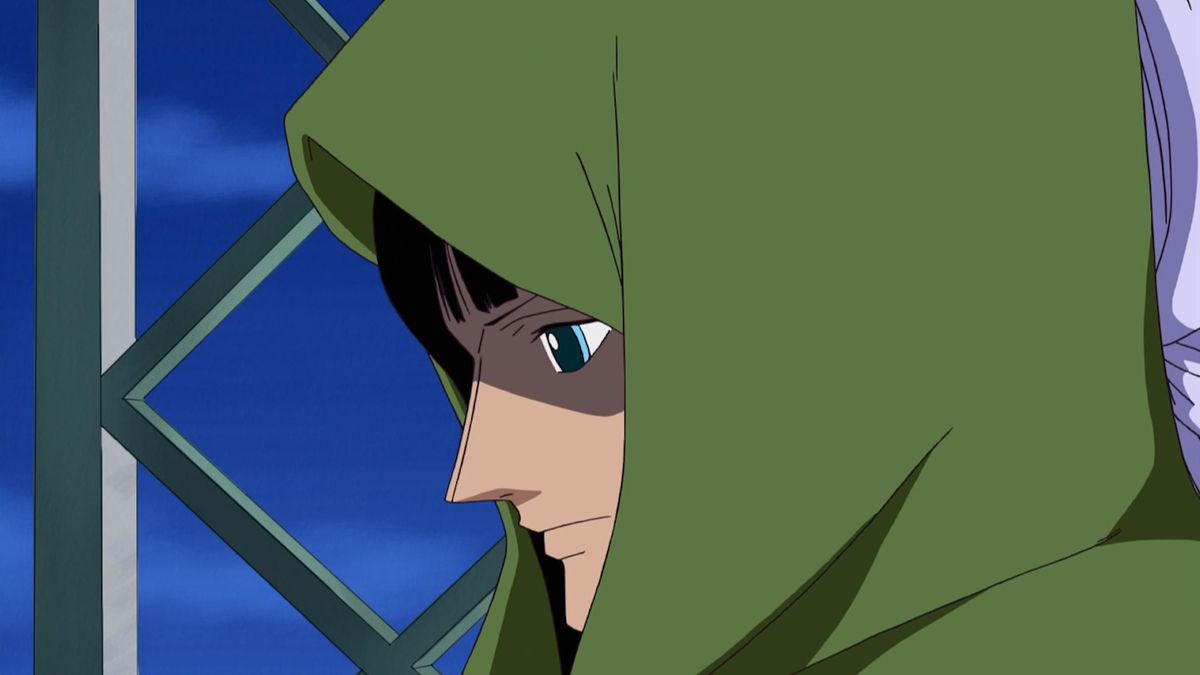
RaeRae Reacts · One Piece Episode 245
Robin Is Speaking Under Guard, and Luffy Knows Better
One Piece Episode 245 has Luffy demand Robin return while CP9 demonstrates Rokushiki and turns coercion into a staged answer.
Bottom line: Luffy finally asks Robin the question CP9 would not let her answer
One Piece Episode 245 puts Robin in front of the crew and still refuses to pretend proximity equals freedom. Luffy tells her to come back. Robin refuses while Lucci, Kaku, Kalifa, and Blueno stand around her as the physical terms of that answer. Then CP9 demonstrates Rokushiki and turns the Galley-La mansion into a lesson about how badly the Straw Hats misjudged the people they were chasing.
The reunion hurts because everybody says something true inside a situation built to make truth useless. Luffy wants Robin home. Robin wants the crew alive. CP9 wants the Pluton blueprints and has already shown what happens when Iceburg resists. Nobody gets an honest conversation while assassins control the room.
The official episode record
ONE PIECE.com lists Episode 245, “Come Back, Robin! Showdown with CP9,” with a Japanese broadcast date of September 18, 2005. Hirohiko Kamisaka wrote the screenplay, Hidehiko Kadota directed, Mitsuru Sugimoto and Kiyoshi Matsushita received animation-direction credit, and Miyuki Sato and Tadami Shimokawa handled the credited art work.
The official summary centers Luffy demanding Robin’s return, Robin rejecting that demand, and CP9 using superhuman techniques against the Straw Hats. Those facts matter because the episode is both an emotional confrontation and a power-scale correction.
Luffy does not begin with evidence, strategy, or a speech
Luffy sees Robin and tells her to return. He does not ask for a defense brief. He does not list everything she has done for the crew. His answer to the entire mystery is that she belongs with them and needs to come home.
That directness has always been one of Luffy’s gifts. He recognizes the person before the accusation. The same directness becomes a limitation here because Robin is not refusing over a misunderstanding that affection can solve in one sentence.
Robin’s refusal sounds cold because warmth would expose the hostage
Robin tells the crew that she will not return. Her words preserve the identity she used at Iceburg’s bedside: a woman who chose her own departure and cooperated with the attack. If she breaks that performance, CP9 can treat the Straw Hats as active obstacles rather than useful people she persuaded them to spare.
The crew hears rejection. Robin is trying to maintain a bargain. The episode lets the emotional injury remain real without confusing the injury with her full motive.
Nami hears the contradiction before she knows the reason
Nami has already noticed that Robin’s conduct does not fit the woman who traveled with them. Standing in the same room makes the mismatch sharper. Robin’s face, words, and companions tell one story. The pattern of warning and disappearance tells another.
Nami cannot prove coercion yet, but she refuses the convenient conclusion that Robin suddenly stopped caring. That refusal is not blind loyalty. Nami is reading behavior against history.
Chopper wants the living Robin more than a clean explanation
Chopper’s relief from finding Robin does not disappear when she rejects them. He is hurt, confused, and still focused on the person standing across the room. His reaction keeps the reunion from becoming a courtroom scene.
Robin joined a crew where attachment arrives before paperwork. CP9 understands leverage and measurable response. Chopper understands that somebody can say a cruel thing while looking trapped.
Zoro watches the room instead of begging for reassurance
Zoro does not need Robin to make the moment emotionally easy. He watches CP9, measures the danger, and prepares for the fight that her refusal cannot prevent. His restraint also protects the crew from building strategy around wishful thinking.
Trust does not require him to ignore the masked agents or the burning mansion. Zoro’s loyalty has teeth because he keeps looking at what the enemy can actually do.
Paulie has to face four betrayals at once
Lucci, Kaku, Kalifa, and Blueno are not strangers invading Galley-La. Paulie worked beside them, argued with them, trusted their skills, and shared the company Iceburg built. Their calm faces turn five years of ordinary work into evidence of an operation.
Paulie’s anger carries workplace betrayal, civic betrayal, and personal humiliation. CP9 did not merely fool him. They used his loyalty to Iceburg as cover while studying the company from inside.
Lucci explains only what makes CP9 look inevitable
Lucci speaks with the confidence of a man who believes superior force proves superior judgment. He gives the crew enough information to understand that Robin joined their mission and that the blueprints remain the target. He does not give them the conditions surrounding her cooperation.
That selective truth is one of CP9’s best weapons. A statement can be factually accurate and still designed to produce the wrong conclusion.
Rokushiki turns trained bodies into government weapons
CP9 introduces techniques developed through extreme physical training: speed that disappears from ordinary sight, hardened bodies, movement through the air, and attacks delivered through fingers or legs. The agents do not rely on Devil Fruits to establish the gap.
The World Government has turned human movement into an assassination system. Every technique carries institutional time, training, and permission to use the body against whoever receives the target label.
Soru destroys the crew’s confidence in distance
The agents move faster than the Straw Hats can track. A room that looked small enough for a direct fight becomes territory CP9 controls between blinks. Luffy’s speed has overwhelmed enemies before, but Soru removes the comfort of assuming he can always close the gap first.
The visual shock matters because the crew entered expecting answers and perhaps a brawl. CP9 makes ordinary positioning unreliable before the argument can become a rescue.
Tekkai makes a clean hit feel meaningless
When an agent hardens the body through Tekkai, attacks that should move flesh meet something closer to iron. The technique does more than block damage. Tekkai tells the opponent that familiar effort no longer produces familiar results.
That message lands hard after Luffy and Zoro fought through Galley-La without using lethal force. Restraint got them into the room. Restraint cannot explain how to break a government-trained body.
Shigan reveals what CP9 calls precision
The finger pistol compresses assassination into a small movement. CP9 can injure a body without drawing a conventional weapon, which suits agents who spent years looking like carpenters, bartenders, and secretaries.
The technique is clean only from the attacker’s perspective. For the person receiving the strike, government precision still means a hole, blood, fear, and somebody else deciding that the wound was necessary.
Geppo makes the walls and floor optional
Movement through the air changes every escape route. A normal fighter can watch doors, windows, stairs, and ground. CP9 can attack from space that the room does not appear to offer.
Water 7 has spent the arc celebrating physical craft and readable structures. Geppo lets the agents reject the structure around them, which makes the mansion feel even less like Galley-La’s home.
Rankyaku turns a leg into a ranged blade
A slicing kick gives CP9 reach without a sword. The attack carries the logic of the organization: train every part of the body until no ordinary sign warns the target what kind of violence is coming.
Zoro understands blades. Rankyaku removes the visible blade from the exchange and forces him to read stance, timing, and air instead.
The power gap is also an information gap
The Straw Hats did not know CP9 existed, did not know the shipwrights were agents, did not know Rokushiki, and still do not know Robin’s full bargain. CP9 enters the fight with years of surveillance and a prepared exit.
Calling the result a simple difference in strength would let the government off too easily. CP9 designed the room, the story, and the timing before Luffy arrived.
Five years of friendship gave CP9 the first move
Lucci and Kaku know Galley-La’s corridors, Paulie’s habits, Iceburg’s protections, and the workers most likely to respond when alarms spread. Kalifa knows the office and schedule. Blueno knows the city from behind a bar where people spoke freely. Their civilian lives supplied a map no pirate crew could build during a few days in Water 7.
That advantage makes the betrayal bigger than four hidden names. CP9 converted trust into infrastructure. Every casual conversation, shared job, and familiar route helped the government prepare this night while Galley-La believed those relationships belonged to ordinary life.
Robin watches the crew get punished for reaching her
Every blow supports the fear behind her decision. She believes staying near the Straw Hats will bring destruction to them, and CP9 supplies immediate evidence with government uniforms still hidden under civilian identities.
Her silence becomes easier to understand and harder to maintain. The crew keeps choosing her while the agents prove the cost of that choice.
Luffy refuses to treat her answer as the end of the conversation
Luffy does not accept that a frightened refusal beside four assassins settles Robin’s future. He cannot yet explain the coercion, but he knows the relationship well enough to reject the performance as complete truth.
That stubbornness is not respectful in every situation. Here, the surrounding threat changes the meaning. Robin has not been given a safe place to choose.
Hidehiko Kadota lets the emotional scene collapse into physical proof
The direction does not keep the reunion and the fight in separate boxes. Robin’s refusal leads directly into CP9’s demonstration. Viewers feel the same helplessness she has been carrying because the agents make the threat visible.
The episode avoids a long explanation of every technique before the danger arrives. Names and effects come through action, then the crew scrambles to understand what just happened.
The animation team sells speed by withholding movement
Mitsuru Sugimoto and Kiyoshi Matsushita’s credited animation work makes CP9 frightening through sudden absence, sharp arrival, and impact. The agents often look calmer than the people they hit. That calm suggests the attack required less effort than the crew hoped.
Robin’s controlled stillness belongs to a different cause. CP9 is calm because the operation works. Robin is still because any visible break can cost lives.
The Galley-La fire turns the confrontation into a countdown
The mansion is burning while characters argue about truth, blueprints, and loyalty. Fire removes the fantasy that everybody can stay in the room until the emotional problem becomes clear.
CP9 planned destruction around the extraction. The Straw Hats need Robin, Iceburg needs survival, Paulie needs answers, and the building keeps running out of time for all of them.
What changed after another watch
The first watch makes Rokushiki the main shock. Another watch makes Robin’s position worse. She has to watch the crew challenge the exact people she feared, then see those people dismantle the rescue attempt with techniques nobody anticipated.
Paulie’s presence also grows more painful. Every named technique comes from a coworker whose habits he thought he knew. The betrayal lives in small remembered days, not only the current attack.
RaeRae verdict: Robin is speaking under guard, and Luffy knows better than to call that freedom
Episode 245 gives Luffy the reunion he demanded and denies him the answer he wanted. Good. A clean rescue here would make Robin’s fear look silly and CP9’s five-year operation look flimsy. The refusal forces the crew to understand that finding somebody is different from making escape possible.
Rokushiki is flashy, but the ugliest power in the room is control over the conditions of speech. CP9 can stand beside Robin, threaten everybody she loves, and then present her answer as voluntary. Luffy may not have the vocabulary for coercion. He still recognizes that the woman in front of him is not talking from a free place.
Receipts and where to watch
The official ONE PIECE.com Episode 245 record supplies the Japanese title, September 18, 2005 broadcast date, CP9 confrontation, and official image used on this page. Credited staff include Hirohiko Kamisaka, Hidehiko Kadota, Mitsuru Sugimoto, Kiyoshi Matsushita, Miyuki Sato, and Tadami Shimokawa. Crunchyroll provides the licensed episode route.
This React stops with Episode 245 knowledge. Later episodes explain more about Robin’s choice, CP9’s techniques, and the government threat surrounding her. At this point, the crew knows enough to reject the easy story and nowhere near enough to win the room.