RaeRae Reacts · One Piece Episode 228
Luffy Loses the Duel and Protects Everyone
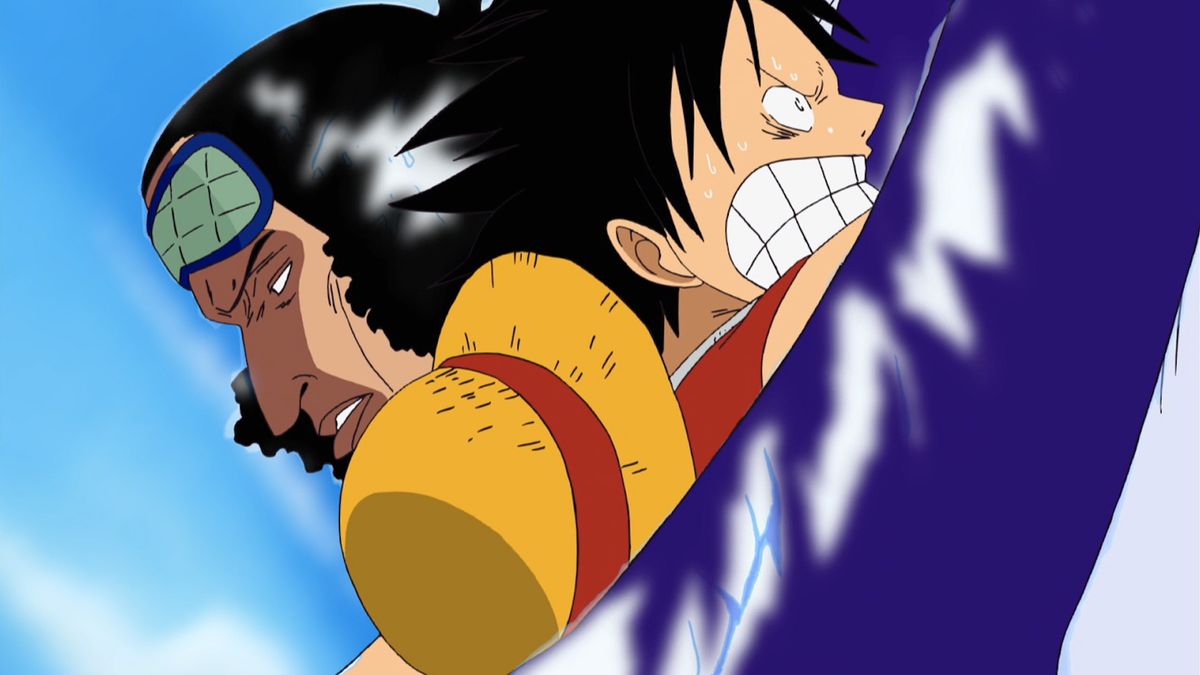
One Piece Episode 228 freezes Robin and Luffy, then proves that a captain can lose completely while using the defeat to protect his crew.
Bottom line: Luffy loses the fight and wins the only choice that matters
One Piece Episode 228 lets Aokiji freeze Robin, break the crew’s ordinary battle confidence, and defeat Luffy without needing the kind of effort previous villains demanded. Luffy cannot win this fight. He still protects his crew by claiming a one-on-one duel and making Aokiji’s pride part of the terms. The loss becomes evidence of leadership rather than a secret victory.
Aokiji walks away because he decides the duel settled the encounter. That decision is not mercy stripped of power. The admiral controls whether everybody lives. Luffy only creates a reason that might influence him. The episode refuses to pretend courage cancels a massive power gap, which makes Luffy’s choice more meaningful. He acts without the comfort of likely success.
Episode facts: the frozen duel closes the Davy Back television range
Episode 228 aired in Japan on March 27, 2005 under the official title “Duel Between Rubber and Ice! Luffy vs. Aokiji.” Hirohiko Kamisaka wrote the screenplay, Yoko Ikeda directed, Naoki Tate served as animation director, and Miyuki Sato with Kumiko Fukuzawa handled the art direction. Episodes 227 and 228 shared the same broadcast date as a paired confrontation.
The official synopsis begins after Aokiji freezes Robin’s entire body. Usopp carries her toward the ship while Chopper fights to save her. Luffy sends Zoro and Sanji away, then requests a one-on-one battle. The official story index treats Episode 228 as the end of the anime’s Davy Back Fight range, with Water 7 beginning at Episode 229.
Robin’s frozen body turns a government warning into an attempted ending
Aokiji does not merely threaten Robin or present an arrest order. He freezes her solid. The attack converts years of institutional pursuit into immediate bodily danger. Robin cannot negotiate, explain, run, or perform calm. Her survival depends on people she once expected to abandon her.
The image is cruel because Robin’s life has already been suspended by the government’s story about her. She has lived as the child from Ohara, the demon, the bounty, the liability. Ice makes that social condition physical. Aokiji tries to stop the woman at the point where the official file wants her history to remain.
Usopp runs because fear does not stop him from carrying family
Usopp has every reason to panic. One wrong movement could shatter Robin. The opponent can freeze the sea and bodies with casual contact. Usopp still lifts her and runs toward the Merry. His courage appears as frightened labor rather than a dramatic attack.
That distinction matters. Bravery in One Piece often belongs to the person willing to perform the next necessary task while knowing the danger. Usopp does not need to believe he can defeat Aokiji. He needs to keep Robin intact long enough for Chopper to work.
Chopper treats an impossible injury as a medical problem
Chopper cannot punch the ice away without risking Robin’s body. He shifts into doctor mode, manages warming, and works against a condition outside ordinary experience. His response grounds the supernatural threat in care, temperature, time, and physical consequence.
The medical scene also answers Aokiji’s claim that Robin destroys every group around her. The crew does not debate whether saving her creates strategic risk. Chopper sees a patient and crewmate. Care arrives before the government’s narrative can finish its argument.
Nami protects the route back to the Merry
Nami understands that survival now depends on movement away from the battlefield. She helps manage the crew’s retreat and Robin’s transport rather than insisting everybody remain for a hopeless group attack. The choice protects the ship as a treatment space and escape route.
Retreat is not cowardice when the opponent has demonstrated overwhelming control. Nami’s practical judgment keeps the crew from confusing solidarity with standing in one place until everybody freezes. Family can split tasks without splitting loyalty.
Zoro and Sanji obey Luffy because the order is about containment
Zoro and Sanji want to fight beside their captain. Luffy orders them away and defines the encounter as a duel. The command prevents Aokiji from treating the entire crew as active opponents. Both men understand enough to leave even though obedience means walking away from Luffy.
That is a different form of trust from charging together. Zoro and Sanji must believe Luffy sees a purpose beyond pride. Their departure carries frustration, but neither wastes time turning the captain’s decision into a public contest of loyalty.
Luffy’s duel request is a legal fiction with emotional force
No referee guarantees that Aokiji will respect a pirate duel. No shared code has been signed. Luffy creates a frame and bets that the admiral’s personal judgment will honor the frame after victory. The strategy relies on character rather than enforceable law.
That gamble is clever in Luffy’s particular way. If everybody attacks, Aokiji can defeat everybody and call the result one battle. If Luffy claims a duel, continuing against the others afterward may feel like reopening a settled contest. Luffy cannot control the power, so he tries to control the meaning.
Rubber offers no miracle answer to cold
Luffy has enjoyed natural advantages before. Enel’s lightning could not conduct through rubber, turning an untouchable god into somebody Luffy could strike. Ice supplies no convenient counterpart. Aokiji can freeze Luffy’s extended limbs and stop movement through contact.
The absence of a secret immunity resets the audience’s expectations. Devil Fruit matchups matter, but personality and destiny do not guarantee the right element will always appear. The Grand Line contains powers that make Luffy’s body vulnerable in ordinary, frightening ways.
Aokiji’s Ice Time makes strength look effortless
The admiral closes the distance, freezes Luffy, and ends the duel with terrifying efficiency. No prolonged exchange convinces Aokiji to reveal a final form. No speech unlocks enough power for Luffy to reverse the outcome. The gap remains visible from beginning to end.
Effortlessness communicates the world’s scale. Luffy has defeated East Blue monsters, Crocodile, and Enel. Those victories do not place him near the ceiling. An admiral can treat the captain who rang the golden bell as a problem requiring only a short stop.
The frozen sea removes escape from the crew’s imagination
Aokiji’s ability controls more than bodies. The ocean around the island can become solid ground, a road, or a prison according to his choice. The Merry’s advantage as a ship loses meaning if water itself obeys the pursuer.
That environmental control explains Robin’s fear better than any bounty number. She has survived by moving between islands, organizations, and temporary shelters. A man who can erase the practical boundary between land and sea threatens the method that kept her alive.
Aokiji’s connection to the past stays partly hidden and therefore sharper
The episode reveals enough to show that Aokiji has watched Robin’s path and knows the destruction behind her alliances. The complete Ohara history remains ahead. That boundary preserves the crew’s ignorance while making the threat personal.
Partial knowledge works because Robin supplies the emotional consequence. Viewers do not need every date to understand that Aokiji belongs to a chapter she cannot revisit safely. His words have the intimacy of somebody who knows the file and the distance of somebody who survived the institution that wrote the file.
The “betrayal” warning blames Robin for surviving other people’s choices
Aokiji frames Robin as a person whose affiliations end badly and whose loyalties should be questioned. The pattern exists on paper. Organizations around her have collapsed, and she has moved on. The missing context is that adults repeatedly used, feared, hunted, or abandoned a child with nowhere safe to remain.
Calling survival betrayal transfers responsibility from powerful groups onto the woman who escaped them. The accusation also prepares future allies to repeat the abandonment. If everybody expects betrayal, they can betray Robin first and call the action prevention.
The crew answers the accusation through behavior, not a committee statement
Usopp carries Robin. Chopper treats her. Nami supports the retreat. Zoro and Sanji follow Luffy’s protective order. Luffy absorbs the duel. Nobody pauses to vote on whether Aokiji’s warning changes membership.
That immediate behavior is the strongest rebuttal available. Robin’s past may contain facts they do not know. Their present relationship contains facts Aokiji does not control. Chosen family does not require ignorance; chosen family refuses to let an enemy define the person before the person can speak.
Aokiji spares Luffy for reasons that remain morally uncomfortable
After winning, Aokiji chooses not to destroy the crew. Gratitude connected to Crocodile’s defeat, curiosity about the Straw Hats, personal history, and respect for the duel all shape the decision. None of those reasons create accountability. The same man who freezes Robin decides whether her family receives another day.
That imbalance should remain visible. Mercy from overwhelming authority saves lives, but mercy does not make the authority just. Aokiji’s choice reveals independence inside the institution while preserving the frightening fact that survival depends on his mood and judgment.
Luffy’s frozen body makes the captain’s responsibility physical
Luffy becomes the second crewmate turned into a fragile object. The visual consequence mirrors Robin’s condition and shows that he cannot stand outside the danger he accepts for others. Captaincy places his body between the threat and the people moving away.
The crew must save him afterward, which prevents sacrifice from becoming solitary hero worship. Luffy protects them by taking the duel. They protect him by treating, warming, carrying, and waiting. Leadership travels in both directions.
The recovery scene proves ordinary care can follow extraordinary failure
Robin and Luffy survive because the crew manages the aftermath. Warming frozen bodies lacks the visual glory of defeating an admiral. The work still decides whether the episode ends with death. Chopper’s instructions and everybody’s cooperation transform defeat into continued life.
One Piece understands that battle consequences require domestic labor. Blankets, heat, monitoring, transport, and patience belong to the adventure as surely as named attacks. The Merry becomes a home because people perform those tasks for one another.
What changed when I stopped treating the duel as a power-scaling loss
The obvious reading ranks Aokiji far above Luffy. True, useful, and incomplete. The duel also shows Luffy reading a person under pressure. He realizes that a formal one-on-one frame may protect the others after he falls. The strategy succeeds because Aokiji accepts the meaning attached to victory.
Luffy loses physically and still influences the outcome. That does not shrink the defeat. The loss remains absolute enough to warn him about the world ahead. Leadership appears in the decision to spend his only available leverage on everyone else.
The episode’s weakness is letting Aokiji’s warning dominate Robin’s voice
Robin’s fear and actions carry enormous weight, but Aokiji controls most of the explanation. The target receives less room than the man interpreting her history. That imbalance is partly deliberate because Robin cannot yet speak freely about Ohara.
The cost is that viewers may absorb his description before hearing hers. Future episodes must correct the record through Robin’s memories, choices, and words. Episode 228 works as pressure, not as a complete account of who she is.
RaeRae verdict: losing well can reveal more than another miracle victory
Luffy cannot overpower Aokiji, exploit a natural immunity, or inspire the admiral into surrender. He can choose the shape of his resistance. Calling for a duel gives Usopp, Chopper, Nami, Zoro, Sanji, and Robin a chance to leave the active fight.
The episode earns respect by keeping the loss ugly. Luffy freezes. Robin nearly dies. The crew escapes because Aokiji allows the encounter to end. Nobody should confuse survival with readiness. Water 7 begins with the Straw Hats carrying proof that love alone will not protect them from every institution hunting the people aboard their ship.
Receipts and the route toward Water 7
The official One Piece Episode 228 page supplies the March 27, 2005 broadcast date, Japanese title, synopsis, and production credits. The synopsis confirms Robin’s frozen condition, Usopp’s transport, Chopper’s treatment, Luffy sending Zoro and Sanji away, and the requested one-on-one fight.
Episode 228 closes the official Davy Back Fight television range. Episode 229 begins Water 7 with the sea train and the city of shipwrights. Continue through the Episodes 225–228 directory for this bounded transition, then move into the next exact episode shelf. Aokiji leaves, but the questions he raises about Robin, the World Government, and the crew’s readiness travel with them.