RaeRae Reacts · One Piece Episode 227
Robin Recognizes the Danger Before Anyone Else
One Piece Episode 227 lets Aokiji rescue stranded families while Robin’s fear exposes the institutional danger hidden inside his relaxed arrival.
Bottom line: Robin’s fear tells the truth before Aokiji does
One Piece Episode 227 introduces Marine Admiral Aokiji as a lazy traveler, a helpful stranger, an impossible bicycle rider, and the first person who makes Nico Robin lose control simply by standing nearby. The crew sees a tall man sleeping on his feet. Robin sees the World Government’s memory walking toward her. Her panic is the episode’s clearest evidence long before anybody throws a punch.
Aokiji helps stranded civilians cross the sea, jokes with Luffy, and behaves as if the meeting requires no urgency. That calm makes him worse. He does not need to announce power because Robin already knows what his rank can do. The episode lets kindness and threat occupy the same body, then asks whether a helpful action can make state violence disappear. No. The ice road is real help. The danger is real too.
Episode facts: one broadcast, two directors, and a dangerous arrival
Episode 227 aired in Japan on March 27, 2005 under the official title “Marine Headquarters Admiral Aokiji! The Threat of the Greatest Military Power.” Yoshiyuki Suga and Hirohiko Kamisaka share screenplay credit. Hidehiko Kadota and Yoko Ikeda share direction credit. Kazuya Hisada and Naoki Tate share animation direction, while Miyuki Sato, Kunihiro Chida, and Kumiko Fukuzawa handled the art direction.
The official synopsis identifies the episode’s core reversal. Aokiji appears before the Straw Hats on an uninhabited island, Robin panics at first sight, everybody works together to help stranded people leave, and apparent friendliness gives way to tension. The production credits are unusually broad because Episodes 227 and 228 aired together on March 27. The story behaves like the first half of one extended confrontation.
Aokiji arrives asleep because urgency belongs to everybody else
A Marine admiral should enter with warships, salutes, and enough ceremony to warn every pirate on the island. Aokiji arrives alone, upright, and apparently asleep. The posture turns rank into a private inconvenience. He can ignore the social weight of his office because the office still follows him.
That laziness is not harmless comedy. A powerful man can afford to look unserious when everybody else must adapt around him. Luffy can misread the mood because he lacks the history. Robin cannot. Aokiji’s relaxed body says that no one present has forced him to become alert.
Robin’s face breaks the crew’s ordinary stranger routine
The Straw Hats usually meet a weird person by staring, arguing, asking blunt questions, or offering food. Robin’s reaction interrupts that rhythm. She loses the composure that has protected her through assassinations, betrayal, and years of hiding. Fear enters before explanation.
That reaction matters because Robin rarely spends emotion carelessly. She can sit beside danger and smile when she believes information offers control. Aokiji represents a category she cannot manage through observation. His presence connects to forces that erased her home, defined her as a criminal child, and taught adults to trade her life for safety.
The crew does not know Robin’s history because belonging arrived before disclosure
Luffy accepted Robin without demanding a complete biography. That choice gave her a home, but a home built on trust still contains rooms nobody has entered. The crew knows she survived Crocodile and can read Poneglyphs. They do not yet understand the machinery that has hunted her since childhood.
Episode 227 exposes the cost of that knowledge gap without blaming Robin. Survivors do not owe immediate access to every wound. The crew’s ignorance becomes dangerous only because an institution arrives with the missing file already open. Aokiji can weaponize context that Robin has not been ready to share.
Aokiji’s rank changes the scale of the World Government
Smoker gave the crew a persistent Marine opponent. Hina demonstrated coordinated capture. G-8 showed a base functioning through discipline, logistics, and intelligence. An admiral represents the top military force of the organization behind all of those encounters. Aokiji is not merely another strong officer.
Rank carries authorization, intelligence, law, surveillance, ships, prisons, and the accepted public story about who deserves pursuit. Even when Aokiji travels alone, he does not become a private citizen. Robin understands that the state can speak through one quiet person.
The stranded civilians prevent a simple villain introduction
Before open hostility, Aokiji helps people trapped on the island. The Straw Hats cooperate because a civilian crisis matters more than pirate and Marine labels in that moment. The scene gives him a humane action with visible consequences. Families receive a route home.
That choice complicates judgment without erasing history. People who participate in harmful institutions can also perform genuine good. The good remains good for the people rescued. The rescue does not cancel what the institution has done to Robin or what Aokiji may do next. Moral accounting cannot be reduced to one column.
Luffy trusts visible behavior because visible behavior usually serves him
Luffy sees Aokiji assist stranded people and responds to the action in front of him. He has always judged rank poorly and conduct quickly. A Marine who helps can receive temporary cooperation. A pirate who harms somebody can receive a punch. Labels do not control his first decision.
That instinct often cuts through propaganda. Here, the same instinct leaves him behind Robin’s understanding. Present behavior cannot explain every historical threat. Luffy needs her fear as additional evidence, even before she can provide the full story.
The ice road makes impossible power look like public service
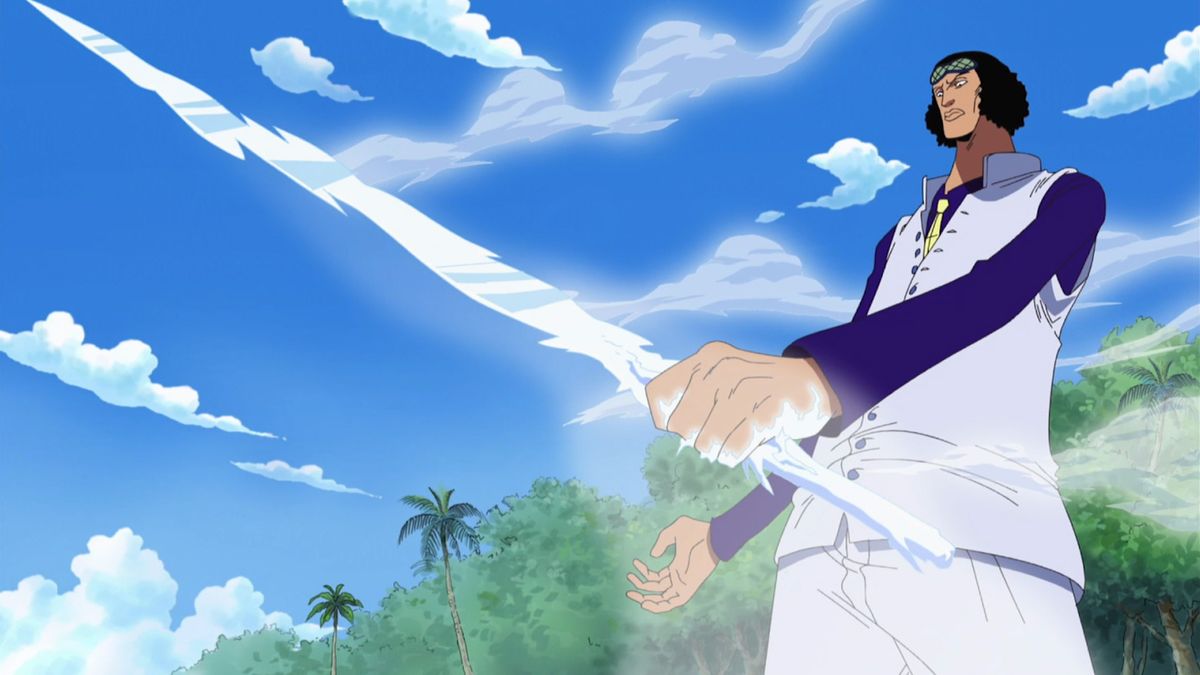
Aokiji freezes the sea into a route broad enough for stranded people to travel. The act is beautiful, practical, and terrifying. He changes an environment that defines the Grand Line’s danger. Water, the natural weakness of Devil Fruit users, becomes material under his command.
The civilians see salvation. The pirates see scale. Robin sees how little distance can protect her. The same frozen surface carries three meanings because power changes according to who receives help and who expects punishment.
The bicycle explains Aokiji’s confidence without a speech
Aokiji can ride between islands because he creates the road beneath the wheels. The bicycle turns a world-breaking ability into routine transportation. No warship, crew, or navigator is necessary for the journey shown here.
That image tells us more than a list of techniques. Aokiji does not only attack with ice. He lives inside a relationship with the sea that other Devil Fruit users cannot imagine. The ocean becomes route rather than threat, and his casual travel advertises control.
Robin attacks first because waiting has never protected her
When tension hardens, Robin moves against Aokiji. Her decision can look rash beside his relaxed behavior. Her life makes the choice legible. Authorities and temporary allies have repeatedly turned on her after using information, fear, or reward to justify the betrayal.
Waiting for Aokiji to define the encounter would surrender initiative to somebody already holding institutional and physical advantage. Robin’s attack is not proof that she misread him. Her urgency shows how often survival required movement before the polite mask fell.
Aokiji knows too much about the crew and especially about Robin
The admiral’s knowledge creates another imbalance. The Straw Hats meet a stranger. He meets a file, a history, a bounty trail, and a target he has considered for years. Information lets him control the emotional pace even before ice controls the battlefield.
Robin cannot introduce herself on her own terms because the government narrative arrived first. A child who survived genocide became “dangerous” in the official story. Aokiji can repeat that framing with the credibility of rank. The crew must decide whether lived relationship outweighs an institution’s warning.
The warning about Robin attacks the architecture of chosen family
Aokiji does not need to call Robin evil. Suggesting that every group around her eventually collapses is enough. The claim reframes survival as contamination. Instead of asking what forces destroyed her communities, the accusation makes the survivor look like the common cause.
That logic is cruel and politically useful. Institutions often isolate a target by describing persecution as a personality pattern. Robin becomes “the woman who betrays everyone” rather than the child repeatedly betrayed by adults protecting themselves. The wording asks the Straw Hats to fear the person closest to the wound instead of the power that made the wound.
Usopp, Nami, Chopper, Sanji, and Zoro read different parts of the threat
Usopp recognizes overwhelming danger. Nami notices the practical impossibility of escape. Chopper sees Robin’s distress. Sanji reacts to a threat against a crewmate. Zoro measures the opponent and understands that ordinary confidence may not survive contact. Their responses differ because belonging is distributed across many kinds of attention.
Luffy remains the final authority, but the crew is not one mind waiting for his verdict. Each person gathers evidence through skill, fear, affection, and experience. That collective reading will matter when Aokiji tries to turn Robin’s isolation into a prediction.
The episode’s calm pacing makes every small movement suspicious
Foxy filled the previous chapters with machines, shouting, and constant motion. Episode 227 allows Aokiji to stand, speak, help, and wait. The reduced pace creates space for Robin’s body language to carry the suspense. A glance becomes more urgent than another explosion.
The direction understands that overwhelming power does not need frantic editing. Aokiji’s stillness makes the crew move around him. The camera can linger because he controls the encounter before combat begins. The quiet produces dread without fake suspense.
Japanese performance context belongs inside the character’s contradiction
Takehito Koyasu voices Aokiji in the Japanese original, bringing the admiral’s drawn-out, unhurried manner into direct conflict with Robin’s alarm. Yuriko Yamaguchi voices Robin, whose usual measured delivery gives the disruption extra weight. Those credited performances support the episode’s central contrast.
The important observation is not a technical fantasy about breath or pitch. The scene gives one character room to sound casual while another loses ordinary control. Performance, posture, and narrative history all point toward the same imbalance.
What changed when I watched the rescue after knowing Ohara
On a first pass, the frozen road can make Aokiji seem like an eccentric good Marine. Later knowledge makes the scene harder. The man helping families travel has also lived inside the institution that destroyed Robin’s family, scholarship, home, and public identity.
The contradiction should remain uncomfortable. Turning Aokiji into a secret saint would flatten the harm. Turning every humane act into a trick would flatten him. Episode 227 works because the rescue is useful, Robin’s fear is justified, and the conflict between those truths has not been resolved.
The episode’s weakness is using civilians as a moral demonstration
The stranded people receive help, but most remain functions inside Aokiji’s introduction. Their names, route, losses, and reason for being trapped barely matter after the ice appears. The story uses them to prove that he can be helpful and powerful at once.
One specific family conversation would have grounded the miracle. A parent deciding whether the frozen road felt safe, or a child touching the ice before departure, could have turned background need into lived consequence. The sequence still works visually, but the civilians deserve more than being evidence in an admiral’s character file.
RaeRae verdict: believe the woman whose body recognizes the danger
Episode 227 does not require viewers to know Robin’s full past before taking her fear seriously. Her history has trained her to recognize threats the crew cannot yet name. Aokiji’s helpful conduct matters, but Robin’s reaction remains evidence. Trust means giving weight to knowledge a friend cannot disclose neatly on command.
The Straw Hats are about to learn that accepting Robin onto the ship was the beginning of belonging, not the end of responsibility. Chosen family eventually means facing the machinery that taught her to expect abandonment. Aokiji arrives to test whether their welcome survives contact with the official story.
Receipts and the route into the frozen duel
The official One Piece Episode 227 page supplies the March 27, 2005 broadcast date, Japanese title, synopsis, and shared production credits. The synopsis confirms Robin’s immediate panic, the joint effort to help stranded people, and the tension that follows apparent friendliness. The official story index keeps the chapter inside the Davy Back Fight television range while the narrative points toward Water 7.
Episode 228 turns the warning into bodily danger when Aokiji freezes Robin and Luffy demands a one-on-one fight. Continue through the Episodes 225–228 directory for the exact static-card sequence. The next chapter answers the question hanging over this introduction: what happens when Luffy’s certainty meets a power he cannot overpower yet?