RaeRae Reacts · One Piece Episode 221
Robin Turns a Shared Dream Into Evidence
One Piece Episode 221 lets Robin trace the stolen memories to a horn-carrying boy while Nami and Zoro follow the childhood histories they still possess.
Bottom line: Robin investigates while everybody else lives inside the evidence
One Piece Episode 221 gives Robin a mystery built from people she loves and facts they cannot verify. She works backward from the night of the attack, notices that every victim fell asleep, and connects the missing memories to a shared dream about a boy playing a strange horn underwater. Her deduction gives the crew a target, but the episode refuses to make knowledge equal safety. Nami and Zoro remain separated from the ship. The boy can strike again. Even the crew members who stay have only Robin’s word that they once belonged together.
My favorite choice comes from Luffy. He hears that his adventures are gone and decides they can make new memories. That answer is hopeful, stubborn, and completely Luffy. The answer is also incomplete. Nami’s missing Arlong tattoo and Zoro’s surviving promise to Kuina prove that memory does not vanish in a tidy block. Old pain, bodily evidence, and unfinished dreams remain. Starting over sounds easy when the person saying so does not yet understand what the theft separated from everyone else.
Episode facts and the five-part anime route
Episode 221 aired in Japan on February 13, 2005. Hirohiko Kamisaka wrote the screenplay with assistance from Hito Koyama. Katsumi Tokoro directed the episode, Takeo Ide served as animation director, and Miyuki Sato and Kumiko Fukuzawa handled the art direction. The official title identifies the two engines of the episode: the mysterious boy carrying a horn and Robin’s deduction.
This is the second chapter of the anime-original Ocean’s Dream story, which runs from Episode 220 through Episode 224 and draws from the PlayStation game One Piece: Ocean’s Dream. The manga journey does not require this detour. The character experiment still earns attention because the story asks what remains when the crew loses the history that made them a crew.
Nami reaches an island that has forgotten itself
Nami arrives on the nearby island expecting a route home. Instead, she finds residents fighting over a newspaper. The entire community has suffered memory loss, and a single printed account has become precious because nobody trusts personal recall. Information scarcity turns neighbors against one another. The paper offers facts from beyond the island, but outside news cannot restore private histories.
The scene expands the threat beyond one pirate ship. The Straw Hats are not uniquely chosen victims. A whole town has become vulnerable because relationships, obligations, debts, and shared knowledge have been cut loose. People who cannot remember yesterday have trouble deciding who deserves trust today. The fight over the newspaper looks ridiculous until the social cost becomes clear.
The boy approaches Nami as though he belongs there
The mysterious boy appears near Nami and offers guidance around the island. She does not recognize him from the shared dream yet, so his ordinary appearance becomes camouflage. He can stand beside the damage because the victims cannot remember the attack. That is a nasty little advantage.
Nami remains practical. She needs a vessel capable of crossing the sea and information about the island’s boats. The boy meets a need instead of announcing himself as an enemy. His approach fits the larger premise: control becomes easier when the target cannot remember why caution exists. Nami has sharp instincts, but instinct has to work without the experiences that once taught her which danger mattered.
Robin builds a case from the final ordinary night
Back on the Going Merry, Robin reconstructs the hours before everyone changed. She remembers reading while the others slept. She remembers the sound. She asks what each person can still recall. The process is patient rather than flashy. Robin separates what she observed from what she suspects and looks for the condition shared by every victim.
Only the sleepers lost their memories. That detail turns sleep from background routine into the attack route. The crew then recalls the same submerged boy playing a low horn. Their minds retained the dream-shaped edge of the theft even after the voyage disappeared. Robin treats that fragment as evidence instead of dismissing the dream as nonsense. Her talent is not merely intelligence. She knows how to take incomplete testimony seriously without pretending uncertainty has vanished.
The kettle whistle breaks open the shared dream
A whistle in the galley triggers recognition. The sound does not restore the voyage, but the tone pulls the victims toward the same underwater image. Suddenly, several private experiences become one shared event. The crew can compare details and confirm that the boy appeared to all of them.
I like this more than a convenient exposition device because memory often returns through association. A sound, smell, texture, or repeated motion can reach something that a direct question cannot. The kettle remains an ordinary object doing ordinary work. Sanji’s kitchen helps expose the attack because daily life provides the cue. The crew begins rebuilding knowledge through the same shared space whose meaning they lost.
Luffy chooses tomorrow because yesterday is unavailable
Luffy decides that missing memories do not have to end the journey. They can make new memories. The statement sounds almost too easy, but simplicity is his genuine strength. He refuses to let an enemy define his future through what was stolen. He does not need a complete theory before choosing movement.
That attitude gives the remaining group a direction Robin’s evidence alone cannot provide. She can explain the crime. Luffy can make staying feel possible. Captaincy begins returning through action before memory returns through magic. He does not remember earning authority, yet his instinct still points toward a shared adventure instead of private escape.
Hope cannot erase the missing people
Luffy’s plan has an obvious hole: Nami and Zoro are gone. New memories cannot be made with crewmates who no longer consent to the crew. Robin understands that rushing after them without solving the attack may create another failure. The group needs to know what happened and whether the thief will return.
The episode lets hope and responsibility sit together. Luffy’s answer protects morale. Robin’s caution protects the investigation. Neither approach is enough alone. That partnership is especially interesting because Robin joined the crew later and normally avoids claiming authority. Memory loss forces her into a leadership role before the coming Water 7 story tests whether she believes she deserves the family’s protection.
Zoro remembers Kuina because the promise came first
A fragment of Zoro’s childhood returns: his rivalry with Kuina, their promise that one of them would become the world’s greatest swordsman, her death, and the Wado Ichimonji passed into his care. The dream survives because the memory thief returned him to a point after that foundational loss. Luffy and the crew disappear, but Kuina remains.
That survival explains why Zoro can continue moving with purpose while rejecting the Going Merry. His ambition predates the crew. The sword in his hand carries a relationship and a promise he still recognizes. The Straw Hats later gave the dream allies, witnesses, and a captain willing to defend the road. Without those memories, the destination remains and the social meaning narrows.
The boy tests Zoro and finds a dangerous target
The horn carrier approaches Zoro away from the ship. Zoro notices him, which already makes the encounter different from the sleeping attack. A swordsman who trusts nobody watches the world closely. The boy cannot rely on forgotten familiarity because Zoro offers none.
Still, Zoro’s isolation creates another vulnerability. Nobody stands beside him to compare impressions or interrupt manipulation. He has strength, discipline, and a surviving goal. He lacks the shared context that would identify the boy as the threat Robin is hunting. The episode keeps returning to the same point from different directions: individual competence cannot replace collective memory.
Nami sees the missing tattoo before she remembers the rescue
While bathing, Nami notices that the Arlong Pirates tattoo is gone. Her body tells her that something enormous happened after the last memories she can reach. A scar and changed mark become evidence of a life she cannot explain. She wonders how she ended up calling pirates her companions, but the answer includes the very rescue now missing from her mind.
This scene carries more weight than another broad flashback. Nami does not simply forget Luffy. She loses the proof that escape became possible. The current tattoo represents her decision to reclaim her body and future after Arlong’s control. Seeing the old mark absent without remembering why creates a gap between identity and evidence. Her own skin has moved beyond the self she remembers.
Arlong’s shadow returns without Arlong entering the room
Nami remembers joining the Arlong Pirates, which means the emotional cage closes around her again. She knows the bargain, the money, and the obligation. She does not know that Arlong betrayed the bargain, that Cocoyasi Village stood with her, or that Luffy destroyed the room where her maps became forced labor.
The memory boundary is cruel because the thief leaves enough history to direct her behavior while removing the history that challenged the trauma. Nami’s decision to take the gold and seek home becomes even more understandable. She remembers a village that still needs saving. Fans remember that she already saved that village with people she now distrusts.
Robin knows facts about bonds she did not witness
Robin can tell the group that Nami navigates, Zoro fights, Sanji cooks, Chopper treats injuries, Usopp shoots and repairs, and Luffy captains. Those roles describe function. The missing stories explain devotion. Robin did not see Luffy give Nami his hat. She did not watch Zoro accept death rather than abandon his promise. She cannot reproduce the private moments that made each role belong inside a family.
Her limitation keeps the mystery human. A person can know friends deeply without knowing every event that shaped them. Robin has to admit where her knowledge ends, then work with what remains. That honesty gives her deductions more credibility than a perfect speech would.
The boy returns because one successful theft invites another
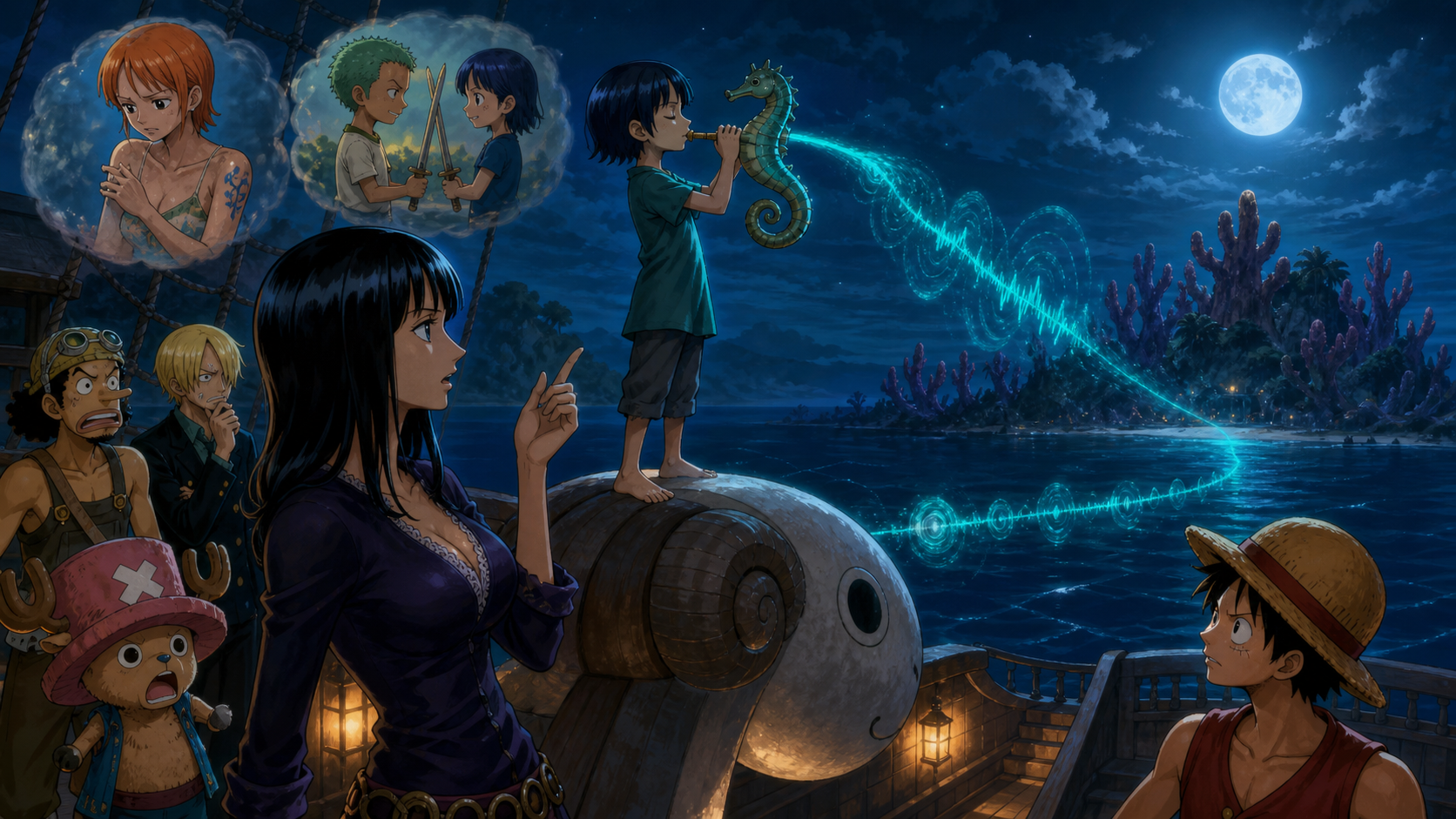
Night falls, and the horn carrier stands on the Going Merry’s figurehead. The image turns the ship’s cheerful face into a stage for another attack. The crew has stayed awake and now recognizes the threat, but recognition arrives seconds before the horn begins.
The second attempt clarifies the stakes. The remaining fragments may disappear. Robin’s immunity may not hold forever. Nami and Zoro are elsewhere. The crew cannot wait for memory to repair itself. They need to stop the thief while fighting with relationships that feel new.
Luffy attacks before certainty becomes permission
Luffy moves against the boy because the evidence is enough. Robin traced the pattern, everyone recalled the dream, and the suspect returned carrying the matching horn. He does not demand a courtroom confession while the weapon is raised. Action becomes his contribution to the investigation.
The confrontation damages the horn, and Luffy suddenly declares that his memories have returned. The episode ends at the exact point where hope becomes a test. If Luffy truly remembers, the crew has regained the person most capable of pulling everyone toward one another. If the claim is another effect of the horn, the danger has changed shape.
What changed when I replayed the episode
On the first watch, I focused on the boy and waited for the mystery answer. On replay, the ordinary objects carried more meaning. The newspaper becomes public memory. Nami’s tattoo becomes bodily memory. Wado Ichimonji becomes a promise stored in a weapon. The kettle whistle becomes sensory memory. Robin’s book and testimony become recorded and witnessed memory. No single form is complete.
I also appreciated Luffy’s decision more after noticing that he begins acting like a captain before recovering his history. He offers a future, listens to Robin’s theory, and confronts the active threat. The title did not restore him. His choices begin rebuilding the role.
The production moves from quiet deduction to a clean cliffhanger
The episode spends much of its time on conversation, fragments, and separated characters. The pacing could feel slow for viewers waiting on a fight, but the quieter structure lets every clue belong to somebody. Robin does not pull an answer from nowhere. Sounds, sleep, dreams, marks, and surviving memories accumulate.
The moonlit figurehead sequence then gives the episode a sharp visual endpoint. Blue-green sound against the dark sea turns memory theft into something physical without explaining the whole mechanism. The horn looks strange enough to be dangerous and simple enough to break. Luffy’s sudden recovery lands because the episode spent time establishing how much one returned memory could change.
RaeRae’s verdict
Episode 221 is stronger than a basic second chapter because Robin’s investigation and the crew’s identity crisis are the same story. Every clue belongs to a person. Nami’s body remembers change she cannot explain. Zoro’s sword carries a vow the thief did not reach. Luffy begins rebuilding captaincy through choice. Robin holds the fragile timeline together while knowing her testimony cannot replace everyone else’s life.
The anime-original premise still has rough edges, especially the conspicuous mystery boy and the convenient boundaries around lost memory. The character work makes those edges easy to forgive. A crew is not only the people standing on a deck. A crew is accumulated proof that those people chose to remain. Episode 221 starts gathering that proof again, one whistle, scar, sword, and stubborn decision at a time.
Official source and next route
The official ONE PIECE episode guide confirms the February 13, 2005 broadcast date, production credits, Robin’s account of the horn, the crew’s shared recollection of the mysterious boy, and the childhood memories followed by Nami and Zoro. Continue through the bounded Ocean’s Dream directory for Episode 222, where the crew moves onto the island to recover what was stolen.