RaeRae Reacts · One Piece Episode 217
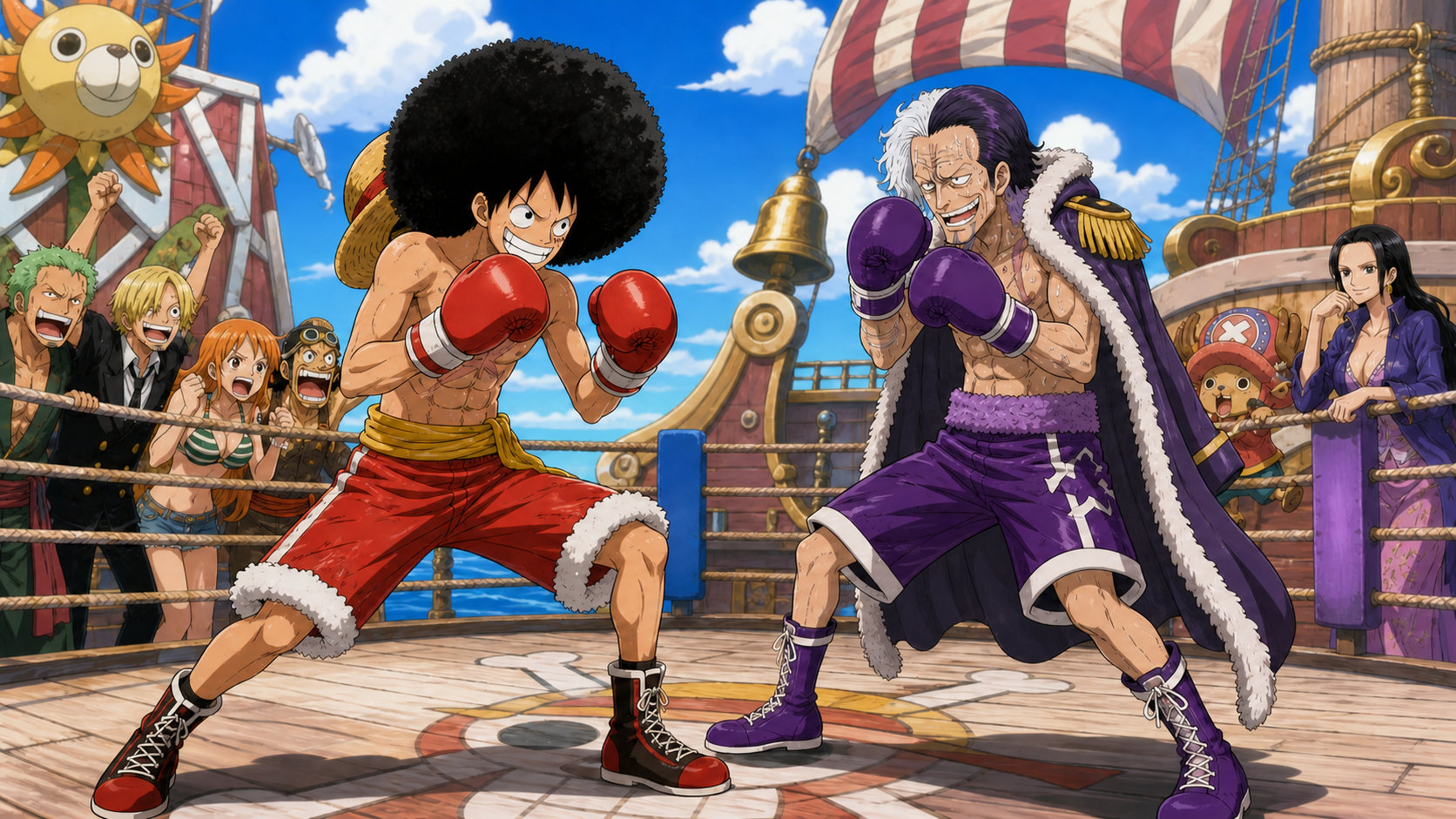
Afro Luffy Enters Foxy’s Trap Ship
One Piece Episode 217 gives Luffy an afro, Foxy a ship full of traps, and the final captain fight that decides whether Robin and Chopper come home.
Bottom line
One Piece Episode 217 puts the entire crew inside Luffy’s boxing gloves. A win restores Robin and Chopper. A loss binds every Straw Hat, plus descendants nobody has even imagined, to the Foxy Pirates. Luffy responds by wearing an afro because Usopp tells him the hair unlocks hidden power. I should be angry that the final rescue begins with a wig. Instead, Afro Luffy walks onto the Sexy Foxy looking so completely certain that the nonsense becomes part of the armor.
Foxy has the ship, the traps, the Slow-Slow Fruit, hidden cannons, bombs shaped like his own face, and years of practice fighting inside his personal playground. Luffy has boxing gloves, stubborn durability, and friends he put in danger. The episode refuses to let raw strength erase preparation. Foxy controls the opening because he built the arena around his ability.
First watch: the afro has no business working this well
Usopp sells the afro like sacred combat technology. Luffy accepts the explanation with the faith of a man who has never needed a reasonable reason to commit fully. The result is absurd and instantly iconic.
The hair does not grant a measurable power. The ritual changes posture, mood, and expectation. Luffy walks out believing the champion version of himself has arrived, and belief affects how boldly he enters Foxy’s ship.
The wager has grown beyond one bad decision
Robin and Chopper are already held by Foxy when the final combat begins. The expanded terms place the rest of the crew and future descendants behind the same result. Foxy turns one captain’s pride into generational ownership.
Luffy accepts because the larger stake lets him recover both crewmates with one victory. That rescue route exists only because two earlier losses made ordinary recovery impossible. The desperate solution does not erase how the crisis formed.
Captain versus captain finally matches responsibility with combat
The earlier games made whole teams carry Luffy’s wager. Final Combat places the physical burden on the two captains who kept escalating. That alignment feels right.
Foxy fights to preserve a collection system built around control. Luffy fights for people he refuses to surrender. Their methods of leadership could not be more different, even when both men helped create the contest.
The Sexy Foxy is not a neutral ring
The entire ship counts as the arena. Foxy knows every passage, mechanism, weapon, hiding place, and escape route. Luffy enters a building that has been designed around the opponent’s habits.
Calling the space open does not make the advantage equal. Foxy can break furniture, trigger devices, and move between prepared positions without learning the environment. Luffy has to discover each danger by surviving the first use.
Usopp becomes a boxing manager through pure confidence
Usopp understands presentation. He knows a fighter can enter a match carrying the crowd’s expectation, an opponent’s confusion, and a new story about himself. The afro speech gives Luffy a role large enough for the stakes.
That contribution is not fake because the power claim is exaggerated. Usopp helps his captain shift from guilty rescuer to active challenger. Sometimes a costume gives the mind permission to use strength already present.
Afro Luffy is fandom joy with a complicated edge
The visual became one of the arc’s most remembered jokes. The joke also draws from a long history of Black hair being treated as costume, spectacle, or shorthand for attitude. Fans can enjoy the design while acknowledging that context rather than pretending representation questions vanish because the scene is funny.
The strongest reading stays with character. Luffy does not mock a person. He believes the afro is powerful and treats the look with complete admiration. Usopp presents the hair as confidence, force, and champion energy.
Foxy’s Slow-Slow Beam controls the first exchange
Foxy lands the Noro Noro Beam and slows Luffy before the captain can establish a rhythm. The effect does not simply reduce movement. The beam gives Foxy time to arrange violence while Luffy remains trapped inside delayed seconds.
That control makes Foxy dangerous beyond comedy. He can separate an action from its consequence, stack multiple attacks, and leave the victim unable to respond until the accumulated force arrives together.
The barrage waits for time to restart
Foxy punches the slowed Luffy repeatedly. The impacts appear suspended until the beam’s thirty-second effect ends, then every blow reaches him in one punishing release.
The sequence turns delay into a weapon. Luffy cannot adapt between hits because his body receives the information after Foxy has already completed the combination.
Rubber durability does not mean painless
Luffy survives enormous punishment because his body absorbs blunt force differently. He still feels the attacks, loses position, and risks consciousness. Foxy’s gloves, traps, and explosions can layer damage beyond one ordinary punch.
The episode needs that distinction. An “invulnerable” hero would make the ship irrelevant. A durable hero can keep rising while the audience understands that each rise costs him.
Foxy rides slowed cannonballs like stepping stones
Foxy freezes cannonballs in midair and uses them as platforms. The trick looks theatrical, but the timing creates a lethal trap. Luffy sees solid footholds where moving explosives are waiting for normal time.
When the effect ends, the cannonballs resume their speed. Foxy has turned the path itself into ammunition. Knowledge of his own power matters as much as the beam.
Luffy learns the trap by triggering the trap
Luffy tries to use the suspended cannonballs and discovers the danger under his feet. That learning style is painful and familiar. He often understands an opponent’s ability through direct contact.
The method works because he survives mistakes other fighters cannot afford. Durability becomes a research tool, but every experiment still moves him closer to the body’s limit.
The face bombs prove Foxy planned for his own vanity
Foxy fires explosives shaped like his face. The design is funny, vain, and practical because the bombs blend branding with attack. Even his ammunition has to advertise the captain.
That vanity tells us how Foxy understands the crew. Every victory, uniform, flag, and weapon should repeat his identity. People join the Foxy Pirates by being absorbed into one man’s image.
Spiked gloves expose the limits of calling this boxing
Foxy attacks with spiked gloves while the whole ship remains legal territory. The event borrows boxing’s bell and gloves without accepting boxing’s protections.
That selective tradition matches the rest of the Davy Back Fight. Ceremony creates legitimacy. Loopholes preserve violence. Foxy wants the dignity of sport and the freedom of an ambush.
Robin watches another organization try to own her usefulness
Robin stands with Foxy’s crew while the captains fight. Her calm does not mean the outcome carries less weight. She has spent much of her life moving through groups that wanted her knowledge while keeping trust conditional.
Luffy’s refusal to leave her matters because he has never reduced her to the Poneglyphs she can read. The problem remains that his reckless rematch gave Foxy the opportunity to make that claim.
Chopper has been taken twice because the lesson did not stick
Chopper watches from the rival side again. His first forced transfer should have ended Luffy’s willingness to gamble crew membership. The rematch recreates the injury before the emotional bruise has faded.
Luffy fighting to recover him is love in action. Love would have been stronger if the captain had listened after the first rescue.
Nami cannot navigate inside a rigged ship from ringside
Nami understands traps, timing, and Foxy’s habits, but the captain’s duel limits how much the crew can intervene. She has to watch Luffy discover mechanisms she would normally study before entering.
Her frustration carries the voice of everyone who warned him against the rematch. Being right offers no comfort while the person who ignored the warning absorbs bombs.
Zoro and Sanji have to trust the captain they criticized
Zoro and Sanji can break through many of Foxy’s crew, yet the rules place the final recovery in Luffy’s hands. They cannot fight this consequence for him.
Trust here is not blind approval. Both men can believe Luffy will rise and still know his choice was reckless. A crew relationship has room for loyalty and criticism at the same time.
Foxy is strongest when the opponent laughs too early
His voice, wounded pride, split hair, and theatrical equipment encourage dismissal. The Slow-Slow Fruit punishes that mistake. Foxy may be insecure, but he has built a complete fighting system around the insecurity.
Luffy cannot win by deciding the opponent is a joke. He has to read the beam, the thirty-second window, the ship, and the traps as seriously as he read Crocodile’s sand or Enel’s lightning.
The episode ends before the afro can become a shortcut
The outfit creates excitement, then Foxy controls the fight. That ordering protects the comedy from becoming a fake power-up. Luffy still has to solve the opponent.
Afro confidence gets him through the entrance. Endurance keeps him conscious. Strategy remains unfinished when the episode closes.
Production notes
Episode 217 aired in Japan on January 16, 2005. Hirohiko Uesaka wrote the script, Yoko Ikeda directed the episode, Kenji Yokoyama served as animation director, and Miyuki Sato with Fumihiro Uchikawa handled the art. The official ONE PIECE guide confirms that victory restores Robin and Chopper while defeat binds the entire Straw Hat crew and their descendants to Foxy.
The shipboard direction expands the boxing ring into a trap maze. Slow motion, delayed impacts, suspended cannonballs, and explosive reveals give Foxy’s Devil Fruit a visual logic beyond one repeated beam.
What the episode gets right
Episode 217 lets Foxy look dangerous without changing his personality. Every weapon remains theatrical, vain, and unfair. The same traits that make him funny also shape an effective home-field strategy.
Luffy’s afro entrance gives fans joy before the fight demands endurance. The contrast makes both halves stronger. A ridiculous costume and real stakes can share the same deck.
What still bothers me
The rematch creates a generational slavery clause for comedy. The absurd scale is meant to sound impossible, but the underlying idea remains ownership enforced through a wager most crew members never approved.
Luffy deserves credit for carrying the final burden. He also deserves direct blame for accepting the burden on everybody’s behalf. The episode cannot cheer one truth loudly enough to erase the other.
RaeRae verdict
Episode 217 earns the Afro Luffy legend by making the look confidence rather than magic. Usopp builds the champion entrance. Foxy answers with a ship designed to punish anybody who mistakes presentation for weakness.
The first round belongs to preparation. Foxy slows time, stacks pain, weaponizes cannonballs, and fills the deck with his own face. Luffy keeps standing because Robin, Chopper, and the future of his crew are now attached to every punch.
Official source
ONE PIECE.com Episode 217 guide
The Afro Works Because Luffy Believes the Hype
Afro Luffy should be nothing but a gag, and the episode absolutely enjoys the gag. Usopp sells the hairstyle like sacred combat technology. Luffy believes every word. That belief changes his posture, his rhythm, and the energy of the arena before Foxy lands another trick. Confidence becomes equipment, even when the equipment is hair.
Foxy’s trap ship keeps the comedy from becoming empty. Every corridor, weapon, and false opening favors the host. Foxy calls the setup a contest after designing the building, choosing the rules, and hiding the mechanisms. Luffy enters anyway because winning back Robin and Chopper matters more than preserving dignity. The afro cannot protect him from cheating, but the persona helps him keep moving through humiliation.
RaeRae verdict: Episode 217 understands wrestling logic. Presentation changes how a fighter and the crowd experience the fight, while the real stakes remain underneath the spectacle. Luffy looks absurd, Foxy acts shameless, and the captain’s refusal to quit makes the whole ridiculous package emotionally honest.
One more receipt: the crowd buys the transformation because Luffy commits completely. Foxy wants spectacle to distract from cheating. Luffy steals spectacle back and uses confidence to keep the rescue mission emotionally visible.