RaeRae Reacts · One Piece Episode 210
Foxy Freezes a Victory He Could Not Earn
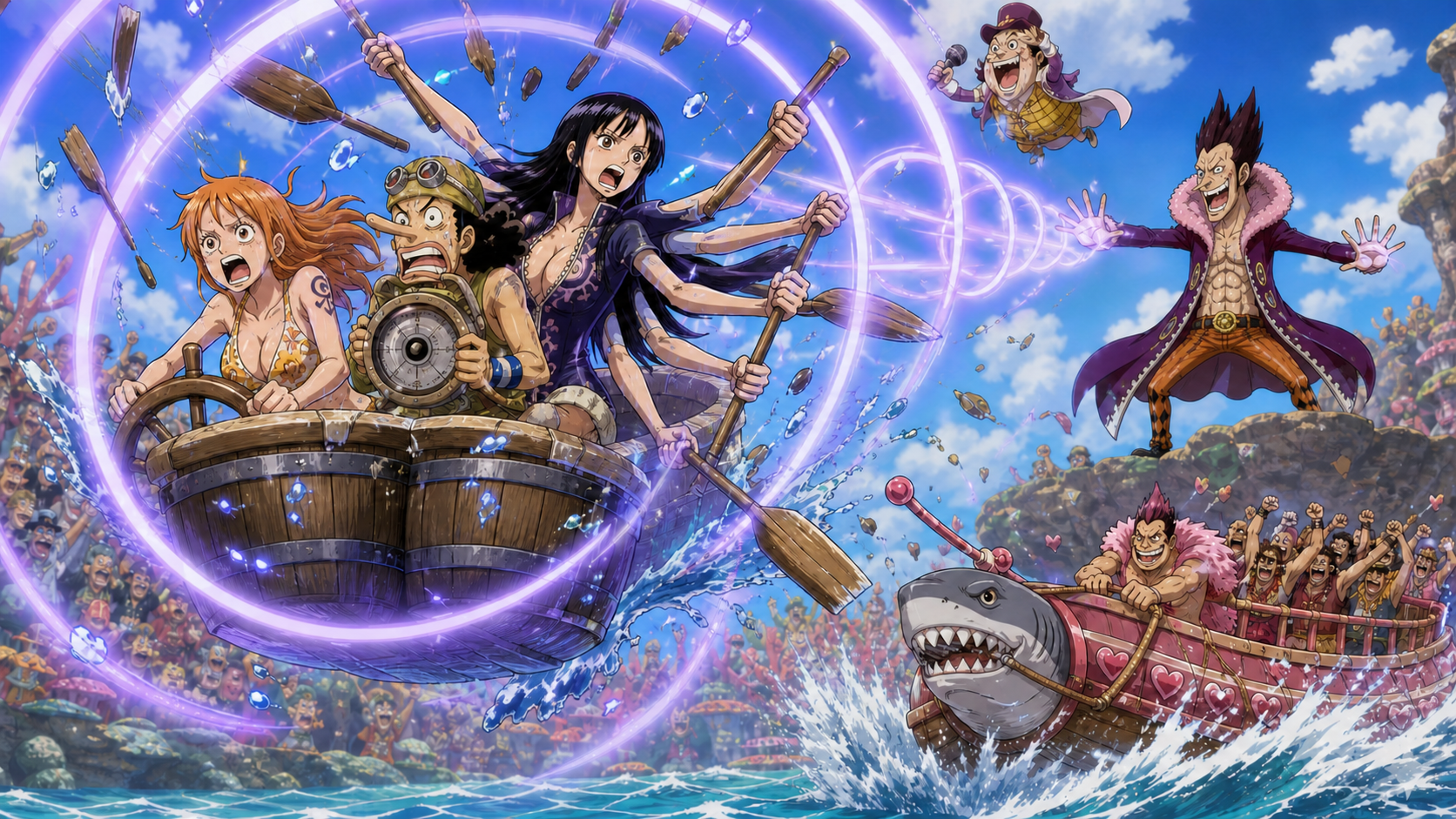
One Piece Episode 210 lets Nami, Usopp, and Robin beat the Donut Race, then gives Foxy thirty stolen seconds to take the result and Chopper.
Bottom line
One Piece Episode 210 lets Nami, Usopp, and Robin do almost everything right, then Foxy freezes their victory inches from the finish. They survive the coral maze, use an Impact Dial for acceleration, read the water, answer repeated interference, and take the lead through actual teamwork. Foxy responds with the Slow-Slow Beam because his version of competition only lasts while he controls the result.
The loss hurts because the Straw Hats earn the win before a rigged system takes the win away. Foxy does not out-navigate Nami, out-invent Usopp, or out-coordinate Robin. He waits on shore with a Devil Fruit power and turns their motion into helpless suspension. Then his team passes them. That is not clever gamesmanship. That is a captain using the rulebook as permission to steal.
First watch: I knew Foxy would cheat, and I was still mad
Foxy has spent two episodes advertising dishonesty, so surprise should not be possible. Somehow the final beam still feels personal. Nami’s team reaches the finish through competence. The camera lets victory become visible. Foxy fires only when their success can no longer be denied.
My anger comes from the timing. The beam does not create a better race. The beam erases the meaning of the race we watched. Foxy wants the applause of winning without accepting any contest he might lose.
The coral maze should have ended the barrel boat
A crude vessel made from barrels has no business threading through coral without becoming kindling. Nami turns the maze into a navigation problem rather than a durability test. She reads openings, anticipates current shifts, and keeps the team from wasting motion.
The sequence proves why expertise matters. Bravery cannot identify safe water. Strength cannot make a hidden channel wider. Nami’s knowledge gives the boat a path where the Foxy spectacle wants viewers to see only danger.
Nami keeps choosing the next solvable problem
Foxy’s interference works by overwhelming attention. A trap appears, the crowd screams, another opponent closes in, and the finish seems farther away. Nami refuses to solve the whole corrupt event at once. She identifies the next current, obstacle, or angle and gives the crew a usable instruction.
That focus is leadership under pressure. Luffy’s leadership often begins with one enormous moral answer. Nami’s leadership builds from dozens of precise answers delivered before panic can take command.
Usopp turns Skypiea experience into speed
The Impact Dial is not a random miracle pulled from storage. Usopp carried technology from Skypiea, learned what stored force can do, and recognizes the moment when that force can launch the barrel boat forward. The voyage becomes an accumulating toolbox.
I love continuity expressed through practical use. Skypiea does not vanish because the arc ended. Dials now affect races, repairs, weapons, and escape plans. Usopp makes earlier wonder useful without reducing the wonder to a souvenir.
The Impact Dial rewards nerve and timing
Stored impact can break a user as easily as an obstacle. Usopp has already learned that power comes with recoil. Using the Dial on an unstable boat requires judging direction, balance, and the instant when acceleration will help instead of flipping everybody into the sea.
His decision works because Nami and Robin are ready. Usopp provides force, Nami provides orientation, and Robin provides control across the hull. The tool matters. The team makes the tool successful.
Robin’s extra arms turn instability into rhythm
Every acceleration threatens to twist the barrels apart. Robin can correct several points at once. Her arms paddle, brace, and redistribute effort while her expression stays focused on Nami’s calls.
That composure is not emotional emptiness. Robin has survived by observing danger before reacting. In the Donut Race, a survival habit becomes a crew advantage. She trusts Nami enough to follow direction and Usopp enough to accept his improvised burst.
This trio wins before the scoreboard says otherwise
Nami, Usopp, and Robin solve the course through combined ability. Their boat reaches winning position despite Foxy’s greater resources, practiced specialists, home venue, and interference network. The official result will not change that evidence.
Sports stories often treat the scoreboard as moral truth. Episode 210 accidentally offers something more interesting. A corrupt result can name a loser without proving failure. The Straw Hat trio demonstrates superiority in every skill the race should measure.
Foxy’s traps keep changing because the crew keeps adapting
Static obstacles would become predictable. Foxy layers environmental hazards, rival attacks, crowd interference, and his own power. Each answer forces him to reveal another advantage.
That escalation exposes him. A confident competitor would let the race test both teams. Foxy cannot tolerate uncertainty long enough to discover who is better. He needs control more than competition.
The Slow-Slow Fruit is terrifying beneath the joke
Foxy’s Noro Noro no Mi emits particles that slow whatever they strike for thirty seconds. Movement continues at an almost frozen pace while outside observers remain free to act. When the effect ends, accumulated consequences arrive together.
That power attacks agency. Victims can see what is happening but cannot respond at ordinary speed. Foxy loves the ability because helpless awareness gives him time to perform, interfere, and arrange the outcome while everyone else watches.
Thirty seconds is forever near a finish line
A half-minute sounds small outside a race. Inches from victory, thirty seconds can contain an entire defeat. The rival craft needs only enough time to pass a boat that can barely move.
The frozen spray makes the theft visible. Water, paddles, faces, and momentum hang in place while Foxy’s team moves through normal time. The image captures the real power imbalance better than another rules explanation could.
Foxy does not bend the rules; he owns the interpretation
The Foxy crowd accepts direct captain interference because “anything goes.” That phrase pretends equal permission creates equal opportunity. The Straw Hats do not possess Foxy’s Devil Fruit, venue staff, surveillance, or established tactics.
A rule available only in theory protects the side with resources. Foxy can claim legality while designing every practical advantage around himself. The referee does not need to lie if the system already defines Foxy’s conduct as acceptable.
The crowd turns theft into celebration
Foxy’s followers cheer the beam because they have learned to experience his control as entertainment. Their reaction isolates the Straw Hats. Every visible injustice receives applause instead of correction.
Crowds can normalize almost anything when belonging depends on shared enthusiasm. A member who admits Foxy needed to steal the race would challenge the story holding this giant crew together. Cheering becomes self-protection.
Monda and the rival craft still deserve credit
The Foxy racers are not useless without their captain. Monda provides frightening speed, Capote understands the water, and Porche knows how to keep the team coordinated. Their skill makes Foxy’s interference more frustrating, not less.
They had a chance to compete honestly. Foxy denies his own people that proof because he cannot risk a clean result. Even the winners lose something when their captain makes competence irrelevant.
Usopp knows exactly what was stolen
Usopp’s anger carries the weight of construction. He built the craft, selected the Dial, endured the course, and watched their solution work. Foxy freezes more than a boat. He freezes the moment when Usopp’s planning should become recognition.
That wound fits Usopp. He often worries that spectacular fighters make his contributions invisible. The Donut Race gives him visible value, then an outside hand steals the public result. His outrage is personal and justified.
Nami hates a rigged transaction
Nami understands cheating better than most because she can cheat with precision when survival requires an edge. Her anger does not come from innocence about pirate behavior. Her anger comes from Foxy demanding everybody call a fixed exchange legitimate.
A thief can recognize another thief. Nami also recognizes bad terms. Foxy wants the status of a fair winner and the freedom of an open criminal. She refuses to give him both.
Robin watches a familiar kind of power
Robin has lived under institutions that used formal rules to justify predetermined outcomes. The World Government called her dangerous before she could choose a life. Foxy’s carnival is smaller and sillier, but the mechanism has a familiar shape: authority creates the category, then category makes harm appear proper.
Her calm during the loss does not mean the loss matters less. Robin has learned that visible outrage rarely changes a system controlled by the opposing side. She stores information and waits for the next opening.
Luffy has to watch his decision collect a price
Luffy accepted the Davy Back Fight. His crew raced brilliantly. Foxy’s system still produces a loss. The captain now faces the consequence he treated as abstract during the challenge.
This is where leadership becomes more than confidence. Luffy cannot punch the result away without breaking the promise he made. He has to live inside the terms long enough to understand what he risked for everyone else.
Chopper becomes the cruelest possible selection
The Foxy Pirates choose Chopper after winning. That selection targets the youngest and most emotionally vulnerable Straw Hat. Chopper knows what rejection feels like. Being claimed by strangers turns his belonging into a public question.
Foxy could choose combat strength or specialized knowledge. Taking Chopper creates pain across the crew and gives Foxy a doctor. The decision reveals that the game’s true product is not athletic victory. The product is control over relationships.
Ken Koyama directs the finish as a robbery
Director Ken Koyama builds confidence through the coral escape and Impact Dial acceleration, then stretches the final approach until the audience can feel the line. Foxy’s beam interrupts that momentum with a completely different visual rhythm.
Suspended action lets frustration replace surprise. We have time to see Nami, Usopp, and Robin understand the theft while the rival boat moves. The scene refuses to hide the mechanism behind fast editing.
Masayuki Takagi makes slow motion feel physical
Animation director Masayuki Takagi uses frozen spray, strained poses, and distorted timing to communicate the Slow-Slow effect. The victims are not statues. Their movement continues with unbearable delay.
That distinction gives the power personality. Foxy does not stop time like a god. He forces other people to experience time badly while he enjoys normal freedom. The cruelty fits him perfectly.
What changed when I replayed the episode
On first watch, the final beam swallowed the rest of the race. On replay, every successful Straw Hat adjustment made the ending stronger. The coral maze, Impact Dial, coordinated paddling, and recovered lead establish that Foxy fires because he has been beaten in the meaningful contest.
I also felt worse for the Foxy racers. They have real ability, but their captain cannot let that ability stand on its own. His insecurity contaminates their victories and teaches the whole crew that results matter more than earned confidence.
What works
The episode makes Nami, Usopp, and Robin’s skills essential. Skypiea continuity returns through the Impact Dial. The coral maze gives navigation a visual challenge. Foxy’s Devil Fruit arrives at the exact point when ordinary sabotage can no longer guarantee his preferred result.
The ending also converts a silly competition into a character threat. Losing Chopper matters far more than losing a race. The rules finally reveal their emotional purpose.
What does not work as well
Several interference beats repeat the same joke: Foxy acts, the announcer praises him, and the Straw Hats protest. The pattern is thematically useful but can slow the race before the final approach.
The Foxy crowd remains more collective noise than individual perspective. One member questioning the beam would have sharpened the difference between loyalty and enforced enthusiasm. The uniform cheering makes the organization feel flatter than the idea deserves.
RaeRae’s verdict
Episode 210 gives the Straw Hats a moral victory and refuses to pretend moral victories feel good when somebody takes your friend. Nami, Usopp, and Robin win the navigation, invention, teamwork, and nerve tests. Foxy wins the official line because he can freeze the people who expose him.
I am not impressed by his record. I am impressed by three pirates in a barrel boat who force a captain with hundreds of followers, a home course, a shark engine, and a Devil Fruit to panic at the finish. Foxy gets the point. The Straw Hats prove the point was never worth respecting.
Production notes and receipts
One Piece Episode 210, “Foxy the Silver Fox! A Violent Interference,” aired in Japan on November 21, 2004. Hirohiko Kamisaka wrote the script, Ken Koyama directed, Masayuki Takagi supervised animation, and Miyuki Sato and Michiyo Kawasaki received the listed art credits.
The official One Piece episode record confirms the airdate, staff, coral-maze escape, Impact Dial acceleration, repeated interference, apparent Straw Hat lead, and Foxy’s final Slow-Slow Beam. The official Davy Back Fight index places the episode directly before Groggy Ring begins in Episode 211.