RaeRae Reacts · One Piece Episode 200
Jonathan Baits the Rescue With a Seastone Cage
One Piece Episode 200 sends Luffy and Sanji into Jonathan’s obvious rescue trap, then lets Condoriano and the wrong Dial break the commander’s clean plan.
Bottom line
One Piece Episode 200 sends Luffy and Sanji into the most obvious rescue trap in Navarone, lets both men recognize the trap, and has them enter anyway because Zoro and Usopp are behind the bait. Jonathan understands the crew’s loyalty. He mistakes predictable loyalty for controllable loyalty.
The episode also gives us Condoriano, one of those jokes that fandom refuses to release back into the wild. Usopp turns an furious Marine officer into an alleged Straw Hat through pure confidence, Zoro supports the lie because chaos is useful, and the actual rescue depends on a mislabeled Dial producing the wrong kind of disaster.
Episode facts
Fuji TV broadcast Episode 200 on August 8, 2004. Hirohiko Kamisaka wrote the screenplay, Munehisa Sakai directed, Kazuya Hisada served as animation director, and Miyuki Sato with Kumiko Fukuzawa handled the art direction. The official Japanese title translates to “Luffy and Sanji’s Desperate Resolve! The Great Rescue Operation!”
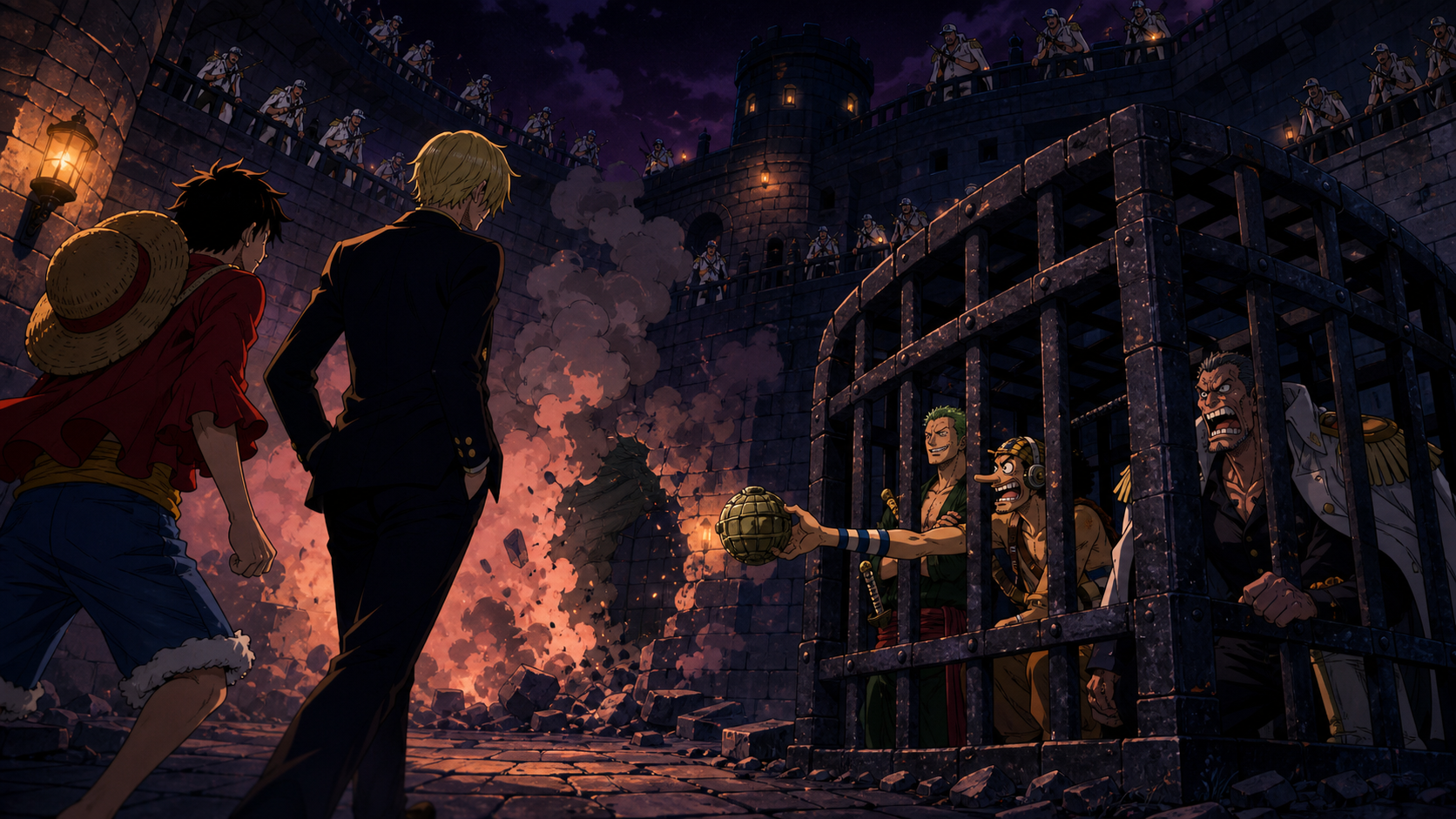
The episode continues the anime-original G-8 arc. Luffy and Sanji learn that Zoro and Usopp are imprisoned on the central island. The empty approach warns Sanji that Jonathan has prepared a trap. They enter, encounter a cage reinforced with Seastone, and face Marines waiting for the rescue attempt.
The empty route is Jonathan speaking clearly
A working fortress does not abandon the road to its central prison during an active search. No patrols, no workers, and no resistance mean somebody wants the pirates to reach the cells. Sanji reads the silence before Luffy reaches the same conclusion.
Jonathan does not hide the invitation perfectly because perfect concealment is unnecessary. He only needs the prisoners to remain at the end of the route. Loyalty can pull the rescuers through a warning they fully understand.
Knowing about the trap does not create another option
Sanji can identify the setup and still lack a safer path. Zoro and Usopp remain inside. Waiting gives Jonathan more time to move them, interrogate them, or use the Merry against the crew.
This is where strategic advice becomes rude in the comfort of a recap. “Do not enter the obvious trap” sounds excellent until the trap contains people you promised not to abandon. The real question is how to enter without accepting the enemy’s planned ending.
Luffy never separates rescue from leadership
Luffy does not calculate whether losing two crew members improves escape odds. The crew is the voyage. Leaving without Zoro and Usopp would not count as success, even if the Merry reached open water.
Jonathan knows that principle and builds around the principle. His mistake is assuming loyalty makes Luffy simple. The captain may choose the expected destination. He rarely arrives through the expected behavior.
Sanji becomes the person who notices consequences
Sanji sees the suspicious path, the Seastone risk, and the surrounding force. He also knows Luffy will continue. His job becomes reducing the damage created by a decision he cannot and would not reverse.
That role fits him. On the ship, he turns limited ingredients into meals. During rescue, he turns limited information into the least disastrous version of a reckless plan.
Shepherd becomes Condoriano because Usopp understands narrative warfare
Lieutenant Commander Shepherd insists that he is a real Marine officer. Usopp responds by claiming the man is a Straw Hat named Condoriano. The lie works as comedy because the situation has already damaged Shepherd’s credibility. He entered Navarone with status and ends up in a cell where nobody treats status as proof.
Usopp does not need every guard to believe the full story forever. He needs uncertainty right now. A ridiculous explanation can still delay authority when the official explanation sounds equally chaotic.
Zoro commits to the lie through attitude
Zoro does not build elaborate stories. He gives Usopp’s nonsense enough weight to irritate Shepherd and confuse observers. His deadpan participation makes the lie feel like crew business the officer does not understand.
The partnership is funny because Zoro and Usopp approach danger differently. Zoro trusts presence. Usopp trusts performance. Inside a cage, performance is the weapon still available.
Mekao asks the question Usopp cannot answer
The veteran shipwright wants to know who repaired the Going Merry. Usopp can only explain that somebody restored the ship during the night in Skypiea. He does not know the full truth yet.
That conversation keeps the Merry’s condition inside the arc. The ship is not only transportation waiting at the dock. Repairs, damage, and care have become part of the crew’s emotional problem, even before Water 7 brings the argument into the open.
The Seastone cage targets Luffy’s body and the crew’s habits
Seastone neutralizes Devil Fruit power, so brute force becomes dangerous the moment Luffy touches the containment. Jonathan pairs material knowledge with behavioral knowledge. He knows the captain will approach the prisoners and try direct action.
A good trap does not merely block power. A good trap invites the target to activate the weakness. The cage turns Luffy’s rescue instinct into the delivery system.
Navarone’s Marines wait instead of charging
The soldiers surrounding the prison do not need to chase across the whole base. Jonathan brings the conflict to a controlled courtyard, positions force around fixed exits, and lets the rescuers step inside the geometry.
That discipline makes the base credible. An army gains advantage through preparation, numbers, communication, and terrain. Individual Marines do not have to outfight the Straw Hats one by one.
The wrong Dial is the correct One Piece solution
Usopp intends to help with Skypiea technology. The crew grabs the wrong shell, releases stored gas, and creates an explosion when flame meets the cloud. The escape succeeds through error, preparation, and the crew’s talent for surviving the gap between those two things.
I refuse to call the result a plan. I will call the result extremely on brand. Usopp brought tools nobody in Navarone fully understands. Mislabeling creates danger, but unfamiliar technology also breaks Jonathan’s forecast.
Filler becomes continuity through the Dials
Skypiea gave the crew objects that should change how they solve problems. Episode 200 uses those objects immediately. The Dials are not souvenirs packed away until canon needs them.
That continuity makes G-8 feel like the next event rather than an interruption. The crew falls from the sky with new tools, incomplete knowledge, and treasure. Navarone has to confront all three.
Escape does not erase Jonathan’s win
Luffy, Sanji, Zoro, and Usopp get out of the immediate containment. Jonathan still forced four crew members into one location, confirmed behavior, and learned how quickly rescue overrides caution.
The commander loses the cage and gains information. That trade keeps the contest alive. A villain who treats every setback as total humiliation becomes less threatening. Jonathan adjusts.
The rescue reunites strength and invention
Luffy and Sanji bring mobility and force. Zoro brings endurance. Usopp brings unfamiliar technology and lies. No single contribution opens the route alone.
The sequence reminds us why crew rescue stories work. Saving a person is rarely a one-directional act in One Piece. The prisoners participate in their own release, and the rescuers need what the prisoners know.
Robin remains outside the loudest mistake
Robin notices the fortress reaction and understands that the crew has moved. Her distance gives the Straw Hats one member who has not entered Jonathan’s central arrangement.
That separation may feel cold beside the rescue, but somebody has to preserve knowledge and flexibility. A crew where everyone charges the same cage becomes a collection.
What worked
The obvious-trap structure works because the episode respects why Luffy and Sanji enter. Condoriano works because Shepherd’s outrage collides with Usopp’s absolute commitment to nonsense. The Dials work because Skypiea technology disrupts a commander who otherwise reads the crew accurately.
The episode also lets Jonathan remain competent after the escape. He planned well. The Straw Hats introduced variables no fortress manual covered.
What held the episode back
The prison rescue moves quickly enough that Seastone feels less dangerous than the setup promises. More time with Luffy weakened near the cage would sharpen the cost of Jonathan’s preparation.
The Condoriano joke is excellent and can distract from Shepherd’s role in the larger deception. The story could say more about how rank fails when an outsider expects an institution to recognize him automatically.
What changed on the replay
On the first watch, Condoriano and the explosion own the memory. On replay, Sanji’s decision becomes the center. He knows the route is bait and enters because recognizing danger does not release him from responsibility.
I also noticed how much Jonathan learns even while losing. The Straw Hats escape the cell, but they demonstrate exactly which relationships can redirect them. Information remains the commander’s real prize.
RaeRae’s verdict
Episode 200 understands that loyalty is both the crew’s greatest strength and the easiest way to predict them. Jonathan builds the right trap. He simply cannot account for Usopp turning a Marine officer into Condoriano and a mislabeled shell into structural engineering.
That sentence is why G-8 works. Strategy matters. Institutions matter. Preparation matters. Then the Straw Hats arrive with friendship, bad labels, and one explosion nobody placed on the planning board.
Jonathan loses control without losing the argument
Most escape episodes flatten the person who designed the trap. The heroes break free, the villain makes a shocked face, and the story quietly asks us to forget every intelligent choice made five minutes earlier. Episode 200 refuses that shortcut. Jonathan was correct about the rescue route, correct about Luffy’s inability to leave crewmates behind, and correct about the value of Seastone. His plan fails because human beings are messier than a tactical diagram.
That distinction matters to the whole G-8 arc. Jonathan does not need a larger fist than Luffy. He needs patience, local knowledge, and enough humility to study whatever survives his first move. The explosion embarrasses the fortress, but the commander now knows that Skypiea left the crew carrying technology his soldiers cannot classify. A good opponent treats surprise as information.
Condoriano exposes how badly Shepherd reads the room
Usopp’s lie lands because Shepherd keeps demanding respect instead of proving identity. Rank has trained the inspector to expect doors to open when he announces a title. Inside a prison full of suspicious Marines and captured pirates, that expectation becomes comedy fuel.
The joke also gives Zoro and Usopp a tiny piece of control while they are physically contained. They cannot cut Seastone or walk out, so they rewrite the social reality of the cell. Shepherd becomes Condoriano because the prisoners tell the more useful story with greater confidence. One Piece has always understood that language can become a weapon long before anybody throws a punch.
Official source and routes
Official ONE PIECE Episode 200 guide
Previous: Episode 199 React
G-8 Episodes 196-206 Directory
Everybody Sees the Trap, and Loyalty Still Wins
Luffy and Sanji know Jonathan placed Zoro and Usopp where rescuers could see them. Recognition does not solve the problem because the prisoners remain their people. That is the nasty elegance of the plan. Jonathan does not need the Straw Hats to believe the bait. He needs their loyalty to outweigh caution. The rescue therefore exposes a genuine weakness and a genuine virtue at the same time. This crew can be manipulated through love because abandoning one another never enters the strategy.
The Seastone cage gives the trap real teeth. Luffy cannot brute-force a substance built to cancel his Devil Fruit power, and Zoro cannot slash freely while bodies crowd the enclosure. Then G-8 chaos interrupts Jonathan’s clean design. Condoriano, mistaken identities, and the wrong Dial do not erase his intelligence. Those elements remind us that even the best commander manages imperfect people and unpredictable tools. Control always has limits.
Usopp remains essential because his bag of strange Skypiea technology turns supposed junk into possibility. A Dial may misfire, embarrass him, or save everybody depending on timing and memory. RaeRae verdict: Episode 200 keeps the comedy attached to character and consequence. Jonathan builds a smart cage, the Straw Hats enter for the right reason, and escape begins through the messy collection of trust, lies, gadgets, and nerve that defines this crew.