RaeRae Reacts · One Piece Episode 199
Usopp Runs Into Jonathan’s Search Net
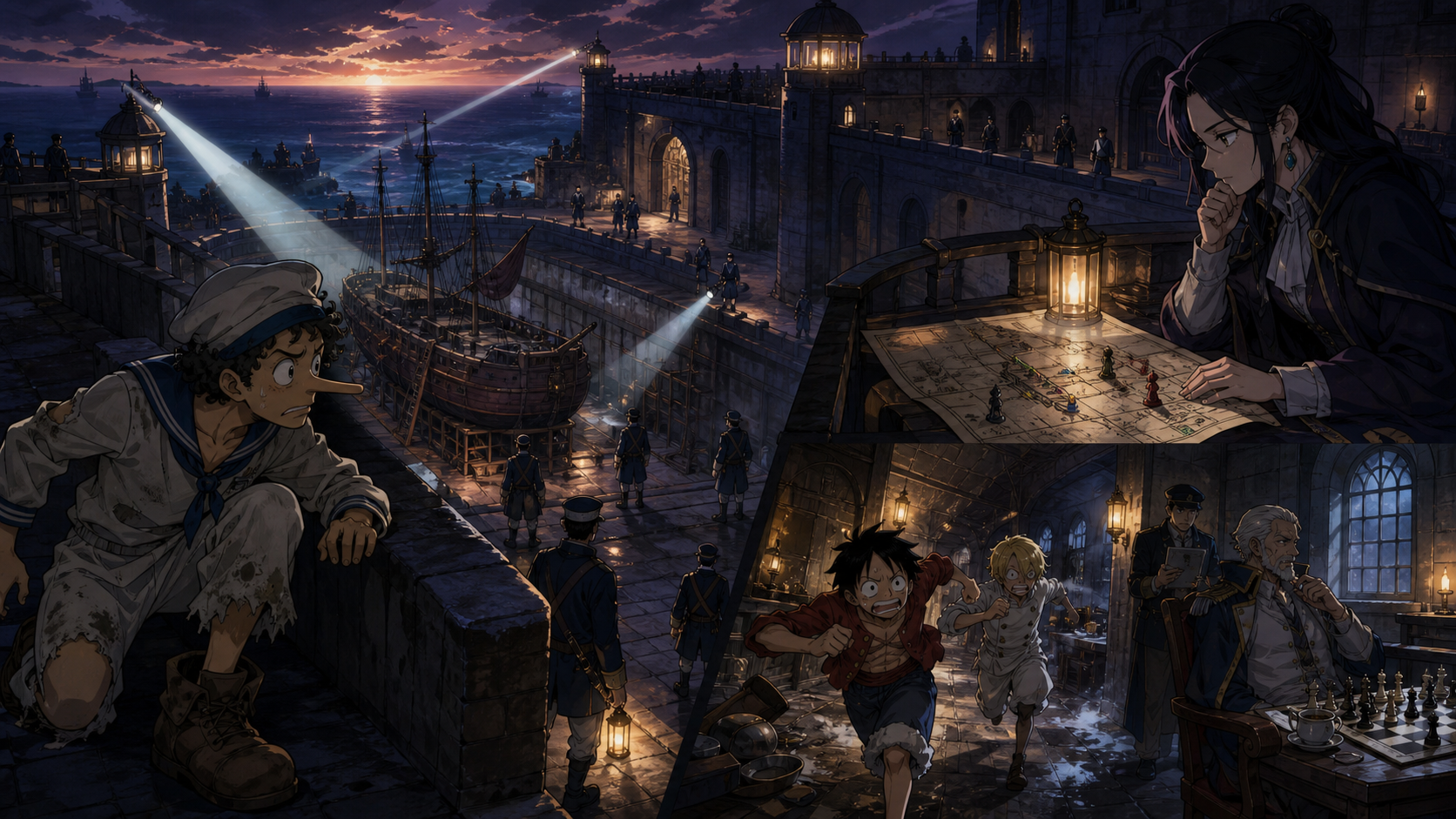
One Piece Episode 199 exposes Luffy and Sanji’s kitchen disguise while Robin studies Navarone and Usopp rushes toward the Merry straight into capture.
Bottom line
One Piece Episode 199 proves Jonathan does not need to overpower the Straw Hats when he can make them reveal themselves. He identifies Luffy and Sanji in the kitchen, lets the fortress tighten around the crew, and watches Usopp run toward the Merry before the sniper has enough information to make a plan.
Robin understands the assignment. She studies routes, uniforms, schedules, and behavior. Usopp understands that the Merry needs help and moves before fear can stop him. Both choices come from loyalty. Only one choice survives the surveillance system.
Episode facts
Fuji TV broadcast Episode 199 on July 18, 2004. Yoshiyuki Suga wrote the screenplay, Mamoru Hosoda directed, Hideaki Maniwa served as animation director, and Miyuki Sato with Fumihiro Uchikawa handled the art direction. The official Japanese title translates to “The Marine Investigation Net Closes In! A Second Crew Member Is Captured!”
The episode continues the anime-original G-8 arc. Jonathan sees through the visiting-cook disguise, forcing Luffy and Sanji to flee. Robin continues cautious reconnaissance. Usopp leaves her position to recover the Going Merry, disguises himself as a Marine, and becomes the second captured Straw Hat.
Jonathan finally cashes the kitchen clue
Sanji’s skill made the cook disguise believable to the kitchen staff. Jonathan looks beyond competence and asks whether the story fits the larger security picture. Two unexpected cooks arrive after a pirate ship falls into the harbor. One cook behaves like a bottomless food emergency. The coincidence cannot survive command-level attention.
That distinction matters. A local supervisor verifies whether somebody can perform the job. A commander verifies why the person appeared at that time. Sanji passed the first test and failed the second.
Luffy and Sanji lose the room without losing the joke
The escape keeps the energy comic because Luffy has spent more effort eating than maintaining cover. Sanji can improvise a professional identity. He cannot make his captain behave like a trained kitchen worker for an entire shift.
The humor does not make Jonathan lucky. He gathers evidence, compares reports, and recognizes a pattern. Luffy merely supplies a pattern loud enough to confirm.
The search net is made from ordinary people
Jonathan’s net is not one magical surveillance device. Guards report movement. Kitchen workers remember faces. Dock crews watch the Merry. Officers circulate descriptions. Gates, bridges, uniforms, and shift changes turn daily operations into information channels.
A fortress sees through accumulation. One Marine may miss a disguise. Ten small observations can still reach a commander who knows how to connect them.
Robin treats the base as a text
Robin reads architecture, hierarchy, clothing, language, and silence. She does not rush toward the first familiar object. Every corridor tells her who has access. Every uniform indicates rank. Every posted order reveals what command believes has happened.
Her archaeological training becomes infiltration skill. A ruin and a fortress both require patience with incomplete evidence. The difference is that a fortress can notice the reader.
Usopp sees the Merry and stops waiting
The Going Merry is not equipment to him. Usopp knows the ship’s repairs, weak points, moods, and history. Seeing the vessel trapped in a Marine dock triggers responsibility before strategy.
I understand the decision even while yelling at him to stay beside Robin. Loyalty often creates bad timing. Usopp cannot calmly watch strangers control the ship he has patched with his own hands.
The Marine disguise fits the body and fails the behavior
Usopp can wear the uniform, repeat the posture, and move among sailors for a while. The disguise cannot give him local knowledge. He does not know who belongs to which unit, which route requires authorization, or which officers expect recognition.
Clothing removes the first question. Behavior invites the second. Robin knows that distinction and keeps gathering context. Usopp tries to outrun the gap.
Robin and Usopp represent two kinds of courage
Robin’s courage looks like patience. She remains still while a friend moves toward danger because incomplete information could cost the whole crew. Usopp’s courage looks like action despite fear. He moves toward a guarded dock because the Merry cannot move alone.
The episode does not need one form to be morally pure. Robin is strategically correct. Usopp is emotionally honest. Good crews need both instincts and suffer when the instincts stop communicating.
Capture turns Usopp into another piece
Jonathan already has Zoro. Usopp gives him a second prisoner and a second crew relationship to study. The commander can compare stories, spread information, and predict which Straw Hats will attempt a rescue.
Usopp may not carry Zoro’s combat threat, but he carries knowledge of the Merry, Dials, inventions, and the crew’s habits. Underestimating him would be foolish. Capturing him also removes the person most capable of repairing or disguising the ship.
The Merry remains the center of the board
The crew can hide in kitchens, clinics, and corridors. Nobody leaves Navarone without the ship. Jonathan understands that geography. Guarding the Merry allows the base to wait while pirates eventually approach.
The ship becomes both hostage and exit. Every rescue plan has to solve surveillance, repairs, crew assembly, and the fortress gate. Punching one officer cannot answer all four problems.
Jonathan’s calm is institutional confidence
Jonathan can wait because Navarone controls the water, bridges, docks, cells, and supply lines. His relaxed manner is not proof that he lacks urgency. He knows time favors the base.
The Straw Hats need food, rest, communication, and a route. The Marines need to continue normal operations while narrowing movement. Jonathan turns ordinary time into pressure.
Information becomes more useful than force
A cannon could damage the Merry. A mass search could create confusion. Jonathan chooses identification and containment. Each confirmed crew member reduces uncertainty without destroying the prize or exhausting the base.
That strategy makes G-8 different from an arc where enemies line up by strength. The central contest asks who can build the more accurate picture first.
Usopp’s fear does not make him cautious
People often treat fear as the opposite of reckless behavior. Usopp shows why that assumption fails. Anxiety can create urgency, tunnel vision, and the need to act before imagination produces a worse outcome.
He runs toward the Merry partly because waiting beside Robin means continuing to picture what the Marines might do. Action gives him one concrete problem. The concrete problem still has guards.
Robin’s patience has an emotional cost
Robin recently learned that the crew will fight a god to protect one another. Remaining behind while Usopp moves is not detachment. She has to trust that information gathered now may help him later.
Her restraint also reflects a life spent surviving pursuit. She knows how quickly one visible reaction can expose everyone connected to a target. That history makes her good at disappearing and cautious about rescue impulses.
The episode earns Hosoda’s tension through composition
Mamoru Hosoda’s direction emphasizes watched spaces, separated characters, and movement across controlled geometry. The fortress feels larger because the episode keeps placing individuals against corridors, docks, walls, and lines of sight.
The visual argument supports the script. Characters do not only face opponents. They face spaces designed to reveal unauthorized movement.
Anime-original continuity stays useful
G-8 cannot permanently take the Merry or remove Usopp from the crew. The arc still creates meaningful pressure by targeting relationships and skills. Usopp’s bond with the ship causes capture. Robin’s survival training prevents another capture. Jonathan’s command skill turns both facts into strategy.
The episode uses established character truth instead of inventing a disposable emotional crisis. That choice keeps the detour connected to the voyage.
What worked
The contrast between Robin and Usopp works. Jonathan’s patient reasoning works. The Merry functioning as both destination and bait works. The episode also makes disguise feel like a system rather than a costume change.
Usopp’s capture hurts because the mistake makes sense. He does not wander into guards for a random joke. He takes a risk for the ship and misjudges how much the base already knows.
What held the episode back
Luffy and Sanji’s exposure arrives quickly after Episode 197 invested in the kitchen cover. A little more time showing Jonathan trace the reports would make the reveal feel even sharper.
Usopp’s failed disguise could also reveal more about Marine class and rank. The uniform opens doors, but the episode only touches the social rules that ultimately expose outsiders.
What changed on the replay
On the first watch, Usopp getting captured dominates the ending. On replay, Robin’s refusal to rush becomes the crucial choice. She is already doing the work that a rescue will need: learning routes, habits, and authority.
I also noticed how Jonathan turns the crew’s strengths into signals. Sanji’s exceptional cooking makes him memorable. Luffy’s appetite makes him identifiable. Usopp’s attachment to the Merry makes him predictable. Strength creates a trail when the enemy understands context.
RaeRae’s verdict
Episode 199 tightens G-8 without pretending louder means smarter. Jonathan wins this round because he listens to the fortress. Robin survives because she listens too. Usopp gets caught because love for the Merry becomes louder than the information he does not have.
I am not mad at him. I am stressed by him. Those are different fandom experiences, and Usopp has always been generous enough to provide both.
A search net also tests command discipline
Closing every route sounds simple until hundreds of Marines receive partial descriptions and start treating every unfamiliar face as a target. Jonathan needs enough pressure to limit the crew without turning Navarone into a panicked mob. The base still has meals, repairs, patients, and ships to manage while the search continues.
That balance gives his calm practical value. A commander who floods every corridor with shouting guards may create more hiding places through confusion. Jonathan keeps ordinary work moving because normal routines make deviations easier to spot.
Usopp loses because he skips the boring questions
Which unit controls the dock? Who has keys? When do patrols rotate? Where can a worker stand without attracting notice? Robin wants those answers before movement. Usopp sees the Merry and treats distance as the only obstacle.
I say “boring” with affection because boring questions save lives. Adventure stories celebrate the leap. Infiltration depends on the person who checked the door schedule, counted uniforms, and learned whether the hallway ends at a locked gate. Robin understands that invisible work. Usopp understands after the handcuffs arrive.
Official source and routes
Official ONE PIECE Episode 199 guide
Previous: Episode 198 React
G-8 Episodes 196-206 Directory
Jonathan Lets the Straw Hats Build His Case
Jonathan’s search works because he understands behavior. Luffy and Sanji can wear uniforms, but neither man can stop acting like himself for long. Sanji corrects a kitchen. Luffy follows food. Usopp sees the Merry and rushes toward safety before checking whether the route feels suspicious. Jonathan does not manufacture those habits. He creates enough pressure and space for the pirates to expose them, then closes the net after they have supplied the evidence.
Robin moves differently, which makes her thread especially satisfying. Years of surviving bounties taught her to read institutions from inside. She studies ranks, rooms, records, and routines rather than treating Navarone as one large opponent. Her calm does not remove danger. Her calm reveals how much practice hides underneath every quiet choice. G-8 lets Robin use the skills that kept her alive before joining the crew without framing those skills as coldness.
Usopp’s capture hurts because the impulse makes emotional sense. The Going Merry represents shelter, identity, and the one familiar object inside a maze of Marine stone. He runs toward home. Jonathan correctly predicts that home will pull somebody out of hiding. RaeRae verdict: Episode 199 makes intelligence an action sequence. The commander advances through inference, the crew resists through improvisation, and every personality trait becomes either a tool or a loose thread waiting to be pulled.