RaeRae Reacts · One Piece Episode 194
Robin Reads Roger’s Message
One Piece Episode 194 gives Robin a message from Roger, a map for the Poneglyphs, and the funniest attempted thank-you gift in Skypiea.
Bottom line: One Piece Episode 194 finally lets Robin do the job she crossed oceans to do, and I love how quiet the episode becomes when she starts reading. Nobody throws a punch. Nobody needs a miracle beam. Robin looks at old stone, understands what generations died protecting, and gives the Shandia chief permission to put down a burden his people never fully understood. Then the Straw Hats hear “giant gold pillar” and run like somebody pulled a cannon on them. That emotional whiplash is One Piece behaving exactly like One Piece.
“I Have Come Here! The Weaving of the Poneglyphs” aired in Japan on June 6, 2004. Hirohiko Kamisaka wrote the script, Junichi Fujise directed, Kenji Yokoyama served as animation director, and Miyuki Sato with Kumiko Fukuzawa handled art. The episode adapts Chapter 301, and Chapter 301 carries a ridiculous amount of future weight for one farewell chapter.
My first reaction: Robin just found a note from the Pirate King
The crew starts packing for the Blue Sea while Robin walks through Shandora alone. That separation feels right. Luffy, Nami, Sanji, Chopper, Usopp, and Zoro are already shifting back toward food, treasure, tools, and departure. Robin is still standing inside the reason she joined the Grand Line journey in the first place.
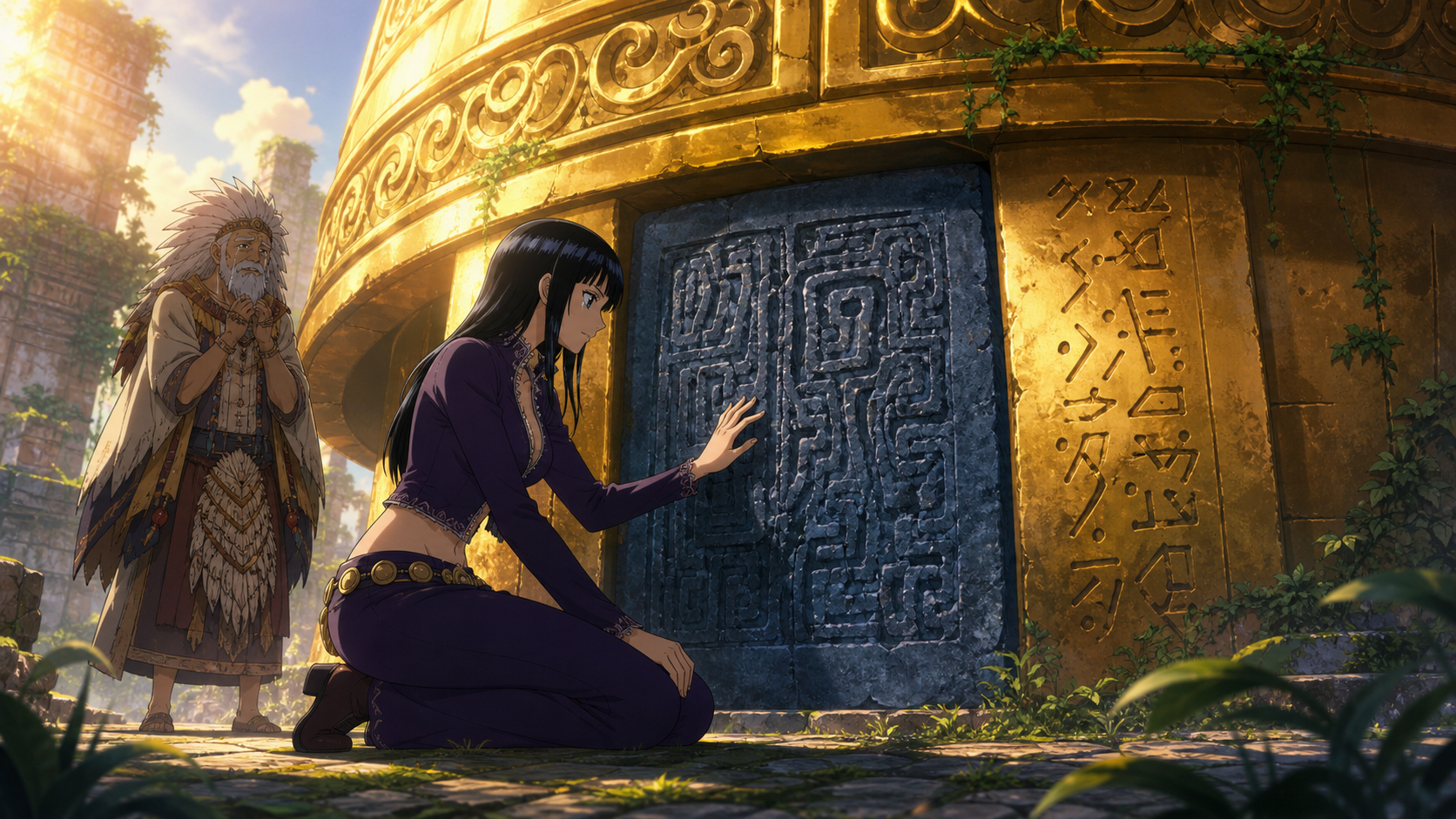
Then somebody points out the writing beside the Poneglyph. Robin reads Gol D. Roger’s name and freezes. Same. A dead man reached the same forbidden record, left a message in the ancient script, and somehow carried the text forward. Robin has spent most of her life being told that her questions make her dangerous. Roger’s message answers with movement: keep going.
The episode gives Robin room instead of making her explain faster
Robin’s scenes work because Junichi Fujise does not rush every discovery into a loud reveal. She kneels, reads, pauses, and thinks. The bell and ruins remain larger than her body, which keeps the history from shrinking into a convenient clue. Robin can decode the words, but she still has to work out what the words mean.
I appreciate that distinction. One Piece loves characters who know strange things, yet knowledge rarely arrives as a finished answer. Nami reads weather. Chopper reads bodies. Robin reads the dead. Every skill produces another decision rather than instant control.
Poseidon is not the answer Robin wanted
The Shandora Poneglyph names Poseidon, an Ancient Weapon, and records a location. Robin recognizes the importance, but her face falls because she came looking for the True History. The stone contains dangerous information, just not her answer.
That disappointment matters. A weaker mystery story would reward every deciphered inscription with the exact clue the hero needs. Robin’s work is slower and meaner than that. She may cross a death trap, reach a lost city, find a protected Poneglyph, and still receive another piece from a puzzle whose shape remains hidden.
Robin also refuses the temptation to treat an Ancient Weapon as treasure. She reads the record and keeps moving. Crocodile wanted weapon information from Alabasta. Robin lied to him because helping a tyrant acquire mass destruction was never the same as seeking history. Episode 194 quietly confirms that boundary again.
Roger’s inscription changes the scale of the search
Roger’s message says he reached this place and would guide the text to the farthest ends of the earth. Robin initially wondered whether the Rio Poneglyph existed as one special object waiting somewhere. The inscription suggests another possibility: scattered records become the True History when a traveler gathers and carries their meaning to the final destination.
That idea makes Robin’s dream active. She cannot wait for one perfect stone to explain eight hundred missing years. She has to read, remember, connect, and move. The government made research lonely by killing scholars and criminalizing the questions. Roger’s message turns that forced loneliness into a relay across generations.
Roger leaves proof that Robin is not chasing nonsense
Robin does not need Roger to validate her intelligence. She does need evidence that the road can go somewhere. Ohara’s scholars died before completing the work. Crocodile reduced her gift to a weapon hunt. Every island could have become another dead end.
Seeing Roger’s words on the bell proves that somebody else followed the Poneglyph trail far enough to understand the need for a final destination. The message does not hand Robin a map. The message gives her a method, which may be more useful.
Gan Fall met Roger, because of course this old man kept that quiet
Gan Fall casually reveals that Roger visited Skypiea more than twenty years earlier. Sir. We have been fighting lightning fascism, falling through clouds, and ringing a four-hundred-year-old bell. You could have mentioned that the Pirate King stopped by.
The reveal also makes Skypiea part of the Grand Line rather than a decorative detour above the “real” route. Roger came here. The Poneglyph mattered to his final voyage. Sky people remember visitors who never appeared in ordinary Blue Sea histories. Skipping Skypiea means skipping one of the places where the story explains how knowledge travels.
The Voice of All Things raises a question without pretending to settle one
Roger’s ability to engage with the ancient text confuses Robin. Gan Fall remembers a man who could hear what objects or living beings carried, though the episode does not hand us a neat technical manual. Later history adds context, but Episode 194 should still be allowed to feel mysterious on its own timeline.
I do not want to flatten that mystery into “Roger could read every symbol.” The visible evidence says he understood enough to know what needed carrying and left a message in the script. How he produced the inscription remains a question at this point in the anime. Honest uncertainty is more interesting than a fake answer.
Robin tells the Shandia their duty is finished
The Shandia protected the Poneglyph across centuries without being able to read the record. Their ancestors knew the stone mattered and paid for that duty with land, lives, and a war that outlasted the original witnesses. Robin explains that Roger already carried the text onward. The record has completed its purpose.
The chief cries because Robin has not merely translated words. She has changed what obedience to the ancestors requires. Protecting memory no longer means producing another generation of fighters. The living are allowed to stop.
This is the peace argument Episode 193 needed
Episode 193 showed medical care and a shared bonfire, but celebration alone could not explain why the Shandia should release their oldest obligation. Episode 194 supplies the missing intellectual answer. Their duty was never endless war for war’s sake. Their duty was protecting a message until the message could continue.
Once Robin confirms that the text moved forward, peace stops looking like surrender. The Shandia can honor their ancestors by accepting that the ancestors succeeded. That distinction is huge for Wyper’s people. Nobody asks them to forget theft, conquest, or Kalgara. Robin tells them the mission survived.
Robin recognizes her own duty in theirs
Robin does not stand outside the Shandia story as a visiting expert. She is another survivor carrying work that dead people entrusted to her. Ohara protected knowledge long enough for one child to escape. Shandora protected a stone long enough for readers and travelers to move the words onward.
The parallel gives Robin a rare community, even if that community crosses centuries and cultures. She is not the only person whose life became an archive. The difference is that the Shandia chief finally hears that his people may rest. Robin still has farther to go.
The episode refuses to make history emotionally tidy
Roger’s inscription does not restore Ohara. The translation does not return Kalgara, Noland, or the generations lost in war. Knowledge changes the future without repairing every wound behind the reader.
I prefer that honesty. One Piece can get sentimental, and I am absolutely sentimental about this entire bell business, but the episode does not claim one correct explanation cures inherited grief. The chief cries from relief and loss at the same time. Both belong there.
Meanwhile, Usopp is shopping for the future
Usopp collects Dials and thinks about new uses for the technology. After several episodes of gods, genocide, ancestral duty, and planetary weather, watching him get excited about practical tools feels wonderful. He sees a device and immediately starts planning what he can build.
Dials also become proof that the Straw Hats will carry Skypiea with them. Gold can be spent. Technology changes how Usopp fights and how Nami’s Clima-Tact develops. Cultural exchange arrives through tinkering, trade, and a man who cannot leave a strange gadget alone.
The crew finds gold inside Nola because adventure rewards audacity
Luffy, Nami, Sanji, and Chopper recover treasure from Nola’s stomach. The hiding place is disgusting, dangerous, and completely appropriate for this crew. They did not conquer Shandora for wealth, but they are still pirates and they would like to be paid in something shinier than personal growth.
Nami’s joy feels earned after she navigated a vertical ocean, survived Enel, and drove Luffy toward the bell while lightning tried to erase the island. Let that woman count gold. She has worked enough.
The Shandia choose a thank-you gift nobody sane could carry
The sky people decide to give the crew a broken golden pillar from the belfry. The gift is enormous. Their gratitude is enormous. Their understanding of ordinary ship cargo is apparently missing.
The generosity still lands because the pillar once formed part of the protected bell. Sharing that gold marks a shift from guarding every fragment against outsiders to choosing what can leave as gratitude. The Shandia are not being robbed. They are making a gift.
The Straw Hats mistake generosity for a cannon and flee
From the crew’s angle, a huge covered object appears while everyone advances toward them. Luffy and company decide they are about to be attacked and make a run for the Going Merry with the smaller treasure.
I laughed because the misunderstanding fits both sides perfectly. The sky people believe a massive pillar says thank you. The pirates assume any object that large must be a weapon. Nobody pauses long enough to compare notes, so the Straw Hats escape from the biggest payday of their lives.
The joke also protects the crew’s relationship with Shandora. They leave with treasure found during the adventure, not after stripping the city bare. Their greed stays funny because the story keeps a line between taking loot and exploiting a people who just survived occupation and war.
What changed when I sat with the episode
On the first pass, Roger’s name swallowed the whole episode for me. That reaction makes sense because One Piece trains viewers to sit up whenever the Pirate King reaches across the timeline. On another pass, the chief’s relief hit harder.
Robin gives an old man information that changes the meaning of his inheritance. He does not have to prove devotion through another funeral. The Poneglyph remains, the ancestors remain honored, and the war can end anyway. That is a much kinder revelation than a treasure coordinate.
Production notes and adaptation choices
Kamisaka’s script lets the Poneglyph discussion carry the serious center while the treasure misunderstanding keeps the farewell from becoming stiff. Fujise’s direction gives Robin’s pauses time, and Yokoyama’s character work keeps her reactions controlled. Robin is shocked, but she does not suddenly become loud or theatrical.
The episode adapts Chapter 301 closely enough for the historical revelation to remain clear while expanding the crew’s departure activity into television rhythm. The balance matters. Too much comedy would cheapen the chief’s release. Too much solemnity would make the Straw Hats feel like visitors in somebody else’s show.
Final reaction: Robin finds a road, not an answer sheet
Episode 194 gives Robin no completed history and no easy destination. She receives proof that the scattered texts can be carried into one larger truth, proof that Roger walked the same road, and proof that translation can end a war as surely as Luffy’s fist ended Enel’s rule.
RaeRae’s verdict: this episode is one of Skypiea’s most important chapters because Robin changes the future by reading carefully. The action arc is over, yet the story still has a bigger reveal waiting in old handwriting. Then One Piece sends everybody running from a gift worth more than the gold they stole. Beautiful. Stupid. Completely on brand.